
Hydraulic test point fittings must be identified as two different interfaces: the equipment-side port connection and the diagnostic-side coupling. A correct thread on one end does not prove that a test hose, gauge adapter, cap, or protective device will fit the other. Treating the fitting as one familiar-looking part can cause port damage, leakage, unusable test equipment, or an unsafe attempt to connect under pressure.
Why One Test Point Creates Two Identification Decisions
The two ends perform different jobs and may follow unrelated product conventions. The equipment end joins a port in a manifold, valve, pump, hose adapter, or tube fitting, while the diagnostic end accepts a mating test connector or test hose. Identification is reliable only when both interfaces are described independently and then tied back to one controlled part reference.

Equipment connection versus diagnostic interface
The equipment-side record should describe the thread and the actual sealing method. A straight thread may seal through an O-ring, bonded seal, metal face, or another designed feature, while a tapered thread may participate in the seal according to its approved connection procedure. Diameter and pitch alone cannot reveal where sealing occurs, and successful thread engagement cannot approve a mismatched port.
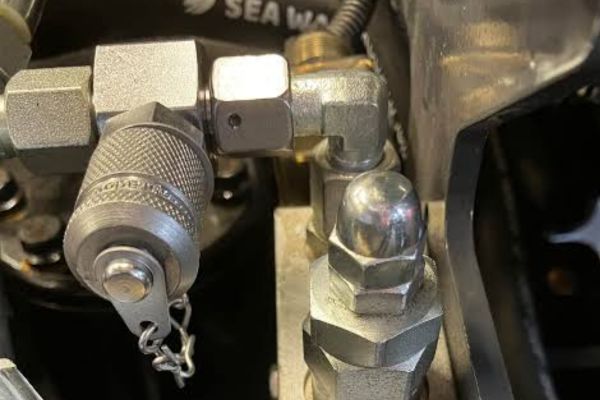
The diagnostic side is usually a coupling profile rather than a second ordinary port thread. Its important features may include the mating nose, valve arrangement, external profile, cap retention, and the test-hose connector intended to open or seal the interface. Similar protective caps do not establish compatible coupling profiles, and a cap thread may not be the fluid connection used during measurement.
What the complete identification must accomplish
A usable specification must let another person select the same equipment connection and the same diagnostic connection without relying on memory. It should also state whether the fitting is being identified for replacement, test-hose matching, drawing control, or an equipment record, because those purposes require different levels of evidence. Replacement normally needs the most complete review: part identity, materials, sealing features, pressure and fluid suitability, installation limits, and approved connection procedures all remain relevant.
Record the Equipment-Side Port and Seal
Start with the installed port because an incorrect assumption here can damage expensive equipment. Before disassembly, stop and isolate the machine, release hydraulic pressure and trapped energy, secure raised loads independently, and follow the equipment manufacturer’s procedure. Never loosen the test point to discover its thread while the circuit may be pressurized.
Measurements and observations
After safe removal is authorized, clean the part without altering sealing marks or losing loose seals. Record whether the connection is male or female, whether the thread appears straight or tapered, and whether an O-ring, bonded washer, cone, shoulder, or other sealing feature is present. Use suitable calibrated tools and the applicable thread reference rather than estimating a nominal size from a ruler.
Capture the following equipment-side evidence as a group:
- Thread outside diameter for a male connection or appropriate inside-diameter evidence for a female connection
- Thread pitch or threads per inch, measured with the correct gauge and confirmed over undamaged threads
- Straight or tapered form, connection gender, and usable thread length
- Sealing face, cone, shoulder, washer land, groove, and O-ring location where applicable
- Port callout, equipment drawing, service manual, or existing traceable part number
- Orientation, hex clearance, installed depth, and nearby interference that may limit the replacement envelope
A photograph supports these observations but does not replace them. Perspective can distort diameter, a cap can hide the port end, and dirt can obscure a sealing face. If the part cannot be removed safely, use the equipment documentation and visible markings to narrow the candidates, then label the final port identity as unresolved until it is confirmed by an approved method.
Describe the Diagnostic Coupling as Its Own Interface
The diagnostic end should be recorded by its complete mating profile, not by a generic label such as “test nipple.” Product families can differ in body diameter, nose length, valve actuation, thread or latching features, seal arrangement, and cap design. A test hose that appears to start onto the fitting may still be the wrong profile and must never be forced.
Profile, cap, valve, and mating end
Take clear views with the cap installed and removed, but do not press, probe, or open the internal valve as an identification experiment. Show the coupling head from the front, side, and an oblique angle; include the cap tether or retention method and every readable marking. If a known test hose is available, record its controlled part number and end description without attempting a live connection merely to see whether it fits.
Useful diagnostic-side fields include:
- Coupling family or profile only when supported by an approved catalog, drawing, or verified mating part
- External and internal features visible without disturbing the valve
- Cap type, cap retention, sealing element, and whether the cap is protective or pressure-retaining according to documentation
- Mating test-hose end, adapter, gauge connection, and their traceable part numbers
- Manufacturer name, series mark, date code, or other identification exactly as marked
- Document revision that establishes connection, operating, and connection-under-pressure limits
Do not assume every diagnostic coupling permits a test hose to be connected or disconnected under pressure. Some products may be designed for a particular live-connection procedure, while others are not, and product-specific limits cannot be transferred across similar-looking profiles. The approved product instructions control the procedure.
Use an Annotated Identification Workflow
A disciplined workflow separates evidence collection from final approval. Each step should say what is known, what remains uncertain, and which record will close the gap. This prevents a likely candidate from silently becoming an accepted replacement.
Seven steps from context to controlled identity
- Secure the system — safety gate. Identify the circuit, isolate energy, relieve trapped pressure, secure loads, and obtain authorization before touching the installed fitting.
- Capture context — location gate. Photograph the component in place, its orientation, nearby ports, hose or tube routing, and the equipment identification plate while protecting confidential identifiers.
- Separate the ends — classification gate. Label images and notes “A: equipment port” and “B: diagnostic coupling” so measurements and assumptions cannot migrate between them.
- Measure end A — port gate. Record thread, gender, taper, sealing method, critical envelope, and the source used to interpret the readings.
- Document end B — coupling gate. Record profile, cap, valve-visible features, markings, and the controlled mating test-hose or adapter identity.
- Reconcile records — evidence gate. Compare the observations with the equipment drawing, fitting catalog, bill of material, service record, and latest approved revision; list every conflict.
- Approve or escalate — disposition gate. Release the identity only when both ends and application limits agree. Otherwise quarantine the candidate specification and request technical review.
This sequence is annotated because each step has a decision purpose. It is not a universal installation or operating procedure. Connection, pressure testing, and commissioning must follow the instructions for the exact test point, test hose, equipment, and measurement device.
Build a Two-End Specification Table
A two-column record exposes missing information more effectively than a single description. It also prevents the diagnostic cap, mating hose, or port seal from being treated as an incidental accessory. Use the table as a controlled worksheet, then transfer approved values to the part record.
| Specification field | End A: equipment port | End B: diagnostic connection |
| Primary function | Attach and seal to the machine port | Connect the approved test hose or diagnostic adapter |
| Identity evidence | Port drawing, manual, thread measurements, sealing feature | Coupling drawing, profile, markings, mating-part documentation |
| Geometry to record | Gender, diameter, pitch/TPI, taper, seal land, installed depth | Nose and body profile, actuation interface, cap and retention features |
| Separate seal evidence | O-ring, bonded seal, cone, face, or approved thread-seal method | Internal valve/seal arrangement and cap function as documented |
| Mating component | Equipment port or adapter part number and revision | Test hose or adapter part number and revision |
| Application limits | Fluid, temperature, pressure, material, installation envelope | Connection procedure, measurement device limits, pressure-state restrictions |
| Acceptance basis | Current controlled drawing and approved port procedure | Current product instructions and confirmed mating interface |
| Open questions | Unreadable callout, damaged thread, missing seal record | Unknown profile, unverified hose end, missing cap or obsolete series |
Do not fill a blank with the nearest familiar standard. Mark it “not confirmed” and state what evidence is required. A precise uncertainty is safer and more useful than a confident but unsupported part description.
Common Mistakes and Reasons to Escalate
Most errors come from collapsing two decisions into one or treating physical fit as proof. A correct equipment thread can be attached to the wrong diagnostic profile, and the correct diagnostic head can be supplied with the wrong port seal. Either mismatch defeats the purpose of the test point.
Mistakes that invalidate the record
Do not identify the part from the cap color, overall silhouette, one diameter, or a partial number. Do not call it a compression fitting merely because a nut or sleeve is visible nearby, and do not use thread sealant to compensate for a damaged face or wrong port form. Never force a test connector, probe the valve, feel for leakage, or assume the protective cap makes a damaged interface safe.
Escalate for technical review when:
- Measurement results conflict with the drawing or catalog
- The sealing method, material, fluid compatibility, or pressure limit is unknown
- The coupling profile cannot be distinguished from another family
- The mating test hose or adapter lacks a traceable identity
- Threads, sealing faces, valve features, or cap retention are damaged
- The applicable document revision or connection-under-pressure instruction is missing
An obsolete part number also deserves review. A successor may change the profile, seal, material, or operating procedure even when the external dimensions appear close. Cross-reference information narrows a search; it does not prove interchangeability.
Next-Action Checklist for Hydraulic Test Point Fittings
The final record should be short enough to use and complete enough to audit. Attach photographs and source documents rather than burying uncertain values in free text. Assign an owner and status to each unresolved item before ordering or connecting equipment.
Release-ready information
- Equipment identity, circuit location, and safe isolation record
- End A thread, gender, taper, sealing method, seal identity, and installation envelope
- End B coupling profile, valve-visible features, cap, markings, and mating test-hose end
- Exact fitting, test hose, and adapter part numbers with current document revisions
- Fluid, temperature, pressure, material, and environmental requirements from approved records
- Product-specific connection, disconnection, testing, and inspection procedures
- Recorded discrepancies, disposition, reviewer, and revision-controlled acceptance decision
If any item that affects connection, sealing, or safe operation remains unresolved, keep the specification open. The practical goal is not to name the fitting quickly; it is to make the next person able to reproduce and verify the decision.
Conclusion
Reliable identification of hydraulic test point fittings depends on treating the equipment port and diagnostic coupling as separate, equally important interfaces. Measure and document the port thread, gender, taper, and sealing feature, then record the coupling profile, cap, visible valve features, and exact mating test-hose end. Photographs and partial numbers can screen candidates, but they cannot approve a replacement or a live connection. Reconcile both ends with current drawings, product instructions, application limits, and traceable part numbers; preserve every unresolved conflict for technical review. Before the fitting is removed or tested, isolate the circuit, relieve stored energy, and follow the approved equipment procedure. This two-end record is the safest basis for selecting hydraulic test point fittings without relying on appearance or forced trial fitting.
Frequently Asked Questions
Can a thread measurement identify the entire test point?
No, a thread measurement identifies only part of the equipment-side connection. The diagnostic coupling profile, sealing feature, cap, mating test-hose end, materials, and application limits still require separate confirmation.
Does a matching protective cap prove two test points are compatible?
No, a matching or similar cap does not prove that the fluid coupling profiles are compatible. Caps may use different retention methods and may be protective rather than part of the pressure seal, so verify the controlled coupling documentation.
May I connect a test hose while the hydraulic system is running?
Only when the exact test point, hose, and equipment procedures explicitly authorize that operation. Never transfer a live-connection claim from another product family or attempt connection under pressure merely because the parts appear to fit.
What if the installed test point cannot be removed for measurement?
Use equipment drawings, service records, readable markings, and nonintrusive photographs to narrow the candidates. Mark the identity as unconfirmed until an approved method can establish the hidden thread and sealing interface.
Should the cap be included in the replacement specification?
Yes, record the cap and its retention method when they are part of the specified assembly or protection plan. Confirm through product documentation whether the cap has only a protective role or another defined function.