






FAQ
What is ORFS fitting?
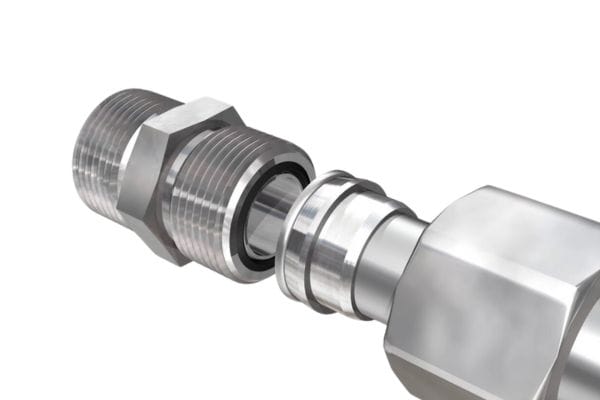
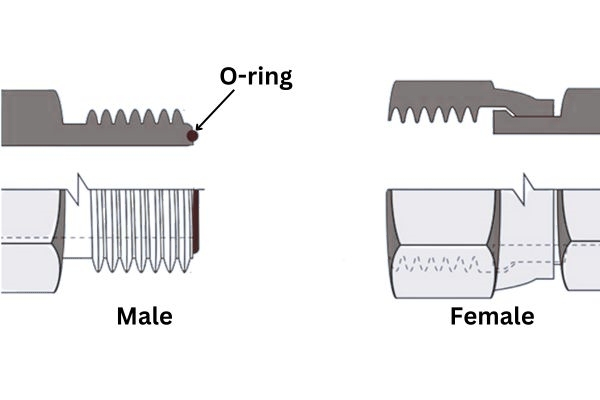
ORFS uses an O-ring compression mechanism for sealing.
Female Orfs fitting has a flat surface and a straight thread UNF swivel nut.
Male Orfs fitting is a straight thread
What are the Precautions for installing ORFS hydraulic fittings?
Step 1. Check for possible contamination or damage during shipping or handling. Verify that the face seal O-ring is properly installed.
Step 2: Lubricate threads and O-rings with your system hydraulic fluid or light lubricant.
Lubricate the system with hydraulic fluid or light lubricant.
Step 3: Align the matching face seal with the O-ring and tighten the face seal.
Tighten the end seal nut.
Step 4: Tighten the packing nut to the value shown in the table on the left side of this manual.
How do you confirm the pressure rating?
Pressure capability must be verified for the exact fitting type, size, material, manufacturing specification, and complete hose or tube assembly; one pressure value should not be applied to every ORFS product.
Can different ORFS sizes and configurations be combined in one order?
Multiple ORFS hose ends, adapters, elbows, tees, bulkhead fittings, caps, plugs, and transition fittings can be included in one quotation, subject to production and commercial review.
Can you produce custom ORFS fittings from drawings?
Drawing-based production can be reviewed after confirming critical dimensions, tolerances, thread and sealing details, material, finish, testing, annual or batch quantity, and application requirements.
Which O-ring material should be specified?
O-ring selection depends on hydraulic fluid, operating temperature, pressure, environmental exposure, and equipment requirements. The compound should be confirmed before production rather than selected from the connection name alone.
What may cause ORFS hydraulic fittings to leak?
Wrong installation operation, the mismatch between system and ORFS hydraulic fittings, poor product quality, etc. All these may lead to leakage.
Can ORFS hydraulic fittings be used in tight places?
Yes, ORFS hydraulic fittings have a straight threaded male fitting, an O-ring sealed to the female thread, and a rotatable female fitting, thus allowing for flexibility in a wide range of situations.
Comparison between ORFS and ORB?
Both are straight threaded, the difference is the sealing method, ORFS hydraulic fittings uses both metal and O-ring for sealing, and ORB hydraulic fittings are sealed by O-ring.
How does JIC compare to ORFS hydraulic fittings ?
The JIC hydraulic fittings is a metal-to-metal seal in the form of a 37-degree flared tube. ORFS hydraulic fittings is a better seal in the form of an O-ring seal and a metal seal. the JIC should be used for fuels and fluids at higher pressures, the ORF is more focused on hydraulic systems under vibration conditions.
Can you cross-reference existing ORFS part numbers?
Existing supplier part numbers can be used as reference points, but the thread, sealing face, dimensions, material, pressure requirement, O-ring specification, and mating component must be checked before interchangeability is confirmed.


