
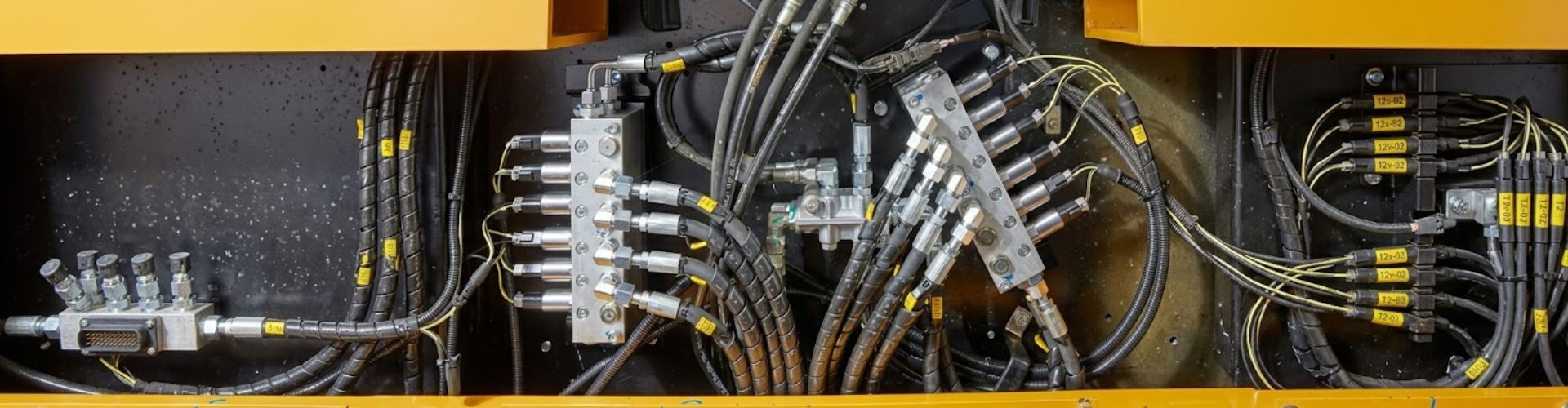
Proper assembly prevents catastrophic leaks, equipment downtime, and workplace injuries by ensuring the conduit can handle extreme pressures. High-pressure hydraulic failure is a constant threat in demanding industrial environments. A single burst can spray hot oil, cause mechanical collapse, or lead to expensive environmental remediation costs. Ensuring you have a high-quality hose assembly is the definitive solution to these operational risks and long-term financial liabilities.
What Are The Four Layers Of A Hose Assembly?
A standard assembly consists of an inner tube, a reinforcement layer, an outer cover, and the connecting fittings. Each component in a hydraulic hose assembly is engineered to manage specific fluid dynamics and external stresses. These layers work in unison to maintain structural integrity under intense loads.
The synergy between these components determines the maximum pressure the system can safely hold. Failure in any single layer can lead to the total degradation of the entire unit.

The Core Inner Tube
The inner tube is the part that actually touches the hydraulic fluid directly. It must be chemically compatible with the media to prevent internal degradation or swelling.
Here is the deal:
- Materials: Nitrile, Neoprene, or synthetic elastomers.
- Function: Leak prevention and fluid containment.
Selecting the right material ensures the tube remains flexible and doesn’t contaminate the hydraulic system.
Reinforcement and Protection
The outer layers provide the strength necessary to resist internal pressure. They also shield the internal components from the harsh realities of the job site.
Believe it or not, these layers define the hose’s “bite”:
- Reinforcement: Steel wire braids or spiral layers for high-pressure resistance.
- Outer Cover: Protects against weather, ozone, and physical abrasion.
Stronger reinforcement allows for higher working pressures without the risk of expansion.
Understanding these layers allows you to select a product that survives the specific rigors of your machinery’s work cycle.
| Layer Type | Primary Material | Main Function |
| Inner Tube | Synthetic Rubber | Fluid compatibility |
| Reinforcement | High-tensile Steel | Pressure resistance |
| Outer Cover | Durable Elastomer | External protection |
| Fittings | Carbon/Stainless Steel | System connection |
How Do You Match Fittings In A Hose Assembly?
Matching requires aligning the fitting’s material, thread type, and pressure rating with the specific hose specifications. Mixing components from different manufacturers can lead to dangerous failures in a hydraulic hose assembly. You must verify that the engineering tolerances of the fitting match the hose’s wall thickness.
Using mismatched parts often voids warranties and increases the likelihood of a “blow-off” incident. Precision is the only way to ensure a leak-free seal that lasts.
Thread and Seat Compatibility
Identifying the correct thread pattern is the first step in a successful match. Threads serve to hold the fitting in place while the seat provides the actual seal.
Here is the deal:
- JIC 37-degree flares are common in North American systems.
- ORFS (O-Ring Face Seal) provides superior leak protection in high-vibration areas.
- BSPP and Metric threads are often found on international equipment.
Never force a fitting that doesn’t thread easily by hand.
Material Integrity
The fitting material must be able to withstand the same environmental conditions as the hose itself. Steel is standard, but stainless steel or brass may be required for corrosive environments.
The bottom line is simple:
- Steel: Best for general industrial use.
- Stainless Steel: Ideal for salt spray or chemical exposure.
Consistency in materials prevents galvanic corrosion between the hose and the machine.
Properly matched fittings eliminate the weak points where most hydraulic leaks originate.
| Fitting Element | Checkpoint | Requirement |
| Thread Type | Pitch and Diameter | Perfect match to port |
| Sealing Surface | Seat Angle | No gaps or burrs |
| Pressure Rating | Maximum PSI | Must meet or exceed hose rating |
Can STAMPED Guide Your Hose Assembly Selection?
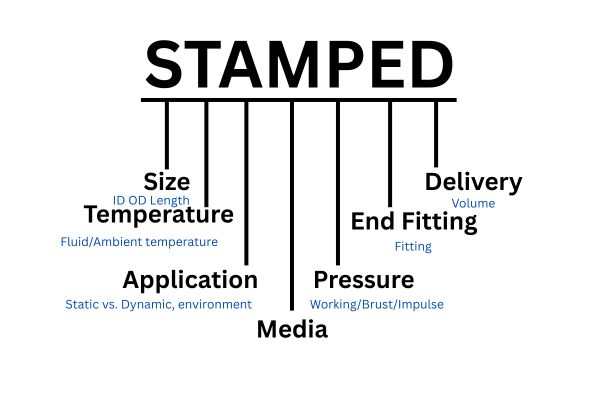
Yes, the STAMPED acronym provides a comprehensive checklist covering size, temperature, application, media, pressure, ends, and delivery. Using this industry-standard guide ensures every hydraulic hose assembly you spec is fit for purpose. It eliminates guesswork that could otherwise lead to system inefficiency or safety hazards.
By following these seven steps, you can be confident that no critical detail has been overlooked. It is the most reliable way to communicate requirements to your supplier.
Breaking Down Size and Temperature
The “S” and “T” are the foundations of your selection process. You need to know the inside diameter for flow and the temperature limits for material survival.
Think about it:
- Size: Measure the Dash Size (1/16th inch increments).
- Temperature: Consider both the fluid heat and the outside air.
Under-sizing a hose leads to excessive friction and heat buildup within the fluid.
Media and Pressure Ratings
The “M” and “P” ensure the hose won’t melt or burst under load. Chemical compatibility is just as vital as the ability to hold thousands of pounds of force.
Here is the deal:
- Media: Verify the hose is rated for petroleum, water-glycol, or synthetic oils.
- Pressure: The working pressure must handle the highest peaks the system generates.
Always design for the maximum surge pressure, not just the average operating load.
Following the STAMPED protocol ensures your equipment operates within its engineered safety margins.
| STAMPED Letter | Factor | Impact |
| S | Size | Flow velocity and heat |
| T | Temperature | Material lifespan |
| A | Application | Environmental wear |
| M | Media | Chemical compatibility |
| P | Pressure | Burst prevention |
| E | Ends | Connection security |
| D | Delivery | Availability and timing |
How To Determine Proper Length For Hose Assembly?
You determine the length by measuring the distance between ports while accounting for the hose’s movement and contraction under pressure. An incorrectly sized hydraulic hose assembly will fail prematurely if it is too short or create snagging hazards if too long. Most hoses contract up to 4% when pressurized, requiring extra slack.
Measuring from the bottom of the fitting’s nut or the end of the flare is standard practice. Accuracy here prevents unnecessary stress on the crimped joints.
Calculating for System Motion
If the hose connects to a moving part, like a cylinder, you must measure the full range of travel. If the hose is too tight at full extension, it will pull on the fittings and cause a leak.
You might be wondering why slack matters:
- Movement: Allows for pivoting and stretching.
- Contraction: Prevents the hose from acting like a guitar string under pressure.
- Vibration: Slack absorbs mechanical shocks.
A well-fitted hose should have a gentle “S” or “U” shape rather than a straight line.
Minimizing Snagging Hazards
Excessive length can be just as dangerous as a hose that is too short. Loose loops can get caught in moving machinery or drag on the ground.
The truth is:
- Routing: Use clamps to manage extra length.
- Visibility: Keep the hose within the machine’s profile.
Properly measured hoses look professional and reduce the risk of accidental damage.
Correct length measurements ensure that the hose can move freely without placing mechanical strain on the connections.
| Measurement Scenario | Requirement | Goal |
| Static Connection | 2-5% extra length | Offset contraction |
| Dynamic/Moving | Full extension + slack | Prevent pulling |
| High Vibration | Extra bend radius | Stress reduction |
Why Is Routing Crucial For Your Hose Assembly?
Proper routing prevents kinks, minimizes heat exposure, and ensures the hose does not rub against moving parts. Strategic routing of a hydraulic hose assembly extends its service life by reducing mechanical stress. Poor paths lead to unnecessary wear and potential safety breaches that are easily avoidable.
Good routing also makes the system easier to service and inspect. It keeps the “arteries” of your machine organized and protected.
Avoiding Excessive Bending
Bending a hose too sharply can restrict flow and damage the reinforcement layers. Every hose has a “minimum bend radius” that must never be exceeded.
Here is the kicker:
- Bend Radius: The tightest curve a hose can take without damage.
- Stress Points: Sharp bends near a fitting lead to cracks.
Using 45-degree or 90-degree elbows can often solve tight routing issues without stressing the hose.
Protection from External Heat
Hydraulic hoses should stay away from exhaust manifolds and other high-heat sources. Excessive external heat will bake the rubber and make it brittle.
Consider this:
- Heat Shields: Use sleeves if the hose must pass near heat.
- Airflow: Route hoses where air can circulate.
Keeping hoses cool is one of the easiest ways to double their expected lifespan.
Logical routing reduces the likelihood of physical damage and improves the overall efficiency of the hydraulic circuit.
| Routing Rule | Action | Benefit |
| Minimum Bend | Follow manufacturer specs | Prevents wire fatigue |
| Heat Sources | Maintain 6+ inch gap | Prevents cover hardening |
| Moving Parts | Use pivot points | Stops abrasion |
What Causes Common Failures In A Hose Assembly?
Most failures stem from improper installation, external abrasion, or using a hose that exceeds its pressure rating. Identifying the root cause of a failing hydraulic hose assembly is the first step toward long-term system health. Consistent monitoring prevents minor leaks from becoming major catastrophes.
When a hose fails, it is rarely a “random” event. There is almost always a measurable reason that can be corrected for the next assembly.

Pressure Spikes and Surges
Standard gauges often miss the rapid “spikes” that occur when a valve slams shut. These surges can exceed the hose’s maximum working pressure in a fraction of a second.
The bottom line:
- Surges: Can be 2-3 times higher than operating pressure.
- Fatigue: Repeated spikes weaken the metal reinforcement.
Using a hose with a higher safety factor can help mitigate the damage from these unexpected peaks.
Internal Contamination
Dirty oil acts like sandpaper on the inner tube of the hose. Over time, this erodes the rubber and allows fluid to reach the reinforcement.
Here is the deal:
- Filtration: Keep your hydraulic oil clean.
- Flushing: Always flush new assemblies before installation.
A clean system ensures the hose material remains intact and functional for years.
Understanding failure modes allows you to implement preventive measures that stop downtime before it starts.
| Failure Cause | Visible Sign | Solution |
| Pressure Spikes | Fitting “blow-off” | Install surge protectors |
| Contamination | Pitting in inner tube | Improve filtration |
| Improper Crimp | Leak at the collar | Calibrate crimper |
How Do Abrasions Affect Your Hose Assembly?
Abrasions wear down the protective outer cover, eventually exposing the reinforcement layers to moisture and corrosion. When the reinforcement of a hydraulic hose assembly is damaged by rubbing, the risk of a burst increases exponentially. Shielding is often necessary in harsh environments where hoses frequently contact metal edges.
Once the steel wires are exposed, they begin to rust and lose their tensile strength. This is a “silent killer” of hydraulic systems because the hose may look fine from a distance.
External Wear and Tear
Hoses that vibrate against a machine frame will eventually saw through their own covers. This is particularly common in mobile equipment used in construction or mining.
Believe it or not:
- Rubbing: The most common cause of hose failure.
- Sharp Edges: Can slice a cover in a single work shift.
Using protective sleeves or plastic wraps can provide an extra sacrificial layer of defense.
Guarding Against Damage
If you cannot route a hose away from a contact point, you must guard it. Spring guards and nylon sleeves are inexpensive ways to prevent expensive failures.
Here is the deal:
- Plastic Spiral Wrap: Easy to install on existing lines.
- Fire Sleeves: Protect against both abrasion and extreme heat.
Guarding should be standard practice for any hose located in a high-traffic or high-vibration area.
Investing in abrasion protection drastically reduces the frequency of hose replacements in rugged applications.
| Protection Type | Best Use Case | Primary Benefit |
| Nylon Sleeve | Bundling multiple hoses | Clean routing |
| Plastic Wrap | High-vibration areas | Sacrificial wear layer |
| Steel Spring | Heavy impact zones | Crush resistance |
Does Temperature Impact Your Hose Assembly?
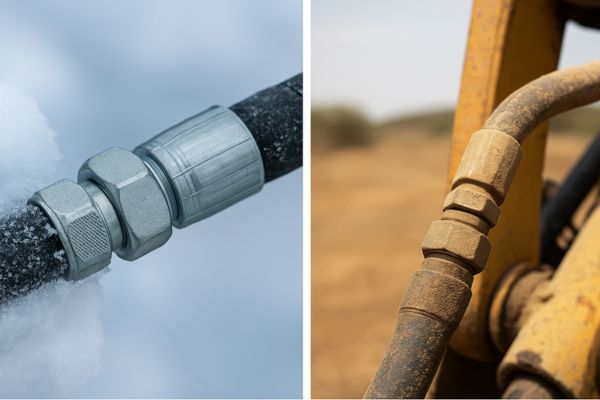
Yes, extreme heat makes rubber brittle, while excessive cold can cause the hose to crack during movement. Temperature ratings for a hydraulic hose assembly must consider both the fluid temperature and the ambient environment. Operating outside these bounds rapidly degrades the hose material and leads to early failure.
Standard hoses are rated for a specific range, usually between -40°F and +212°F. If your application exceeds these, you need specialized materials.
Fluid and Ambient Heat
Internal heat comes from friction in the oil, while external heat comes from the sun or nearby engines. Both contribute to the “aging” of the synthetic rubber.
The truth is:
- Hardening: Heat causes the hose to lose its flexibility.
- Cracking: Brittle rubber will snap when the machine moves.
Regularly checking for a “stiff” hose can help you identify heat damage before a leak occurs.
Cold Weather Challenges
In freezing conditions, the rubber becomes rigid. If a frozen hose is forced to bend during operation, the inner tube can develop micro-cracks.
Here is the deal:
- Low-temp Hoses: Remain flexible down to -60°F or lower.
- Warm-up Cycles: Allow the oil to circulate before working the machine.
Cold-related cracks often lead to “weeping” leaks that are difficult to seal.
Monitoring temperature extremes ensures the chemical bonds in the hose material stay strong and flexible.
| Temperature Condition | Effect on Hose | Recommended Action |
| Excessive Heat | Inner tube “charring” | Use high-temp rated hose |
| Extreme Cold | Cover cracking | Implement warm-up periods |
| Rapid Cycling | Material fatigue | Ensure proper cooling |
Why Is Seating Important In A Hose Assembly?
Proper seating ensures a leak-proof connection by aligning the sealing surfaces of the fitting and the hose perfectly. A hydraulic hose assembly that isn’t seated correctly will leak even at low pressures. Precision during the crimping and installation phase is non-negotiable for system safety.
Misalignment during assembly can damage the threads or the sealing face. Once a seat is marred, it will likely never achieve a perfect seal again.
Achieving a Metal-to-Metal Seal
Most hydraulic fittings rely on a metal-to-metal contact to stop the oil. This requires high-precision machining and careful tightening.
Here is the deal:
- Flare Angle: Must be identical between the male and female ends.
- Torque: Too much can crush the seat; too little allows leaks.
Always use two wrenches when tightening to prevent twisting the hose itself.
The Role of O-Rings
Some fittings, like ORFS, use an O-ring to create the seal. If the O-ring is pinched or missing, the assembly will fail immediately.
The bottom line is:
- Lubrication: Always lubricate the O-ring before installation.
- Inspection: Check for cuts or flat spots on the seal.
A simple O-ring is often the only thing standing between a dry system and a dangerous oil spray.
Ensuring every connection is seated correctly is the final step in building a reliable and safe hydraulic circuit.
| Sealing Method | Key Component | Success Factor |
| JIC Flare | 37-degree cone | Accurate torque |
| ORFS | Rubber O-ring | Clean seal groove |
| Pipe Thread | Tapered threads | Thread sealant/tape |
Conclusion
System safety depends on the integrity of your hydraulic conduits. From selecting the right layers to implementing the STAMPED protocol and maintaining a strict inspection schedule, every detail matters. Ignoring these steps leads to expensive downtime, environmental damage, and potential injury. If you are ready to upgrade your system’s reliability, contact us today to speak with a specialist.
FAQ
Can I mix fittings from different manufacturers?
No, you should avoid this. Different brands have varying engineering tolerances, and mixing them can compromise the safety rating and lead to premature failure.
What’s the best way to prevent hose abrasion?
The best way is proper routing combined with protective sleeving. Ensuring hoses don’t rub against sharp edges or each other will drastically extend their service life.
How do I know if my hose is the right length?
You know it is correct if there is enough slack to account for a 4% contraction under pressure and full movement of any connected actuators. It should never be pulled tight or “taut” during operation.
Can I reuse a hydraulic fitting?
No, it is generally not recommended for permanent crimped fittings. The crimping process deforms the metal collar to create a seal, meaning it cannot be reliably resealed a second time.
How do I know if a hose needs to be replaced?
You should replace it if you see any exposed wire reinforcement, cracks in the outer cover, or oil dampness around the fittings. These are clear indicators that the hose’s structural integrity is compromised.