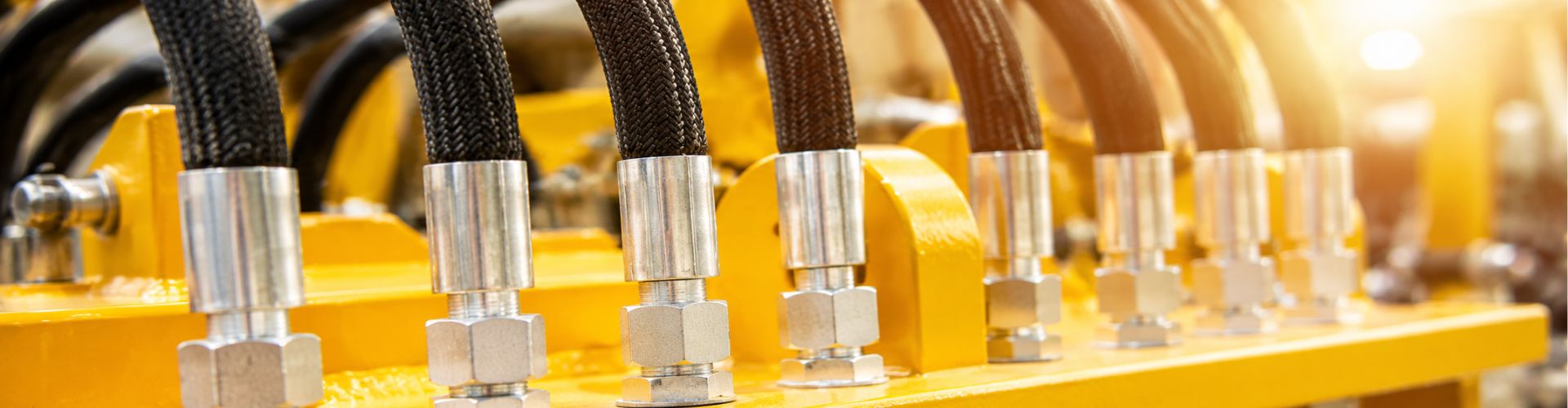
How Do One-Piece Fittings Reduce Assembly Mistakes

How Do One-Piece Fittings Reduce Assembly Mistakes?

One-piece hydraulic hose fittings reduce hose assembly errors mainly because the fitting stem and ferrule are supplied as one matched unit, so the assembler does not have to select a separate ferrule for each stem. That removes one common source of mismatch, especially in busy hose assembly work where similar parts, mixed bins, urgent repairs, and repeated small orders can lead to picking mistakes. The benefit is practical, not magical: one-piece fittings can reduce ferrule mismatch and sorting errors, but they still require correct hose selection, thread identification, sealing confirmation, and valid crimp data.

Fewer Separate Choices Mean Fewer Picking Errors

The ferrule decision is built into the fitting

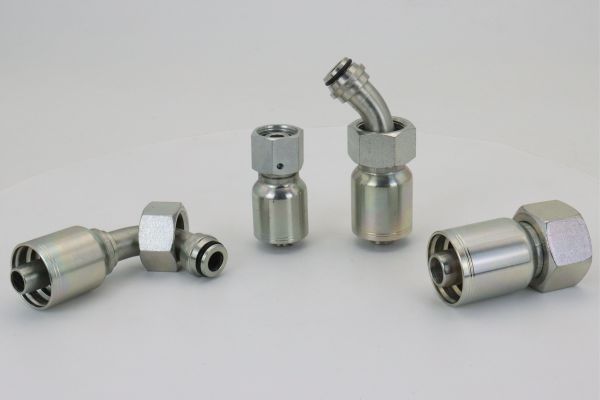
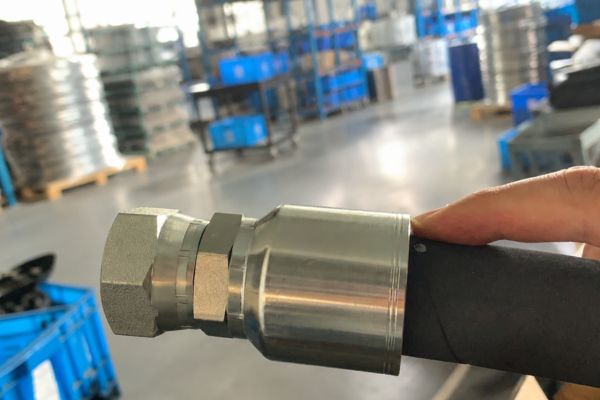
A one-piece fitting normally combines the fitting body or stem with a ferrule that is pre-assembled or fixed as part of the same component. The exact construction can vary by product series, but the working idea is simple: the hose tail and ferrule are no longer selected as two independent items. In real assembly work, that reduces the chance of pairing a correct stem with the wrong sleeve.

This matters because many hose assembly errors start before the crimper is used. A worker may identify the connection end correctly, then pick a ferrule from the wrong drawer, the wrong series, or a visually similar size. With one-piece hydraulic hose fittings, the matched ferrule is already attached to the fitting, so the picking step becomes simpler and easier to control.
crimp Fitting Assembly

The design reduces errors, but it does not approve the assembly

The one-piece structure reduces one category of error: separate ferrule and stem mismatch. It does not prove that the fitting is suitable for every hose with the same dash size, every crimping machine, or every working condition. A one-piece fitting still belongs to a specific fitting series and must be used with compatible hose construction and assembly data.

The Assembly Errors One-Piece Fittings Help Prevent

Ferrule and stem mismatch is the clearest target

The most direct error that one-piece fittings help prevent is ferrule mismatch. In a two-piece arrangement, the stem and ferrule may be stored, labeled, and picked separately. If several series look similar, the wrong ferrule can be selected even when the hose size appears correct.

The result can be more than a cosmetic problem. A mismatched ferrule may crimp unevenly, grip the hose incorrectly, damage the cover or reinforcement, or fail to meet the required assembly dimensions. That can lead to leakage, pull-off risk, repeat labor, and loss of confidence in the finished hydraulic hose assembly.

They also reduce sorting and labeling confusion

One-piece fittings can also reduce errors in storage and job preparation. A single part number can represent the complete hose-end fitting instead of requiring the assembler to manage one number for the stem and another for the ferrule. This is useful when several hose sizes, thread styles, and fitting orientations are handled at the same counter or workbench.

Cleaner identification supports faster work because the assembler has fewer small parts to cross-check during each job. It also helps purchasing and stock control because the finished fitting is easier to count, reorder, and label. For deeper selection work, the fitting still has to be tied to hydraulic hose fitting types and the intended hose series, not just a shelf label.

How the One-Piece Structure Changes the Workflow

Assembly starts with a more controlled component

In a two-piece process, the assembler must confirm the connection end, hose tail, ferrule, hose type, and crimp specification as a combined set. One mistake in the ferrule selection can break the assembly even if the other details are correct. A one-piece fitting reduces that burden by arriving as a more controlled component.

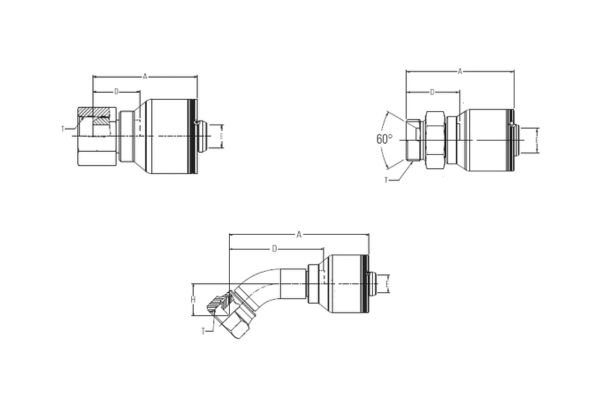
This helps most in repeat work where the same hose sizes and common connections are assembled frequently. Straight, 45-degree, and 90-degree fittings can be stocked as complete items, which reduces the time spent matching sleeves and stems under pressure. The work becomes less dependent on memory and more dependent on verified part identification.
crimp hydraulic fitting design

It supports repeatability at the workbench

Repeatability is one of the strongest reasons to use one-piece fittings. When the same fitting series, hose series, and crimp data are used consistently, the assembler can follow a stable routine: select the complete fitting, confirm the hose, insert to the correct depth, crimp to the specified data, and inspect the finished assembly. Fewer loose variables make the routine easier to train and audit.

This does not mean every part with the same dash size is interchangeable. Dash size is only a size reference, not a full compatibility approval. The hose construction, reinforcement, cover thickness, skive or no-skive requirement, and manufacturer crimp data still decide whether the assembly is correct.

What Still Must Be Confirmed Before Crimping

Hose side details decide whether the fitting can be used

Before crimping, the hose side must be checked against the fitting series. Hose ID, dash size, hose construction, reinforcement type, cover condition, and skive requirement can all affect whether the fitting will assemble correctly. A one-piece fitting for one hose family may not be suitable for another hose with a similar nominal size.

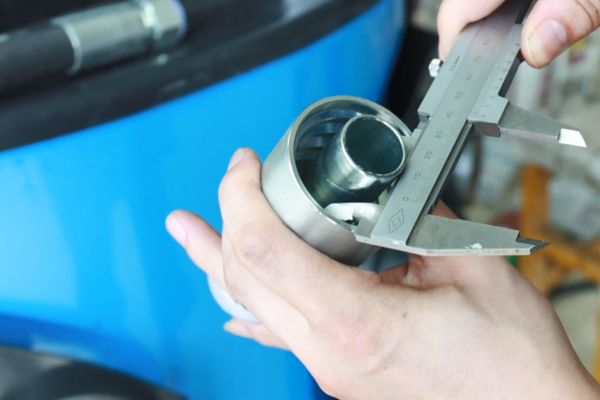
The crimp data is especially important. Crimp diameter, insertion depth, die selection, and assembly procedure should come from the applicable hose, fitting, and crimping equipment information. There is no universal crimp diameter that safely applies to all one-piece fittings, so hydraulic hose crimping data should be treated as part of the specification, not an optional detail.

Connection side details decide whether the joint will seal

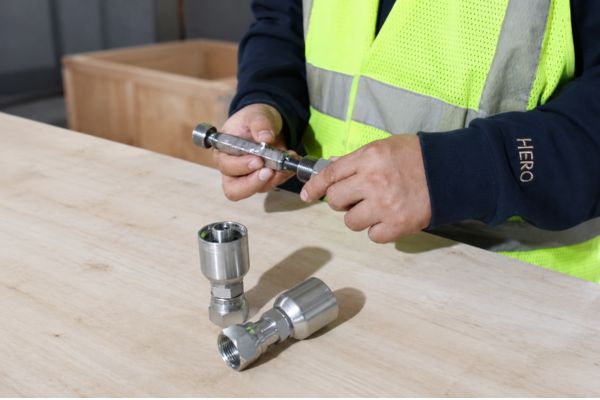
The connection end must be confirmed separately from the hose side. Thread form, connection standard, male or female style, straight or tapered thread, seat angle, sealing face, and O-ring arrangement all affect whether the joint can seal correctly.

Photos can help with first screening, but they cannot replace measurement. A clear photo may show that a fitting is elbow-shaped or female, yet it may not show thread pitch, seat angle, damaged sealing surfaces, or whether the thread is tapered. When the connection is uncertain, use a proper hydraulic fitting thread identification process before selecting the fitting.

A Practical Error-Reduction Workflow

Check the old part and the hose before choosing the fitting

The most reliable workflow starts with identification, not crimping. If an old assembly is available, inspect the complete fitting, thread end, sealing face, hose marking, and orientation before choosing a replacement. If only a photo is available, treat it as a starting point and ask for measurements before approving the part.

Use this information before selecting the fitting:

Inspect the assembly after crimping

After the fitting is selected, the assembly process still needs inspection. Confirm insertion depth, hose position, crimp diameter, die set, and whether the finished crimp shape matches the relevant procedure. If the fitting requires skiving or a specific preparation method, that instruction should be followed before the crimp is made.

A simple post-crimp check can catch errors before the hose is installed:

Where One-Piece Fittings Help and Where They Do Not

High-repeat and emergency work benefit from simpler picking

One-piece fittings are especially useful where the same common hose assemblies are made repeatedly. The fewer separate parts the team has to pick, the lower the chance of using the wrong ferrule or mixing similar sleeves. This is why one-piece fittings often work well for high-turnover sizes and common connection styles.

They also help when several workers share the same stock area. A complete fitting with a clear label is easier to control than separate stems and ferrules that may be returned to the wrong bin. Better stock control can reduce rework and support smoother hydraulic fittings inventory management without forcing every part into a complicated system.

Emergency hose repairs often create conditions where mistakes become more likely. The machine is down, the old part may be damaged, the operator wants a fast repair, and the assembler may have limited information. One-piece fittings reduce the number of loose components that must be matched while the job is urgent.

The safety boundary does not change. Before inspection or replacement, equipment should be shut down, hydraulic pressure and stored energy should be released, and the relevant safety procedures should be followed. A faster fitting selection process should never lead to loosening parts under pressure, checking pinhole leaks by hand, or using unverified components just to restart equipment.

They cannot fix wrong thread, seal, or crimp data

A one-piece fitting can be correctly made and still be wrong for the port. If the thread type is misidentified, the seat angle is wrong, or the sealing face is damaged, the joint may leak even though the hose-side crimp looks acceptable. Thread sealant should not be used as a repair for an incorrect thread or a damaged sealing surface.

This is one reason similar-looking fittings should be treated carefully. An ORFS fitting, a BSPP fitting with a bonded seal, and a metric fitting with an O-ring may all appear close to someone working from a photo. The final choice should be based on measurement and sealing structure, not visual similarity.

One-piece fittings also do not remove the need for manufacturer data. Any decision involving crimp diameter, insertion depth, skive or no-skive preparation, die selection, pressure suitability, or assembly sequence should be checked against the applicable data. The complete hydraulic hose assembly is limited by the lowest-rated component and by the actual working conditions.

Pressure, impulse, temperature, fluid compatibility, vibration, corrosion, and installation routing can all change the risk level. A fitting that works well in one assembly may not be suitable for another application with different hose construction or operating conditions. When leakage history is part of the problem, review hydraulic hose leak causes along with the fitting selection.

What to Prepare Before Ordering or Replacing

Send enough information to prevent guessing

If the goal is to reduce assembly errors, the inquiry should include enough technical information for the fitting to be checked before shipment or use. A request that only says “same as photo” or gives a partial part number leaves too much room for error. Better input creates better selection and fewer corrections later.
check connection side

For a one-piece fitting inquiry, prepare the most relevant items:

The final decision should be based on controlled reduction of risk

One-piece hydraulic hose fittings reduce hose assembly errors because they remove the separate ferrule-selection step and make stock picking more controlled. They are most useful when repeat work, shared inventory, urgent repair, or mixed fittings make picking mistakes likely. Their value is strongest when they are paired with clear hose identification, verified thread and seal details, and valid crimp data.

The next step is not to choose one-piece fittings by appearance or price alone. Prepare the hose information, connection measurements, sealing details, working conditions, and crimping data source before approving the part. Correct matching is what reduces rework, leakage, and downtime; the one-piece structure simply makes that correct matching easier to manage.

FAQ

Do one-piece fittings eliminate ferrule mismatch completely?
They reduce ferrule mismatch by pairing the stem and ferrule as one component, but they do not eliminate errors caused by wrong hose series, wrong crimp data, or wrong connection identification.

Can I choose a one-piece fitting only by dash size?
No, dash size is not enough because hose construction, fitting series, crimp specification, and sealing style must also match. Two hoses with similar nominal size can require different fittings or crimp procedures.

Are one-piece fittings better than two-piece fittings for every hose assembly?
No, they are better when simplified picking and repeatable assembly reduce risk, but two-piece systems may still be used where the hose, ferrule, and crimp data are controlled correctly.

What is the most common mistake when replacing an old fitting?
The most common mistake is relying on appearance or a partial photo instead of confirming thread pitch, seat angle, sealing face, hose markings, and crimp requirements. Visual similarity should only be used for preliminary screening.

When should manufacturer crimp data be checked?
Manufacturer crimp data should be checked whenever the hose series, fitting series, crimping machine, die set, skive requirement, insertion depth, or pressure suitability is involved. It is required before approving a new or replacement assembly process.
Branded vs Compatible One-Piece Fittings Which Is Better

Branded vs Compatible One-Piece Fittings: Which Is Better?

Branded fittings are not automatically better, and compatible fittings are not automatically risky. The better choice is the one that can be verified against the hose, thread connection, sealing method, material, finish, pressure range, and crimp data for the actual assembly. For one-piece hydraulic hose fittings, the real buying question is not only “Which part costs less?” It is “Which option reduces mismatch, rework, leakage, downtime, and after-sales disputes while keeping supply stable?”

Choose the Fitting You Can Verify

Brand name is useful, but it is not proof

A branded one-piece fitting gives the buyer a clear reference point because the part number, catalog description, hose series, and crimp data usually belong to one controlled system. That can reduce uncertainty when the same hose, fitting, and crimping equipment are already used in the workshop or maintenance network. The value is consistency, not the logo itself.

A compatible fitting can be the better commercial choice when it is technically confirmed and supplied with stable identification, dimensions, material information, and assembly guidance. It may help reduce purchasing cost, improve availability, and avoid delays when the original branded item is difficult to source. But a compatible part should never be treated as “the same” just because it looks similar or is listed against a brand reference.

order of one piece Fitting

Compatible means confirmed fit, not assumed interchange

In hydraulic hose assemblies, compatibility has several layers. The thread may connect, the seat may seal, the stem may fit the hose bore, the ferrule may appear to grip, and the final crimp may still be wrong if the series or crimp data does not match. A correct decision needs technical evidence across all these layers, not only a cross-reference table.

The safest way to compare branded and compatible one-piece fittings is to separate identification from approval. A branded part number can help identify the required style, thread, angle, hose size, and application. Approval should come only after checking the technical details and, where required, the hose, fitting, equipment, and crimping data from the relevant manufacturers.

What One-Piece Fittings Change in the Decision

The ferrule and stem are already paired

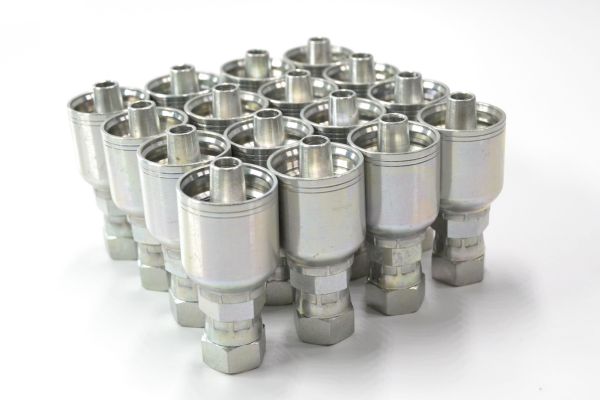
A one-piece hydraulic hose fitting is normally built as a fitting body or stem with the ferrule pre-assembled or fixed as one unit. The exact construction can vary by product series, but the practical idea is that the hose tail and ferrule are selected together instead of being picked as separate parts. This helps reduce errors caused by choosing the wrong ferrule for the stem.

That structure can simplify storage, picking, and assembly, especially for common hose sizes and repeat orders. It does not automatically prove that the fitting is compatible with every hose of the same dash size, every crimper, or every working condition. The fitting series must still match the hose construction, assembly procedure, and valid crimp specification.

The one-piece design reduces some errors, not all risks

One-piece construction is valuable when the main problem is sleeve mismatch, mixed parts, or inconsistent picking. It can help workers avoid combining a stem from one series with a ferrule from another series. For high-turnover items, that can make stock handling cleaner and reduce the chance of assembly rework.

The risk moves to the selection stage. If the buyer chooses the wrong thread, sealing face, hose compatibility, or crimp data, the one-piece structure will not save the assembly. A neatly packaged wrong fitting is still a wrong fitting, and it can create the same leakage, pull-off, contamination, or downtime risk as any other incorrect component.

Where Each Option Makes More Sense

Use branded parts when the system is already controlled

Branded fittings often make sense when a maintenance program already uses that manufacturer’s hose, crimping machine, dies, and published crimp data. In that situation, the brand is part of a controlled assembly method. Changing one component without checking the rest can break the logic of the system.

This is especially important in higher-risk applications where pressure, impulse, vibration, temperature, hazardous fluid, or difficult access makes failure expensive or unsafe. The lowest unit price is not the real comparison in those conditions. The buyer should compare the cost of the fitting against the cost of leakage, repeat labor, shutdown time, field complaints, and possible damage to nearby components.

Branded fittings are also safer as the first reference when the old part is worn, the thread is damaged, the hose marking is missing, or the equipment information is incomplete. A familiar brand number may help trace the original assembly system and reduce guesswork. Even then, the part number should be verified against actual dimensions and sealing details.

Replacement should be conservative when the application is safety critical, when the hose assembly is hard to inspect after installation, or when failure could stop a machine at a costly moment. A compatible product may still be possible later, but the first step should be identification and risk control, not price reduction.

Standard crimp Fitting

Use compatible parts for repeatable, well-defined demand

Compatible one-piece fittings become attractive when the buyer repeatedly uses common sizes, common thread standards, and known hose series. In these cases, the technical details can be confirmed once, documented clearly, and then repeated with less uncertainty. That is where compatible fittings can reduce cost without creating unnecessary confusion.

The strongest candidates are usually items with stable demand, clear drawings or catalog references, and low ambiguity in thread and sealing style. A common JIC female swivel for a known hose series, for example, is easier to verify than a damaged metric fitting copied from a blurry photo. The point is not that one connection type is always low risk, but that clear identification makes validation more reliable.

Compatible fittings may also be better when the branded option has long lead times, unstable availability, or limited local stock. A hose assembly that cannot be completed because one fitting is missing may create more cost than the price difference between two components. Availability matters most when downtime, urgent repair, or repeated small orders are part of daily work.

The buyer should still avoid treating compatible supply as a shortcut. A lower price with poor labeling, changing dimensions, unclear material, or missing crimp guidance can increase total cost through sorting errors and after-sales work. A compatible supplier must be able to keep the product stable from sample to batch and from one shipment to the next.

What Must Be Checked Before Replacing a Branded Fitting

Compare the connection, hose side, and assembly data

The first check is the connection end. Thread form, connection standard, male or female style, straight or tapered thread, seat angle, sealing face, O-ring arrangement, and port type must be confirmed separately.

The second check is the hose side.

A compatible fitting with the same dash size can still be wrong if it belongs to a different hose series or assembly system.

Crimp Fitting dia

Use a simple verification checklist

Before placing a trial order or approving a replacement, prepare a complete comparison pack. Photos are useful for screening, but they are not enough for final approval. Measurements, markings, and application information reduce the risk of choosing the wrong part.

Comparing Branded and Compatible Options Beyond Price

A low unit price can hide higher handling cost

The cheaper fitting is not always the lower-cost fitting. If the replacement creates extra checking, sorting, relabeling, customer clarification, rework, or urgent resupply, the apparent saving disappears quickly. Total cost includes both the purchase price and the operational friction around that item.

This is why branded and compatible fittings should be compared through a decision framework rather than a simple price column. The right framework forces the buyer to look at technical risk, supply reliability, documentation, and repeatability. It also prevents a common mistake: approving a replacement because the first sample looks acceptable, while ignoring whether the next batch can be controlled.

The best choice may vary by SKU

A practical buying policy can use both options. Keep branded parts for high-risk, unclear, or tightly controlled assemblies, and validate compatible fittings for repeatable common items where the technical data is complete. This gives purchasing teams a way to reduce cost and improve availability without turning every replacement into a risk.

The policy should be written at SKU level, not as a general rule that “branded is best” or “compatible is cheaper.” Some fittings deserve strict original control. Others can be validated through samples, trial orders, and documented inspection. The decision should follow the application, not the label.

How to Validate Compatible One-Piece Fittings

Start with a limited trial, not a full replacement

A low-risk validation process should begin with a small group of common, well-defined fittings. The goal is to check whether the compatible option can match the required dimensions, assembly behavior, labeling, packaging, and repeatability before it becomes normal stock. Expanding too fast creates confusion when a problem appears later.

The trial should include both product inspection and assembly confirmation. Check the thread and sealing geometry, verify the hose-side design, confirm the correct crimp procedure, and compare the sample with the documented requirement. Do not approve the part only because it can be screwed onto a port or because it resembles the previous fitting.

Record what changed and what did not

Good validation creates a record that can be reused. If the compatible fitting is approved, record the matching brand reference, the compatible part number, hose series, approved crimp data source, inspection notes, packaging label, and any limits on use. If it is rejected, record the reason so the same mistake is not repeated in the next inquiry.

Useful trial records should answer four practical questions:

When to Stay Branded and How to Finalize the Decision

Avoid replacement when safety or data is uncertain

Do not replace a branded one-piece fitting with a compatible option when the original specification is unclear and the application risk is high. This includes assemblies where failure could cause injury, severe leakage, environmental contamination, equipment damage, or major production interruption. In those cases, missing data is a reason to stop and verify, not a reason to guess.

Substitution is also poor practice when the only information is a photo, an outside diameter, or an old part with worn sealing surfaces. Any decision involving skiving, insertion depth, crimp diameter, die selection, pressure suitability, or assembly procedure should refer to the applicable hose, fitting, crimping equipment, or component manufacturer data. Thread sealant should not be used to compensate for an incorrect thread or damaged sealing surface.

Before inspection or replacement, the equipment should be shut down, hydraulic pressure and stored energy should be released, and the relevant safety procedures should be followed. Do not loosen fittings under pressure, check pinhole leaks by hand, or restart equipment with unverified parts. A rushed repair can turn a purchasing mistake into a safety problem.

Decide by risk, repeatability, and evidence

Branded one-piece fittings are better when they are part of a controlled hose and crimp system, when the application is high risk, or when the original specification is not clear enough to validate a replacement. Compatible one-piece fittings are better when the item is repeatable, the technical details are fully confirmed, supply is stable, and the total cost is lower after considering inspection, inventory, and after-sales risk.

The next step is to prepare a complete technical inquiry package instead of asking only for a cross-reference or a lower price. Include the brand reference, photos, thread measurements, sealing details, hose markings, hose size, fitting shape, material and finish needs, working conditions, and required crimp data source. The better choice is the fitting that can be checked, assembled, stocked, and repeated with confidence.

FAQ

Can a compatible one-piece fitting be used if it has the same thread size?
No, the same thread size is not enough because the seat angle, sealing method, port style, hose compatibility, and crimp data may still be different. Thread size is only one part of the identification process.

Is a one-piece fitting always safer than a two-piece fitting?
No, a one-piece fitting reduces some ferrule selection and picking errors, but safety still depends on correct hose selection, fitting series, crimp procedure, pressure suitability, and installation conditions.

Can a brand part number be used to order a compatible fitting?
It can be used as a reference for identification, but it should not be treated as proof of full interchangeability. The replacement must be checked against dimensions, sealing design, hose side, material, finish, and crimp information.

What should be inspected when samples arrive?
Inspect thread form, sealing face, stem and ferrule condition, markings, plating quality, packaging labels, and the fit with the approved hose and assembly data. Any deviation should be recorded before the part is used in regular stock.

When is it better to keep using the branded fitting?
Keep the branded fitting when the application is safety critical, the crimp system is controlled by one manufacturer, the old part cannot be clearly identified, or the compatible option lacks reliable technical documentation.

How Do Repair Shops Build Reliable Hydraulic Fitting Stock

How Do Repair Shops Build Reliable Hydraulic Fitting Stock?

Hydraulic service centers fear hydraulic fitting stockouts because one missing hose end can block completion of an otherwise routine assembly. The correct hose, crimper, technician, and second fitting may all be available, yet the job cannot leave the bench until both ends match the equipment and the hose system. The delay then spreads beyond the value of the missing part: equipment remains down, purchasing starts an emergency search, freight and receiving work increase, and pressure grows to accept a visually similar substitute. Stock availability is therefore a service-capacity issue, not merely a warehouse target.

Why Can One Missing Fitting Stop the Entire Repair?

A hose assembly is only usable when every interface is correct

A replacement hose must connect to the equipment at both ends, fit the available route, and use components supported by the hose and crimp system. Thread form, seat angle, sealing method, orientation, material, and hose-tail design all affect whether the finished assembly can be released. The missing end may also prevent the center from promising length, orientation, or delivery time because changing to another fitting can alter assembly dimensions and routing.

hydraulic fitting packing stock Topa

One-piece fittings reduce one error but not the range problem

A one-piece hydraulic hose fitting normally has its fitting body or stem and ferrule preassembled or fixed as one component, although construction varies by series. This can reduce the chance of choosing a separate ferrule that does not belong with the stem. It does not reduce every required thread, size, hose series, angle, or material to one universal SKU, so a service center can still have a full-looking shelf and lack the exact fitting needed for the repair in front of it.

What Costs Begin After a Stockout?

The first delay creates several transactions

Once the bin is empty, staff must confirm the shortage, check open orders, search other locations, request quotations, compare cross-references, arrange freight, receive the shipment, and reschedule assembly work. A small fitting may therefore create multiple administrative and handling steps before it reaches the bench. If the hose has already been cut or the machine is waiting, the job also occupies work-in-process space and requires another setup later.

The stockout can produce costs that are easy to miss:

Equipment downtime continues outside the shop

The operational cost belongs mainly to the machine owner, but it shapes how the service center is judged. A disabled machine may hold a production step, maintenance schedule, vehicle, or seasonal task, while the center can provide no reliable completion time until the correct fitting is secured. Repeated missed completion times also weaken future planning because customers may stop sharing forecasts or sending routine work when they expect every uncommon end to create an open-ended wait.

Why Is a Fast Substitute Often the Wrong Response?

Similar appearance does not prove connection compatibility

Under time pressure, a fitting that threads in partway or resembles the old part can appear to be a practical solution. It may still have the wrong pitch, taper, seat, sealing face, O-ring arrangement, elbow drop, or connection standard. Forcing mismatched components can damage the port or create partial sealing contact that leaks when pressure, impulse, temperature, or vibration begins; a controlled thread-mismatch identification process is safer than an urgent visual guess.

The hose side and crimp data must also agree

Correct equipment-side geometry does not prove that the hydraulic fitting stem and ferrule match the hose. Confirm hose manufacturer, series, construction, hose ID or dash size, fitting series, insertion requirement, preparation, crimper, dies, crimp diameter, measurement location, and inspection method from current applicable data. An emergency substitute that lacks this evidence can turn a stockout into a damaged hose, failed inspection, pull-off risk, leakage, contamination, rework, and another shutdown.

Which Fitting Stockouts Hurt the Most?

Core and critical-service SKUs deserve different attention

Core fittings recur across many routine assemblies and normally justify local stock with a defined minimum and reorder point. Critical-service items may move less often but repeatedly block repairs on common equipment or have a long, unreliable replenishment route. The fast-moving one-piece fitting stock framework separates demand frequency from service consequence so annual volume does not hide a low-volume item that repeatedly stops complete jobs.

A broad catalog is not the same as useful availability

Stocking every catalog variant ties cash and space to low-use parts while core bins can still empty. Useful coverage comes from complete SKU history, local equipment and hose systems, repair frequency, stockout records, lead time, seasonality, and approved alternatives. Straight fittings may be common, but a missing swivel, elbow orientation, jump size, special seal, or local Metric/BSP variation can still stop the assembly; each center must derive its range from actual work. Review complete assemblies rather than fitting counts alone, since a large quantity of one end does not provide coverage when the matching second end or compatible hose series is repeatedly absent.

How Should Stock Be Set Without Creating Dead Inventory?

Separate minimum, reorder point, and safety stock

The minimum is the operating floor the center intends to protect, the reorder point is the stock position that starts replenishment, and safety stock covers a justified level of demand or lead-time variation. Set them by SKU from expected use during replenishment, open commitments, lead-time history, pack quantity, seasonality, and stockout consequence. Do not copy one number across all hose sizes and connection families or treat a large emergency order as permanent demand.

order of one piece Fitting

Track stock position using:

Pool slow variants while keeping core items near the bench

If several branches or mobile units operate within a practical transfer area, less common fittings can be pooled while core same-day items remain local. This works only when part numbers, descriptions, labels, units, bin status, and transfer time are reliable. A fitting located elsewhere but not visible in the system, mixed under a vague description, or unable to arrive before the promised repair time does not provide real coverage. Test the transfer route before relying on it for critical service, document actual arrival performance, and define who owns reservation, dispatch, receiving, and stock-balance correction.

What Should Happen During an Actual Stockout?

Triage the job without skipping safety or identification

First confirm the exact connection, hose, fitting series, orientation, material, application, and crimp requirement; then check local stock, quarantine status, approved branch stock, and open supply. Shut equipment down, release hydraulic pressure and stored energy, and follow the equipment and component manufacturers’ procedures before removing or inspecting an assembly. Never search for a pinhole leak with a hand, disconnect a pressurized line, patch a failed hose, or install an unverified fitting simply to restore operation. Keep the old assembly and mating-port evidence available until the replacement specification is resolved.

Use a controlled escalation order:

Record the unmet demand even when no sale occurs

Sales history alone cannot show a job that was lost, delayed, transferred, or completed elsewhere because the fitting was unavailable. Record the requested SKU, quantity, equipment or job category, date, action taken, emergency cost, promised-time effect, and whether demand later converted. These records separate a recurring stock gap from a one-time unusual request and give future reorder decisions evidence that ordinary invoice history misses.

How Can Repeat Stockouts Be Prevented?

Correct the cause, not every minimum quantity

A stockout can come from an incorrect reorder point, delayed supply, sudden demand, a mislabeled bin, duplicate part records, a return placed in the wrong location, unrecorded consumption, or a technically rejected shipment. Raising every minimum treats these different failures as one problem and can create excess without improving availability. Review each event by cause, then change the demand forecast, lead-time assumption, label, source plan, inspection release, or reorder control that actually failed. Track whether the correction prevents recurrence at the next demand cycle; otherwise, the same shortage can return under a different emergency purchase order without improving the inventory system.

Validate new sources before counting them as backup

A quotation or catalog cross-reference is not available stock until the alternative has passed connection, hose compatibility, material, application, crimp, sample, receiving, and approval checks. Use a controlled one-piece fitting trial order for recurring gaps and keep samples separate from approved inventory. The one-piece fitting cross-reference method should make missing evidence visible so an urgent future repair does not discover that the backup is unusable. Record the approved scope by SKU and application so one verified size or hose combination is not extended silently to a whole product family.

Final Stockout Decision

Hydraulic fitting stockouts matter because service centers sell completed, safe hose assemblies, not isolated pieces. Protect the verified core and critical-service SKUs that repeatedly determine whether a job can leave the bench, while ordering rare or uncertain items through a controlled route. Set replenishment from actual demand, lead time, commitments, seasonality, and service consequence; record lost and delayed jobs as well as sales. Before adding stock, confirm connection geometry, hose and fitting series, material, application, and current crimp data; when a shortage occurs, use approved transfers or alternatives and stop if compatibility remains uncertain—speed cannot justify another failure.

Frequently Asked Questions

Should a service center stock every thread standard it may encounter?
No. Stock complete verified SKUs supported by local demand and service risk, while maintaining an identification and sourcing route for rare or unfamiliar standards.

Can adapters prevent all fitting stockouts?
No. Approved adapters can bridge specific standards, but they add length and sealing interfaces and must suit pressure, material, routing, and equipment requirements.

Is emergency freight always cheaper than holding more fittings?
No. Compare freight, handling, delayed work, downtime impact, demand frequency, and carrying risk by SKU rather than applying one answer to every fitting.

How should a shop count a fitting that is in quarantine?
Treat it as unavailable until receiving inspection or technical approval releases it, because unverified physical stock cannot safely support a promised repair.

Does one-piece construction eliminate ferrule-related stockouts?
It can remove the separate loose-ferrule selection for that fitting design, but the center still needs the correct hose size, fitting series, thread, seal, orientation, material, and crimp data.

Contact Topa

Save 30% on maintenance costs with our easy-install hydraulic fittings. Contact Now!