
UNF threads are Unified inch fine-pitch threads. The “UNF” part tells you the thread series and pitch family; the class marking, such as 1A, 2A, or 3A, tells you the tolerance class of an external thread.
That distinction matters because 1A, 2A, and 3A are not pressure ratings, sealing ratings, or material grades. They describe how tightly or loosely an external UNF thread is manufactured so it can mate with the correct internal thread class, such as 1B, 2B, or 3B.
For most commercial mechanical and hydraulic fitting applications, 2A is the common external thread class. 1A is a looser fit and is rarely used for precision connections. 3A is a tighter precision class used when the drawing, mating part, inspection requirement, or application clearly calls for a closer fit.
In hydraulic fittings, the UNF thread often provides mechanical engagement, while the actual seal may come from a 37-degree flare, an O-ring, a face seal, or another sealing surface. Choosing the right UNF class is important, but it must be considered together with the mating part, sealing interface, material, coating, and inspection method.
What are UNF Threads?
Definition and Background
Unified National Fine (UNF) threads are part of the Unified Thread Standard (UTS), which includes various thread forms commonly used across North America. The UNF designation specifically refers to threads with a fine pitch—meaning the distance between the thread crests is smaller compared to coarse threads like Unified National Coarse (UNC). The finer pitch of UNF threads allows for increased tensile strength and a more secure fit, making them particularly suited for precision applications where tight tolerances and secure connections are essential.
What is UNF Thread
UNF stands for Unified National Fine. It is part of the Unified Thread Standard used for inch-based screw threads in the United States and other markets that specify Unified threads.
A UNF thread uses a 60-degree thread form and a fine pitch compared with UNC threads of the same nominal diameter. For example, a 1/2-20 UNF thread has a 1/2 inch nominal diameter and 20 threads per inch. The fine pitch gives more threads in the same axial length, which can be useful where space is limited or where finer adjustment is needed.
The word “UNF” does not tell you whether the thread is external or internal, and it does not tell you the class of fit by itself. A complete thread callout normally includes the nominal size, threads per inch, thread series, and class, such as:
3/4-16 UNF-2A
In this example, 3/4 is the nominal diameter, 16 is the number of threads per inch, UNF is the fine-thread series, and 2A means the external thread is made to Class 2A limits.
Comparison to Other Thread Types (UNC, UNJF)
While UNF threads standard are characterized by their fine pitch, other thread types under the Unified Thread Standard have different purposes:
UNF, UNC, and UNJ are related, but they do not describe the same decision.
UNC is the coarse-thread series. It has fewer threads per inch than UNF at the same nominal diameter and is often used where faster assembly, stronger thread roots, or better performance in softer materials is needed.
UNF is the fine-thread series. It has more threads per inch and is commonly used where a compact connection, fine adjustment, or a specified inch fine thread is required.
UNJ is a related thread form with a controlled root radius, commonly associated with aerospace and fatigue-sensitive applications. UNJ should not be treated as a simple stronger version of UNF. If a drawing specifies UNJ, the part must be manufactured and inspected to the correct UNJ requirements.
The class marking, such as 2A or 3A, is a separate part of the specification. A thread can be UNF-2A, UNF-3A, UNJ-3A, or another specified combination. Do not replace one thread series or class with another unless the drawing, standard, and mating part have been checked.

Common Applications of UNF Threads
UNF threads are widely adopted in various industries due to their fine pitch and secure fit, which ensures stability and precision. Some common applications include:
Precision Hydraulic Fittings: UNF threads are frequently used in hydraulic systems, where maintaining a leak-free and secure connection is critical. The fine pitch allows for a tight seal, essential for preventing fluid leaks under high pressure.
Automotive Assemblies: In the automotive industry, UNF threads are utilized in components like brake fittings, engine parts, and suspension systems. Their fine pitch helps create strong, reliable connections in areas subject to vibration and movement, ensuring that parts remain securely fastened even under dynamic conditions.
Aerospace Components: Given their high strength-to-size ratio, UNF threads are a preferred choice in the aerospace sector. They are used in high-stress components such as aircraft fasteners, engine parts, and hydraulic systems, where weight reduction and reliability are crucial.
Industrial Machinery: UNF threads are also common in industrial equipment and machinery where precise assembly is required, and components must withstand high pressures or frequent adjustments without compromising system integrity.
The Three Classes of UNF Threads: 1A, 2A, and 3A
Overview of Thread Classes
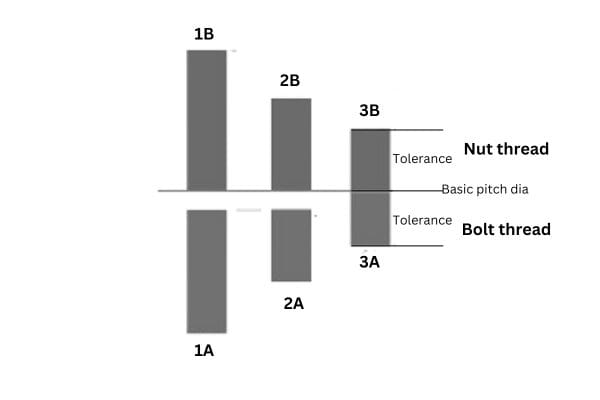
For Unified inch threads, Class 1A, 2A, and 3A apply to external threads. The number describes the tolerance class, and the letter “A” tells you the thread is external.
The main difference is the amount of tolerance and allowance. Class 1A and 2A external threads include an allowance, which places the external thread slightly below the basic size to help provide clearance during assembly. Class 3A has no allowance and uses tighter limits, so it produces a closer fit when matched with the correct internal thread.
| External class | General fit | Typical use | Key point |
| 1A | Loose | Special cases where easy assembly is more important than close fit | Rare for precision hydraulic components |
| 2A | Standard commercial | General-purpose external threads, including many fittings and fasteners | Most common choice when no special class is required |
| 3A | Close precision | Applications requiring tighter fit and stricter inspection | Should be used only when specified by drawing or mating requirement |
A higher class number does not automatically mean the part can handle higher pressure. Pressure rating depends on the complete fitting design, material, size, wall thickness, seal type, manufacturing quality, and test data. The thread class controls fit, not the full performance rating of the hydraulic connection.
UNF 1A Thread Class
Class 1A is the loosest external UNF thread class. It provides the most clearance among the three external classes, which can make assembly easier when parts are dirty, worn, coated heavily, or used in less precise mechanical situations.
Because of that loose fit, 1A is not the normal choice for precision hydraulic fittings or controlled industrial assemblies. It may be useful in special field-assembly situations where easy engagement matters more than close fit, but it should not be selected simply because a part is expected to be disassembled often.
If a hydraulic fitting drawing does not clearly specify 1A, do not assume it is acceptable. In most commercial supply situations, 2A is more common for external Unified threads. Use 1A only when the drawing, mating component, or engineering requirement specifically allows that looser fit.
UNF 2A Thread Class
Class 2A is the standard commercial external thread class for many Unified inch threads. It provides a practical balance between manufacturability, assembly clearance, and reliable fit with the matching internal thread class.
For many bolts, adapters, and fitting threads, 2A is the class engineers expect unless another class is stated on the drawing. A 2A external thread is commonly paired with a 2B internal thread, although the complete mating requirement should always be confirmed from the drawing or catalog.
In hydraulic fittings, a 2A external UNF thread may appear on connections that seal somewhere other than the thread itself. For example, a JIC fitting may use UNF threads for mechanical engagement while sealing on the 37-degree flare seat. An ORB connection may use straight threads for retention while the O-ring creates the seal. In these cases, the 2A thread class helps the parts assemble correctly, but it is not the sealing feature by itself.
UNF 3A Thread Class
Class 3A is a close-fit external thread class. Compared with 2A, it has tighter limits and no external thread allowance. This can reduce clearance between mating threads when paired with the correct internal class, but it also leaves less room for plating buildup, burrs, dirt, or manufacturing variation.
3A is normally used when the design requires closer control of thread fit, more precise alignment, or a specified inspection condition. It should not be chosen only because the system has high pressure or vibration. A tighter thread class does not automatically create a hydraulic seal, and it does not replace the need for the correct sealing interface.
When specifying 3A, confirm the mating internal thread class, coating thickness, material pairing, and inspection gauge requirements. A part that passes as 2A may not pass as 3A, and a plated or coated thread can become difficult to assemble if the class and finish are not planned together.
Why the Matching B Class Matters
A UNF external thread does not work alone. It must mate with an internal thread, and the internal thread uses a “B” class, such as 1B, 2B, or 3B.
The most common commercial pairing is 2A external with 2B internal. This combination gives enough clearance for normal production variation while still providing a controlled fit. A closer fit, such as 3A with 3B, should be used only when the design and inspection requirements support it.
Problems often happen when only one side of the connection is checked. For example, a buyer may specify a 3A external thread but continue using a port or nut that was made and inspected as a general 2B internal thread. The parts may still assemble in some cases, but that does not prove the connection meets the intended specification.
For purchasing and inspection, always confirm both sides of the callout:
– External thread class, such as 2A or 3A
– Internal thread class, such as 2B or 3B
– Nominal size and TPI
– Thread series, such as UNF
– Right-hand or left-hand direction
– Coating or plating thickness
– Required gauges or inspection method
UNF Threads in Hydraulic Fittings
UNF threads are common in hydraulic connections, but the thread is often not the sealing point. This is one of the most important distinctions for fitting selection.
In a JIC 37-degree flare connection, the UNF thread pulls the male and female halves together. The seal is made at the metal-to-metal flare seat, not along the thread flanks. In an SAE ORB connection, the straight UNF thread provides mechanical engagement, while the O-ring seals against the port face or chamfer. Other hydraulic connections may use different sealing surfaces, elastomers, or tapered pipe threads.
Because of this, changing from 2A to 3A does not automatically stop leakage. If a connection leaks, the cause may be a damaged flare seat, wrong O-ring, incorrect port form, poor surface finish, mismatched thread, over-tightening, under-tightening, contamination, or using the wrong fitting style.
When reviewing a hydraulic fitting with UNF threads, check the thread class and the sealing interface separately. The thread class helps control assembly fit. The sealing design controls fluid containment.
Tolerance Levels and Fit in UNF Threads
Understanding Tolerance and Fit
Tolerance refers to the allowable variation in the dimensions of a thread, specifically the degree of tightness or looseness in the connection between mating components. In thread manufacturing, tolerance levels determine how closely the threads on bolts, screws, and other fasteners align with their corresponding nuts or fittings. A higher tolerance level (looser fit) allows for easier assembly and flexibility, while a lower tolerance level (tighter fit) requires more precision but provides a more secure and stable connection.
The fit between threaded components affects the overall performance, alignment, and stability of mechanical systems. For example, loose-fitting threads may be beneficial for quick assembly or when frequent disassembly is needed, but they may not hold up under high pressure or vibration. Conversely, tight-fitting threads offer superior strength and stability but may require careful alignment during assembly to prevent damage and ensure a proper fit. The appropriate tolerance level must be chosen based on the application requirements, including load conditions, environmental factors, and the frequency of assembly or maintenance.
Comparative Analysis: 1A vs. 2A vs. 3A
| UNF Thread Class | Fit / Tolerance Level | Main Characteristics | Suitable Applications |
| UNF 1A | Loose fit | Largest clearance, easiest to assemble, more forgiving when alignment is not perfect | Temporary fixtures, non-critical mechanical assemblies, parts that need easy assembly |
| UNF 2A | Standard commercial fit | Balanced clearance and accuracy, common external thread class, easier to manufacture and inspect | General hydraulic fittings, automotive assemblies, industrial machinery, standard fasteners |
| UNF 3A | Close precision fit | Tightest external tolerance, less clearance, requires more accurate machining and inspection | Aerospace parts, precision components, drawing-specified critical assemblies |
Factors to Consider When Choosing the Right Thread Class
The safest way to choose a UNF thread class is to start with the drawing or mating component. If the drawing specifies 3/4-16 UNF-2A, the external thread should be manufactured and inspected as 2A. If it specifies 3A, do not substitute 2A without engineering approval.
If the class is not shown, 2A is often the practical default for commercial external Unified threads, but this should still be confirmed against the part function and customer requirement. Do not upgrade every thread to 3A just because it sounds more precise. A tighter class can increase machining difficulty, inspection cost, assembly sensitivity, and coating-related fit problems.
Use these decision points:
| Decision point | What to check | Why it matters |
| Drawing callout | Size, TPI, UNF series, class, hand direction | Prevents wrong-thread production |
| Mating part | Internal class, port or nut condition, thread depth | External class must fit the internal thread |
| Sealing method | Flare, O-ring, face seal, thread sealant, or other seal | Thread class does not always create the seal |
| Coating or plating | Zinc, nickel, anodizing, passivation, or other finish | Finish thickness can affect fit |
| Material pairing | Carbon steel, stainless steel, brass, aluminum | Galling and wear risk vary by material |
| Inspection method | Ring gauge, plug gauge, pitch gauge, optical check | Confirms the class instead of relying on appearance |
| Application requirement | Alignment, repeated assembly, vibration, safety factor | Helps decide whether standard 2A is enough or 3A is justified |
How to Confirm a UNF Thread Class
A UNF thread class cannot be confirmed by looking at the fitting. Two threads may look similar in a photo but have different pitch diameter limits, coating thickness, or inspection requirements.
For external threads such as 2A or 3A, thread ring gauges are commonly used to check acceptability. For internal threads such as 2B or 3B, thread plug gauges are used. A pitch gauge can help identify the number of threads per inch, but it does not confirm the full tolerance class.
A practical inspection process should include:
1. Confirm the nominal diameter and TPI.
2. Confirm the thread series, such as UNF.
3. Confirm whether the thread is external A or internal B.
4. Check the required class, such as 2A, 2B, 3A, or 3B.
5. Inspect with the correct GO/NO-GO gauge.
6. Review coating thickness if the part is plated after machining.
7. Check the sealing surface separately from the thread.
This is especially important for replacement fittings and cross-reference projects. A fitting that starts by hand does not automatically have the correct thread class, and a fitting that tightens firmly is not automatically sealing correctly.
Conclusion
Understanding these differences is crucial for making informed decisions when selecting thread classes. Choosing the correct UNF thread class directly impacts system performance, reliability, and safety. An incorrect choice can lead to leaks, loose connections, or even system failures, especially in high-pressure or high-vibration environments. Selecting the appropriate thread class based on the application, environment, and precision requirements ensures that components remain securely fastened, maintaining the efficiency and safety of the overall system.
FAQ
What are UNF threads?
UNF (Unified National Fine) threads are a type of thread with a fine pitch used for secure, precise connections in various applications, including hydraulics, automotive, and aerospace.
What is the difference between UNF 1A, 2A, and 3A threads?
UNF 1A threads have the loosest tolerance for easy assembly, 2A threads provide a balanced fit for general use, and 3A threads have the tightest tolerance for high-precision applications.
When should I use UNF 1A threads?
Use UNF 1A threads when components need frequent assembly and disassembly, as they offer flexibility and easy alignment, suitable for non-critical, low-pressure environments.
Why are UNF 2A threads the most common choice?
UNF 2A threads are the most versatile, offering a balanced fit that ensures both ease of assembly and a secure connection, making them ideal for most hydraulic and automotive applications.
In which situations are UNF 3A threads best used?
UNF 3A threads are ideal for high-pressure or high-vibration applications where precision and a tight fit are critical, such as in aerospace components and critical hydraulic systems.
How do I choose the right UNF thread class for my application?
Consider the application’s environment, the frequency of assembly, and the precision required. For guidance, consult professionals or industry experts to ensure the best fit for your system’s needs.