
R14 PTFE hoses require specialized fittings because the high-density PTFE core is significantly more rigid than standard rubber, meaning it cannot be compressed or “bitten” into by traditional ferrules without risk of leakage. When you are dealing with high-performance fluid transfer, the stakes are incredibly high. A minor mismatch between the hose and the fitting can lead to catastrophic blowouts, expensive fluid loss, and dangerous safety breaches in your facility. To ensure a leak-free environment, you must utilize R14 PTFE hose assemblies that feature specifically engineered ferrules and inserts designed to handle the unique mechanical properties of fluoropolymer materials.
What Is the Unique Structure of R14 PTFE Hose?
The structure of an R14 PTFE hose consists of a high-purity polytetrafluoroethylene inner tube reinforced by a single layer of Type 304 stainless steel wire braid. This combination provides an exceptional balance of chemical inertness and mechanical strength. When selecting components, you should recognize that the R14 PTFE hose is engineered to withstand pressures and temperatures that would cause standard rubber hoses to degrade rapidly.

How Does Polytetrafluoroethylene Differ From Rubber?
Polytetrafluoroethylene (PTFE) is a synthetic fluoropolymer that possesses one of the lowest coefficients of friction of any solid. Unlike rubber, it does not age, crack, or harden when exposed to extreme weather or UV light.
What Role Does the Stainless Steel Braid Play?
The stainless steel braid provides the necessary pressure containment for the soft PTFE inner core. It protects the tube from external abrasion and prevents the hose from expanding under high pressure.
- Increases working pressure capacity.
- Provides a grounded path for static electricity.
- Ensures structural integrity during handling.
- Prevents kinking in tight radius applications.
| Inspection Point | What to Look For | Action Required |
| Outer Braid | Broken Wires | Replace Hose |
| Fitting Junction | Fluid Weeping | Retighten or Replace |
| Hose Body | Kinks / Flat Spots | Replace Hose |
| Threads | Stripping / Galling | Replace Fitting |
Why Is Chemical Resistance Vital for R14 PTFE Hose?
Chemical resistance is vital because the R14 PTFE hose is often tasked with transporting aggressive fluids that would melt or swell traditional elastomers. If the material were to react with the medium, it would lose its structural integrity and fail.
Can This Hose Handle Strong Acids and Alkalis?
PTFE is virtually inert to almost all industrial chemicals, including concentrated acids and strong bases. This makes it the preferred choice for laboratories and chemical processing plants.
- Resistant to nitric acid and sulfuric acid.
- Unaffected by sodium hydroxide solutions.
- Maintains integrity in phosphoric acid applications.
- Compatible with aggressive plating chemicals.
How Does Temperature Affect R14 PTFE Hose Performance?
Temperature stability is a hallmark of the R14 PTFE hose , which can operate in environments ranging from extreme cold to intense heat. Unlike other materials that become brittle or soft, PTFE maintains its mechanical properties consistently. This stability is critical for applications involving steam or cryogenic fluids.
Why Can It Sustain Heat Up to 260 Degrees Celsius?
The thermal stability of PTFE is due to the strength of its molecular bonds, which do not break down until reaching very high temperatures. This allows the hose to be used in high-heat industrial ovens and engine compartments.
Does It Remain Flexible in Sub-Zero Environments?
PTFE remains flexible even at temperatures as low as -54°C (-65°F), where many rubbers would shatter like glass. This makes it ideal for outdoor applications in arctic climates or for transporting liquefied gases.
- No “cold-flex” cracking issues.
- Consistent flow rates in freezing conditions.
- Resistance to thermal shock during rapid changes.
- Long-term durability in cryogenics.
Managing Thermal Expansion in High-Heat Applications
While PTFE is stable, the metal fittings attached to it will expand and contract at different rates. Specialized fittings for R14 are designed to maintain their seal despite these thermal cycles. This prevents the “weeping” of fluid that often occurs at the fitting-hose interface during cool-down periods.
Evaluating thermal performance data assists in choosing the right hose for extreme operational variables.
| Temperature Range | Material Condition | Application Suitability |
| -54°C to 0°C | Flexible & Strong | Cryogenic / Arctic |
| 1°C to 150°C | Stable | Standard Industrial |
| 151°C to 260°C | Softens Slightly | High-Pressure Steam |
Should You Choose Smooth or Corrugated R14 PTFE Hose?
Choosing between smooth and corrugated R14 PTFE hose depends entirely on your balance of flow requirements versus flexibility needs. Smooth bore hoses are standard for most high-pressure applications, while corrugated versions are used when extreme bending is required. Making the wrong choice can lead to kinking or reduced flow efficiency.

When Is Flexibility More Critical Than Flow Speed?
In tight engine bays or complex machinery, you might not have the space for the large bend radii required by smooth bore hoses. Corrugated PTFE allows the hose to bend around much tighter corners without collapsing. Now, consider this: while more flexible, the “bellows” design of corrugated hose creates more turbulence.
Understanding the Trade-Offs in Inner Wall Design
The trade-off is simple: smooth bore provides maximum flow and easy cleaning, whereas corrugated provides maximum flexibility. If you are transferring food or paint, smooth bore is almost always required to prevent material entrapment.
- Smooth Bore: Best for hygiene and flow speed.
- Corrugated: Best for movement and tight spaces.
- Smooth Bore: Easier to attach high-pressure fittings.
- Corrugated: Higher risk of sediment buildup in valleys.
Most R14 applications utilize the smooth bore design due to its superior pressure ratings and ease of assembly.
Which Type Is Best for High-Vibration Environments?
High-vibration environments generally favor corrugated hoses because they can absorb more movement without stressing the fittings. However, for most hydraulic and steam applications, a properly routed smooth bore R14 hose with stainless steel braiding provides more than enough vibration resistance.
Comparing these two designs helps you determine the best fit for your specific installation footprint.
| Temperature Range | Material Condition | Application Suitability |
| -54°C to 0°C | Flexible & Strong | Cryogenic / Arctic |
| 1°C to 150°C | Stable | Standard Industrial |
| 151°C to 260°C | Softens Slightly | High-Pressure Steam |
What Are the Primary Industrial Uses for R14 PTFE Hose?
The primary industrial uses for R14 PTFE hose range from pharmaceutical manufacturing to high-pressure steam lines in commercial laundries. Because it is non-toxic and incredibly durable, it fits into niches where other hoses simply cannot survive. In the B2B world, reliability is the most important currency.
Why Is It a Standard for Food Processing Safety?
PTFE is FDA-compliant because it is chemically inert and does not impart any taste or odor to the food product. Its non-stick surface also makes it incredibly easy to sanitize using CIP (Clean-In-Place) methods.
Handling High-Pressure Steam and Chemical Transfers
In the chemical industry, the ability to move “hot and nasty” fluids is essential. R14 hoses are used to transfer everything from sulfuric acid to high-pressure steam used in sterilization.
- Pulp and paper processing.
- Automotive paint spray systems.
- Pharmaceutical fluid transfer.
- Compressed gas discharge.
The Importance of Non-Toxic and Bio-Compatible Materials
In the medical and pharmaceutical fields, bio-compatibility is a non-negotiable requirement. PTFE does not react with biological tissues or fluids, making it safe for sensitive manufacturing processes. This ensures that the final product remains pure and free from any hose-derived contaminants.
A review of industrial applications shows the breadth of environments where PTFE is the preferred solution.
| Temperature Range | Material Condition | Application Suitability |
| -54°C to 0°C | Flexible & Strong | Cryogenic / Arctic |
| 1°C to 150°C | Stable | Standard Industrial |
| 151°C to 260°C | Softens Slightly | High-Pressure Steam |
How Do Working Pressure Limits Change With Hose Size?
Working pressure limits for R14 hoses decrease as the internal diameter (ID) of the hose increases. This is a fundamental principle of fluid mechanics: as the surface area increases, the force exerted on the walls also increases. Understanding this relationship is crucial for preventing a blowout when you scale up your system.
Analyzing Pressure Ratings for Small Versus Large ID
A 1/4″ R14 hose might have a working pressure of 3,000 PSI, whereas a 1″ hose of the same construction might only handle 800 PSI. The stainless steel braid can only contain so much outward force.
Why Wall Thickness Varies Between Different Dash Sizes
Manufacturers adjust the wall thickness and braid density to try and maintain pressure integrity, but there are physical limits. As the hose gets larger, it also becomes less flexible due to the increased amount of material required to hold the pressure.
- Small ID (e.g., -04): High pressure, high flexibility.
- Medium ID (e.g., -08): Moderate pressure, moderate flexibility.
- Large ID (e.g., -16): Low pressure, low flexibility.
- All sizes: Maintain same temperature range.
If you need high pressure in a large diameter, you may need to move to a multi-braid or heavy-wall PTFE design.
Why Do R14 PTFE Hose Assemblies Need Specific Ferrules?
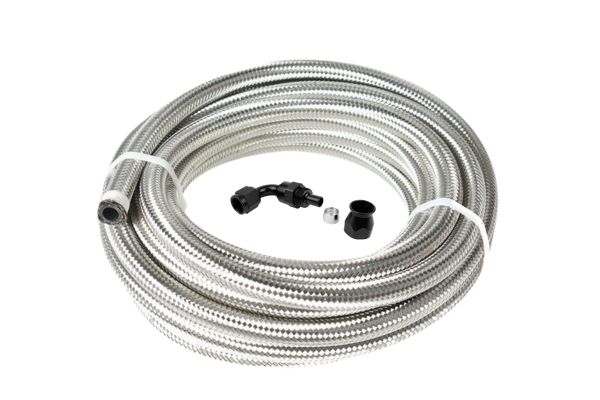
R14 PTFE hose assemblies need specific ferrules because standard ferrules are designed to crush into soft rubber, which would simply slide off or damage a rigid PTFE tube. These specialized ferrules often feature a different internal profile that “interlocks” with the stainless steel braid. Without this mechanical lock, the fitting would eventually blow off under pressure.
What Is the Function of the 00TF0 Series Ferrule?
The 00TF0 series and similar specialized ferrules are designed specifically for the thinner, harder walls of PTFE hose. They provide a concentric squeeze that distributes pressure evenly around the tube.
How Special Fittings Prevent Material Cold Flow
PTFE has a tendency to “cold flow” or deform under constant pressure. Special fittings are designed to compensate for this by maintaining a constant tension on the sealing surface. This ensures that the seal remains tight even as the material naturally tries to move away from the pressure point.
- Specially serrated inserts for better grip.
- Chamfered edges to prevent braid shearing.
- Specific crimp diameters for PTFE.
- Material-matched expansion rates.
Why Standard Rubber Hose Ferrules Often Fail
Standard ferrules have teeth that are too aggressive or a profile that is too deep. On a PTFE hose, these teeth can cut through the thin braid and puncture the inner tube. Furthermore, the crimp diameter for rubber is much different than for PTFE, leading to a connection that is either too loose or dangerously over-crimped.
Understanding fitting mechanics is the difference between a reliable assembly and a dangerous one.
| Temperature Range | Material Condition | Application Suitability |
| -54°C to 0°C | Flexible & Strong | Cryogenic / Arctic |
| 1°C to 150°C | Stable | Standard Industrial |
| 151°C to 260°C | Softens Slightly | High-Pressure Steam |
Which Thread Standards Are Compatible With These Fittings?
Compatibility with thread standards like JIC, NPT, and BSP is essential for integrating R14 hoses into global hydraulic systems. Most R14 fittings are available in these common standards to ensure you can connect to existing pumps, valves, and cylinders. However, the internal design of the fitting must still be specific to PTFE, regardless of what the thread looks like.
Comparing JIC, NPT, and Metric Thread Options
JIC (Joint Industry Council) 37-degree flare fittings are very common in the US and are excellent for high-pressure seals. NPT (National Pipe Thread) relies on thread interference and is common in plumbing but can be prone to leaks if not installed with sealant.
- JIC: Excellent for high-vibration applications.
- NPT: Good for low-pressure chemical transfer.
- BSP: Preferred for international machinery.
- Metric: Standard for most OEM equipment.
How to Ensure a Leak-Proof Connection Every Time
To ensure a leak-proof connection, you must match the thread type exactly and use the correct torque. Using a JIC fitting on a BSP port will result in a failed seal and potentially damaged threads. Always verify the thread pitch and angle using a thread gauge before installation.
What Are the Benefits of Using Stainless Steel Fittings?
Stainless steel fittings are often paired with R14 PTFE hose to provide a completely corrosion-resistant assembly. If you are using a PTFE hose because of chemical aggression, using a carbon steel fitting would create a “weak link” in your system. Stainless steel ensures that the entire assembly can survive the environment.
How Can You Properly Maintain an R14 PTFE Hose?
Maintaining an R14 PTFE hose requires regular visual inspections of the stainless steel braid and the fitting connections. While the PTFE core is incredibly durable, the outer braid can be damaged by physical impact or extreme vibration. Identifying these issues early prevents unplanned downtime and hazardous leaks.
What Are the Signs of Stainless Steel Braid Wear?
You should look for “bird-caging” (where the wires bulge out) or broken wires. If more than a few wires are broken in a small area, the hose’s pressure rating is compromised. Believe it or not, even minor abrasion against a metal bracket can eventually saw through the braid.
Best Practices for Inspecting High-Temperature Seals
In high-temperature applications, check the area where the fitting meets the hose for any signs of discoloration or “weeping.” This can indicate that the thermal cycles have caused the fitting to loosen. Here is the kicker: always perform these inspections when the system is depressurized and cool.
- Check for braid abrasion.
- Inspect fittings for corrosion.
- Look for signs of internal kinking.
- Verify torque on threaded connections.
How to Detect Internal Tube Kinking or Damage
If you notice a sudden drop in flow rate or an increase in pump noise, the PTFE inner tube may have kinked. Because PTFE is a plastic, once it kinks, it usually leaves a permanent deformation that restricts flow. You can sometimes feel these kinks through the braid by running your hand along the length of the hose.
| Inspection Point | What to Look For | Action Required |
| Outer Braid | Broken Wires | Replace Hose |
| Fitting Junction | Fluid Weeping | Retighten or Replace |
| Hose Body | Kinks / Flat Spots | Replace Hose |
| Threads | Stripping / Galling | Replace Fitting |
Conclusion
Through this detailed analysis, we have explored why the unique properties of PTFE—from its chemical inertness to its rigid physical structure—demand a specialized approach to fitting selection and maintenance. By understanding the mechanical interaction between the 304 stainless steel braid and purpose-built ferrules, you can avoid the common pitfalls of standard hydraulic assembly. We solve the problem of premature hose failure by providing high-performance R14 PTFE solutions that stand up to the most aggressive industrial environments. If you need assistance selecting the perfect assembly for your specific application, feel free to contact us today.
FAQ
Can I use standard hydraulic crimp fittings on an R14 PTFE hose?
No. Standard fittings are designed for thicker-walled rubber hoses and will not provide a secure or leak-proof seal on the thinner, more rigid PTFE core, leading to potential blowouts.
What is the best way to cut R14 hose without fraying the braid?
The best way is to wrap the cut area tightly with masking tape and use a high-speed abrasive saw or a specialized hose-cutting blade to ensure a clean, square end.
How do I know if my R14 hose is kinking?
You can usually detect a kink by a sudden decrease in flow efficiency or by manually feeling for a permanent “flat” or “sharp” spot along the hose length that doesn’t follow a smooth curve.
Can I use R14 PTFE hose for fuel lines in automotive applications?
Yes. PTFE is exceptionally resistant to all modern fuels, including ethanol blends and biodiesel, making it an excellent choice for high-performance fuel systems where rubber might degrade.
Does R14 PTFE hose require a special assembly machine?
It depends. While standard crimpers can often be used, you must use the specific crimp dies and diameters recommended by the fitting manufacturer to ensure the ferrule is compressed correctly for PTFE.