Branded fittings are not automatically better, and compatible fittings are not automatically risky. The better choice is the one that can be verified against the hose, thread connection, sealing method, material, finish, pressure range, and crimp data for the actual assembly. For one-piece hydraulic hose fittings, the real buying question is not only “Which part costs less?” It is “Which option reduces mismatch, rework, leakage, downtime, and after-sales disputes while keeping supply stable?”
Choose the Fitting You Can Verify
Brand name is useful, but it is not proof
A branded one-piece fitting gives the buyer a clear reference point because the part number, catalog description, hose series, and crimp data usually belong to one controlled system. That can reduce uncertainty when the same hose, fitting, and crimping equipment are already used in the workshop or maintenance network. The value is consistency, not the logo itself.
A compatible fitting can be the better commercial choice when it is technically confirmed and supplied with stable identification, dimensions, material information, and assembly guidance. It may help reduce purchasing cost, improve availability, and avoid delays when the original branded item is difficult to source. But a compatible part should never be treated as “the same” just because it looks similar or is listed against a brand reference.
Compatible means confirmed fit, not assumed interchange
In hydraulic hose assemblies, compatibility has several layers. The thread may connect, the seat may seal, the stem may fit the hose bore, the ferrule may appear to grip, and the final crimp may still be wrong if the series or crimp data does not match. A correct decision needs technical evidence across all these layers, not only a cross-reference table.
The safest way to compare branded and compatible one-piece fittings is to separate identification from approval. A branded part number can help identify the required style, thread, angle, hose size, and application. Approval should come only after checking the technical details and, where required, the hose, fitting, equipment, and crimping data from the relevant manufacturers.
What One-Piece Fittings Change in the Decision
The ferrule and stem are already paired
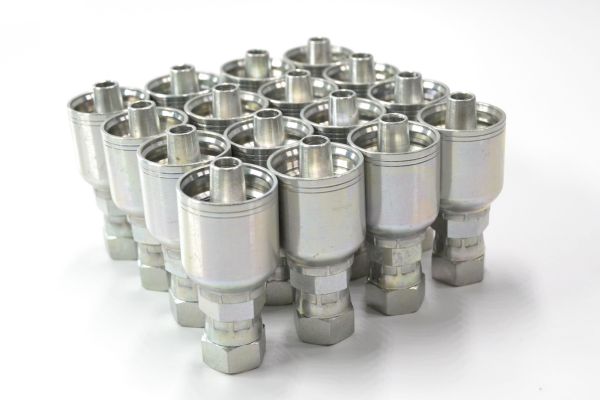
A one-piece hydraulic hose fitting is normally built as a fitting body or stem with the ferrule pre-assembled or fixed as one unit. The exact construction can vary by product series, but the practical idea is that the hose tail and ferrule are selected together instead of being picked as separate parts. This helps reduce errors caused by choosing the wrong ferrule for the stem.
That structure can simplify storage, picking, and assembly, especially for common hose sizes and repeat orders. It does not automatically prove that the fitting is compatible with every hose of the same dash size, every crimper, or every working condition. The fitting series must still match the hose construction, assembly procedure, and valid crimp specification.
The one-piece design reduces some errors, not all risks
One-piece construction is valuable when the main problem is sleeve mismatch, mixed parts, or inconsistent picking. It can help workers avoid combining a stem from one series with a ferrule from another series. For high-turnover items, that can make stock handling cleaner and reduce the chance of assembly rework.
The risk moves to the selection stage. If the buyer chooses the wrong thread, sealing face, hose compatibility, or crimp data, the one-piece structure will not save the assembly. A neatly packaged wrong fitting is still a wrong fitting, and it can create the same leakage, pull-off, contamination, or downtime risk as any other incorrect component.
Where Each Option Makes More Sense
Use branded parts when the system is already controlled
Branded fittings often make sense when a maintenance program already uses that manufacturer’s hose, crimping machine, dies, and published crimp data. In that situation, the brand is part of a controlled assembly method. Changing one component without checking the rest can break the logic of the system.
This is especially important in higher-risk applications where pressure, impulse, vibration, temperature, hazardous fluid, or difficult access makes failure expensive or unsafe. The lowest unit price is not the real comparison in those conditions. The buyer should compare the cost of the fitting against the cost of leakage, repeat labor, shutdown time, field complaints, and possible damage to nearby components.
Branded fittings are also safer as the first reference when the old part is worn, the thread is damaged, the hose marking is missing, or the equipment information is incomplete. A familiar brand number may help trace the original assembly system and reduce guesswork. Even then, the part number should be verified against actual dimensions and sealing details.
Replacement should be conservative when the application is safety critical, when the hose assembly is hard to inspect after installation, or when failure could stop a machine at a costly moment. A compatible product may still be possible later, but the first step should be identification and risk control, not price reduction.
Use compatible parts for repeatable, well-defined demand
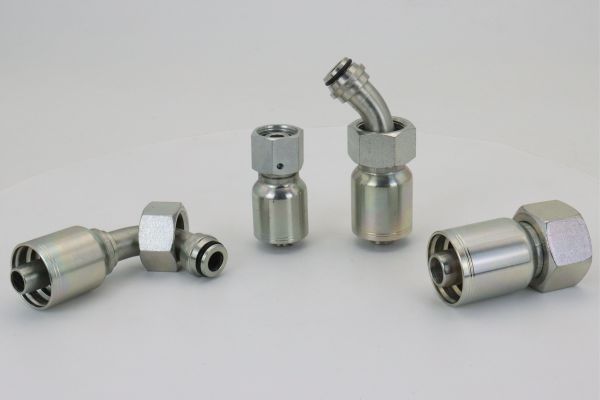
Compatible one-piece fittings become attractive when the buyer repeatedly uses common sizes, common thread standards, and known hose series. In these cases, the technical details can be confirmed once, documented clearly, and then repeated with less uncertainty. That is where compatible fittings can reduce cost without creating unnecessary confusion.
The strongest candidates are usually items with stable demand, clear drawings or catalog references, and low ambiguity in thread and sealing style. A common JIC female swivel for a known hose series, for example, is easier to verify than a damaged metric fitting copied from a blurry photo. The point is not that one connection type is always low risk, but that clear identification makes validation more reliable.
Compatible fittings may also be better when the branded option has long lead times, unstable availability, or limited local stock. A hose assembly that cannot be completed because one fitting is missing may create more cost than the price difference between two components. Availability matters most when downtime, urgent repair, or repeated small orders are part of daily work.
The buyer should still avoid treating compatible supply as a shortcut. A lower price with poor labeling, changing dimensions, unclear material, or missing crimp guidance can increase total cost through sorting errors and after-sales work. A compatible supplier must be able to keep the product stable from sample to batch and from one shipment to the next.
What Must Be Checked Before Replacing a Branded Fitting
Compare the connection, hose side, and assembly data
The first check is the connection end. Thread form, connection standard, male or female style, straight or tapered thread, seat angle, sealing face, O-ring arrangement, and port type must be confirmed separately.
The second check is the hose side.
- Hose ID
- Dash size
- Hose construction
- Fitting series
- Skive or no-skive requirement
- Insertion depth
- Die selection
- Crimp diameter
A compatible fitting with the same dash size can still be wrong if it belongs to a different hose series or assembly system.
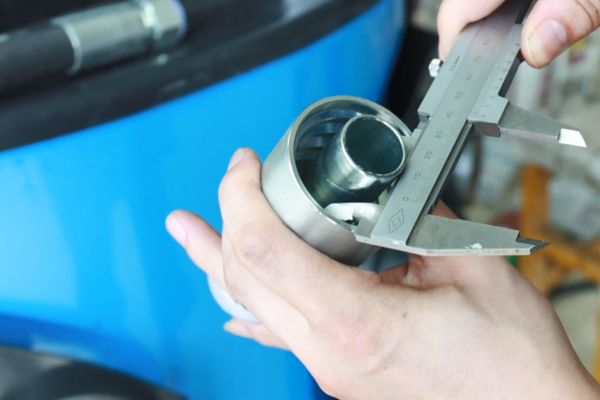
Use a simple verification checklist
Before placing a trial order or approving a replacement, prepare a complete comparison pack. Photos are useful for screening, but they are not enough for final approval. Measurements, markings, and application information reduce the risk of choosing the wrong part.
- Existing branded part number, if available, used only as an identification reference
- Hose ID, dash size, hose type, hose construction, and visible hose markings
- Thread OD or ID, pitch or TPI, male or female style, and straight or tapered thread
- Seat angle, sealing face, O-ring position, and any cone or flat-face details
- Fitting shape, such as straight, 45-degree, or 90-degree, plus drop length if relevant
- Material, surface finish, fluid, temperature, pressure, impulse, and installation conditions
- Required crimp data, including crimp diameter, insertion depth, die set, and skiving instruction
Comparing Branded and Compatible Options Beyond Price
A low unit price can hide higher handling cost
The cheaper fitting is not always the lower-cost fitting. If the replacement creates extra checking, sorting, relabeling, customer clarification, rework, or urgent resupply, the apparent saving disappears quickly. Total cost includes both the purchase price and the operational friction around that item.
This is why branded and compatible fittings should be compared through a decision framework rather than a simple price column. The right framework forces the buyer to look at technical risk, supply reliability, documentation, and repeatability. It also prevents a common mistake: approving a replacement because the first sample looks acceptable, while ignoring whether the next batch can be controlled.
| Decision factor | Branded one-piece fitting | Compatible one-piece fitting |
|---|---|---|
| Identification | Usually clear through original catalog and part number | Must be confirmed with dimensions, connection details, and cross-checks |
| Assembly data | Often linked to the brand’s hose and crimp system | Must be verified against the actual hose and crimping equipment |
| Availability | Stable in some systems, limited or slower in others | Can improve stock availability if supply is consistent |
| Unit cost | Often higher | Often lower, but not always lower in total cost |
| Risk control | Strong when the full branded system is used | Strong only when validation, labeling, and batch control are reliable |
The best choice may vary by SKU
A practical buying policy can use both options. Keep branded parts for high-risk, unclear, or tightly controlled assemblies, and validate compatible fittings for repeatable common items where the technical data is complete. This gives purchasing teams a way to reduce cost and improve availability without turning every replacement into a risk.
The policy should be written at SKU level, not as a general rule that “branded is best” or “compatible is cheaper.” Some fittings deserve strict original control. Others can be validated through samples, trial orders, and documented inspection. The decision should follow the application, not the label.
How to Validate Compatible One-Piece Fittings
Start with a limited trial, not a full replacement
A low-risk validation process should begin with a small group of common, well-defined fittings. The goal is to check whether the compatible option can match the required dimensions, assembly behavior, labeling, packaging, and repeatability before it becomes normal stock. Expanding too fast creates confusion when a problem appears later.
The trial should include both product inspection and assembly confirmation. Check the thread and sealing geometry, verify the hose-side design, confirm the correct crimp procedure, and compare the sample with the documented requirement. Do not approve the part only because it can be screwed onto a port or because it resembles the previous fitting.
Record what changed and what did not
Good validation creates a record that can be reused. If the compatible fitting is approved, record the matching brand reference, the compatible part number, hose series, approved crimp data source, inspection notes, packaging label, and any limits on use. If it is rejected, record the reason so the same mistake is not repeated in the next inquiry.
Useful trial records should answer four practical questions:
- Is the connection end confirmed by measurement and sealing style, not only by photo?
- Is the hose-side design approved for the actual hose construction and crimping method?
- Are material, finish, pressure, temperature, fluid, and environment suitable for the application?
- Can the supplier keep markings, labels, packaging, and batch consistency stable?
When to Stay Branded and How to Finalize the Decision
Avoid replacement when safety or data is uncertain
Do not replace a branded one-piece fitting with a compatible option when the original specification is unclear and the application risk is high. This includes assemblies where failure could cause injury, severe leakage, environmental contamination, equipment damage, or major production interruption. In those cases, missing data is a reason to stop and verify, not a reason to guess.
Substitution is also poor practice when the only information is a photo, an outside diameter, or an old part with worn sealing surfaces. Any decision involving skiving, insertion depth, crimp diameter, die selection, pressure suitability, or assembly procedure should refer to the applicable hose, fitting, crimping equipment, or component manufacturer data. Thread sealant should not be used to compensate for an incorrect thread or damaged sealing surface.
Before inspection or replacement, the equipment should be shut down, hydraulic pressure and stored energy should be released, and the relevant safety procedures should be followed. Do not loosen fittings under pressure, check pinhole leaks by hand, or restart equipment with unverified parts. A rushed repair can turn a purchasing mistake into a safety problem.
Decide by risk, repeatability, and evidence
Branded one-piece fittings are better when they are part of a controlled hose and crimp system, when the application is high risk, or when the original specification is not clear enough to validate a replacement. Compatible one-piece fittings are better when the item is repeatable, the technical details are fully confirmed, supply is stable, and the total cost is lower after considering inspection, inventory, and after-sales risk.
The next step is to prepare a complete technical inquiry package instead of asking only for a cross-reference or a lower price. Include the brand reference, photos, thread measurements, sealing details, hose markings, hose size, fitting shape, material and finish needs, working conditions, and required crimp data source. The better choice is the fitting that can be checked, assembled, stocked, and repeated with confidence.
FAQ
Can a compatible one-piece fitting be used if it has the same thread size?
No, the same thread size is not enough because the seat angle, sealing method, port style, hose compatibility, and crimp data may still be different. Thread size is only one part of the identification process.
Is a one-piece fitting always safer than a two-piece fitting?
No, a one-piece fitting reduces some ferrule selection and picking errors, but safety still depends on correct hose selection, fitting series, crimp procedure, pressure suitability, and installation conditions.
Can a brand part number be used to order a compatible fitting?
It can be used as a reference for identification, but it should not be treated as proof of full interchangeability. The replacement must be checked against dimensions, sealing design, hose side, material, finish, and crimp information.
What should be inspected when samples arrive?
Inspect thread form, sealing face, stem and ferrule condition, markings, plating quality, packaging labels, and the fit with the approved hose and assembly data. Any deviation should be recorded before the part is used in regular stock.
When is it better to keep using the branded fitting?
Keep the branded fitting when the application is safety critical, the crimp system is controlled by one manufacturer, the old part cannot be clearly identified, or the compatible option lacks reliable technical documentation.