A reliable one-piece fitting cross-reference must compare more than a brand name or part number. Confirm the hose series, fitting configuration, thread, seat, sealing method, critical dimensions, material, finish, application conditions, and valid crimp data.
What Does a One-Piece Fitting Cross-Reference Mean?
A cross-reference identifies a possible alternative
A one-piece fitting cross-reference connects an existing part number with another fitting that may serve the same defined requirement. It is a starting point for technical comparison, not automatic proof that the two products are identical or interchangeable.
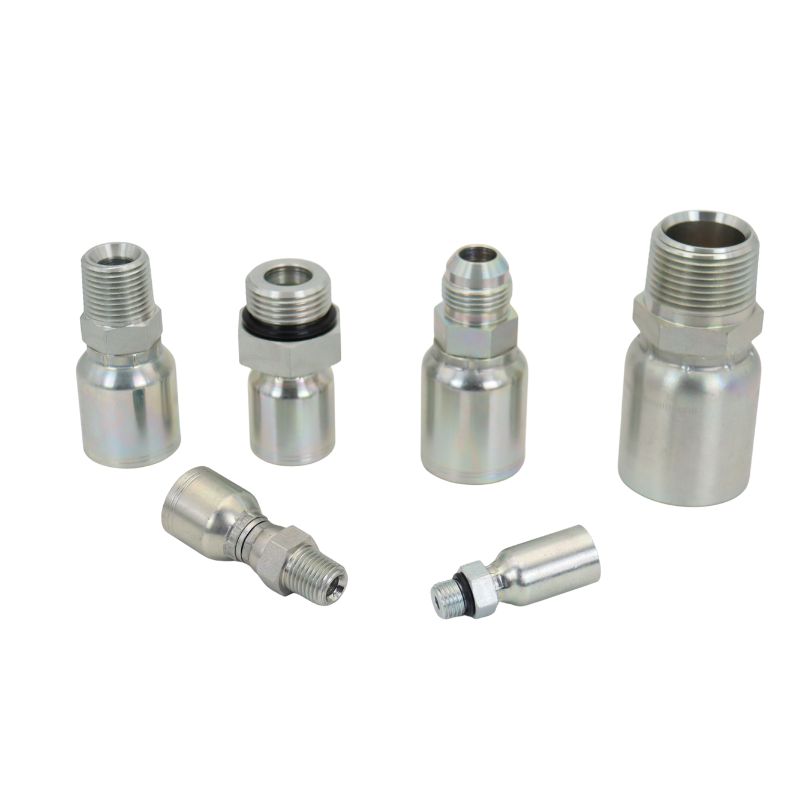
One-piece fittings normally have the fitting stem and ferrule preassembled or fixed together as one component, although the exact structure varies by product series. This design may reduce mistakes caused by selecting a separate ferrule. It does not make all one-piece fittings of the same dash size compatible.
A useful cross-reference should answer three questions:
- Does the alternative connect to the same port or mating component?
- Does it match the required hose construction and size?
- Can it be assembled using valid data for the proposed fitting system?
“Looks the same” is not an acceptance criterion
Two fittings can share the same general shape, thread diameter, and hose size while differing in thread pitch, seat angle, sealing method, hose-tail geometry, or ferrule design. These differences may not be visible in a catalog image.
A fitting may even screw into the mating component without creating the correct seal. Partial thread engagement therefore does not prove compatibility.
The risk is greater when buyers rely on an old fitting that is worn, damaged, or missing its seal. Corrosion, deformation, previous over-tightening, and contamination can hide the original dimensions and sealing features.
The correct objective is not to find a part that resembles the original. It is to find a fitting that matches every characteristic required for connection, assembly, installation, and operation.
Decode the Existing Part Number Carefully
Use the code as a reference, not a specification
Part numbers often contain information about the product series, hose size, connection type, thread size, fitting angle, material, or special options. The coding rules are not universal, however, and similar-looking numbers from different manufacturers may mean different things.
Use an official catalog or technical reference to decode the existing number. Avoid interpreting it through a pattern learned from another brand.
Record both the full original number and the proposed alternative number. Do not shorten them by removing suffixes until you know what each suffix represents. A final character may identify a material, coating, drop length, O-ring, or special configuration.
If the existing part number cannot be confirmed, mark it as an unverified reference and continue through physical identification. Do not let an uncertain number control the entire cross-reference.
Collect supporting evidence
Part numbers become more useful when combined with drawings, purchase records, hose details, and clear photographs. Ask for the complete fitting rather than one close-up image.
Useful photographs include:
- The complete fitting from the side.
- The thread and connection end.
- The seat or sealing face.
- The fitting stem and ferrule.
- Existing markings and package labels.
- Angled fittings photographed beside a scale.
- The hose layline when the fitting is attached to an assembly.
Photographs support initial screening but cannot reliably confirm thread pitch, seat angle, or internal dimensions. Measurements and technical documents are still required before selecting the final part.
Identify the Thread and Connection Standard
Measure diameter and pitch
Confirm whether the connection is male or female, then measure the relevant outside or inside thread diameter. Use a thread-pitch gauge to determine the pitch or threads per inch, and identify whether the thread is straight or tapered.
Take measurements from an undamaged section. Worn thread crests, coating thickness, and measurement technique can affect the result, so compare several dimensions with a reliable thread-identification reference.
A basic connection record should include:
| Connection detail | Information to record |
|---|---|
| Gender | Male or female |
| Thread diameter | Measured outside or inside diameter |
| Thread pitch | Metric pitch or threads per inch |
| Thread form | Straight or tapered |
| Standard | JIC, NPT/NPTF, BSPP/BSPT, ORFS, ORB, metric, DIN, JIS, or another confirmed system |
| Seat | Angle and geometry |
| Seal | Flare, cone, O-ring, bonded seal, tapered thread, or another method |
Keep similar connection families separate
JIC and SAE 45-degree flare connections use different seat angles. BSPP and BSPT have different thread and sealing behavior. Metric connections may use different cones, O-rings, sealing washers, or tube-fitting arrangements.
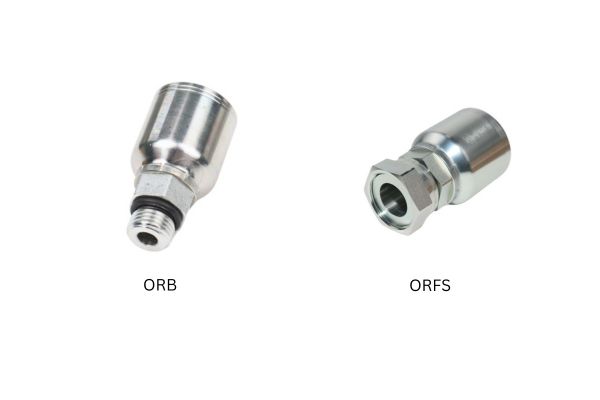
NPT and NPTF may share nominal dimensions but have different design and sealing considerations. An ORFS connection uses a face O-ring and must not be identified only by its straight thread. ORB fittings seal through an O-ring at the port, not through the straight thread itself.
Do not force an unknown fitting into a port to test compatibility. A partially matching thread may damage the port without proving that the connection seals correctly. Thread sealant must not be used to repair a mismatched thread or damaged sealing surface.
Confirm the Seat and Sealing Method
Determine where the hydraulic seal forms
The thread may hold the parts together while a separate surface creates the hydraulic seal. A correct cross-reference must therefore identify both the thread and the sealing feature.
Inspect whether the original fitting uses:
- A male or female flare seat.
- A cone connection.
- A face-mounted O-ring.
- An O-ring on a straight-thread stud.
- A bonded seal or sealing washer.
- A tapered pipe thread.
- Another defined sealing design.
Measure the seat angle with a suitable method or compare it with confirmed technical documentation. A photograph taken at an angle can make different seats look similar and should not be used as the final evidence.
When replacing an O-ring fitting, confirm the O-ring location, dimensions, and material. O-ring color is not a reliable way to identify the compound. Compatibility depends on the fluid, temperature, and application conditions.
Check the mating component
A fitting cannot be evaluated without considering the port, adapter, tube, or other component to which it connects. If possible, identify both sides of the connection.
A damaged mating seat may continue to leak after the correct replacement fitting is installed. Repeatedly tightening the new fitting can then damage the replacement as well.
If the existing component shows thread damage, corrosion, scratches, or deformation, record that condition separately. Cross-referencing the fitting will not correct a damaged port or incompatible mating surface.
Compare Dimensions That Affect Installation
Verify more than thread size
Even when the hose end and connection are correct, the alternative fitting may not fit the equipment. Overall length, hex size, elbow drop, bend radius, and connection orientation can affect installation.
For straight fittings, compare the dimensions that control clearance and wrench access. For 45-degree and 90-degree fittings, measure the centerline, drop length, and orientation.
Useful dimensional checks may include:
- Overall length.
- Connection-end length.
- Hex width.
- Fitting-stem length.
- Ferrule length and position.
- Elbow angle.
- Centerline-to-end dimensions.
- Drop length.
- Tube or standpipe length.
- Relative orientation of multiple features.
Compare the hose tail and ferrule
The hose side is not interchangeable simply because both fittings accept the same nominal hose ID. Compare the fitting series, stem profile, insertion requirements, and ferrule construction.
Do not remove the ferrule from a one-piece fitting to make it resemble a separate two-piece component. This can damage the fitting and eliminates the controlled relationship between its parts.
If the alternative uses a different stem or ferrule design, obtain the assembly data intended for that fitting. The original fitting’s crimp diameter must not be copied automatically.
Confirm Material, Finish, and Operating Conditions
Match the fitting to the actual environment
A dimensionally correct fitting can still be unsuitable if its material, coating, or seal is incompatible with the application. Confirm the base material and surface finish for both the original requirement and proposed alternative.
- Hydraulic fluid or other medium.
- Normal working pressure.
- Pressure impulses and equipment duty.
- Minimum and maximum temperatures.
- Corrosion and chemical exposure.
- Outdoor, marine, washdown, or indoor conditions.
- Vibration, impact, and mechanical loading.
- Customer or regulatory requirements.
No single material is best for every application. Carbon steel with a suitable surface treatment may meet many requirements, while stainless steel or another material may be needed under specific conditions. The decision must remain connected to fluid compatibility, temperature, pressure, and environment.
A coating test result should not be converted directly into a guaranteed service life. Actual corrosion depends on installation damage, humidity, chemicals, temperature, maintenance, and other field conditions.
Check the complete assembly rating
Do not compare only a pressure number in two catalogs. The allowable operating conditions of a hose assembly depend on the lowest-rated relevant component and the approved combination of hose, fitting, connection, and assembly method.
Temperature, impulse, routing, bend radius, fluid, and external loads can further affect suitability. A replacement fitting must meet the requirements of the complete assembly, not simply match the original fitting’s appearance.
Safety-critical, regulated, or severe-duty systems require a more detailed technical review. Do not approve a substitution in these applications solely to reduce purchase cost or avoid a delivery delay.
Validate Crimp Data and Sample Assembly
Use data for the proposed fitting system
A cross-reference is incomplete until valid crimping information is available for the proposed fitting and hose combination. The required data may cover hose preparation, skiving, insertion depth, die selection, target crimp diameter, and final inspection.
There is no universal crimp setting for all fittings of the same dash size. Differences in hose construction, stem geometry, ferrule thickness, and fitting design can require different settings.
Before assembling the alternative, confirm:
- The exact hose manufacturer, series, and size.
- The proposed fitting manufacturer, series, and part number.
- The approved source and revision of the crimp data.
- The required preparation and insertion method.
- The crimping machine and suitable tooling.
- The dimensions to inspect after crimping.
- Any application-specific validation requirements.
Record sample results
Keep alternative fittings separate from approved inventory while they are being evaluated. Record the original and proposed part numbers, hose details, drawings, measurements, assembly settings, and final result.
If the fitting fails to insert or crimp correctly, stop and investigate. Possible causes include an incorrect hose, fitting series, ferrule, die, insertion depth, preparation method, or crimp specification.
Inspection and testing must follow appropriate safety procedures. Shut down equipment and release hydraulic pressure and stored energy before working on a hydraulic system. Never use a bare hand to search for a pinhole leak or disassemble a pressurized connection.
A successful sample applies only to the tested combination. It does not automatically approve every size or configuration in the alternative product series.
Build a Cross-Reference Record That Can Be Reused
Create one controlled comparison sheet
Record the evidence behind each approved alternative so the next order does not depend on personal memory. The cross-reference sheet should connect purchasing, receiving, warehouse, and assembly information.
- Internal part number.
- Original manufacturer and part number.
- Proposed supplier and part number.
- Hose manufacturer, series, and size.
- Connection standard and thread measurements.
- Seat angle and sealing method.
- Fitting style and critical dimensions.
- Material, finish, and O-ring requirement.
- Applicable crimp-data source and revision.
- Sample or trial-order result.
- Approved application and limitations.
- Approval date and responsible reviewer.
Use clear approval statuses
A candidate cross-reference should not enter normal stock until it has a defined status. Use categories such as:
- Candidate—technical comparison incomplete.
- Sample requested.
- Sample under inspection.
- Trial assembly required.
- Conditionally approved.
- Approved for a defined hose and application.
- Rejected because of a confirmed mismatch.
- Suspended pending updated information.
Frequently Asked Questions
Can I cross-reference a fitting using only its part number?
A confirmed part number can identify a candidate, but it should be supported by hose, thread, seat, seal, material, and dimensional information. This protects the order from coding differences, discontinued references, and unverified substitutions.
Are two fittings interchangeable if they have the same thread?
No. Their seat angles, sealing methods, hose tails, ferrules, materials, orientations, or application limits may differ. Confirm the complete connection and hose assembly.
Can photographs confirm a one-piece fitting cross-reference?
Photographs help identify possible product families but cannot reliably confirm thread pitch, seat angle, internal dimensions, or hose compatibility. Use them together with measurements and technical documents.
Can the original crimp setting be used for an alternative fitting?
Not unless the setting is approved for the proposed fitting and hose combination. A different stem or ferrule design may require different tooling, preparation, and crimp dimensions.
When should a cross-referenced fitting be trial-ordered?
Use a trial order when the technical comparison identifies a suitable candidate but the new product or supplier has not been approved. Define the dimensional, assembly, labeling, and acceptance checks before ordering.