
Clear hydraulic fitting labels improve repeat orders because they preserve the exact identity of a part after the original quotation, sample, or repair is forgotten. A label that connects the physical fitting to its complete part number, connection, hose size, fitting series, and approved record lets purchasing reorder the same verified SKU instead of rebuilding the identification process. Vague labels such as “1/2 BSP” or “Metric elbow” hide differences that affect fit, sealing, crimping, and inventory. The result is not merely slower administration: it can be a wrong part, a mixed bin, a rejected hose assembly, or another equipment delay.
Why Is the Label Part of the Technical Record?
It connects the physical item to approved data
A fitting on a shelf cannot carry its complete drawing, hose-compatibility table, crimp instructions, inspection history, and purchasing record on its metal surface. The label provides the link by showing a unique internal part number and enough readable attributes to verify that the correct record has been opened. If that link breaks, staff may identify the fitting again from appearance, a partial thread description, or the nearest old order, which can reproduce an earlier mistake.
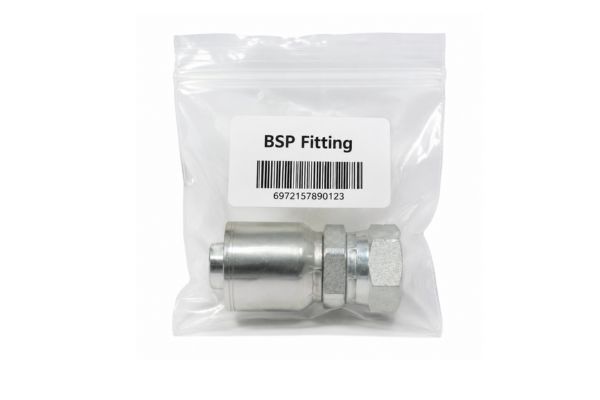
One-piece construction does not remove identification needs
A one-piece hydraulic hose fitting normally combines or fixes the fitting body or stem and ferrule as one component, although its construction varies by series. This can reduce the separate task of matching a loose ferrule to a stem, but many one-piece fittings still look similar across thread standards, hose sizes, angles, materials, and fitting families. Clear hydraulic fitting labels therefore reduce one source of ambiguity without claiming that the one-piece format makes every hose or crimp process compatible.
What Information Should a Fitting Label Preserve?
Use a unique code and a controlled description
The main identifier should be unique to one approved SKU, not shared by several “similar” parts. Pair that code with a concise description that distinguishes the features needed at receiving, picking, assembly, and reorder. The label should match the purchase order, packing list, bin record, drawing, and digital item master; multiple names for the same SKU or one name for several SKUs both create avoidable repeat-order risk. When more than one approved source exists, keep the internal item identity stable while linking each source code and its approval scope in the item record instead of printing a new local SKU for every quotation.
Include the fields that matter to your operation:
- internal part number and source part number where applicable;
- connection family, male or female form, thread size, and pitch or TPI;
- straight or tapered thread, seat angle, sealing method, and required seal;
- hose ID or dash size, complete fitting series, and fitting orientation;
- material, finish, unit of measure, pack quantity, and controlled revision;
- lot, batch, inspection status, or traceability reference where required.
Do not compress away the decisive difference
A short label is useful only when it remains unambiguous. “BSP 1/2” does not say whether the connection is BSPP or BSPT, male or female, or whether it seals with a cone, washer, O-ring, or thread interference. “Metric -8 elbow” can also hide metric pitch, cone system, light or heavy series, elbow drop, hose size, and fitting family. Use an internal code to keep the printed label compact, but make the human-readable description specific enough to catch a wrong bin or wrong pick.
How Do Unclear Labels Break Repeat Orders?
They turn a verified purchase back into a new identification job
The first order may have required photos, measurements, drawings, samples, technical questions, and assembly checks. If the received box is relabeled with a shorthand name, the next buyer loses the chain that connected those checks to the approved product. The team must either repeat the work or trust an incomplete description, and time pressure often pushes the decision toward the second option. A clear label preserves the inquiry revision and approved code so the repeat order can begin with a controlled record while still requiring review when the drawing, source, hose system, or application has changed.
They allow similar parts to exchange identities
Two fittings can share a nominal size and general shape while using different thread forms, seat angles, sealing faces, hose tails, or ferrule designs. When labels detach, fade, or use the same description, returns and unused pieces may be placed in the wrong bin and later ordered under the wrong code. A measured thread-mismatch prevention process can resolve uncertainty, but clear labeling prevents routine stock from becoming uncertain in the first place.
Why Do Labels Improve Picking and Receiving Accuracy?
Receiving can compare shipment, order, and specification
A useful receiving label lets staff compare the physical package with the purchase-order line before parts enter approved stock. Part number, description, quantity, unit of measure, revision, lot or batch reference, and inspection status should agree with the receiving record. If a line is new, changed, or under evaluation, the label should make quarantine or restricted status visible so an urgent hose job cannot consume an unapproved part. Receiving should also verify that inner bags and split quantities retain identity after the outer carton is opened, since a correct pallet label cannot prevent mixing once unlabeled smaller packs move to separate bins.
Use a simple status flow:
| Status | Label and location action | Reorder consequence |
|---|---|---|
| Quarantine | Keep source identity and lot intact; separate physically | Do not count as usable stock or reorder as approved |
| Inspection | Link to inspection plan, drawing, and sample record | Hold until required checks pass |
| Approved | Assign controlled internal code and bin | Eligible for normal picking and replenishment |
| Restricted | Show the approved hose, application, or other limitation | Reorder only for the defined use |
| Rejected | Identify affected quantity and disposition | Block picking and automatic replenishment |
Picking becomes a verification step, not a memory test
At the bin, the label should let the picker compare the work order with the part code, connection, hose size, fitting series, material, and orientation. Separate visually similar standards and give them distinct location codes or label layouts where confusion is likely. The fast-moving one-piece fitting stock method recommends consistent part numbers, descriptions, barcodes, units, and bin logic because a fitting that cannot be found or identified is functionally unavailable.
How Do Labels Connect to Inventory and Reordering?
The same identifier must follow every transaction
Use one controlled SKU code from quotation and sample approval through purchasing, receiving, bin placement, issue, return, stock count, and repeat order. The transaction history can then show true demand, stockouts, returns, and slow stock for that exact fitting. If one item has several local codes, demand appears fragmented; if several items share one code, the inventory balance may look sufficient even though the needed connection is absent.
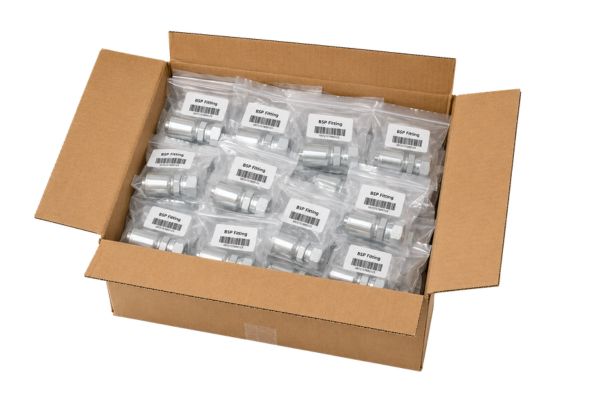
The digital item record should connect the label to:
- approved description, drawing, and revision;
- source code and approved-source status;
- hose series, fitting series, and crimp-data location;
- bin, unit of measure, pack quantity, minimum, and reorder point;
- inspection status, lot history, deviations, and restrictions.
Barcodes accelerate capture but do not repair bad master data
A barcode or QR code reduces manual typing and can open the correct item record, but the encoded identifier must still point to accurate, governed data. The GS1 Global Traceability Standard distinguishes product-level, batch or lot-level, and serialized identification, allowing an organization to choose the level appropriate to its traceability objective. A small operation does not need a complex global system merely to label bins, yet human-readable text should remain beside machine-readable data so staff can verify the part when a scanner or database is unavailable.
Why Do Labels Matter for Hose Compatibility and Crimping?
The label should point to the assembly system
The connection end does not define the hose side. A JIC or ORFS fitting of one dash size may exist in several fitting series for different hose constructions and crimp procedures. The label should therefore show or link to the full fitting series and supported hose identity, while the controlled record holds the applicable crimp diameter, measurement point, insertion depth, die selection, preparation method, and inspection instructions.
A clear label cannot replace technical approval
Printing “compatible” on a package does not prove that the stem, ferrule, hose, and crimp equipment form a validated assembly. Before a new or alternative item receives an approved inventory label, complete the relevant hose, connection, material, application, and crimp checks. The trial-order inspection process keeps samples separate until their identity and assembly requirements are verified, preventing a well-printed but technically unresolved part from becoming routine stock.
How Should a Labeling System Be Implemented?
Start with the highest-confusion and highest-repeat SKUs
Do not begin by designing a complicated label for every old item. First map fast-moving fittings, visually similar thread families, frequent returns, repeated emergency orders, and bins that require staff to open bags for identification. Clean the item master, merge true duplicates, split falsely combined SKUs, and confirm technical descriptions before printing replacement labels. Test the format on a small group through receiving, picking, return, stock count, and reorder, then correct field order, abbreviations, scan behavior, label durability, and assigned ownership before expanding it across the full assortment and every affected storage location.
A practical label review asks:
- Does one code identify exactly one approved fitting configuration?
- Can receiving match the package to the purchase order and inspection status?
- Can a picker distinguish the part without relying only on appearance?
- Does scanning or reading the code open the correct technical and reorder record?
- Will the label remain readable under the storage environment and normal handling?
Control changes, returns, and damaged labels
Define who can create or revise part records, what evidence is required, and when a change needs reapproval. Returned parts should retain their original identity and be inspected before they reenter approved stock; unidentified pieces belong in quarantine, not the nearest similar bin. Replace damaged labels from the controlled item record, record affected lots when required, and audit shelves against digital balances so a correct database does not hide mixed physical stock.
Final Labeling Decision
Clear hydraulic fitting labels improve repeat orders by keeping the physical part connected to the exact SKU that passed technical and commercial checks. The label should show a unique code and enough readable detail to distinguish connection, seal, hose size, fitting series, orientation, material, and status, while the linked record stores drawings, hose compatibility, crimp data, source, lot, and replenishment controls. Apply the same identifier across quotation, receiving, storage, picking, returns, stock counts, and reorders. Before changing a label, resolve duplicate codes, vague descriptions, and missing technical fields; a faster scan is valuable only when it retrieves the correct fitting record.
Frequently Asked Questions
Is a supplier part number enough for repeat ordering?
It is a useful source reference, but an internal controlled code can preserve approved sources, revisions, hose compatibility, bin location, and restrictions without assuming that all similarly numbered parts are interchangeable.
Should the label include the thread standard or only a barcode?
Include enough human-readable thread and sealing information to catch a wrong pick, while the barcode links to the complete record and reduces manual entry.
Do hydraulic fittings need lot or batch numbers?
Use lot or batch identification when required by the quality plan, application risk, contract, regulation, inspection process, or deviation-control needs; not every operation requires serialized pieces.
What should happen to a fitting with a missing label?
Move it to a controlled hold area and reidentify it from measurements and approved evidence; do not place it in a bin based only on visual similarity.
Can the same bin label cover straight and elbow fittings of one size?
No. Straight, 45-degree, and 90-degree forms are different configurations and may also differ in drop, orientation, and part number, so each approved SKU needs distinct identification.