Before ordering one-piece hose fittings, confirm the hose series, fitting size, connection standard, thread dimensions, sealing method, fitting orientation, material, surface finish, application conditions, and applicable crimp data. A fitting that looks correct or shares the same dash size may still be incompatible. Checking these details before requesting a quotation helps prevent incorrect orders, assembly rework, leakage, and delays.
Confirm What “One-Piece” Means for the Required Fitting
Understand the fitting structure
A one-piece hose fitting normally has a fitting stem and ferrule preassembled or fixed together as one assembly. The exact method used to retain the ferrule may vary between product series. This design distinguishes it from a two-piece fitting system in which the stem and ferrule are selected and handled separately.
The one-piece structure can simplify picking and reduce the possibility of combining a stem with the wrong separate ferrule. However, it does not mean that the fitting is compatible with every hydraulic hose of the same nominal size. The hose construction, fitting series, hose-tail design, and crimp specification must still match.
Define the exact fitting configuration
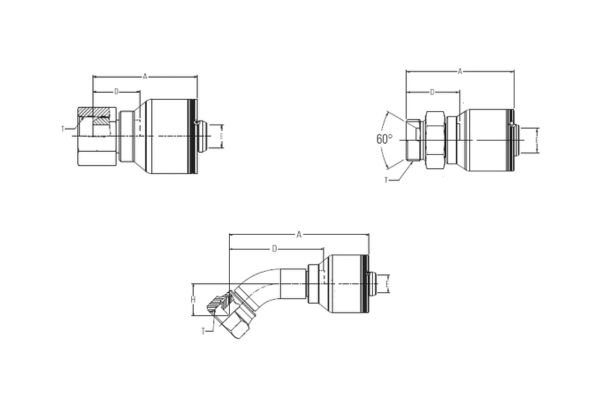
“Hydraulic hose fitting” is too general for an accurate quotation. A complete description should identify both the hose end and the connection end. It should also specify whether the fitting is straight, 45-degree, 90-degree, or another configuration.
For an angled fitting, confirm the orientation and the dimensions that affect installation. Two 90-degree fittings can share the same connection and hose size but have different drop lengths or overall dimensions. These differences may determine whether the finished hose assembly fits inside a restricted installation space.
An initial order description should therefore include:
- One-piece fitting series or an approved reference.
- Hose size and compatible hose construction.
- Straight, 45-degree, 90-degree, or other fitting style.
- Male or female connection.
- Connection standard, thread, seat, and sealing method.
- Material and surface-finish requirements.
- Existing part number or drawing, if available.
This information gives the supplier something measurable to confirm. It also creates a clear reference for checking the quotation and inspecting the delivered parts.
Confirm the Hose and Fitting Series Are Compatible
Identify the complete hose specification
Begin with the hose manufacturer, product series, construction, and size. Hose ID or dash size alone is not enough because hoses with the same nominal ID can have different reinforcement layers, cover thicknesses, tube materials, outside diameters, and fitting requirements.
Do not select a fitting only because its tail can be inserted into the hose. Physical insertion does not demonstrate that the stem profile and ferrule are suitable for the hose construction. An incorrect combination may damage the hose during crimping or fail to provide the required retention and sealing performance.
If you are replacing an existing assembly, record all available hose markings before removing or discarding the old hose. Useful markings may include the manufacturer, series, standard, size, pressure designation, and production identification. If the marking is worn or incomplete, consult the applicable equipment or component documentation instead of estimating the hose series from appearance.
Check the fitting series, not only the dash size
The fitting series connects the hose specification with the required stem, ferrule, and crimping procedure. Two fittings described as “-8” may have different tail geometries or ferrule designs even though both are intended for a nominal half-inch hose.
Confirm the following relationship before ordering:
Hose manufacturer and series → hose size → compatible fitting series → approved assembly data
If one part of this chain is missing, the order is not technically complete. Ask for clarification or applicable documentation before approving the item.
Compatibility claims should have a traceable source. Depending on the product and application, that source may be the hose manufacturer’s crimp chart, the fitting manufacturer’s assembly data, an approved internal specification, or equipment documentation. A catalog cross-reference can help narrow the search, but it should not replace confirmation of the actual hose-and-fitting combination.
Confirm the Thread and Connection Standard
Measure the thread instead of judging by appearance
Similar-looking threads are a common source of incorrect fitting orders. Confirm whether the connection is male or female, then measure the relevant outside or inside diameter and determine the thread pitch or threads per inch. Also identify whether the thread is straight or tapered.
Use suitable measuring tools, such as a caliper and thread-pitch gauge. Take measurements from an undamaged area and compare the result with reliable technical data. A photograph can help identify possible connection families, but it cannot show thread pitch or small dimensional differences accurately enough to confirm the final part number.
The basic thread-identification record should contain:
- Male or female connection.
- Measured thread outside or inside diameter.
- Thread pitch or TPI.
- Straight or tapered thread.
- Suspected connection standard.
- Applicable dimensional reference.
- Condition of the existing thread.
Do not force a thread to test whether it fits. Partial engagement does not prove compatibility and may damage both components. Thread sealant is also not a valid solution for an incorrect thread form or a damaged sealing surface.
Distinguish common connection families
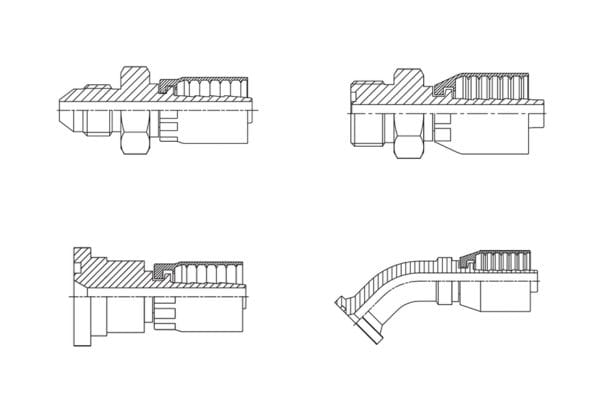
Names such as JIC, NPT, NPTF, BSPP, BSPT, ORFS, ORB, metric, DIN, and JIS describe different connection systems or related product families. These names must not be used interchangeably.
For example, JIC and SAE 45-degree flare connections use different seat angles. BSPP and BSPT differ in thread form and sealing behavior. Metric fittings may use several different sealing arrangements even when the measured thread diameter appears similar. Some fittings seal on a cone, some on an O-ring, some on a bonded seal, and others through controlled thread interference.
An existing branded part number can support identification, but it is not complete evidence of interchangeability. Cross-reference information may contain series limitations, material differences, or application conditions. Use the part number together with measured dimensions and sealing details.
Confirm the Seat and Sealing Method
Find where the connection actually seals
Threads do not always create the hydraulic seal. In many connections, the threads provide mechanical engagement while a separate seat, cone, O-ring, or sealing washer contains the fluid. Ordering the correct thread with the wrong sealing face can therefore produce a connection that assembles but leaks.
Inspect the connection and determine whether sealing occurs through:
- A metal flare or cone seat.
- An O-ring on the face.
- An O-ring on the male stud.
- A bonded seal or sealing washer.
- A tapered pipe thread.
- Another specified sealing feature.
Record the seat angle when it is relevant. Do not estimate it from a front-facing photograph, especially when two connection families have similar external shapes. Use an appropriate gauge, a known technical reference, or the original product documentation.
Check seals and sealing surfaces
If the fitting uses an O-ring, confirm its location, dimensions, material, and compatibility with the hydraulic fluid and operating temperature. O-rings that look similar may use different compounds and may respond differently to heat, chemicals, or long-term compression.
Inspect an existing fitting carefully before using it as a reference. Scratches, corrosion, deformation, previous over-tightening, or a missing seal can hide the original sealing method. A damaged old fitting should not become the only standard for a new order.
The consequences of an incorrect sealing choice extend beyond visible leakage. A poor connection may require repeated tightening, damage the mating port, introduce contamination during rework, or cause unplanned equipment downtime. In high-risk applications, the result can also create a serious safety hazard.
Confirm Material, Finish, and Application Conditions
Match the fitting to the operating environment
Material and surface finish should be selected according to the fluid, temperature, pressure, corrosion exposure, mechanical load, and applicable regulatory requirements. No material is automatically the best choice for every hydraulic system.
Carbon steel fittings with an appropriate surface treatment are common in many applications, but the required corrosion protection depends on the actual environment. Stainless steel may be considered for particular fluids or corrosive conditions, but its suitability must still be checked against pressure, temperature, sealing, assembly, and system requirements.
Provide the supplier with the relevant application information:
- Hydraulic fluid or other medium.
- Normal working pressure and expected pressure impulses.
- Minimum and maximum operating temperatures.
- Indoor, outdoor, marine, washdown, or chemically exposed environment.
- Vibration, impact, movement, and mechanical-load conditions.
- Equipment type and installation location.
- Applicable standards or customer specifications.
Check the complete assembly pressure limit
A fitting should not be selected by an isolated pressure number. The allowable conditions of a hose assembly depend on the lowest-rated relevant component and the approved combination of hose, fitting, connection, and assembly procedure.
Pressure suitability can also change with temperature, fluid, impulse frequency, routing, bend radius, and external loading. A fitting connection may have different limitations from the hose itself. Confirm the complete assembly requirements rather than assuming that a high fitting rating increases the rating of the finished hose assembly.
Applications involving personnel safety, lifting systems, braking, severe impulses, high temperatures, or regulated equipment require additional technical review. A price comparison or approximate cross-reference is not sufficient for these systems.
Confirm the Crimping Requirements Before Purchase
Obtain data for the exact hose-and-fitting combination
Before ordering fittings for hose assembly, confirm that valid crimp data is available for the exact hose series, size, and fitting series. This information may include the target crimp diameter, die selection, insertion depth, skiving requirement, and inspection procedure.
There is no single crimp diameter that applies to all one-piece fittings of the same dash size. The correct result depends on the hose construction and fitting design. Copying a crimp setting from a visually similar fitting can cause under-crimping, over-crimping, hose damage, restricted flow, leakage, or fitting pull-off.
The assembly team should be able to answer these questions before the parts arrive:
- Which hose series is approved for the fitting?
- Is the assembly skive, no-skive, or otherwise prepared?
- What insertion or positioning requirement applies?
- Which crimping machine and dies will be used?
- What is the source and revision of the crimp data?
- How will the crimped assembly be measured and inspected?
- What additional validation is required for the intended application?
If the supplier proposes a different fitting series from the one originally requested, do not assume the existing crimp settings remain valid. Treat it as a new combination and obtain the applicable data.
Make safe assembly and inspection mandatory
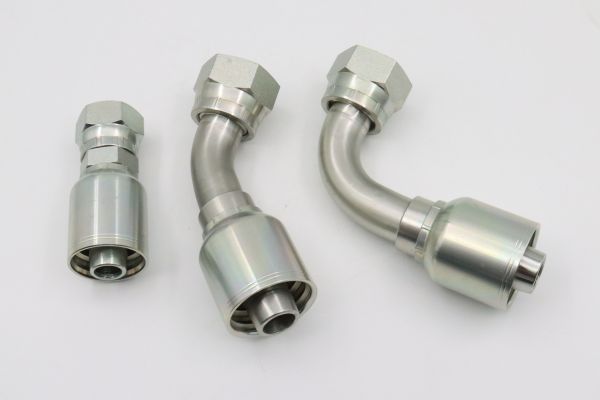
A one-piece design can simplify component handling, but it cannot compensate for an incorrect assembly procedure. The hose must be prepared, inserted, crimped, and inspected according to the applicable manufacturer’s instructions.
Before inspecting, repairing, or replacing a hydraulic hose assembly, shut down the equipment and release hydraulic pressure and stored energy. Follow the safety procedures supplied by the equipment, hose, fitting, and crimping-equipment manufacturers. Never search for a pinhole leak with a bare hand or disassemble a pressurized connection.
Do not approve a fitting because the crimped assembly looks acceptable. Record the specified and measured values, part identification, hose series, tooling, and inspection result. This record helps separate product issues from setup or assembly errors.
Prepare an Order Sheet That Can Be Verified
Use one controlled line for each part number
A clear order sheet reduces errors between technical confirmation, quotation, purchasing, receiving, and assembly. Each line should describe one fitting configuration and connect it to the supporting drawing or specification.
Include these fields where applicable:
| Field | Information to provide |
|---|---|
| Internal reference | Your controlled part number or item code |
| Supplier reference | The proposed supplier part number |
| Hose specification | Manufacturer, series, construction, and size |
| Fitting configuration | Straight or angled style and relevant dimensions |
| Connection | Male or female, standard, thread, seat, and seal |
| Material and finish | Required base material and surface treatment |
| Application | Fluid, pressure, temperature, equipment, and environment |
| Crimp data | Applicable source, revision, and equipment |
| Quantity | Trial, stock, repair, resale, or production quantity |
| Supporting files | Drawing, specification, and non-sensitive photographs |
Mark missing information as “to be confirmed” rather than leaving a blank field that may be interpreted as unrestricted. Keep technical questions associated with the correct line item.
When reviewing a quotation, compare every line with the controlled order sheet. Do not check only the total quantity and price. Verify the fitting series, connection, thread, orientation, material, finish, and drawing revision before issuing a purchase order.
Use samples or a trial order when uncertainty remains
A controlled trial order is appropriate when you are evaluating a new source, alternative product, or unfamiliar fitting series. Begin with technically confirmed, regularly used items that your team can inspect and assemble under controlled conditions.
Define the acceptance checks before ordering. Depending on the product and application, these may cover:
- Part-number and packaging accuracy.
- Critical thread, seat, and overall dimensions.
- Fitting orientation and hose-tail construction.
- Material and surface-finish documentation.
- Hose insertion and crimping behavior.
- Finished assembly inspection.
- Identification and repeat-order traceability.
Keep trial parts separate from approved inventory until the evaluation is complete. Record the result by part number instead of giving the entire shipment a general pass or fail. Expand future orders only for items that meet the defined requirements.
Correctly ordering one-piece hose fittings depends on complete identification, not appearance or price alone. Confirm the hose series, fitting configuration, thread, sealing method, material, application conditions, and valid crimp data before approving the order. Send TOPA your fitting list, measurements, photos, hose information, application details, and estimated quantities to begin a controlled quotation or trial order.
Frequently Asked Questions
Can I identify a one-piece hose fitting from a photo?
A photo can narrow the possible fitting families, but it cannot reliably confirm the thread pitch, seat angle, sealing method, or hose compatibility. Provide measurements, hose details, and clear images of the complete fitting, thread, sealing face, and hose tail.
Is matching the dash size enough to confirm compatibility?
No. Dash size identifies a nominal size but does not confirm the hose construction, fitting series, stem profile, ferrule design, or crimp requirements. Use approved compatibility and crimp data for the exact combination.
Can two fittings with the same thread be interchangeable?
Not necessarily. They may have different seat angles, sealing features, materials, pressure limitations, orientations, or hose ends. Confirm the complete connection and application specifications before treating one as a replacement.
What should I do if the existing part number is unavailable?
Measure the thread and sealing features, identify the hose, record the fitting configuration, and obtain clear photographs and application information. Use the old number as a search reference only; do not approve a replacement until the technical details match.
Should I order samples before placing a bulk order?
Use a sample or trial order when the source, product series, or cross-reference has not been approved. Define the dimensional, documentation, assembly, and application checks first so that the trial produces a clear purchasing decision.