One piece fitting cross-reference support works by using an existing part number, sample, photo, or technical description to identify possible replacement fittings, then checking whether the candidate actually matches the hose, thread, sealing method, material, finish, pressure conditions, and crimp data. It is not a shortcut that proves complete interchangeability. For one-piece hydraulic hose fittings, cross-reference support is most useful when it turns scattered information into a controlled comparison, so buyers can avoid wrong threads, mismatched hose tails, incorrect crimping, and costly rework.
Cross-Reference Support Is a Screening Process, Not Final Approval
A cross-reference narrows the search
Cross-reference support usually starts with a known reference point.
That may be:
- A brand part number
- An old fitting removed from a hose assembly
- A drawing
- A catalog description
- A label from previous stock
- A clear set of photos.
The purpose is to narrow the search from many possible one-piece fittings to a smaller group of likely candidates.
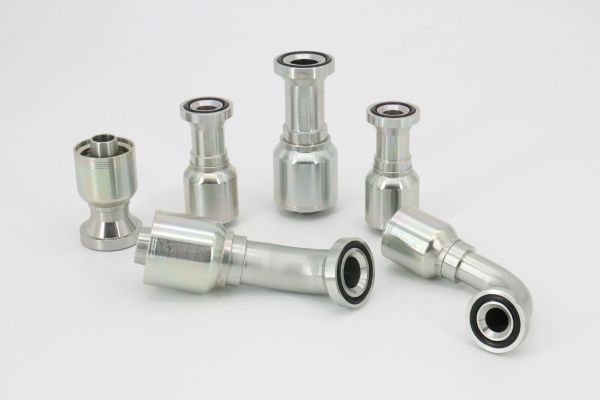
This step is valuable because one-piece fittings can look similar across different brands and series. A female swivel elbow, for example, may appear simple from the outside, but the thread standard, seat angle, hose tail, ferrule design, and crimp specification may differ. Cross-reference support helps organize the first comparison before a purchasing decision is made.
Final approval still depends on technical matching
A cross-reference result should be treated as a candidate, not as proof. Even when a supplier lists a part against a known brand number, the replacement must still be checked against the actual hose assembly requirement. The fitting has to match both the connection side and the hose side.
This matters because the consequences of a wrong match are practical and immediate. The assembly may leak at the port, fail to grip the hose correctly, require rework, delay a repair, or create an after-sales dispute. The purpose of cross-reference support is to reduce guessing, not to replace technical confirmation.
What Information Starts the Cross-Reference Process?
Part numbers and photos help, but they are incomplete
An existing part number is often the fastest starting point, but it should be used for identification rather than automatic replacement approval. Part numbers may be incomplete, outdated, copied from a different region, or linked to a specific hose and crimp system. If the number is used alone, it may hide details that are critical to the final assembly.
Photos are also useful, especially when the old fitting is unavailable. They can show whether the fitting is straight, 45-degree, or 90-degree, and whether the connection appears male or female. But photos cannot reliably confirm thread pitch, seat angle, sealing face condition, hose tail geometry, or whether the ferrule belongs to the correct fitting series.
The best input combines identification and application details
Good cross-reference support needs more than a brand code or a picture. It needs enough information to compare the candidate fitting against the working assembly. That means connection details, hose details, material requirements, operating conditions, and crimping information should be collected before the order is confirmed.
Prepare the most relevant information before asking for a cross-reference:
- Existing part number, old label, drawing, or catalog description
- Clear photos of the complete fitting, thread end, sealing face, and hose tail
- Fitting shape and orientation, such as straight, 45-degree, or 90-degree
- Male or female connection, thread OD or ID, pitch or TPI, and thread type
- Hose ID or dash size, hose series, hose construction, and visible hose markings
- Material, surface finish, fluid, pressure, temperature, and application conditions
How the Connection Side Is Checked
Thread standard and sealing method must be separated
The connection side is usually where cross-reference errors become visible first. A fitting may screw in partway and still be wrong, or it may look similar to another standard but seal on a different surface. Thread form, connection standard, seat angle, sealing face, and O-ring arrangement should be checked as separate items.
Measuring prevents false matches
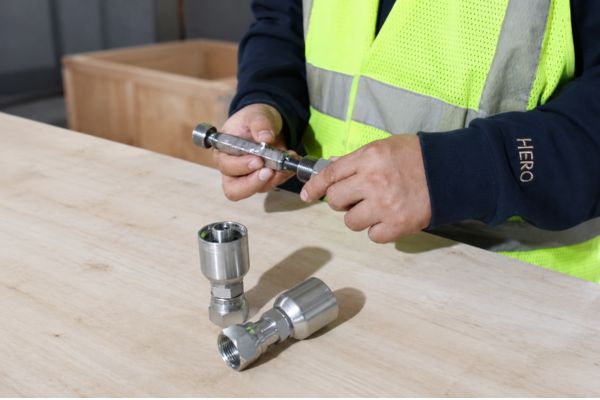
The safest connection-side check includes thread outside or inside diameter, pitch or TPI, male or female style, straight or tapered thread, seat angle, and sealing face type. If an O-ring is involved, its position and sealing surface should also be confirmed. Damaged threads and worn seats should be treated carefully because they can mislead the comparison.
Thread sealant should not be used to fix an incorrect cross-reference. If the sealing method is wrong or the sealing face is damaged, adding sealant does not make the fitting correct. A cross-reference that cannot confirm the connection side should remain unresolved until the missing data is measured.
How the Hose Side and Crimp Data Are Checked
One-piece design does not remove hose compatibility checks
A one-piece fitting has the fitting stem and ferrule pre-assembled or fixed as one component, depending on the product series. This helps reduce ferrule picking errors because the assembler does not choose a separate sleeve for the stem. It does not prove that the fitting is suitable for every hose with the same dash size.
The hose side must be checked against hose ID, hose construction, fitting series, and the assembly method. A compatible-looking fitting may still have the wrong stem profile, ferrule design, insertion depth, or skive requirement for the hose being used. That is why one-piece fitting cross-reference support should include hose information, not only the port connection.
Crimp data is part of the specification
Crimp data should be treated as a technical requirement, not as a workshop detail left until the end. Crimp diameter, insertion depth, die selection, skive or no-skive instruction, and assembly sequence need to match the hose, fitting, and crimping equipment being used. There is no universal crimp diameter that applies safely to all one-piece fittings.
When a cross-reference candidate is selected, the next question should be whether valid hydraulic hose crimping data is available for the actual assembly. If the hose, fitting, or crimper data cannot be confirmed, the replacement decision is still incomplete. This is especially important for pressure, impulse, vibration, temperature, and difficult installation conditions.
What a Reliable Cross-Reference Result Should Include
A candidate should be documented clearly
A useful cross-reference result should provide more than a replacement code. It should explain what has been matched and what still needs confirmation. At minimum, the candidate should be tied to connection type, thread details, fitting style, hose size, fitting series, material, finish, and any limits that affect use.
This documentation protects both purchasing and assembly work. If a candidate is approved, the same information can be reused for future orders. If it is rejected, the reason can be recorded so the same unsuitable part is not suggested again.
| Cross-reference item | Why it matters |
|---|---|
| Brand or existing part reference | Helps identify the original target but does not prove interchangeability |
| Thread and sealing details | Prevents port leakage and wrong-standard substitutions |
| Hose size and construction | Confirms whether the hose side can be assembled correctly |
| Crimp data source | Shows whether the fitting can be crimped with the actual hose and equipment |
| Material and finish | Helps check fluid compatibility, corrosion exposure, and environment |
| Application conditions | Connects the part choice to pressure, temperature, vibration, and risk |
Unconfirmed items should stay visible
A cross-reference result should not hide uncertainty. If thread pitch has not been measured, if the sealing face is unclear, or if crimp data is missing, those gaps should be shown clearly. This prevents the candidate from being treated as approved when the comparison is only partial.
This is especially important when the part is intended for stock, resale, or repeated repair work. A single uncertain item can spread into multiple wrong assemblies if it becomes a normal stock code. Clear notes on what is confirmed and what is pending help prevent that kind of repeat error.
How Samples or Trial Orders Should Be Verified
Check dimensions, markings, and assembly behavior
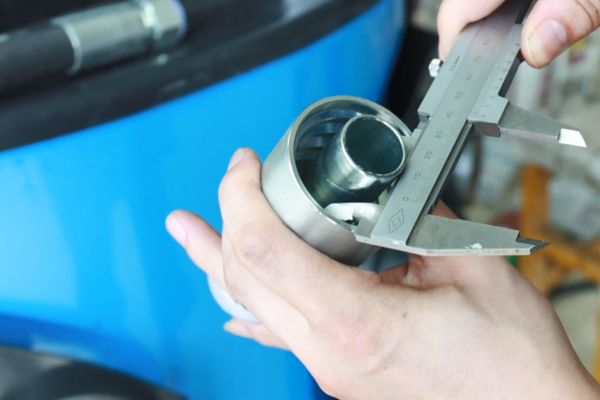
After a candidate is selected, a sample or small trial order should be used to verify the part before larger purchasing decisions. The check should cover thread dimensions, sealing structure, fitting orientation, stem and ferrule condition, markings, packaging label, material or finish requirement, and compatibility with the intended hose. The goal is to find differences before the fitting enters normal use.
Assembly behavior is part of the verification. The fitting should insert, prepare, and crimp according to the applicable procedure, and the finished assembly should be inspected at the specified crimp location. If the result depends on a different die, different hose, or unclear preparation method, the candidate should not be approved casually.
Record deviations before expanding use
Trial results should be recorded in a simple way that purchasing, inventory, and assembly staff can reuse. If the sample matches, record the approved replacement code, original reference, hose series, crimp data source, and any limits on use. If it does not match, record the reason, such as wrong seat angle, unsuitable ferrule design, unclear marking, or missing crimp guidance.
This record turns cross-reference support into a repeatable process. Without records, the same comparison has to be rebuilt each time a buyer asks for a replacement. With records, future orders can move faster while still keeping technical risk visible.
Building a Repeatable and Conservative Cross-Reference Workflow
High-risk applications need more than a part match
Cross-reference support should be conservative when failure could cause injury, major leakage, environmental contamination, equipment damage, or expensive downtime. In these cases, the decision should not be reduced to price or availability. The complete hydraulic hose assembly is limited by its lowest-rated component and by the real operating conditions.
Pressure, impulse, temperature, fluid compatibility, corrosion, routing, movement, and vibration all affect whether a replacement is suitable. A fitting that matches the old part number may still be wrong if the application has changed or if the old assembly was not correct in the first place. If leakage history exists, review hydraulic hose leak causes before assuming the fitting alone is the problem.
Cross-reference support often starts when an old assembly is removed, photographed, or measured. Before any inspection or replacement work, the equipment should be shut down, hydraulic pressure and stored energy should be released, and the relevant equipment and component safety procedures should be followed. Speed should not replace safe handling.
Do not loosen fittings under pressure, check pinhole leaks by hand, or restart equipment with an unverified substitute just because it appears close. A rushed cross-reference decision can turn a sourcing problem into a field failure. The safer path is to pause, measure, confirm, and document the replacement.
Standardize the information collected
A repeatable workflow starts with a standard request format. The person asking for support should provide the part reference, photos, thread measurements, sealing details, hose information, working conditions, and quantity purpose. The quantity purpose matters because stock, urgent repair, resale, and equipment production do not carry the same risk.
Use the same structure for every request:
- Identify the old part by number, label, sample, or drawing
- Measure thread size, pitch or TPI, and confirm sealing method
- Confirm hose ID, hose construction, fitting series, and crimp data source
- Check material, finish, pressure, temperature, fluid, and installation conditions
- Decide whether the candidate needs a sample, trial order, or manufacturer data check
Separate identification, validation, and stock approval
The most reliable process separates three steps. First, identify possible candidates through cross-reference support. Second, validate the technical match with measurements, hose-side checks, crimp data, and sample inspection when needed. Third, approve the part for stock or repeated use only after the results are documented.
This separation prevents a common mistake: treating a candidate part as an approved stock item too early. One-piece fitting cross-reference support works best when it reduces uncertainty step by step. It helps the buyer move from scattered information to a controlled decision, while keeping the limits of the comparison visible.
FAQ
Can a cross-reference part number prove that two fittings are fully interchangeable?
No, a cross-reference part number only helps identify a possible replacement and must be checked against thread, seal, hose compatibility, material, finish, pressure conditions, and crimp data.
Is a photo enough for one-piece fitting cross-reference support?
No, a photo can help screen fitting style and orientation, but final selection needs measurements such as thread diameter, pitch or TPI, seat angle, sealing method, and hose-side details.
Why does hose information matter if the fitting connection matches?
The connection side may fit the port, but the stem and ferrule must still match the hose construction and crimp procedure. A correct thread does not guarantee a correct hose assembly.
When should a sample be requested before buying more fittings?
A sample is useful when the replacement will become regular stock, when the application risk is high, or when thread, seal, hose side, material, finish, or crimp data needs physical confirmation.
What should be recorded after a cross-reference is approved?
Record the original reference, approved replacement code, confirmed thread and sealing details, hose series, crimp data source, sample notes, and any limits on use.