
Fast-moving one-piece fitting stock should contain the technically verified hose ends that repeatedly support profitable assembly work in your market—not every item shown in a supplier catalog. For a hydraulic fitting distributor or importer, the right assortment comes from sales frequency, customer spread, local equipment, common connection standards, replenishment time, and the operational cost of a stockout. A popular-looking fitting is not a sound inventory item if its hose compatibility or crimp data remains uncertain.
Define Fast-Moving Stock by Repeat Demand, Not Catalog Size
What the one-piece design changes
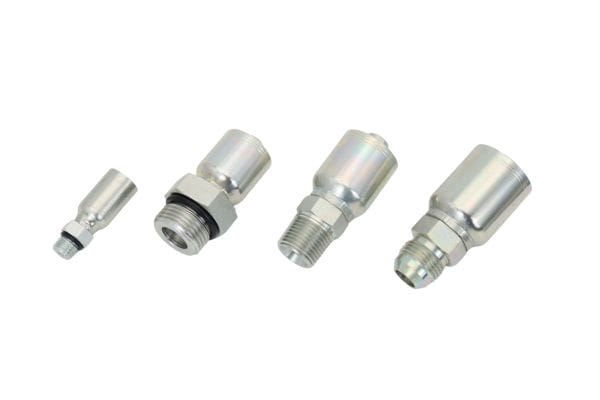
A one-piece hydraulic hose fitting normally has the fitting body or stem and ferrule preassembled or fixed as one assembly component, although the exact construction varies by product series. This format can reduce the separate ferrule-selection step and the warehouse error of pairing a compatible-looking stem with the wrong ferrule. That benefit matters when a you handles many hose sizes and connection types. It does not mean that any fitting with the correct dash size will match a hose, and it does not guarantee a leak-free assembly. The fitting series must still correspond to the hose manufacturer, hose construction, size, and valid crimp specification. One-piece fittings are also not the same as reusable or field-attachable fittings, and the term should not be used as a general label for every crimp fitting.
Why a complete range is not a healthy inventory
Stocking every straight, 45-degree, and 90-degree variation across JIC, NPT/NPTF, BSPP/BSPT, ORFS, Metric, DIN, and other systems can spread working capital across items that rarely move. The opposite approach—keeping only a handful of familiar straight fittings—can also fail because a missing orientation or female swivel may prevent completion of an otherwise routine hose assembly. Healthy inventory covers recurring jobs with verified products while preserving a defined route for seasonal, unusual, and hard-to-find items. The number of stocked SKUs must therefore come from theyour sales and service environment rather than a fixed recommendation.
Find the Fittings That Deserve Priority
Use transaction history without letting projects distort it
Start with invoice, counter-sale, branch-transfer, and hose-assembly records. Rank complete SKUs by order frequency, quantity, number of purchasing customers, and regularity of demand. A large order for one rebuild can make a slow item appear important, while a modest quantity requested every week by several customers is stronger evidence of repeat demand.
Separate scheduled production orders, one-time projects, and seasonal campaigns from ordinary replenishment. Include lost sales, back orders, emergency purchases, and jobs delayed because a fitting was unavailable; sales history alone cannot reveal demand that the business failed to serve. If several branches operate in different territories, analyze them individually before combining the results.
Connect demand to the local equipment population
Historical records are more useful when checked against the machines and hose systems operating in the territory. An agricultural region may have demand that rises before planting or harvest, while a mining service area may place greater value on fitting availability during planned maintenance and unplanned breakdowns.
Record the equipment brands and models commonly serviced only as identification clues, then confirm the actual port, hose, and assembly specifications. Imported equipment can introduce several thread systems into the same market. A JIC seat, SAE 45-degree seat, ORFS face seal, tapered pipe thread, parallel pipe thread, or metric cone connection cannot be selected by appearance alone.
Classify Each SKU by Demand Pattern and Service Risk
Use more than annual unit volume
A practical classification combines demand frequency with operational consequence. Core repeat items sell to multiple customers at reasonably regular intervals and are primary candidates for permanent stock. Critical service items may move less often but can stop a common repair, and their local availability may justify a controlled quantity. Seasonal items should follow dated forecasts rather than remain at peak quantity all year.
Project items belong to a known contract, rebuild, or production run and should not automatically alter the standard assortment. Rare items with short replenishment times may stay special order, while hard-to-find items with long lead times require a deliberate service-level decision. This approach prevents annual volume from hiding customer concentration, seasonality, and downtime exposure.
Convert the classification into a stocking action
The decision table below separates demand signals from the response they normally justify. It is a framework, not a universal formula; lead time, available capital, branch-transfer speed, and customer commitments can change the final action.
| Demand and risk signal | Initial stocking action | Main reason |
|---|---|---|
| Frequent orders from several customers | Set a minimum, reorder point, and reviewed safety stock | Demand is diversified and repeatable |
| Moderate volume with high service impact | Hold controlled service stock | Availability may matter more than raw volume |
| High volume from one scheduled customer | Link stock to a forecast or order agreement | Volume may be concentrated rather than broadly repeatable |
| Predictable seasonal demand | Build stock before the service window | Avoids year-round excess and late emergency purchases |
| Rare demand with short lead time | Consolidate or replenish on demand | Permanent stock may not earn its carrying cost |
| Unclear thread, hose series, or crimp data | Stop expansion until specifications are confirmed | A stocked mismatch creates technical and after-sales risk |
Treat Compatibility as an Inventory Qualification
Verify the connection and hose side separately
A SKU should not enter routine stock until its complete description can be verified. On the connection side, record male or female form, thread standard, outside or inside diameter, pitch or TPI, parallel or tapered form, seat angle, and sealing method. Similar outside diameters do not prove interchangeability, and thread sealant cannot correct the wrong thread or a damaged sealing face.
On the hose side, confirm hose ID or dash size, manufacturer and series, construction, fitting tail design, and applicable fitting series. A photograph can help narrow the possibilities, but final identification needs dimensions and sealing details. Where a supplier or branded part number is stored, use it for cross-reference and checking—not as a claim of complete equivalence.
Require valid crimp and application data
The proposed fitting and hose combination must have current assembly data applicable to the available crimping equipment. Depending on the documented system, that information may include die selection, skive or no-skive preparation, insertion depth, and final crimp diameter.
Do not infer these values from a visually similar component or apply one setting to every product. Confirm the relevant hose, fitting, and crimp-equipment manufacturer data through a controlled hydraulic hose crimping guide. Also review fluid compatibility, corrosion exposure, temperature, impulse, routing, mechanical load, and legal or equipment requirements. The complete hose assembly is limited by its lowest-rated component or interface; the fitting alone does not establish working pressure suitability.
Before approving a stock item, verify that:
- the connection standard, thread form, seat, and seal match the intended port or mating component;
- the fitting series matches the specific hose construction and size;
- valid crimp instructions exist for the actual assembly equipment;
- the material and finish suit the fluid, environment, temperature, and mechanical conditions; and
- the part number and label describe the full configuration, including orientation.
Set Replenishment Controls for Each Demand Class
Separate minimum, reorder point, and safety stock
These controls solve different problems and should not be copied from one fitting to another. A minimum represents the lowest operating quantity the business intends to hold. A reorder point identifies when replenishment must begin. Safety stock protects against a justified level of demand or lead-time variation. Establish them from expected consumption during replenishment, actual order intervals, lead-time reliability, supplier pack quantities, and the service consequence of running out.
A simple average can mislead when demand is intermittent, so inspect the pattern behind the average. Repeated emergency freight may indicate a poor reorder point, but it does not justify increasing every SKU minimum.
Decide what belongs locally and what can be pooled
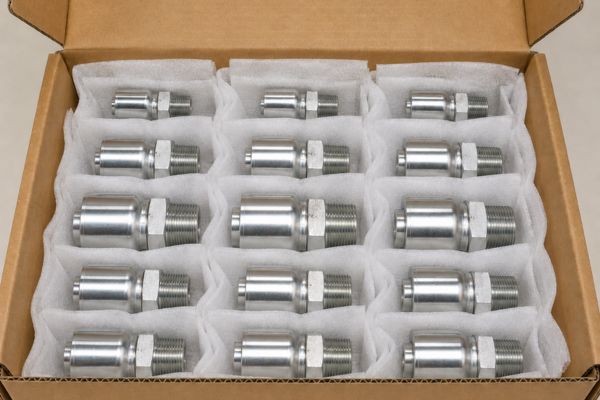
Multi-branch distributors must balance rapid local service against duplicated slow stock. Core fittings used for same-day hose work often belong near the assembly point. Less common orientations, special materials, or unusual threads may be pooled centrally if branch-transfer time remains compatible with customer needs. Standardize the internal part number, product description, barcode, unit of measure, and bin-location logic across all branches even when stocking quantities differ.
Keep visually similar connection standards physically separated where confusion is likely. A fitting in the building but hidden under an unclear label is functionally unavailable; worse, it may be picked for the wrong assembly and turn a warehouse problem into a leakage or return problem.
Useful inventory records should include:
- complete controlled description and internal part number;
- sales, lost-sale, stockout, return, and emergency-order history;
- supplier lead time, pack quantity, and approved source status;
- assigned branch, bin location, minimum, reorder point, and safety stock; and
- hose compatibility and the location of current crimp documentation.
Compare Total Cost Instead of Unit Price Alone
Count the costs created by shortage and confusion
The commercial value of fast-moving one-piece fitting stock appears in total operating cost, not only purchase price. A stockout can trigger repeated small orders, emergency freight, split shipments, extra receiving, branch transfers, lost hose jobs, and longer customer downtime. Poor product descriptions can create picking corrections, returns, rework, and after-sales investigation. Uncertain compatibility can consume technical time before any fitting is sold.
Track stockout frequency, emergency purchase frequency, returns by reason, picking corrections, dead-stock age, and immediate fill rate by SKU or family. Separate wrong ordering, thread misidentification, incompatible hose series, damaged sealing surfaces, warehouse errors, and manufacturing nonconformance; each cause requires a different corrective action.
Include the cost of holding too much
Excess stock also carries a real burden through tied-up cash, warehouse space, counting, handling, insurance, and obsolescence risk. A lower unit price for a larger order does not automatically offset those costs. Compare the proposed saving with realistic consumption before the next replenishment and the chance that equipment demand, supplier series, or customer preferences may change.
Slow inventory can also hide duplicate records created under different local names. Map synonyms to one controlled part number rather than treating them as separate products. The objective is not the highest possible shelf quantity; it is reliable service at a level of investment supported by turnover and risk.
Validate a Limited Assortment Before Expanding
Run a controlled stock and assembly trial
Select trial SKUs with repeat demand, clear specifications, available manufacturer crimp data, and manageable application risk. The trial should test the complete process: quotation, receiving, dimensional verification, labeling, bin placement, picking, hose matching, assembly records, sales, replenishment, and return handling. Verify thread and sealing dimensions, fitting orientation, hose-tail configuration, material, finish, markings, and packaging against the approved description. Assemble only with the correct hose series, fitting series, crimp equipment, and current procedure. Do not approve an entire family because one size performed acceptably; every proposed combination needs applicable documentation.
Expand, adjust, or stop using recorded results
Expand a SKU when it demonstrates repeat demand, accurate identification, reliable supply, acceptable turnover, and consistent assembly support. Adjust its quantity when demand exists but replenishment settings create avoidable shortage or excess. Pause or remove it when sales depend on one completed project, the item duplicates existing stock, labels require repeated manual correction, or compatibility remains unresolved. Record sample or delivery deviations by part number, specification, observed condition, disposition, and required corrective action.
Before final approval, prepare the hose manufacturer and series, hose ID or dash size, fitting style and orientation, male or female connection, thread diameter, pitch or TPI, parallel or tapered form, seat angle, sealing method, existing part number, and clear photos of the complete fitting, thread, and sealing face. Add material and finish requirements, operating fluid, pressure, temperature, environment, available crimp equipment, and the applicable crimp specification.
Frequently Asked Questions
Should every branch stock the same one-piece fittings?
No. Standardize part numbers, descriptions, compatibility records, and labeling, but set the assortment and quantity from local equipment, customer demand, transfer time, and service expectations. Slow variants can be pooled centrally when transfer time remains acceptable.
Are one-piece fittings always easier to inventory than two-piece fittings?
Not in every operation. Their preassembled stem-and-ferrule format can reduce separate-component picking decisions, but a you may still need many thread, size, orientation, material, and hose-series combinations. The better system is the one supported by verified assembly data and disciplined inventory records.
How often should fast-moving classifications be reviewed?
Review them often enough to detect changes before persistent shortages or excess develop. The appropriate interval depends on sales volume, seasonality, lead time, and market volatility. Seasonal businesses should review before the demand window rather than relying only on an annual count.
Can a supplier cross-reference replace technical identification?
No. A cross-reference is a starting point for comparison, not proof of interchangeability. Confirm thread, seat, seal, dimensions, hose compatibility, material, finish, operating conditions, and applicable crimp data before stocking or assembling the alternative.