You ensure hydraulic fittings match international standards by verifying certifications like ISO, DIN, or SAE and checking for manufacturer markings. Using non-standard components often leads to catastrophic system failures and dangerous leaks in high-pressure environments. These preventable risks can result in expensive downtime, legal liabilities, and serious workplace injuries. Our guide provides a systematic approach to identifying and selecting certified components for your industrial needs.
Why are standards vital for hydraulic fittings?
Standards ensure that hydraulic fittings operate safely under high pressure while providing universal interchangeability between components. These regulations prevent catastrophic leaks and system failures by mandating specific thread tolerances and material strengths. By following these rules, you protect your equipment from premature wear.
Global Safety Protocols
Safety protocols defined by international bodies reduce the risk of high-pressure injection injuries and environment-damaging spills. These rules establish the baseline for testing and verification in industrial environments.
- Pressure burst tests
- Impulse fatigue cycles
- Leak-free verification
Compliance with global protocols ensures that every connection point remains stable during intense mechanical vibrations. Adopting these international benchmarks guarantees that your system maintains peak efficiency throughout its operational life cycle.
| Standard | Primary Benefit |
| ISO | Universal Compatibility |
| SAE | High-Pressure Safety |
Standardized safety measures protect both personnel and high-value machinery assets.
Which organizations regulate hydraulic fittings globally?
International organizations such as ISO, DIN, and SAE regulate hydraulic fittings to ensure consistent manufacturing quality across the globe. These entities publish detailed specifications regarding dimensions, materials, and testing procedures. Understanding these bodies helps you identify the correct parts for different geographic markets.
The Role of ISO
The International Organization for Standardization provides the most widely accepted frameworks for fluid power components. They harmonize regional differences to allow for global trade and assembly.
- ISO 12151 series
- ISO 8434 specifications
- ISO 6162 flange codes
Check this out: ISO standards act as the bridge between European metric systems and North American imperial sizes. Utilizing ISO-certified components ensures that your machinery is serviceable in any international port or industrial hub.
| Body | Focus Area |
| ISO | International Trade |
| DIN | European Metrics |
Global regulation simplifies procurement for companies operating in multiple jurisdictions.
How do JIC hydraulic fittings meet SAE standards?
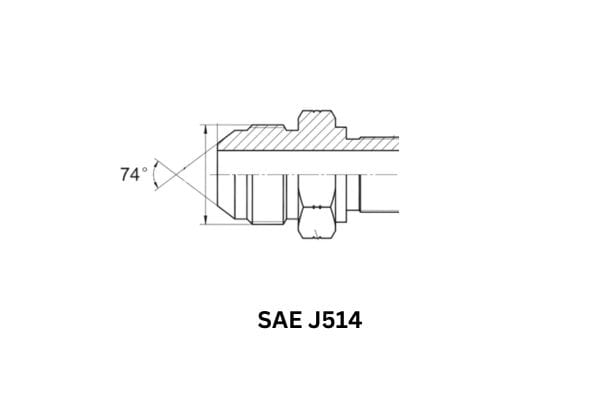
JIC hydraulic fittings meet SAE J514 standards by utilizing a precise 37-degree flare seating surface for reliable metal-to-metal sealing. These components are designed to withstand high-vibration applications without loosening or leaking over time. You will find them most commonly in mobile construction and agricultural equipment.
37-Degree Flare Design
The 37-degree flare angle provides a mechanical seal that does not require additional sealing compounds or O-rings. This simplicity makes it a favorite for field repairs and high-temp environments.
- Metal-to-metal contact
- Reusable seating surface
- High vibration resistance
Think about this: The flare design creates a massive surface area for sealing, which distributes pressure more evenly across the joint. Selecting JIC components ensures your high-pressure lines remain leak-free under extreme thermal cycling.
| Standard | Feature |
| SAE J514 | 37-Degree Flare |
| Threads | UN/UNF Straight |
The engineering behind flare fittings optimizes the balance between ease of assembly and long-term durability.
What markings should you find on hydraulic fittings?
Authentic hydraulic fittings must feature permanent markings that indicate their source, pressure rating, and standard compliance. These markings are typically stamped or laser-engraved onto the body or hex nut for easy identification. Checking these symbols is the fastest way to verify a component’s legitimacy.
Manufacturer Identification
Clear manufacturer logos or names indicate that the company stands behind the quality of their component. Traceability is essential for maintaining safety records and performing maintenance audits.
- Stamped logo marks
- Unique batch numbers
- Country of origin
A missing logo often suggests a counterfeit part that has not undergone rigorous international testing. Identifying the source of your parts helps you maintain a high standard of quality control across your entire fleet.
How are SAE hydraulic fittings tested for quality?
To meet strict guidelines, hydraulic fittings undergo rigorous testing, including proof pressure, burst pressure, and cyclic endurance tests. These evaluations simulate years of heavy-duty use in just a few days to ensure the design is sound. You can trust these parts because they are built to exceed their stated limits.
Proof Pressure Testing
Proof pressure testing involves subjecting the fitting to twice its rated working pressure to check for deformation. This ensures the component can handle sudden pressure spikes without failing or leaking.
- 2:1 Safety factor checks
- Deformation inspection
- Leakage monitoring
Take note of this: Successful proof testing guarantees that the fitting will perform reliably under the most demanding industrial conditions. Investing in tested components eliminates the uncertainty associated with high-pressure fluid power operations.
What role does material play in hydraulic fittings?
The material used in hydraulic fittings determines their maximum pressure capacity and resistance to environmental corrosion. Most industrial systems utilize carbon steel for standard applications or stainless steel for harsh environments. Choosing the wrong material can lead to rapid oxidation and structural failure.
Stainless Steel Resistance
Stainless steel is the preferred choice for marine, offshore, and chemical processing applications due to its superior corrosion resistance. It maintains its structural integrity even when exposed to salt spray or acidic fluids.
- 316L Grade options
- Salt spray resistance
- High temperature stability
While more expensive, stainless steel significantly reduces the total cost of ownership by extending replacement intervals. Selecting the right material protects your system against environmental degradation and premature leaking.
| Material | Best Environment |
| Carbon Steel | Dry Industrial |
| Stainless Steel | Corrosive/Marine |
Why are metric hydraulic fittings popular in Europe?
European manufacturers prefer metric hydraulic fittings because they align with the DIN 2353 standard used across the continent. These fittings utilize a compression-style bite ring that creates a secure seal on metric-sized tubing. You will often encounter these on machinery produced by major European OEMs.
DIN 2353 Compliance
The DIN 2353 standard specifies three series of fittings: Light (L), Heavy (S), and Extra Light (LL). This classification allows you to choose the exact strength needed for your specific pressure requirements.
- Metric thread patterns
- Cutting ring technology
- High sealing precision
The cutting ring design provides a visible “bite” into the tube, making it easy to inspect for proper assembly. Utilizing metric standards ensures seamless integration with modern European mechanical engineering designs.
| Series | Pressure Level |
| L Series | Medium Pressure |
| S Series | High Pressure |
How can you verify threads on hydraulic fittings?
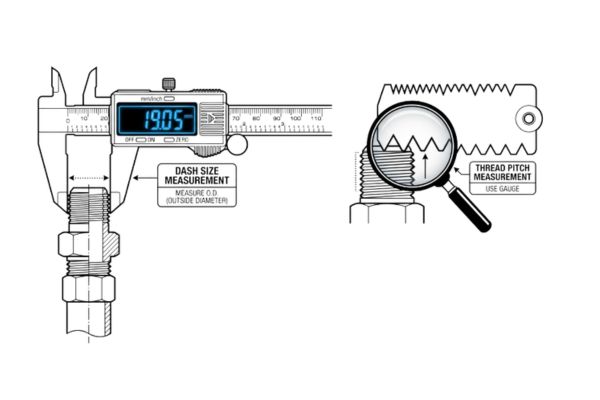
Verifying the threads on hydraulic fittings requires a pitch gauge and calipers to measure the distance between threads and the outer diameter. Identifying whether a thread is tapered or straight is critical to ensuring a leak-proof connection. You should never guess thread types, as mismatched threads are a primary cause of system damage.
Pitch Gauge Measurement
A pitch gauge allows you to match the thread profile against a standard template to confirm the count per inch or metric pitch. This tool eliminates errors when distinguishing between closely related thread types like NPT and BSPT.
- Metric pitch blades
- TPI (Threads Per Inch)
- Profile matching teeth
Using a pitch gauge ensures that you never accidentally cross-thread a component during high-pressure assembly. Accurate thread verification is the most important step in preventing expensive downtime caused by damaged ports.
| Tool | Measurement |
| Caliper | Outer Diameter |
| Gauge | Thread Pitch |
When should you use NPT hydraulic fittings?
You should use NPT hydraulic fittings when your system requires a tapered thread that creates a seal through metal-to-metal interference. These are widely used in North American plumbing and low-to-medium pressure hydraulic applications. You must use a thread sealant or tape to ensure these connections remain airtight.
Tapered Thread Mechanics
The tapered design of NPT threads causes the threads to tighten as they are screwed into the mating port. This wedging action creates the primary seal, although it can be susceptible to leaks if over-tightened.
- 60-Degree thread angle
- 1-in-16 Taper ratio
- Sealant-assisted joints
Pay attention: NPT fittings are highly effective for static applications but may require frequent inspection in high-vibration systems. Selecting tapered threads is an economical solution for many general-purpose industrial fluid applications.
| Feature | Specification |
| Seal Type | Interference Fit |
| Requirement | Thread Sealant |
Where can you source certified hydraulic fittings?
You can source certified hydraulic fittings from reputable manufacturers like Topa, who provide full documentation and compliance certificates for every order. Reliable suppliers maintain large inventories of ISO, SAE, and DIN-compliant parts to support your immediate needs. You should prioritize partners who offer technical support and material traceability.
Reliable Supplier Criteria
A top-tier supplier offers more than just parts; they provide the assurance that every component meets international safety benchmarks. Look for companies that have invested in CNC precision and robotic manufacturing.
- ISO 9001 certification
- Material test reports
- Large stock availability
Partnering with a dedicated manufacturer ensures that you receive consistent quality across every batch of components. Choosing a reliable source is the final step in securing your high-pressure hydraulic infrastructure.
Conclusion
Solving hydraulic leakages and mismatched standards is our specialty at Topa. We manufacture high-precision components that meet the strictest ISO, SAE, and DIN requirements to ensure your operations never stop. Our vision is to provide a leak-free future for industrial systems through innovation and unmatched quality. If you need reliable components to protect your machinery, contact us today.
FAQ
Can I mix different thread standards?
No. Mixing thread standards like NPT and Metric will damage the threads and cause high-pressure leaks or system failure.
What is the most common hydraulic standard in the US?
It depends. While NPT is common in general plumbing, SAE and JIC are the dominant standards for high-pressure US mobile equipment.
Can I reuse a JIC fitting multiple times?
Yes. JIC fittings are designed for multiple assemblies, though you must inspect the 37-degree flare for cracks or deformations before each use.
What is the difference between NPT and NPTF?
It depends on the seal. NPT requires sealant, while NPTF is designed to provide a dry-seal through more precise thread interference.
How can I identify a metric thread?
Yes. You can identify it by measuring the outer diameter in millimeters and using a pitch gauge to find the distance between threads.