Possible ozone cracking in a hydraulic hose cover is identified by combining surface pattern, hose strain, exposure history, location, and comparison with abrasion, heat aging, flex fatigue, and other weathering. Fine cracks often become visible where rubber is stretched, but pattern recognition alone cannot prove the cause or remaining pressure capability. The cover protects reinforcement from environment and damage; once it is cracked, a competent reviewer must decide whether the assembly should be removed, investigated, or replaced under the applicable maintenance rules. Never tape, coat, or patch a damaged hose to return it to service, and never inspect a pressurized hose by hand.
Understand What Ozone Does to a Hose Cover
Ozone can react with susceptible elastomer compounds and create surface cracking where the material is under strain. Exposure may come from the surrounding atmosphere or sources associated with electrical equipment. Resistance depends on the exact cover compound, formulation, construction, condition, and exposure; black color does not identify performance.
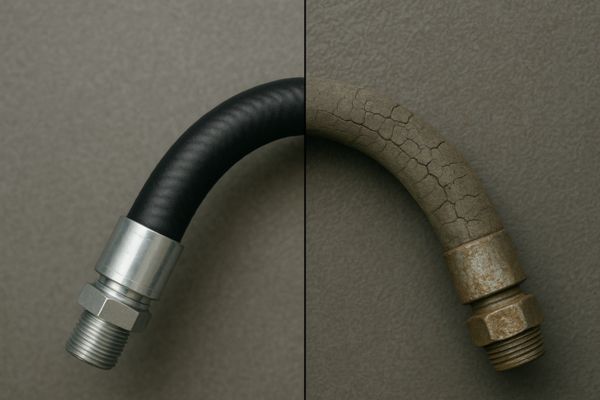
Strain reveals the damage
Cracks may be more visible on the outside of a bend because that surface is stretched. Installed twist, tight routing, clamps, or stored deformation can create other strained zones. This relationship is useful evidence, but it is not a stand-alone diagnosis because heat aging and repeated flexing can also produce cracks in highly stressed areas.
Cover damage can affect deeper layers
The cover is not the pressure reinforcement, yet cracks can admit moisture, dirt, chemicals, and abrasive debris toward reinforcement. Visual depth is difficult to judge in service. Do not infer that shallow-looking checks are harmless or that an assembly is safe because wire is not visible.
Make the Inspection Safe Before Looking Closely
Hose inspection begins with equipment control, not touching the crack. Stop the machine, isolate energy, depressurize the circuit, release accumulators and trapped pressure, secure suspended loads, and follow lockout and equipment instructions. Allow hot components to cool and control hazardous fluids.
Avoid dangerous leak checks
Never run a hand along the hose or bend it while pressurized. High-pressure injection can occur through a very small opening, and a cracked cover may conceal reinforcement damage. Use only approved guarded inspection or test methods performed by trained personnel.
Preserve the installed evidence
Before removal, record hose position, bend, twist, clamps, guards, nearby electrical and heat sources, rubbing points, sunlight, weather, and contamination. Photograph the complete route and crack orientation from a safe position. Mark orientation only by a method that does not damage or contaminate the assembly.
Compare Ozone With Other Damage Patterns
The table organizes competing explanations. Real assemblies may show more than one mechanism, so the purpose is to guide evidence collection rather than declare a cause from one photograph.
| Possible mechanism | Pattern or context to examine | Supporting history | Important limit |
| Ozone-related cracking | Fine cracks associated with strained cover areas | Atmospheric or electrical-source exposure, storage, installed strain | Pattern is not conclusive |
| Abrasion | Local wear, polishing, cuts, or missing cover at contact | Rubbing against frame, another hose, clamp, or debris | Abrasion may coexist with aging |
| Heat aging | Hardening, brittleness, widespread cracking or discoloration | Hot surface, exhaust, poor airflow, high fluid temperature | Appearance does not identify exact temperature |
| Flex fatigue | Damage concentrated at repeated bending or near restraint | Dynamic motion, insufficient bend allowance, twisting | Requires routing and motion review |
| UV/weathering | Fading, chalking, generalized surface change | Outdoor exposure and storage history | Ozone and UV effects may overlap |
| Chemical exposure | Softening, swelling, tackiness, discoloration, or cracking | Spills, washdown, fluid incompatibility | Identify exact chemical before concluding |
Crack direction is only one clue
Ozone-associated cracks are often discussed in relation to the direction of surface strain. Field surfaces can have complex, changing strain and multiple exposures, so orientation may not be uniform. Use it together with location, material data, environmental history, and examination by the hose manufacturer or competent failure analyst.
Examine the whole circumference and a meaningful length after safe isolation, because the most visible outer-bend area can bias the record. Note whether cracks stop at a clamp, repeat at regular flex points, appear only on one side, or continue into areas with different strain. Compare the cover near fittings with the mid-span while accounting for assembly stress and guards. These observations help form testable alternatives, but they still do not establish how deeply damage extends or whether reinforcement remains fit for pressure service.
Collect the Product and Service Record
Identification determines which ozone-resistance and inspection information applies. Record the hose manufacturer, exact series, size, cover type, layline, assembly date, installation date, fittings, length, and routing. A similar-looking cover from another series may use a different compound.
Exposure and storage history
- Outdoor or indoor storage, sunlight, weather, temperature, and humidity
- Proximity to motors, welding, high-voltage equipment, or other potential ozone sources
- Storage near oils, solvents, fumes, or heat and whether ends were capped
- Installed bend, twist, clamps, guards, abrasion points, and dynamic movement
- Cleaning chemicals, washdown, leaks from nearby components, and contamination
- Inspection dates, previous photos, changed appearance, and related replacements
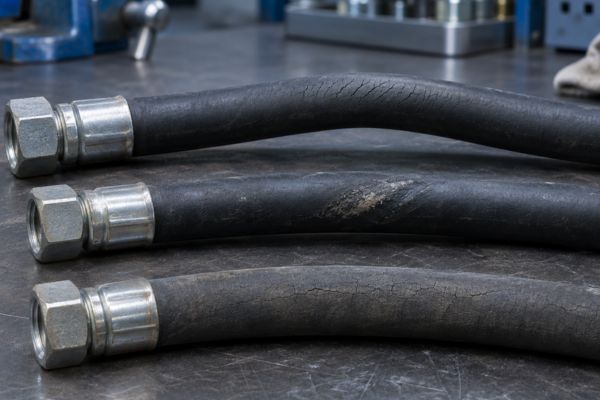
Evidence limits
An unused hose can age in poor storage, while an older hose may have been stored under controlled conditions. Age alone does not diagnose ozone damage, and a date code is not a universal expiration decision. Use the manufacturer’s storage, shelf-life, inspection, and replacement guidance for the exact product and application.
Compare current photographs with earlier inspections when camera angle, lighting, scale, and hose position are known. A different bend position can open cracks that were previously difficult to see, creating the appearance of sudden growth. Record whether the machine was operating, parked, hot, cold, washed, or recently serviced at each observation. This timeline helps separate progressive aging from one event such as rubbing, chemical spill, overheating, or installation damage.
If the assembly is removed for analysis, preserve both ends, the complete damaged region, layline, orientation, and relevant guards or clamps according to the investigation plan. Do not cut through the most important crack before it is documented. A laboratory may examine surfaces or material characteristics, but the request should state the competing questions; sending an anonymous hose segment without exposure history sharply limits the conclusion.
Assess Severity Without Estimating Remaining Strength
Cover appearance cannot quantify remaining pressure capacity. A crack may be superficial, may have reached reinforcement, or may be one visible sign of broader heat, chemical, or flex damage. Field personnel should apply defined removal and escalation criteria, not invent a safe crack depth.
Conditions requiring removal or urgent review
Remove the assembly from service according to the approved procedure when reinforcement is exposed, fluid is leaking, fittings move, the hose is kinked or crushed, or the cover is severely cracked, charred, blistered, soft, or loose. Also escalate rapid progression, widespread cracking, uncertain depth, or damage in a safety-critical function. The exact disposition belongs to the responsible maintenance or technical authority.
Do not repair the cover for continued service
Tape, paint, sealant, protective spray, or a sleeve can hide progression and trap contamination; none restores unknown reinforcement condition or product approval. Guards and sleeves are design controls when specified for an acceptable assembly, not repairs for a damaged one. Replace with an approved assembly and correct the exposure or routing cause.
Disposition also needs a boundary around adjacent stock. If stored hose from the same series shared the suspect environment, identify and segregate it until the responsible authority reviews storage conditions and manufacturer criteria. Do not scrap or release an entire batch from visual similarity alone. Connect product identity, storage location, dates, packaging, exposure, and representative condition without using one damaged installed assembly as universal proof.
Hypothetical Example: Cracks on an Outdoor Machine
This example is hypothetical and does not diagnose a real assembly. A maintenance team finds fine cover cracks on the outside of a fixed bend in a machine stored outdoors near electrical equipment. The hose is not visibly leaking, but its installation and storage records are incomplete.
Compare rather than assume
The machine is isolated, depressurized, and secured. The team records crack location and orientation, hose layline, bend and twist, nearby rubbing and heat, equipment motion, outdoor exposure, and similar hoses on the machine. It does not flex the pressurized hose or declare the condition safe because reinforcement is not visible.
The exact hose documentation and maintenance criteria are reviewed. Because ozone, UV weathering, installed strain, and heat could overlap, the assembly is removed under the approved rule and preserved for competent review. The replacement is selected from current manufacturer data, routed without twist and within requirements, and entered into a follow-up inspection plan.
Correct the Exposure and Prevent Recurrence
Replacing the hose without addressing the environment can repeat the damage. Review cover resistance, routing, bend radius, twist, clamps, heat shielding, abrasion protection, electrical-source proximity, storage, and stock rotation. Any change must remain within the hose and equipment manufacturers’ instructions.
Prevention starts before installation. Store hose in a cool, dark, dry controlled area away from ozone-generating equipment, incompatible chemicals, heat, and damaging deformation, following the manufacturer’s instructions. Keep ends protected and inventory identifiable. During assembly and installation, avoid twisting, forcing a bend below the permitted radius, or clamping the hose so that normal motion concentrates strain at one point.
After installation, create a baseline image and route record for exposed or critical assemblies. Inspection frequency should reflect the equipment, environment, duty, consequence, manufacturer guidance, and observed condition rather than a universal interval. A baseline makes later change visible and helps distinguish a cover issue from route-specific stress concentration or new external exposure.
Use comparison across the machine carefully
Inspect assemblies of the same series and exposure, but do not assume they share identical damage because one looks better. Differences in strain, route, temperature, installation date, and cover batch can matter. Preserve source and installation records so recurring patterns can be separated from isolated mechanical damage.
Next-action checklist
- Isolate, depressurize, release stored energy, and secure loads
- Record exact hose series, cover, date, fittings, route, bend, twist, and restraints
- Map cracks by location, orientation, extent, and change over time
- Document ozone, sunlight, weather, heat, electrical, chemical, and abrasion exposure
- Compare plausible mechanisms without relying on pattern alone
- Apply manufacturer and site removal criteria without estimating strength
- Replace only with an approved complete assembly and correct contributing conditions
- Record findings, disposition, replacement identity, and follow-up inspection
Conclusion
Ozone cracking on a hydraulic hose cover is a condition to investigate, not a diagnosis that can be confirmed from a crack photograph. Look for the relationship between cracks, surface strain, exposure, routing, storage, and service history, then compare abrasion, heat, flex fatigue, UV weathering, and chemical contact. Cover appearance cannot establish remaining pressure capability, and a patch cannot restore it. Isolate and depressurize the machine before inspection, apply the exact manufacturer and maintenance criteria, and escalate uncertain or progressing damage. The useful final record identifies the hose, environment, crack distribution, competing causes, removal decision, approved replacement, and corrective action so the same exposure is not built into the next assembly.
Frequently Asked Questions
Are cracks on the outside of a bend always caused by ozone?
No, that location is highly strained and can also reveal heat aging, flex fatigue, weathering, or combined damage. Use product and exposure evidence before assigning a cause.
Can a cracked cover be taped if no wire is visible?
No, tape does not reveal or restore the underlying condition and may hide progression. Apply the approved removal and replacement criteria.
Does outdoor storage prove ozone damage?
No, it establishes possible exposure, not the mechanism. Review sunlight, temperature, electrical sources, chemicals, strain, product resistance, and observed pattern together.
Can a pressure test prove a cracked hose is safe?
No improvised or field test establishes future service life. Any authorized testing must follow a defined standard or manufacturer procedure with guarded equipment and competent review.
Should nearby hoses be replaced at the same time?
Inspect and assess each assembly under the applicable criteria. Shared exposure may justify a broader review, but replacement scope should follow condition, identity, history, and risk evidence.