A fitting found months after receipt may still have a readable bin label while its sealing face is scratched, cap is missing, finish shows corrosion, or lot identity has been mixed. To store one-piece hydraulic fittings long-term, preserve both physical condition and traceable identity from receiving through issue. That requires suitable packaging, environmental control, protected connection surfaces, segregated SKUs and lots, disciplined handling of opened cartons, and scheduled reviews based on actual risk. It does not require inventing a universal storage life, humidity limit, or replacement interval.
Map the Risks Before Assigning Storage Locations
Long-term protection starts by identifying how the warehouse can damage or confuse the fittings. A dry-looking room and closed carton do not automatically control every exposure.
Consider the full storage path
Map receiving, inspection, repacking, movement, picking, cycle counting, and return-to-stock activities. Moisture can enter during transport or temperature changes; caps can be lost during sampling; mixed lots can occur at replenishment; and connection ends can contact metal bins during picking. A fitting protected on a high shelf may still be damaged repeatedly at the workbench.
Review roof and wall leaks, condensation points, doors, wash areas, chemical storage, salt or outdoor air, floor cleaning, dust, and temperature cycling. Also consider load stability, vibration, forklift contact, falling objects, and shelf edges. The purpose is to select controls appropriate to the actual environment rather than declare a generic room “safe.”

Classify the product’s vulnerable features
One-piece fittings keep the stem and ferrule preassembled or retained, which may reduce separate-part mixing. They still contain vulnerable threads, seats, sealing faces, O-ring grooves or seals when present, ferrule edges, hose-side features, finishes, and identification marks. Different end configurations need different physical protection.
Do not infer corrosion resistance or storage durability from color. Material and finish must be verified from controlled product records, and field suitability later depends on fluid, temperature, corrosion exposure, pressure, and the complete assembly.
Preserve the Original Protective Package
Manufacturer or controlled incoming packaging should remain intact when it is clean, dry, identifiable, and suitable for continued storage. Unnecessary repacking creates new contact, mixing, and labeling risks.
Inspect packaging at receipt
Check cartons, bags, dividers, desiccant or barrier material when specified, caps and plugs, labels, and evidence of water, crushing, tearing, contamination, or corrosion. Record damage against the receiving lot before moving product into normal stock. Do not place a damp carton on the shelf simply because its contents have not yet been inspected.
Keep packaging instructions tied to the relevant product or supplier record. Avoid adding unapproved oil, corrosion inhibitor, wrapping, or cleaning chemical; a substance that protects one finish may contaminate a sealing surface, elastomer, hose, or hydraulic system.
Repack only through a defined method
When packaging must be replaced, use clean, compatible material and reproduce the required segregation and identification. Prevent fittings from rubbing against one another. Heavy fittings should not crush smaller parts or press connection ends through thin bags.
Label the new package before transferring parts so identity is never temporarily lost. Record the original lot, quantity, repack date, reason, and responsible person when the warehouse system requires it.
Protect Threads, Seats, and Sealing Faces
Connection protection is a primary storage control because small dents, contamination, or scratches can prevent correct engagement or sealing. Caps and plugs are functional safeguards, not cosmetic accessories.
Use the correct protective device
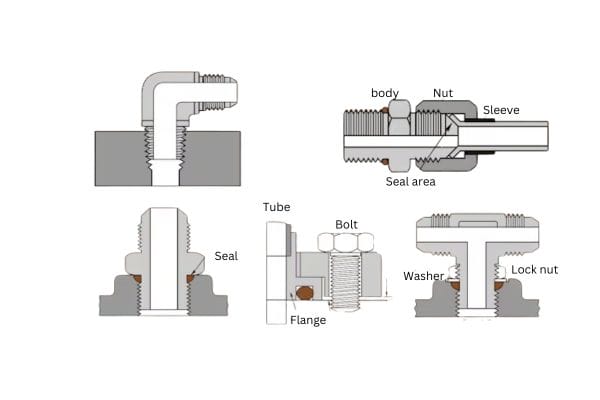
Keep the specified cap, plug, sleeve, or divider on each vulnerable end. The protector should fit without damaging threads, deforming an O-ring, contacting a critical seat, or leaving residue. Do not force a nearly matching cap onto a different thread or use adhesive tape directly on a sealing surface unless the controlled packaging method explicitly permits it.
After inspection or picking, replace protection immediately. A tray of uncapped fittings left on a bench can collect abrasive particles or suffer contact damage before it returns to the bin.
Prevent metal-to-metal contact
Use compartments, dividers, trays, or individual wraps appropriate to fitting weight and geometry. Arrange elbows and long fittings so their own mass does not drive a thread or seat into another part. Keep connection ends away from shelf edges, steel bin walls, staples, and loose hardware.
If a protector is missing or a sealing face has contacted another object, move the fitting to hold status for evaluation. Do not wipe a damaged surface and return it to stock based only on a quick visual impression.
Control Moisture, Corrosion, and Shelf Exposure
Environmental controls should prevent condensation, wetting, contaminant deposition, and prolonged contact with unsuitable surfaces. The correct limits and packaging system depend on documented product and warehouse requirements.
Manage moisture sources
Store fittings away from leaks, exterior doors, wet processes, direct floor contact, and locations with repeated warm-cold cycling when condensation is possible. Keep cartons off concrete floors and allow inspection around pallets or shelves. Address water entry at its source instead of relying only on extra wrapping.
Where a controlled humidity or barrier system is specified, monitor and maintain it under the facility procedure. Do not invent a universal humidity percentage for all fittings, finishes, packaging, and climates. Use documented material and packaging requirements plus observed warehouse risk.
Choose stable shelf placement
Shelves must support the load without sagging and protect stock from impact. Place dense cartons where they can be handled safely without dropping or dragging. Avoid overstacking, unstable piles, and positions where a forklift tine or ladder routinely contacts the package.
Separate fittings from corrosive chemicals, batteries, wash products, salt, dust-generating work, and materials that can transfer contamination. Keep food, drinks, and unrelated maintenance parts out of hydraulic-component bins.
Segregate SKUs, Sizes, and Lots
Preserving identity is as important as preventing corrosion. A clean fitting in the wrong bin can cause an incorrect assembly, leakage, rework, or equipment downtime.
Design bins around error risk
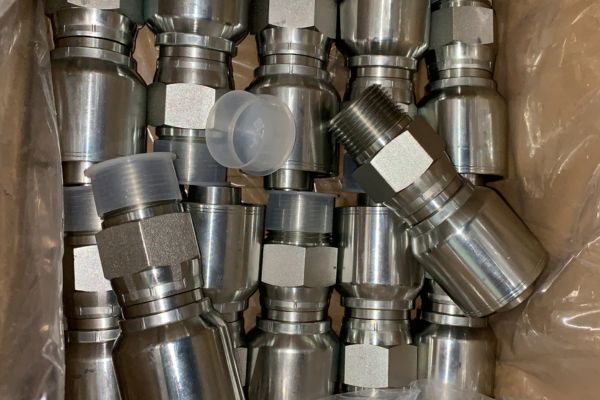
Use a unique controlled location for each complete fitting code unless the warehouse system has a validated alternative. Do not group parts only by visual similarity, dash size, or connection family. Straight, 45-degree, and 90-degree forms, male and female connections, different thread systems, and similar ferrules can be confused during fast picking.
Labels should show the full SKU or part number, plain-language description where useful, unit of measure, and barcode or system identifier when used. Avoid handwritten abbreviations that collapse distinct series into the same name.
Maintain lot traceability
Keep lots separated physically or through a controlled location and inventory system. Apply the organization’s approved rotation method, but do not assume oldest stock is automatically acceptable for use. Rotation manages inventory sequence; it does not replace condition review or technical approval.
When consolidating partial cartons, preserve every lot relationship. If the system cannot represent mixed lots accurately, do not combine them. A small saving in shelf space is not worth losing the ability to trace affected stock.
Control Opened Cartons and Partial Quantities
Opened packaging creates the highest routine opportunity for caps, labels, and lot control to fail. A defined open-carton method keeps the remainder equivalent to protected stock.
Open only what the job requires
Pick from one identified carton or lot at a time where practical. Use a clean surface and return unused fittings promptly. Count parts without dumping them into a mixed tray, and keep labels with the original contents rather than on a removable lid that can be exchanged.
Before resealing, check:
- all required caps and plugs are present;
- no visible moisture, debris, or contact damage is present;
- the quantity and unit of measure are updated;
- the SKU and lot labels remain legible and attached;
- packaging and dividers remain functional;
- the opened status or date is recorded when required.
Relabel without breaking traceability
Replace a damaged label from the inventory record and original source documentation, not from appearance. Use a second-person verification when similar SKUs could be confused. Do not copy a part number from a neighboring bin.
If identity cannot be reconstructed with controlled evidence, quarantine the stock. A technically correct fitting with uncertain identity cannot be safely selected for assembly.
Review Stored Stock According to Risk
Storage review should be regular enough to detect deterioration and control failures, but no single inspection interval applies to every warehouse, finish, package, or turnover pattern.
Set review triggers
Base review frequency on environmental history, packaging type, material and finish documentation, product value and criticality, handling frequency, prior damage, storage duration, and facility changes. Add event-driven reviews after a leak, flood, heating or ventilation failure, relocation, shelf collapse, chemical spill, or evidence of condensation.
Review the environment and system as well as sample parts. Repeated missing caps may point to poor picking practice; corrosion concentrated on one shelf may indicate a building or airflow issue; mixed lots may reveal a replenishment-control failure.
Inspect without creating damage
Use a sampling or inspection plan authorized by the quality system. Handle fittings with clean practices, protect sealing surfaces, and return acceptable samples to their original identified package. Record the SKU, lot, location, condition observed, action, and reviewer.
This storage review detects and prevents deterioration. It does not establish whether aged or questionable stock is fit for a specific hose assembly or application; that separate decision may require controlled inspection, technical records, or qualified approval.
Use a Warehouse Control Checklist
A concise checklist makes preventive controls visible during receiving, shelving, picking, and review. Adapt it to the documented requirements for the actual product and facility.
Receiving and placement
- Confirm full SKU, quantity, lot, and package identity.
- Inspect for wetting, crushing, contamination, missing protectors, and visible corrosion.
- Assign a clean, stable, segregated location away from identified environmental risks.
- Preserve original packaging or repack through the controlled method.
- Keep stock off the floor and prevent connection-end contact.
Picking and ongoing control
- Pick one clearly identified SKU and lot at a time.
- Replace caps, plugs, dividers, and package closure after access.
- Record partial quantity, relabeling, movement, and mixed-lot status accurately.
- Quarantine uncertain identity, damaged packaging, corrosion, or sealing-face contact.
- Review locations based on risk and after environmental or handling events.
These controls preserve evidence and condition until a later selection decision is made. They do not promise unlimited shelf life.
Conclusion
Long-term fitting storage succeeds when condition and identity are protected together. Map moisture, contact, handling, and labeling risks; retain suitable original packaging; and guard threads, seats, sealing faces, and hose-side features with the correct protectors. Keep cartons off the floor, control condensation and contamination, separate complete SKUs and lots, and apply a disciplined method to opened packages. Review stock according to documented product needs, warehouse history, handling frequency, and abnormal events rather than a universal interval. Quarantine any part with uncertain identity or condition instead of returning it to saleable stock. These practices help store one-piece hydraulic fittings long-term without claiming a fixed storage life or making the separate fitness-for-use decision.
Frequently Asked Questions
How long can one-piece hydraulic fittings remain in storage?
There is no universal storage life for every material, finish, package, and environment. Use product documentation, packaging requirements, condition reviews, traceability, and an authorized fitness decision when stock is questionable.
Should caps and plugs stay on fittings inside closed cartons?
Yes, when they are part of the specified protection system. The carton does not prevent fittings from contacting one another or protect an exposed sealing surface during opening and handling.
Can fittings from two lots share one bin?
Only when the inventory system and physical controls preserve each lot’s identity. If mixed lots cannot be traced accurately, keep them in separate locations or packages.
Is visible color change enough to reject a stored fitting?
Not by itself, because appearance may have several causes and acceptance depends on controlled criteria. Quarantine the item and obtain qualified inspection rather than cleaning it and returning it automatically.
Should desiccant be added to every package?
No, use desiccant or barrier packaging only when the documented packaging system calls for it. Uncontrolled additions may be ineffective, become saturated, contaminate parts, or create false confidence.