
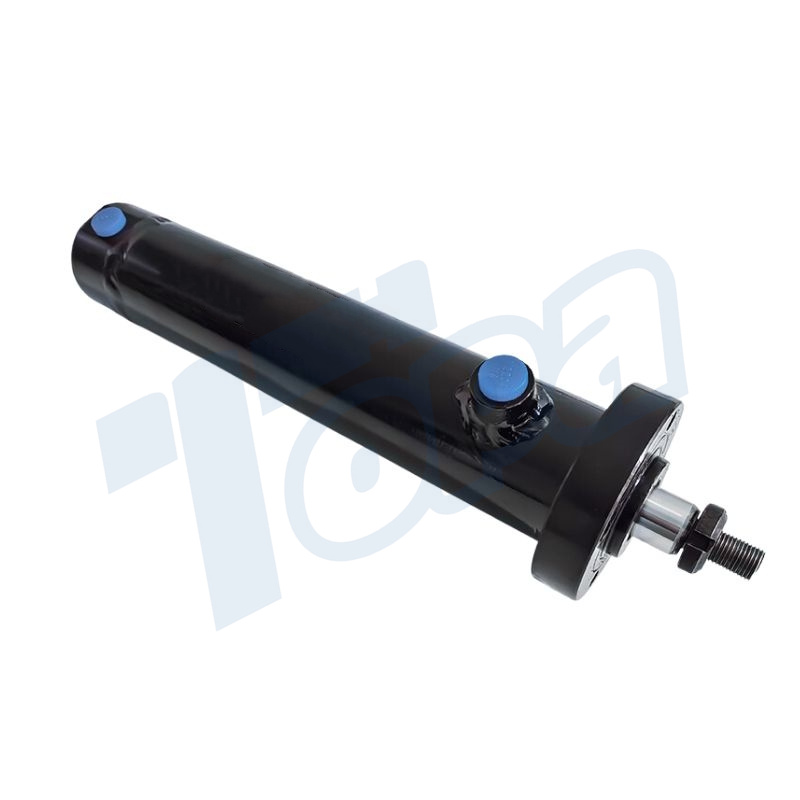
Flange Hydraulic Cylinder

HSG Series Flange Hydraulic Cylinder

Topa flange hydraulic cylinders are designed for equipment that requires a fixed mounting interface and controlled linear movement. The mounting flange secures the cylinder to the machine structure, with its dimensions and position matched to the installation requirements.

Cylinder Barrel: The core structure, typically made from durable steel, houses the piston and the hydraulic fluid.

Piston: Precision-engineered to move seamlessly within the barrel, converting hydraulic pressure into mechanical force.

Piston Rod: A hard-wearing rod that extends from the piston, transferring the lifting force to the machine component.

Front Flange: A robust mounting plate at the base of the barrel, designed for secure attachment and easy integration into various machinery.

Seal Gland: Located at the head of the cylinder, it contains high-quality seals to prevent leaks and maintain pressure integrity.

Hydraulic Ports: Strategically placed for optimal fluid flow, allowing for smooth and efficient cylinder operation.

End Cap: Seals the opposite end of the barrel, ensuring the hydraulic fluid is contained and the pressure is maintained.

For a new design or an existing cylinder replacement, send us your drawing, flange dimensions, stroke, and working pressure. We can review the mounting interface, rod-end connection, and port arrangement to help define the required configuration.

Description

HSG series flanged hydraulic cylinders have a sleek cylindrical shape with a sturdy flange at one end for mounting. The bodies are typically made of steel for a rugged appearance. The external surfaces are usually in industrial colors such as black or red, or can be customized to meet customer requirements.

The main purpose of these cylinders is to convert hydraulic energy into linear motion. This makes them ideal for applications that require a strong and controlled push and pull action. The end flanges provide a stable base that allows the cylinders to apply force without movement or misalignment.

In terms of pressure range, the HSG series can operate effectively over a wide range. They can typically withstand pressures ranging from 2,000 PSI to 5,000 PSI or higher for heavy-duty industrial needs. The stroke length (i.e., how far the piston rod can extend) is variable and can be tailored to the specific needs of the application, ensuring versatility in different situations.

Features of Flange-Mounted Hydraulic Cylinders

Fixed Mounting Interface
The flange provides a defined attachment point between the cylinder and the machine structure. Hole positions, locating features, and mounting dimensions can be specified to match the equipment.

Straight-Line Force Transfer
Flange mounting supports applications with a fixed cylinder position and a guided linear load path. Correct alignment helps limit unnecessary loading on the rod and guiding components.

Application-Specific Stroke
Stroke and retracted length can be specified together to suit the required movement and available installation space.

Flexible Connection Layout
Port positions and rod-end connections can be reviewed to accommodate hose routing, surrounding components, and assembly access.

HSG Series Flange Hydraulic Cylinder

At Topa, quality inspection of HSG series flanged hydraulic cylinders begins with a meticulous visual inspection. Our inspectors check each cylinder for any external defects. We then perform dimensional verification, measuring all aspects of the hydraulic cylinder with precision instruments to confirm that it meets standard specifications.

After this initial inspection, we perform a series of functional tests. High-pressure tests are performed on the cylinders to verify the limits of the cylinders and ensure that they can withstand the specified PSI without failure. We also perform a leak test to ensure the integrity of the seals. Only after a cylinder successfully passes these rigorous tests do we approve it for delivery, ensuring that customers receive a product that embodies the strength and reliability that Topa stands for.

Contact us today to place your order!

Selecting the Right Flange Mounting Arrangement

Confirm the Main Load Direction

Identify whether the cylinder mainly pushes, pulls, or carries substantial loads in both directions. The mounting position and supporting structure should be selected to suit these forces.

Match the Flange Interface

Check the flange thickness, hole diameter, hole spacing, and any locating features. A similar-looking flange may still require different mounting dimensions.

Check Alignment and Load Guidance

The rod should move in line with the load. If the machine mechanism changes angle during travel, the mounting arrangement needs further review. A fixed flange does not provide a pivoting connection.

Review Installation and Service Space

Allow space for the full rod travel, hose connections, mounting tools, and maintenance work. Port access should be checked with the cylinder installed in its intended position.

Topa hydraulic cylinder factory welding

Other Products

Contact Topa

Save 30% on maintenance costs with our easy-install hydraulic fittings. Contact Now!