BSP stands for British Standard Pipe. It refers to a family of 55-degree Whitworth pipe threads used on valves, adapters, hose fittings, instruments, pneumatic components, and hydraulic equipment in many markets outside North America.
“BSP” by itself is not a complete thread specification. The connection may use a parallel thread or a tapered thread, and the thread may or may not be the surface that creates the pressure seal. This distinction is why two fittings described casually as “BSP” can have the same nominal size yet require different ports, seals, or assembly methods.
BSP connections are commonly divided into two groups. BSPP uses parallel threads and is usually identified by the letter G. BSPT belongs to the ISO 7 pressure-tight thread system and uses designations such as R, Rp, and Rc. Both families use a 55-degree Whitworth thread form with rounded crests and roots, but their thread geometry and sealing arrangements are different.
The terms BSPP and BSPT are useful starting points, but the markings on drawings and components provide a more precise description.
BSPP refers to British Standard Pipe Parallel threads. These are constant-diameter threads covered by ISO 228-1 and normally identified by the letter G. ISO 228 threads provide mechanical retention; the pressure seal must be created at a separate sealing surface.
BSPT refers broadly to the tapered pipe-thread system covered by ISO 7-1. In this system, R identifies a tapered external thread, Rp identifies a parallel internal thread, and Rc identifies a tapered internal thread. An R male thread may form an ISO 7 pressure-tight joint with a compatible Rp or Rc female thread when the size, thread specification, engagement, and sealing method are correct.
The terms “parallel” and “tapered” describe thread geometry, not the allowable working pressure. A BSPP fitting is not automatically a low-pressure component, and a BSPT fitting is not automatically suitable for high-pressure hydraulic service. Pressure capability must be taken from the rating of the complete fitting, port, seal, and assembly.
A BSPP thread has a constant diameter along its threaded length. It is commonly marked with the letter G, followed by the nominal size, such as G1/4, G1/2, or G3/4.
The parallel threads hold the components together but are not intended to create a pressure-tight seal by thread interference. The actual sealing surface depends on the connection design. A BSPP port may use a bonded seal or sealing washer under the fitting shoulder. Other hydraulic connections use an O-ring, a machined port face, or a 60-degree cone seat.
This distinction matters during replacement. Two components can both have G1/2 threads and still use different sealing interfaces. A flat-face port designed for a bonded seal should not be treated as equivalent to a female swivel connection that seals on a 60-degree cone. The thread may assemble, but the connection can still leak if the mating seat or sealing element does not match.
When specifying a BSPP fitting, include the nominal thread size and the sealing style. “G1/2 male with bonded seal” or “G1/2 female swivel with 60-degree cone seat” is more useful than simply writing “1/2 BSP.”
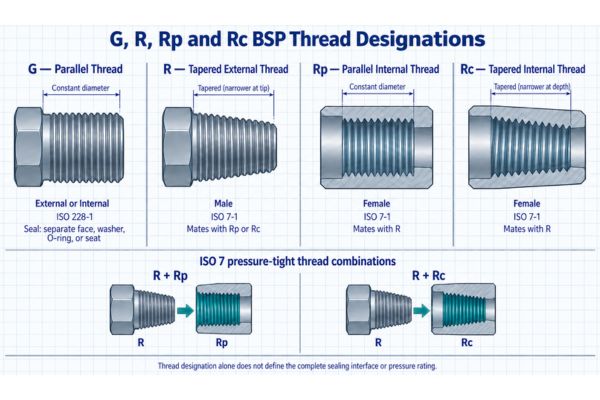
Image for illustrative purposes only
BSPT connections use the 55-degree Whitworth thread form and a taper of 1 in 16 on the tapered member. The changing diameter creates increasing thread interference as the male and female components are tightened.
The ISO 7 designation shows which side is tapered:
– R identifies a tapered external thread.
– Rp identifies a parallel internal thread intended to mate with an R external thread.
– Rc identifies a tapered internal thread intended to mate with an R external thread.
A compatible R male thread may therefore connect with either an Rp or Rc female thread, depending on the specified port and application. This is different from a G thread under ISO 228, even though some basic diameters and pitches may appear similar.
BSPT should not be described as requiring no sealant. In a conventional metal pipe-thread joint, a suitable thread sealant is normally used to fill the helical leakage path and lubricate the threads during assembly. The sealant must be compatible with the fluid, temperature, fitting material, and system requirements. PTFE tape or a general pipe compound should not be assumed suitable for every hydraulic fluid, gas, chemical, oxygen, or plastic-port application.
Feature | BSPP | BSPT / ISO 7 |
Thread geometry | Parallel | Tapered external thread; compatible internal thread may be parallel or tapered |
Common designation | G | R, Rp, Rc |
Main standard | ISO 228-1 | ISO 7-1 |
Thread angle | 55° Whitworth | 55° Whitworth |
Sealing location | Separate face, washer, O-ring or cone seat | Pressure-tight joint made at the threads |
Thread sealant | Normally not applied to create the seal on G threads | Normally required for conventional tapered-thread assembly |
Pressure capability | Depends on complete connection rating | Depends on complete connection rating |
Typical identification | Constant thread diameter | Diameter changes along tapered member |
Interchangeability | Requires matching seal design | Requires correct R/Rp/Rc combination |
BSP threads are governed by several key standards that ensure compatibility and reliability across various applications and industries.
BS 21:
BS 21 is the original British Standard for pipe threads, providing the foundational specifications for BSP threads. This standard encompasses both parallel and taper threads used in pipework and fittings. It ensures that threaded components are compatible and can form pressure-tight joints when needed.
ISO 228:
ISO 228 is an international standard that specifies the requirements for pipe threads where pressure-tight joints are not made on the threads. This standard applies primarily to BSPP (British Standard Pipe Parallel) threads. The focus here is on ensuring that threads maintain consistent dimensions and profiles, allowing for the use of sealing washers or O-rings to achieve a pressure-tight connection.
ISO 7:
ISO 7 outlines the specifications for pipe threads where pressure-tight joints are made on the threads themselves. This standard applies to BSPT (British Standard Pipe Taper) threads, which are designed to deform slightly when tightened to create a secure, leak-proof seal. ISO 7 ensures that the taper angle and thread profiles are consistent, providing reliable performance in high-pressure applications.

Marking | Thread form | Connection position | Sealing function |
G | Parallel | External or internal | Does not seal on the threads |
R | Tapered | External | Used in ISO 7 pressure-tight joints |
Rp | Parallel | Internal | Mates with a compatible R male thread |
Rc | Tapered | Internal | Mates with a compatible R male thread |
Do not identify a BSP thread from appearance alone. A short tapered thread can look almost parallel, and several pipe-thread families have similar nominal diameters. Use the component marking, thread geometry, measured diameter, pitch, and sealing surface together.
Start by checking the drawing, catalog, or marking on the component. A G prefix usually indicates an ISO 228 parallel thread. R, Rp, or Rc indicates an ISO 7 jointing thread. The marking is useful evidence, but it should be confirmed when a component is unmarked, worn, plated, or supplied under an older part number.
Next, determine whether the thread is parallel or tapered. On a male thread, measure the outside diameter near the first full thread and again farther back. A consistent diameter suggests a parallel thread, while a measurable increase toward the fitting body suggests a tapered external thread. Use measurements as part of the identification process rather than relying on the apparent shape.
Measure the pitch with a suitable thread-pitch gauge and compare the outside diameter with a BSP reference chart. Finally, inspect the end of the fitting and the port. A flat shoulder, bonded seal, O-ring, 60-degree cone, or machined seat may reveal where the connection is intended to seal.
Before approving a replacement, confirm:
– Nominal BSP size
– G, R, Rp, or Rc designation
– Male or female connection
– Threads per inch
– Parallel or tapered geometry
– Sealing surface
– Mating component
– Material and finish
– Required pressure and fluid compatibility
Accurate identification often requires precise measurement tools:
Thread Gauge: A thread gauge is an essential tool for measuring the pitch of the threads. By matching the threads against the gauge, you can determine the number of threads per inch or the thread pitch in millimeters.
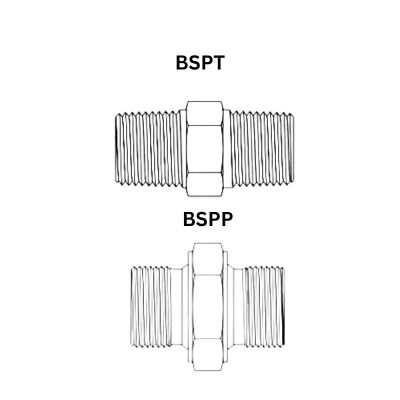
Calipers: These are used to measure both the outer diameter (OD) and inner diameter (ID) of the threads. For BSPP threads, the OD should be consistent along the length, whereas, for BSPT threads, the OD will decrease from one end to the other.
To measure:
Use the calipers to measure the OD at several points along the thread length. Consistency in measurement indicates BSPP, while a decrease in diameter suggests BSPT.
Use the thread gauge to check the thread pitch. Ensure the gauge fits snugly into the threads for an accurate reading.
NPT Threads:
Tapered with a 60-degree thread angle: NPT threads are designed with a taper and a 60-degree thread angle. The taper ensures that as the threads are tightened, they deform slightly to create a tight, leak-proof seal.
Primarily used in North America: NPT threads are widely adopted in the United States and Canada, serving as the standard for plumbing and pipe fittings in these regions.
Comparison:
Thread Angle and Pitch:
BSPT threads: These have a 55-degree thread angle and a unique pitch that differs from NPT threads. The slight difference in thread angle and pitch means BSPT and NPT threads are not interchangeable.
BSPP threads: These are parallel threads, maintaining a constant diameter along their length, unlike the tapered NPT threads. This fundamental difference in design affects how each type achieves a seal and their respective applications.
Usage and Compatibility:
BSPT vs NPT: While both BSPT and NPT threads are tapered and designed to form a seal through thread deformation, the different angles and pitches make them incompatible without specialized adapters.
BSPP: These threads require additional sealing components, such as O-rings or washers, unlike NPT threads, which rely on the thread taper to achieve sealing.

Metric Threads:
Defined by ISO 261 with a 60-degree thread angle: Metric threads follow the ISO 261 standard and feature a 60-degree thread angle. They are widely used in European machinery and manufacturing due to their standardized nature.
Commonly used in European machinery: Metric threads are the go-to choice for various applications across Europe, especially in the automotive and mechanical engineering sectors.
Comparison:
Thread Angle and Form:
BSP Threads: BSP threads have a 55-degree angle, differing from the 60-degree angle of metric threads. Additionally, the thread form of BSP threads is distinct, characterized by the Whitworth profile.
Sizing:
Metric Threads: These use the nominal outer diameter (OD) for sizing, providing a direct measurement of the thread’s external diameter.
BSP Threads: These use the nominal bore, which refers to the internal diameter of the pipe, not the thread’s outer diameter. This difference in sizing methodology can lead to confusion if not properly understood.
Proper installation of BSP threads is crucial for ensuring leak-free and reliable connections. Here are some best practices:
Ensure Clean and Undamaged Threads: Before starting the installation, inspect the threads for any dirt, debris, or damage. Clean the threads using a brush or cloth to remove any contaminants. Damaged threads should be repaired or replaced to prevent leaks and ensure a secure connection.
Use Appropriate Sealing Components for BSPP Threads: BSPP threads require sealing components like washers or O-rings to achieve a leak-proof connection. Ensure that these components are in good condition and compatible with the fluids being used in the system.
Having the right tools and equipment is essential for the proper installation of BSP threads:
Wrenches: Adjustable wrenches or spanners are needed to tighten the fittings.
Thread Gauges: These are used to measure the thread pitch and ensure compatibility with other components.
Calipers: Useful for measuring the outer and inner diameters of the threads.
Sealant Tapes: PTFE (Polytetrafluoroethylene) tape or similar thread sealants are used for enhancing the sealing of BSPT threads.
Thread Sealant: For BSPT threads, applying thread sealant can help ensure a tight and leak-free seal. Choose a sealant that is compatible with the system’s fluids.
To achieve a reliable and leak-free connection, follow these tips:
Tighten Threads to Manufacturer Specifications: Over-tightening can damage the threads or sealing components while under-tightening can result in leaks. Always follow the manufacturer’s torque specifications to ensure optimal tightness.
Use Thread Sealants Appropriately: For BSPT threads, apply an appropriate amount of thread sealant or PTFE tape. Wrap the tape in the direction of the threads to prevent it from unraveling during assembly.
Regular maintenance is vital for the longevity and reliability of BSP threaded connections:
Regularly Inspect Connections: Periodically check the connections for signs of wear, corrosion, or damage. Look for any leaks or signs of fluid seepage.
Replace Worn-Out Sealing Components: Washers, O-rings, and other sealing components can degrade over time. Replace them promptly to maintain the integrity of the connection.
Check for Leaks and Retighten or Reseal as Necessary: If leaks are detected, identify the source and address it immediately. Retighten the connections to the specified torque or reapply the thread sealant if necessary.
By following these best practices and maintenance tips, you can ensure that BSP threaded connections remain secure, leak-free, and reliable throughout their service life. Proper installation and regular maintenance not only enhance the performance of the system but also prevent costly downtimes and repairs.
In summary, BSP threads are a vital component in various industrial applications, offering reliable and standardized pipe connections. Understanding the differences between BSPP and BSPT, recognizing the relevant standards, and knowing how to identify and install these threads are essential skills for professionals in the field. For further reading and exploration, consult additional resources and industry standards to deepen your knowledge and expertise.
BSP stands for British Standard Pipe. It refers to a family of standard screw threads used internationally for interconnecting and sealing pipes and fittings.
BSPP threads are parallel and require sealing components like washers or O-rings, while BSPT threads are tapered and achieve sealing through thread deformation.
BSPP and BSPT threads are not typically used together due to their different sealing mechanisms. BSPP threads require a sealing component, whereas BSPT threads rely on the taper for sealing.
BSP threads have a 55-degree Whitworth profile. BSPP threads maintain a constant diameter along their length, while BSPT threads taper. Thread markings, such as “G” for BSPP and “R” for BSPT, and measurements with thread gauges can also help in identification.
BSP threads are not compatible with NPT (National Pipe Thread) threads due to differences in thread angle (55 degrees for BSP, 60 degrees for NPT) and pitch. Special adapters are required to connect BSP and NPT threads.
Essential tools for installing BSP threads include adjustable wrenches or spanners, thread gauges, calipers, PTFE tape or thread sealant (for BSPT threads), and sealing components like washers or O-rings (for BSPP threads).