
Low MOQ hydraulic fittings can help a small repair shop refill proven fast-moving items without committing cash to a broad catalog. The benefit comes from smaller, more frequent, evidence-based orders—not from buying a few pieces of every thread and size. Start with fittings that repeatedly support the hoses, equipment, and connection standards seen at your bench, then set a reorder rule for each SKU. This keeps common repairs moving while limiting slow stock, incorrect substitutions, emergency freight, and bins filled with parts that cannot be assembled under valid crimp data.
What Does Low MOQ Actually Solve?
It reduces order size, not inventory uncertainty
A low minimum order quantity lowers the number of pieces you must buy on one purchase line, which can make frequent replenishment and small-scale testing more practical. It does not tell you which fittings are common, whether demand will repeat, or whether the part matches your hose system. If a SKU is technically unclear or rarely used, a smaller purchase creates less excess than a large one but still consumes cash, bin space, receiving time, and attention.
One-piece fittings simplify only part of the workflow
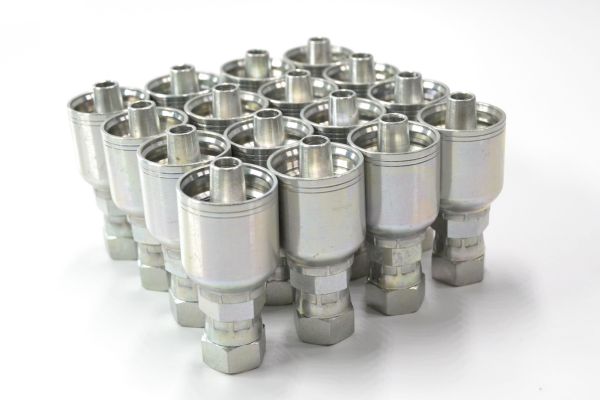
A one-piece hydraulic hose fitting normally has the fitting body or stem and ferrule preassembled or fixed as one component, although construction varies by series. This can reduce the warehouse and assembly error of pairing a stem with the wrong loose ferrule. It does not make the connection end, hose series, dash size, pressure suitability, or crimp setting universal, so low MOQ purchasing still needs a verified part specification.
Which Common Fittings Should Be Refilled First?
Let completed jobs and missed sales define “common”
Review a useful period of repair tickets, hose assembly records, sales, stockouts, lost jobs, returns, and emergency purchases. Group demand by complete fitting SKU rather than broad labels such as “JIC fitting” or “Metric elbow,” because the same connection family contains different sizes, orientations, hose tails, and seals. The fittings that recur across several jobs and remain technically supported form the first refill list; the method for building fast-moving one-piece fitting stock should guide this decision. Where records are incomplete, begin logging every issued, unavailable, substituted, returned, and urgently purchased fitting before expanding the range, since memory tends to overvalue recent emergencies and overlook steady routine use.
Capture enough detail to distinguish a usable stock item:
- internal and source part numbers, plus a controlled description;
- straight, 45-degree, or 90-degree form and required orientation details;
- male or female connection, thread size and pitch, seat, and sealing method;
- hose manufacturer, series, construction, ID or dash size, and fitting series;
- location of current crimp and assembly instructions.
Include service impact without confusing it with popularity
A fitting used every week normally deserves different treatment from one used twice a year, but frequency is not the only signal. A moderate-use SKU may still justify a small service quantity when its absence repeatedly stops a repair, the replenishment time is long or unreliable, and no approved substitute is available. Record that reason explicitly; otherwise, every urgent request can be misclassified as a permanent fast mover. Also separate broad demand from one-machine demand: a frequently ordered fitting tied to a single scheduled account or piece of equipment may need job-linked stock rather than an unrestricted local minimum.
How Should a Small Shop Divide Its SKU List?
Use three action classes instead of one “common” bin
Divide the list by repeat demand, technical certainty, replenishment time, and service consequence. The classes are decisions, not fixed volume thresholds, so each shop should set them from its own records. A simple structure keeps low MOQ from turning into a reason to stock every attractive catalog item. Give every classification a review date and an owner, because a core fitting can become slow after the local equipment mix changes, while a former special item can become a repeat requirement after several verified repairs; record the reason whenever the class changes.
| Stock class | Typical evidence | Replenishment action |
|---|---|---|
| Core | Repeated demand, complete specification, supported hose and crimp data | Hold locally, set a minimum and reorder point, review usage regularly |
| Service | Lower or uneven demand, but a justified repair impact and verified compatibility | Hold a controlled small quantity or replenish on a planned schedule |
| Special | Rare, custom, unclear, safety-critical, or technically unsupported demand | Order against a confirmed job or use a separate approval process |
Keep similar-looking standards physically distinct
Separate JIC, NPT/NPTF, ORFS, BSPP/BSPT, Metric, DIN, and JIS items by controlled descriptions and bin labels rather than color or memory. Two fittings may have close diameters yet use different pitches, thread forms, seats, or seals. Low quantities do not reduce mismatch risk if several standards are mixed in one drawer; they can make identification harder because the label and reference sample are easier to lose.
How Do You Set Reorder Points Without Overbuying?
Base the trigger on demand during replenishment
For each core SKU, estimate expected consumption while a replacement order is in transit, then consider justified protection for demand or lead-time variation. The reorder point is the stock position at which purchasing must begin, not the quantity to buy and not automatically the same as minimum stock. Use actual order intervals and supplier lead-time performance instead of a generic number copied across all fitting sizes. Track stock position as usable on-hand quantity plus confirmed inbound supply minus committed demand, because counting quarantined returns, unidentified parts, or overdue purchase orders as available can postpone replenishment until the shelf is effectively empty.
The basic record should show:
- normal usage pattern and whether demand is steady, intermittent, or seasonal;
- available stock, open purchase orders, and committed quantities;
- typical and delayed replenishment times;
- supplier pack quantity, MOQ, and feasible order frequency;
- consequence of a stockout and any approved alternative source or adapter route.
Choose order quantity from the next review cycle
Order enough to cover expected demand until the next planned review or replenishment opportunity, plus any justified safety stock, then subtract usable stock and confirmed inbound supply. A low MOQ gives you freedom to order closer to this requirement, but freight, receiving work, pack quantities, and payment terms still affect the economic choice. Do not enlarge every line merely to obtain a lower unit price; compare the saving with carrying cost, slow-stock risk, and the chance that demand or specifications will change.
How Can Low-MOQ Lines Be Combined Efficiently?
Consolidate compatible replenishment needs
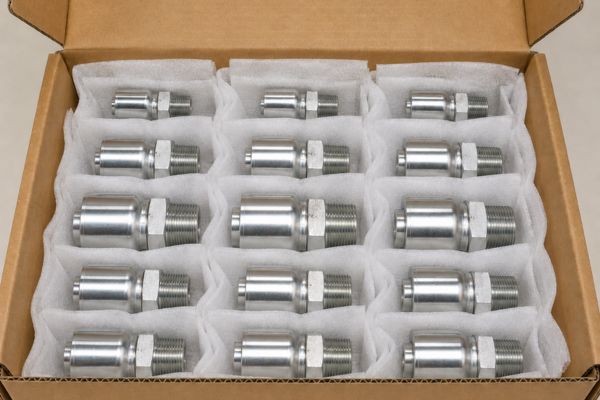
Create a regular review day and combine the core and justified service items that have reached their reorder triggers. Consolidation can reduce repeated quotation, freight, receiving, and payment work while preserving line-level quantities based on demand. Keep each fitting as a separate controlled line with its full part description; a combined purchase order must not become a mixed box that receiving staff cannot trace to the correct bin.
Before releasing a combined order, verify:
- Each line has a current demand reason and intended stock class.
- Part number, connection, hose size, fitting series, material, and finish are complete.
- MOQ and pack quantity do not force unexplained excess.
- The expected arrival fits the repair coverage and available stock.
- Labels and packaging will preserve SKU identity through receiving and storage.
Compare total replenishment cost, not MOQ alone
An offer with a smaller MOQ can still be expensive if it requires frequent urgent freight, creates many receiving transactions, uses unclear packaging, or supplies parts that need repeated dimensional sorting. A slightly larger line may be reasonable when demand is stable and the total landed and handling cost is lower, while even one piece is too many for an unresolved specification. Evaluate price, freight, payment charges, inspection work, carrying time, mismatch exposure, and stockout impact together. Keep these costs at SKU or order-line level where practical; otherwise, low-volume items can appear profitable because their emergency freight, sorting time, and write-offs are hidden inside the cost of faster-moving lines.
What Must Be Confirmed Before a Fitting Enters Stock?
Verify both the equipment connection and hose side
Confirm male or female form, thread diameter, pitch or TPI, straight or tapered thread, seat angle, sealing face, and any O-ring, bonded seal, or washer. Then verify the hose manufacturer and series, hose ID or dash size, construction, fitting series, and required preparation. A brand number, photograph, or similar outside diameter can narrow a search, but the one-piece fitting cross-reference process must keep unconfirmed attributes visible until measurements and technical data agree.
Use current crimp data for the exact combination
Crimp diameter, measurement location, insertion depth, die selection, skive or no-skive preparation, and inspection method must apply to the actual hose, fitting, size, and crimping equipment. Parker’s hydraulic hose and fitting catalog likewise separates hose type, fitting series, end configuration, connection size, and hose size in its ordering logic. Complete the one-piece fitting hose-compatibility checks before a low-MOQ sample becomes routine stock; a small quantity of an unsupported combination is still a technical risk.
What Is the Simplest Repeatable Restocking Workflow?
Test uncertain items before normal replenishment
When a new source, cross-reference, finish, or fitting series is proposed, keep it out of normal stock until a controlled sample or small trial has passed the defined document, dimensional, labeling, assembly, and application checks. The one-piece fitting trial-order checklist helps separate confirmed lines from open technical questions. Record deviations by SKU and do not use a successful sample from one size or configuration to approve every related item automatically.
Review, refill, and remove on a fixed cycle
At each review, update usage, stockouts, returns, emergency purchases, open orders, lead-time performance, and any technical changes. Recalculate the action when demand shifts: raise protection only where the record supports it, move intermittent items to service stock, and stop automatic replenishment for obsolete or repeatedly idle SKUs. A fitting can remain technically valid while no longer earning local shelf space, so technical approval and stocking approval should stay as two separate decisions.
Final Restocking Decision
Low MOQ hydraulic fittings help a small repair shop when they support more frequent replenishment of proven core and service SKUs. They do not replace demand records, complete part descriptions, hose compatibility, or current crimp data. Build the refill list from actual jobs and stockouts, classify each item, set its reorder trigger from consumption and lead time, and combine only the lines that are genuinely due. Before ordering, prepare fitting part numbers, connection and seal details, hose manufacturer and series, sizes, material and finish, crimping equipment, crimp-data source, stock class, estimated use, and receiving requirements; remove automatic replenishment when evidence no longer supports the shelf space.
Frequently Asked Questions
What is a good MOQ for a small hydraulic fitting order?
There is no universal good MOQ; the useful quantity is the amount that fits verified demand, the replenishment cycle, pack constraints, inspection needs, freight economics, and acceptable carrying risk.
Should every commonly requested thread family be kept in stock?
No. Keep the complete SKUs that recur in your actual work and can be assembled under verified technical data, not one token item from every JIC, BSP, Metric, ORFS, or NPT family.
Can adapters reduce the number of hose fittings held locally?
Approved adapters can cover some verified transitions, but they add connections, length, and sealing interfaces; use them only when pressure, material, routing, and equipment requirements allow the specific arrangement.
How often should fitting reorder points be reviewed?
Review them on a consistent cycle and after meaningful changes in demand, lead time, equipment mix, seasonality, source, or part specification rather than following one fixed interval for every shop.
Does a one-piece fitting always reduce inventory?
It can reduce separate stem-and-ferrule combinations and related picking errors, but total inventory still depends on how many hose sizes, fitting series, thread standards, orientations, materials, and service needs the shop supports.