
Mixing hydraulic fitting thread types causes problems because JIC, NPT, ORFS, BSP, and Metric connections do not share one thread form or one sealing method. Two parts may begin to screw together, yet their pitch, taper, seat, or seal can still be incompatible. That false fit can damage a port, cut an O-ring, leave the real sealing surfaces apart, or create a connection that leaks after pressure, impulse, or vibration begins. A reliable repair therefore requires identification of the complete connection—not a visual match or a successful first turn of the nut.
Why Thread Engagement Does Not Prove Compatibility
The thread may only provide clamping force
Many hydraulic connections do not seal on the thread. A JIC connection uses straight UN/UNF threads to pull matching 37-degree flare surfaces together, while ORFS uses straight threads to compress an O-ring between flat faces. In both cases, the threads retain and load the joint, but the seat or O-ring contains the fluid. Matching the thread diameter while ignoring the sealing face can therefore produce full-looking engagement with no valid fluid seal.
Tapered pipe connections work differently. NPT or NPTF and BSPT develop interference as the male and female threads tighten, but they use different thread forms and may use different pitches for apparently similar nominal sizes. A parallel BSPP connection is different again: the thread normally provides retention while a cone, bonded seal, O-ring, or another specified face arrangement performs the sealing. Treating every “pipe thread” as the same connection confuses both geometry and seal location.

A one-piece fitting solves only the hose-side handling problem
A one-piece hydraulic hose fitting normally has its fitting body or stem and ferrule preassembled or fixed as one component, although the retention design varies by series. This can reduce the chance of picking a loose ferrule that does not belong with the stem. It does not identify the equipment port, make different thread standards interchangeable, or prove that the fitting series matches the hose and crimp specification. The one-piece fitting seal-mismatch check should therefore be completed before the fitting becomes permanently attached to the hose.
How JIC, NPT, ORFS, BSP, and Metric Connections Differ
Compare the sealing system, not just the name
Each label describes a particular family of thread and sealing geometry. The table is an identification starting point, not an interchange chart; exact size, pitch, seat dimensions, seals, and applicable standard still require confirmation from controlled technical data.
| Connection family | Typical thread behavior | Intended sealing feature | Frequent mixing error |
|---|---|---|---|
| JIC | Straight UN/UNF | Matching 37° metal flare surfaces | Thread engagement is accepted without checking the 37° seat |
| NPT/NPTF | Tapered U.S. pipe thread | Specified thread interference and sealing practice | Forced into BSPT because both appear tapered |
| ORFS | Straight UN/UNF | O-ring compressed at a flat face | Confused with another straight thread or face-seal design |
| BSPP | Parallel 55° Whitworth-form pipe thread | Connection-specific cone, washer, bonded seal, or O-ring arrangement | Assumed to seal on the parallel thread alone |
| BSPT | Tapered 55° Whitworth-form pipe thread | Specified thread interference and sealing practice | Treated as NPT because the nominal pipe size sounds familiar |
| Metric | Usually identified by metric diameter and pitch; parallel and tapered forms exist | Depends on the system: 24° cone, O-ring, face, flare, or another specified design | “Metric” is treated as one universal seat and seal |
“Metric” and “BSP” are families, not complete specifications
Calling a fitting Metric does not tell you whether it uses a DIN/ISO 24-degree cone, a metric O-ring port, a metric flare, or another system. Likewise, BSP must be separated into BSPP and BSPT, then further identified by the actual sealing arrangement. Even when two families use straight threads, the pitch, flank form, seat angle, and seal location may disagree. Use a detailed hydraulic fitting standards identification process instead of converting a regional label directly into a part number.
What Actually Happens When Different Thread Types Are Mixed
Partial engagement can deform the threads and port
Close diameters and pitches can let mismatched threads start, especially when a worn part, contamination, or limited access hides the resistance. Continued tightening does not correct the mismatch; it can cross-thread the connection, flatten thread crests, distort the female port, or concentrate load on only a few threads.
Port damage matters because replacing the hose fitting alone may no longer restore the joint. The mating adapter, valve, cylinder, or manifold can retain deformed threads or a damaged spotface, so the next correct fitting may also leak or fail inspection. Unusual resistance, shallow engagement, or a need for excessive torque is a stop signal, not evidence that a different standard can be made to fit.
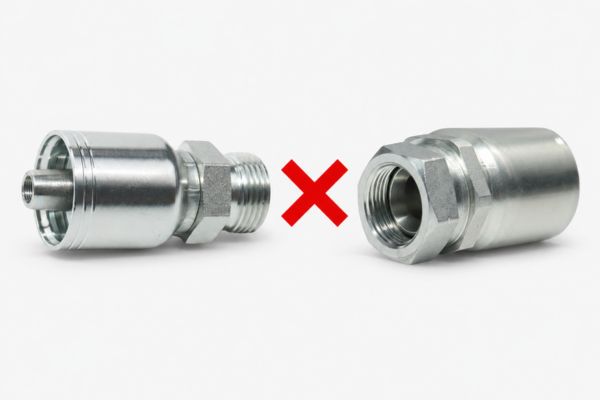
The wrong surfaces never create the designed seal
A connection may tighten while the sealing elements remain misaligned. A JIC seat can contact the wrong cone at a narrow edge; an ORFS O-ring can be cut, extruded, or left without the correct face; a BSPP connection can lack its specified washer or cone; and mismatched tapered threads can engage unevenly. The result may be an immediate leak, or partial contact may appear dry during assembly and open later under working pressure, temperature change, impulse, or vibration.
Adding sealant cannot manufacture a missing 37-degree seat, correct a 55-degree versus 60-degree thread form, or repair a damaged O-ring face. Over-tightening can briefly reduce visible seepage while increasing deformation. These shortcuts also make the next diagnosis harder because witness marks no longer show the original geometry clearly.
How to Identify an Unknown Hydraulic Connection
Isolate the equipment and collect physical evidence
Shut the equipment down, release hydraulic pressure and stored energy, and follow the equipment and component manufacturers’ safety procedures before removing or inspecting a connection. Never use a hand to search for a pinhole leak or loosen a line to see whether it is pressurized. Once the part is safe to handle, clean it without changing the thread or sealing surfaces and collect evidence from both the old fitting and the mating port.
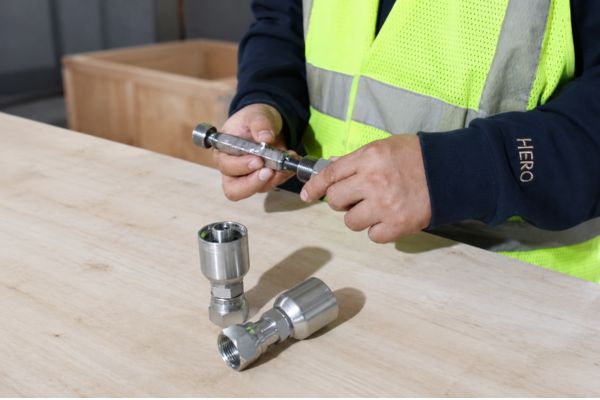
Record the features that can separate one standard from another:
- male or female connection, plus straight or tapered thread;
- thread outside diameter for a male part or the appropriate female-thread measurement;
- pitch in millimeters or threads per inch, checked with the correct gauge;
- flare, cone, flat face, groove, washer location, O-ring, and measured seat angle;
- readable part numbers, equipment-port designations, and clear photos of the complete connection.
Measure in a fixed sequence and cross-reference the result
Start by deciding whether the thread is parallel or tapered, then measure pitch and diameter rather than estimating them from a photo. Next, locate where the joint is designed to seal and inspect that surface for damage. Finally, compare the complete set of findings with an applicable standard chart, controlled drawing, parts list, or current manufacturer data. This sequence is also explained in a practical guide to identifying hydraulic fittings.
Use the following release order:
- Identify the thread form, size, pitch, taper, and connection sex.
- Identify the seat angle, face geometry, and required seal on both mating parts.
- Compare the measured combination with controlled reference data.
- Confirm the equipment port rather than copying an undocumented old replacement.
- Quarantine the part if measurements, markings, or documents conflict.
Why a Correct Port End Can Still Produce a Bad Hose Assembly
The hose tail must match the exact hose construction
Choosing the correct JIC, ORFS, NPT, BSP, or Metric connection only resolves the equipment side. The fitting stem and ferrule must also match the hose manufacturer and series, reinforcement construction, hose ID or dash size, and required preparation. Equal dash size does not prove compatibility because hoses with the same nominal bore can have different wall, reinforcement, cover, and fitting requirements. Use the six one-piece fitting hose-compatibility checks before assembly.
The one-piece format removes one loose-component decision, but the preassembled fitting can still belong to the wrong hose family. Selecting by stem appearance or bin label can produce difficult insertion, incorrect compression, hose damage, inadequate retention, or an assembly that cannot be validated. The complete fitting series and part number must be tied to the identified hose in current technical data.
Crimp data belongs to a specific assembly system
Crimp diameter, die selection, insertion depth, skive or no-skive preparation, crimp position, and inspection limits must apply to the actual hose, fitting series, size, and crimping equipment. A value from a similar fitting or another series is not a safe substitute. Verify full insertion and inspect the completed assembly using the documented procedure; a final diameter within a familiar range cannot rescue a hose assembled from incompatible components.
Pressure suitability also belongs to the complete assembly. The controlling limit may be the hose, fitting, port, adapter, or another interface, and service depends on fluid, temperature, impulse, routing, vibration, and installation. Do not assign a universal pressure rating merely because two parts share a thread label or nominal size.
The Safe Way to Connect Two Different Standards
Approve an exact match or use a specified transition
If the hose end and equipment port use different standards, do not force one into the other. Use a purpose-designed inter-series adapter whose two ends are each correctly specified, pressure-suitable, and compatible with the fluid, temperature, material, and environment. An adapter creates a controlled transition; it does not make the original standards interchangeable.
Before releasing the repair, verify:
- the complete designation and sealing method on both adapter ends;
- suitable seals, material, finish, pressure, temperature, and fluid compatibility;
- adequate clearance, orientation, alignment, and hose routing after installation;
- current assembly and tightening instructions for every connection in the load path.
More adapters create more interfaces to inspect
Avoid stacking several adapters merely to reach the needed geometry. Each added joint creates another sealing interface, changes installed length, and may increase bending load or interfere with routing. If a transition would require several pieces, or if the application is safety-critical, obtain an approved assembly design from the relevant equipment, hose, fitting, or connection manufacturer instead of improvising at the bench.
What Information Should Be Recorded Before Replacement?
Build a reusable connection record
A verified record prevents the next repair from starting with the same unknown fitting. Store the equipment location, mating-port designation, hose manufacturer and series, hose ID or dash size, fitting series and complete part number, connection sex, thread diameter, pitch or TPI, taper, seat angle, sealing method, fitting orientation, and approved crimp-data source. Add clear photos of the full fitting, thread, sealing face, hose layline, and installed routing without including sensitive customer information.
For the specific replacement, also record:
- working pressure, temperature, fluid, impulse, vibration, and environmental exposure;
- material and surface-finish requirements;
- crimping machine, dies, and applicable assembly specification;
- whether the part is for a repair, controlled stock, resale, or equipment production.
Stop when critical evidence is missing
If a damaged seat cannot be measured, the old fitting conflicts with the equipment record, or the hose layline and fitting series cannot be verified, do not guess from the closest sample. Preserve the old part and mating-port evidence, then obtain current data from the equipment, hose, fitting, port, or crimp-equipment manufacturer as applicable. Correct identification carries more weight than speed, unit price, or the fact that two threads seem to start.
Final Matching Decision
Mixing hydraulic fitting thread types fails because JIC, NPT, ORFS, BSP, and Metric connections combine different threads with different seats and seals; a part that screws in may still damage the port or leave the intended sealing surfaces apart. One-piece construction reduces stem-and-ferrule handling errors, but it cannot correct the wrong connection end, hose series, or crimp data. Before approving a replacement, identify thread diameter, pitch, taper, seat angle, sealing method, mating port, hose series, fitting series, and the applicable assembly procedure. When two standards must meet, use a fully specified adapter or approved design—not force, extra sealant, or visual similarity.
Frequently Asked Questions
Can NPT and BSPT fittings be used together if they tighten?
No. Their thread forms and pitches can differ even when their nominal sizes appear similar, so engagement does not establish a correct or pressure-suitable seal.
Can a JIC fitting seal against any 37-degree-looking cone?
No. Confirm the complete standard, thread designation, measured seat geometry, mating component, and condition of both metal sealing surfaces before treating the parts as compatible.
Does ORFS thread size identify the O-ring I need?
Not by itself. Use the fitting standard and manufacturer data to verify the correct O-ring dimensions, material, hardness where specified, and fluid and temperature compatibility.
Can thread sealant stop a leak caused by mixed fitting standards?
No. Sealant cannot correct a mismatched thread form, seat angle, face geometry, damaged sealing surface, or missing designed seal; its use must follow the verified connection specification.
Is a photo enough to identify a Metric or BSP hydraulic fitting?
No. A photo can narrow the possibilities, but final identification requires diameter, pitch or TPI, straight-versus-tapered form, seat angle, sealing method, and mating-port evidence.