
R1 single-wire braid hoses fail prematurely under high-pressure spikes because their reinforcement structure is only rated for constant working pressures up to 2,000 PSI depending on diameter. When you push these components into heavy-duty cycles, the thin wire reinforcement fatigues rapidly, leading to R1 hose fail incidents that result in immediate machine downtime and potential fluid injection injuries. In a busy workshop or construction site, a burst R1 hose doesn’t just mean a mess; it stops production and forces an emergency replacement that could have been avoided with proper specification.
Why Does R1 Hose Fail Under High Pressure Spikes?
R1 hoses fail because the single layer of high-tensile steel wire braid cannot absorb the kinetic energy of rapid pressure fluctuations common in modern piston pump systems. When the system pressure exceeds the rated limit, the wire reinforcement undergoes plastic deformation, losing its ability to contain the internal rubber tube.

How Internal Pressure Exceeds Reinforcement Limits
- Single-wire braiding offers lower hoop strength than multi-spiral or double-braid designs.
- Pressure “hammering” during valve shifts creates localized stress points.
- You will see the hose outer cover bubbling before the final rupture.
Visual Indicators Of Pressure Fatigue
- The wire braid appears “bird-caged” or separated at the point of failure.
- The inner tube shows longitudinal cracks.
- You might notice the hose stiffening due to repeated over-expansion.
| Failure Symptom | Probable Cause | Immediate Action |
| Longitudinal Burst | Over-pressurization | Check relief valve settings |
| Pin-hole leak | Wire fatigue/abrasion | Replace with R2 or 4SP |
The presence of longitudinal cracks usually points to a system running consistently above the hose’s dynamic pressure rating.
Can R1 Hose Withstand Constant Medium Pressure Cycles?
R1 hoses are engineered specifically for medium-pressure applications, such as return lines or low-pressure pilot circuits, where the flow is relatively stable. You will find that these hoses perform reliably as long as the working pressure remains within the SAE 100R1 standards, typically around 1,000 to 2,750 PSI depending on the dash size.
Determining Safe Operating Windows
- Check the layline of the R1 hose fail documentation to confirm the exact PSI rating for your specific diameter.
- Monitor fluid temperatures, as heat reduces the pressure-bearing capacity of the rubber.
- You should utilize R1 in suction lines where vacuum resistance is more critical than high-burst pressure.
Impact Of Duty Cycle On Service Life
- Intermittent use allows the wire braid to “rest” and cool.
- Continuous high-flow cycles accelerate the degradation of the internal nitrile tube.
- R1 hoses in return lines often outlast those in pressure lines by a factor of three.
Does Improper Fitting Selection Lead To R1 Hose Fail?
Improper fitting selection is a leading cause of assembly blow-outs because the bite of the ferrule must be calibrated specifically for the thinner wall of a single-wire braid hose. If you use a heavy-duty R2 or 4SP fitting on an R1 hose, the teeth may crush the wire reinforcement or fail to provide enough “grip,” leading to the hose blowing out of the coupling under load.
Matching Ferrule Bite To Hose Wall Thickness
- R1 hoses have a thinner outer diameter (OD) compared to R2 hoses of the same inner diameter (ID).
- Standard “non-skive” fittings must be verified for compatibility with the specific cover thickness.
- You will experience leaks at the crimp point if the compression ratio is incorrect.
Common Crimp Errors In The Field
- Under-crimping leads to the hose “walking” out of the shell.
- Over-crimping fractures the single layer of wire braid.
- Using used or reclaimed fittings compromises the integrity of the seal.
| Fitting Issue | Resulting Failure | Prevention Method |
| Incorrect Die Size | Leak at coupling | Use manufacturer crimp spec |
| Wrong Shell Type | Hose blow-out | Verify R1 vs R2 shell |
A secure connection depends entirely on the mechanical interlocking between the ferrule teeth and the steel wire reinforcement.
How Does Outer Cover Abrasion Cause R1 Hose Fail?
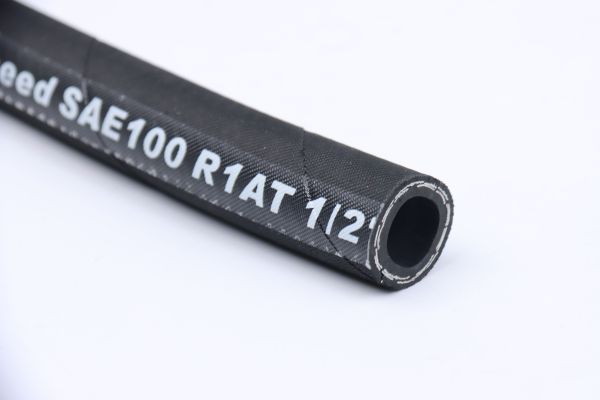
Outer cover abrasion exposes the single layer of steel wire to environmental moisture, leading to rapid corrosion and eventual R1 hose fail events. Since there is only one layer of braiding, once that wire is compromised by rust or physical wear, the hose has zero remaining structural integrity and will burst at the weakened spot.
Identifying High-Wear Zones On Equipment
- Hoses crossing over sharp metal edges are primary candidates for failure.
- Vibration causes the hose to “saw” against brackets or other hoses.
- You can prevent this by installing plastic spiral wrap or nylon sleeves.
Environmental Factors In Wire Corrosion
- Saltwater or road chemicals accelerate the oxidation of the steel braid.
- UV exposure cracks the synthetic rubber cover, letting moisture in.
- Internal condensation can also rot the wire from the inside out in poorly maintained systems.
| Abrasion Stage | Condition | Action Required |
| Scuffed Cover | Superficial | Monitor/Apply sleeve |
| Exposed Wire | Critical | Replace Immediately |
A small investment in protective sleeving can double the service life of an R1 assembly in harsh environments.
Is Excessive Bending Stress Rupturing Your R1 Hoses?
Excessive bending stress, particularly near the fitting, creates a “hinge point” that fatigues the wire braid until it snaps. Every R1 hose has a minimum bend radius specified by the manufacturer; if you force the hose into a tighter curve to save space, you are essentially pre-stressing the reinforcement to its breaking point before the pump even turns on.
Understanding Minimum Bend Radius Limits
- Bending the hose too tightly restricts flow and increases internal friction.
- Stress is highest at the tail of the crimped fitting where the hose loses flexibility.
- You should use 45-degree or 90-degree elbows to reduce the strain on the hose body
Signs Of Mechanical Stress Failure
- The hose looks “kinked” rather than curved.
- The wire braid is broken specifically on the outside of the bend.
- Fittings show signs of being pulled or torqued.
| Layout Error | Mechanical Effect | Solution |
| Tight Bend | Wire fatigue | Increase hose length |
| Torqued Assembly | Twist stress | Use live swivels |
Proper routing is an engineering requirement, not an aesthetic choice, for ensuring long-term hose reliability.
Why Does Fluid Incompatibility Cause R1 Hose Fail?
Fluid incompatibility causes the inner nitrile tube of the R1 hose to swell, harden, or dissolve, which eventually leads to an R1 hose fail as the oil reaches the reinforcement layer. While most R1 hoses are compatible with standard mineral oils, using them with biodegradable fluids, phosphate esters, or high-water-content glycols without checking compatibility charts will destroy the rubber liner from the inside.
Chemical Reactions Within The Inner Tube
- Incompatible fluids leach the plasticizers out of the rubber, making it brittle.
- Swelling can restrict flow, causing heat build-up and pump cavitation.
- You will see “black flakes” in your filters when the inner tube starts to disintegrate.
Selecting The Right Tube Compound
- Nitrile (NBR) is standard for most petroleum-based hydraulic fluids.
- EPDM is required for certain phosphate ester fluids but will fail with mineral oil.
- Check the hose layline for the specific compound code before installation.
| Fluid Type | Standard R1 (NBR) | Result of Mismatch |
| Mineral Oil | Compatible | Long life |
| Phosphate Ester | Incompatible | Rapid swelling/failure |
Ensuring chemical harmony between your fluid and your hose material is the first step in any procurement process.
Can High Operating Temperatures Melt Your R1 Hoses?
High operating temperatures exceed the thermal limits of the synthetic rubber, causing it to harden and crack, which is a classic precursor to an R1 hose fail. Most R1 hoses are rated for temperatures up to 100°C (212°F); once the oil temperature stays consistently above this mark, the rubber loses its elasticity and can no longer “seal” around the wire braid or the fitting.

Thermal Degradation Of Synthetic Rubber
- Heat causes the rubber to undergo a process similar to vulcanization, making it “plastic-like.”
- Hardened rubber cannot flex, leading to cracks when the hose moves.
- You will hear a “cracking” sound if you try to bend a heat-damaged hose.
Heat Shielding And Routing Strategies
- Route hoses away from exhaust manifolds or hot engine blocks.
- Install fire sleeves or heat-reflective tape in high-heat zones.
- Check that your oil cooler is functioning at 100% efficiency.
| Temperature Range | Effect on R1 Hose | Action |
| <100°C | Normal Operation | Routine check |
| >120°C | Rapid Hardening | Install heat shield |
A “baked” hose is a brittle hose, and a brittle hose is a failure waiting to happen during the next pressure spike.
How Do Pressure Surges Impact R1 Hose Integrity?
Pressure surges—often called “spikes”—can reach three to four times the normal operating pressure in milliseconds, far exceeding the burst pressure of an R1 hose. These spikes occur when a valve closes abruptly or a heavy load is suddenly dropped, sending a shockwave through the fluid that hits the R1 hose fail point with hammer-like force.
The Physics Of Hydraulic Shock
- The velocity of the fluid carries momentum that must be absorbed when flow stops.
- Single-wire reinforcement has very little “stretch” to dampen these shocks.
- You can detect these spikes using high-speed digital pressure transducers.
Mitigating Shock In Hydraulic Circuits
- Install accumulators to act as “shock absorbers” for the system.
- Use cushioned valves or soft-start electronics to ramp pressure.
- Upgrade to R2 (double-wire) or R12 (four-spiral) if spikes are unavoidable.
| System Event | Peak Spike (Est) | R1 Safety Margin |
| Normal Flow | 2,000 PSI | Safe |
| Sudden Valve Shut | 6,000 PSI | Immediate Failure |
If your machinery “shudders” when a cylinder hits the end of its stroke, your R1 hoses are taking a beating.
Does Poor Installation Technique Cause R1 Hose Fail?
Poor installation technique, specifically twisting the hose during tightening, introduces a constant torsional stress that drastically reduces the burst pressure of an R1 assembly. When a hose is twisted, the wire braid is pulled out of its optimal angle, meaning the R1 hose fail occurs because the reinforcement is fighting itself rather than the internal fluid pressure.
The Danger Of The “Twist” Stress
- A 7-degree twist can reduce the service life of a hydraulic hose by up to 90%.
- The layline (the printed text on the hose) should always be straight, never spiraled.
- You should use two wrenches: one to hold the hose and one to turn the nut.
If that printed line on the side of the hose looks like a candy cane, your installation is going to fail.
Ensuring Proper Hose Routing And Support
- Use clamps to prevent the hose from whipping or rubbing during cycles.
- Leave enough slack for the hose to contract (up to 4%) when pressurized.
- Avoid “S” bends that create multiple stress points in a short span.
| Installation Step | Correct Action | Failure If Ignored |
| Tightening | Use back-up wrench | Torsional rupture |
| Measuring | Allow for contraction | Pull-off at fitting |
Correct installation is the final, and perhaps most critical, step in preventing premature hydraulic system failure.
Conclusion
Understanding why an R1 hose fails is the first step toward achieving zero-downtime operations in your facility. By addressing pressure spikes, ensuring chemical compatibility, and mastering proper installation techniques, you can significantly extend the life of your medium-pressure circuits. Implementing these engineering standards reduces the frequency of emergency repairs and keeps your equipment running at peak efficiency. For more technical support on selecting the right reinforcement for your specific application, talk with our team to find the ideal solution for your hydraulic challenges.
FAQ
Can I use an R1 hose for high-pressure applications?
No. R1 hoses are rated for medium pressure only; using them in high-pressure systems will cause an immediate and dangerous burst failure.
How do I know if my R1 hose is failing internally?
Look for small black particles in your hydraulic filters or a sudden increase in system temperature, which indicates the inner tube is disintegrating.
What is the best way to prevent R1 hose abrasion?
Install a protective nylon sleeve or plastic spiral guard over the hose in areas where it contacts the machine frame or other components.
Can I repair a burst R1 hose with a joiner fitting?
It is not recommended for permanent use; a joiner creates two potential leak points and changes the hose’s flow characteristics and bend radius.
How long should an R1 hose last in storage?
If stored in a cool, dark place away from ozone sources, an R1 hose typically has a shelf life of up to ten years according to ISO standards.