A reliable one-piece fitting import order begins with technical identity, not price or visual similarity. This checklist helps sourcing teams verify hose compatibility, end connections, crimp data, samples, production consistency, and receiving records before imported fittings become saleable inventory. The objective is simple: prevent a low-cost purchase from turning into mismatched stock, hose assembly rework, leakage, or an unsupported interchange claim.
Define the Product Before Requesting a Quote
Treat the fitting as part of an assembly system
A one-piece hydraulic hose fitting normally combines the fitting body or stem and ferrule as one preassembled or fixed assembly component; its detailed construction varies by series. That design removes the need to select a separate ferrule during hose assembly, but it does not make the fitting compatible with every hose of the same dash size. An import specification must connect the fitting to a defined hose construction and valid crimp procedure.
Begin with the exact commercial and technical scope. State whether the order covers straight, 45-degree, or 90-degree configurations; hose sizes; fitting series; end-connection families; materials; finishes; and package quantities. Separate confirmed requirements from items that remain open, so a quotation does not silently convert an assumption into a production specification.
Build a controlled inquiry package
Send one revision-controlled inquiry sheet rather than specifications scattered across emails, photos, and spreadsheets. Each line item should include:
- Your internal part number and the proposed source part number.
- Hose manufacturer, hose series, hose ID or dash size, and hose construction to be assembled.
- Fitting style, orientation, male or female connection, and dimensional drawing.
- Thread form, nominal size, pitch or TPI, straight or tapered thread, seat angle, and sealing method.
- Material, surface finish, working environment, fluid, temperature, and applicable pressure requirements.
- Required crimp data, marking, packaging, documentation, estimated quantity, and intended use.
Existing branded part numbers may help identify a target, but they do not prove interchangeability. If a source proposes an alternative, require it to be evaluated against the complete specification rather than accepting “equivalent” as a technical conclusion. The inquiry revision should remain linked to the quotation, sample, purchase order, and receiving inspection.
Check 1: Verify Threads, Seats, and Sealing Methods
Similar-looking ends may seal differently
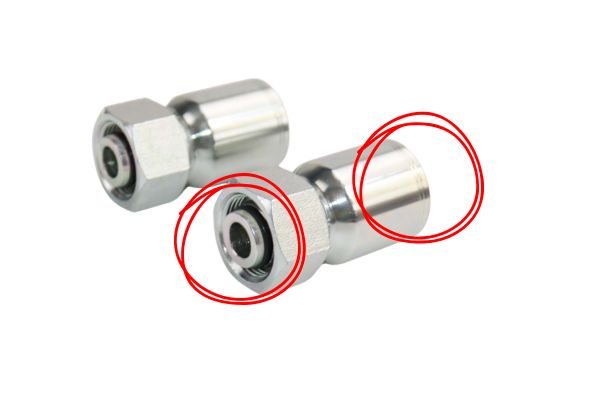
Thread identity and sealing identity are separate checks. A thread can provide mechanical engagement while a flare, cone, bonded seal, elastomeric O-ring, or thread form provides the seal. JIC, SAE 45-degree flare, NPT/NPTF, BSPP/BSPT, ORFS, ORB, metric, DIN, and JIS connections must not be treated as interchangeable because their diameters appear close or because a male thread starts into a female port.
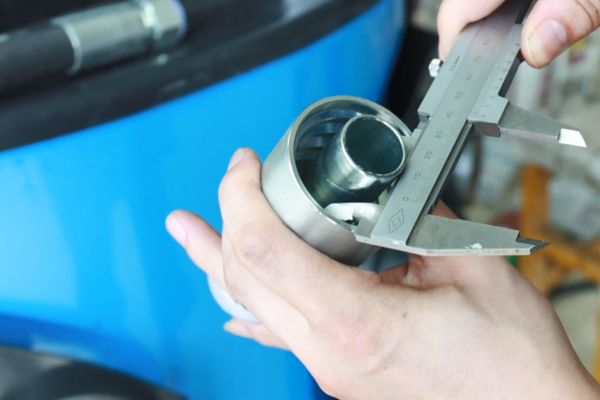
For every imported SKU, record the measurable connection details: outside or inside diameter, pitch or TPI, straight or tapered form, gender, seat angle, sealing face geometry, and seal type. Photographs are useful for preliminary sorting, but dimensions and connection standards must determine the final identity. A thread sealant cannot correct an incorrect thread, incompatible seat, or damaged sealing face.
Approve a drawing, not a resemblance
The controlled drawing should define dimensions that affect connection, assembly, routing, and identification. Include thread and seat geometry, stem and ferrule features relevant to the approved hose system, overall length, drop and centerline dimensions for elbows, hex size, sealing components, and critical tolerances. Define the measurement method when two inspectors could otherwise interpret a feature differently.
Check 2: Confirm Hose Compatibility and Crimp Data
Dash size is not a compatibility approval
The imported fitting series must be suitable for the exact hose manufacturer, hose series, size, and construction that will be used. Hoses sharing a nominal ID can have different tubes, reinforcement arrangements, cover thicknesses, and outside diameters. Those differences change insertion, ferrule compression, stem interaction, and finished retention.
Require current crimp instructions that identify the fitting series, hose series and size, preparation method, insertion depth, die or tooling selection, target crimp diameter and tolerance, and measurement location. Skive or no-skive status must be explicit. There is no responsible universal crimp diameter, insertion depth, or die setting that applies to all one-piece fittings of a given size.
Establish who owns system validation
Compatibility claims need a traceable basis. Determine whether the proposed fitting is part of a qualified hose-and-fitting system, whether the hose manufacturer recognizes the combination, or whether another documented validation route applies to the intended market and application. A dimensional match or a pressure rating printed beside the fitting does not establish the performance of the finished hose assembly.
The assembly’s allowable working conditions depend on its lowest-rated component and on pressure impulses, temperature, fluid, routing, mechanical loading, and installation. Ask for evidence relevant to the actual combination and use; do not replace missing system data with a generic certificate. High-risk, safety-critical, or unclear applications should remain outside an alternative-source trial until their technical approval path is defined.
Check 3: Evaluate Samples Before a Production Order
Choose a representative sample matrix
A sample review should test the difficult and commercially important parts of the proposed range, not merely the easiest straight fitting. Select high-turn sizes, major thread families, both straight and elbow forms, sealing ends with damage-sensitive faces, and products that exercise different stem or ferrule designs. The matrix should be small enough to investigate carefully but broad enough to reveal whether drawings, markings, and manufacturing controls work across the range.
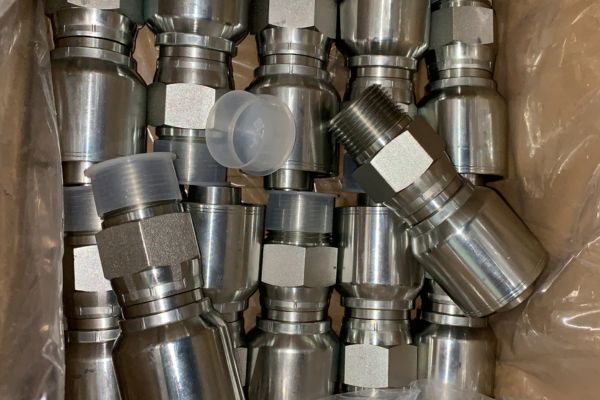
Keep sample identity intact from receipt through evaluation. Label each piece with the inquiry line, source part number, lot or sample reference, drawing revision, and inspection status. Mixing approved samples with general inventory destroys their value as comparison masters and makes later disputes harder to resolve.
Inspect, assemble, and document results
Use a written sample plan with acceptance requirements established before the parts arrive. Depending on the intended application and approval route, the plan may include:
- Verify part number, marking, material declaration, coating or finish requirement, dimensions, thread gauges, pitch, seat, sealing face, and O-ring details.
- Inspect stem, ferrule, bore, plating coverage, edges, contamination, cracks, deformation, and protective packaging.
- Assemble samples only with the defined hose, preparation, crimper, dies, and current crimp data; record insertion and finished crimp measurements.
- Perform any required qualification or production testing under the applicable procedure, using suitable guarded equipment and authorized personnel.
- Record each nonconformance, disposition, corrective requirement, and evidence needed before approval.
Do not invent an arbitrary pressure test or pull test as a substitute for a recognized system-validation requirement. Testing must follow the applicable hose, fitting, equipment, customer, or regulatory procedure. Before handling any hydraulic test article, isolate personnel from stored energy and follow the test equipment and component manufacturers’ safety instructions.
Check 4: Review Production and Lot-Control Evidence
Sample approval is not blanket approval
An acceptable sample confirms only the parts and evidence evaluated under that sample record. Production approval must also control material, drawing revision, tooling, processes, subcontracted operations, inspection, marking, and change notification. Otherwise, the first bulk shipment can differ from the sample while retaining the same part number.
Agree on lot definition and traceability before the purchase order is released. The required records should allow a received fitting to be connected to its production lot and relevant material, finish, inspection, and process documents. Traceability depth should match product risk and contractual requirements; more paperwork is not automatically better if identifiers cannot be linked to the physical goods.
Define changes that require approval
State which changes require written review before shipment. Typical triggers include changes to material grade, coating or surface treatment, sealing components, drawing dimensions, stem or ferrule geometry, manufacturing location, critical process, tooling that affects form, and approved sub-sources. A change-control clause is useful only if it identifies affected part numbers, revision status, and the evidence needed for reapproval.
| Control point | Evidence to link | Risk if uncontrolled |
|---|---|---|
| Product revision | Purchase order, drawing, sample approval, production record | Bulk parts differ from the approved configuration |
| Material and finish | Lot identifier and applicable declarations or inspection results | Fluid, corrosion, or environmental suitability becomes uncertain |
| Critical dimensions | Inspection plan, method, sample size, and results | Threads, seals, or crimp geometry fail at assembly |
| Change control | Written notice, technical review, and approval status | Undisclosed changes enter inventory under an existing SKU |
| Marking and packaging | Approved artwork or format and packing specification | Lots become mixed, damaged, or untraceable |
Request documents because they support a decision, not because a long document list looks rigorous. Certificates that cite no part, lot, standard, revision, or result may add little control. Any claimed standard compliance or certification should be checked against the exact product scope and issuing evidence rather than inferred from a logo.
Check 5: Control Receiving Inspection and Inventory Release
Keep new stock on hold until it passes
Imported fittings should enter a quarantine status until receiving checks confirm purchase order, part identity, quantity, revision, lot references, marking, packaging, documents, and defined inspection characteristics. This prevents unverified parts from being picked for an urgent hose build. The receiving plan should distinguish routine checks from characteristics that require technical inspection or outsourced verification.
Compare production parts with the approved drawing and retained master sample, but do not let the master sample override a newer controlled requirement. Inspect packaging damage, corrosion, contamination, thread protection, sealing-face damage, mixed parts, label accuracy, and lot separation. For sampled dimensional inspection, define the sampling method and acceptance rules in the quality plan rather than choosing favorable pieces after opening the shipment.
Make inventory status visible
Use clearly separated statuses such as quarantine, inspection, approved, rejected, and restricted-use where the quality system permits them. Bin labels, barcode records, and internal part numbers should connect the physical fitting to the approved technical record. Similar fittings should not share vague descriptions such as “metric elbow” when pitch, seat, size, or sealing method differs.
When a nonconformance appears, identify the affected lot and stop further release. Do not sort or rework without an authorized plan that defines the characteristic, method, acceptance criteria, traceability, and final verification.
Decide What to Stock and When to Expand
Start with verified demand, not the full catalog
A complete catalog is not a healthy inventory plan. Initial orders should favor technically verified SKUs supported by sales history, equipment population, repair frequency, local thread systems, lead time, and service consequences of a stockout. Low-frequency or poorly defined items may be better controlled as special orders until demand and identification quality improve.
Evaluate landed cost beyond unit price. Include technical review, samples, inspection, testing where required, freight, duties, financing time, storage, minimum-order exposure, mixed-part risk, rework, returns, expedited replenishment, and obsolete stock. The lowest quotation can have the highest total cost when documentation gaps or mismatches delay inventory release.
Expand only after evidence stays consistent
Use a limited trial order to verify ordering accuracy, documents, shipment condition, receiving results, hose assembly performance under the approved process, and market demand. Record deviations by SKU and lot. Expand the range only when repeat shipments maintain the approved configuration and the operational cost of inspection and correction remains acceptable.
Set reorder points, safety stock, and order quantities from actual demand variability, replenishment lead time, equipment criticality, and service targets. Avoid fixed rules claiming that every operation should stock a certain number of one-piece fitting SKUs.
Final Import Release Checklist
Release a one-piece fitting import program only after five areas pass: exact technical definition, thread and seal verification, hose-and-crimp compatibility, representative sample approval, and controlled production plus receiving evidence. One-piece construction reduces separate-ferrule selection errors during assembly; it does not remove replacement risk, validate an alternative, or guarantee a correct crimp.
Before requesting a final quotation, prepare hose manufacturer and series, hose size, fitting style and orientation, male or female connection, thread diameter and pitch, straight or tapered form, seat and sealing method, existing part numbers, controlled drawings, material and finish requirements, application conditions, crimper and crimp specifications, estimated quantity, and intended stock or resale use. Correct matching and traceable approval matter more than appearance or unit price because imported inventory must remain identifiable and usable long after the first shipment arrives.
Frequently Asked Questions
Can a supplier cross-reference number prove that a fitting is interchangeable?
No; a cross-reference can identify a candidate, but interchangeability requires verification of the connection, hose compatibility, material, finish, application limits, and valid crimp data. Treat the original number as identification evidence, not blanket approval.
Should every SKU receive the same inspection level?
Not necessarily; inspection should reflect technical risk, source history, process capability, application consequence, and contractual requirements. Any reduced inspection plan should be documented and reversible when results deteriorate or the product changes.
Is a material certificate enough to confirm the fitting material?
Only when the document is applicable, credible, and traceably linked to the correct part and production lot. The purchasing requirement should state what evidence is needed and whether independent verification applies.
Can approved samples be sold after evaluation?
Retain identified master samples when they are part of the ongoing acceptance method. Other samples should be released only through the normal status and inspection process, and test articles or altered parts must never enter saleable inventory.
What should happen if production fittings differ from the approved sample?
Quarantine the affected lot and compare both parts with the controlled drawing and purchase requirements. Obtain a documented cause, disposition, and corrective action before release, rework, replacement, or future ordering.