External leakage releases oil outside the cylinder, while internal leakage lets oil bypass a sealing boundary inside it. Correctly diagnosing hydraulic cylinder leakage requires you to examine visible oil, cylinder behavior, pressure loss, and the control circuit instead of blaming the seals immediately.
Imagine raising a loaded attachment and watching it slowly sink even though the cylinder looks completely dry. Replacing the pump or fitting a new seal kit without isolating the fault can waste time and leave the real problem inside a valve, damaged barrel, or misaligned rod. A structured inspection helps you identify where pressure is escaping before you dismantle the cylinder.
What Is External Hydraulic Cylinder Leakage?
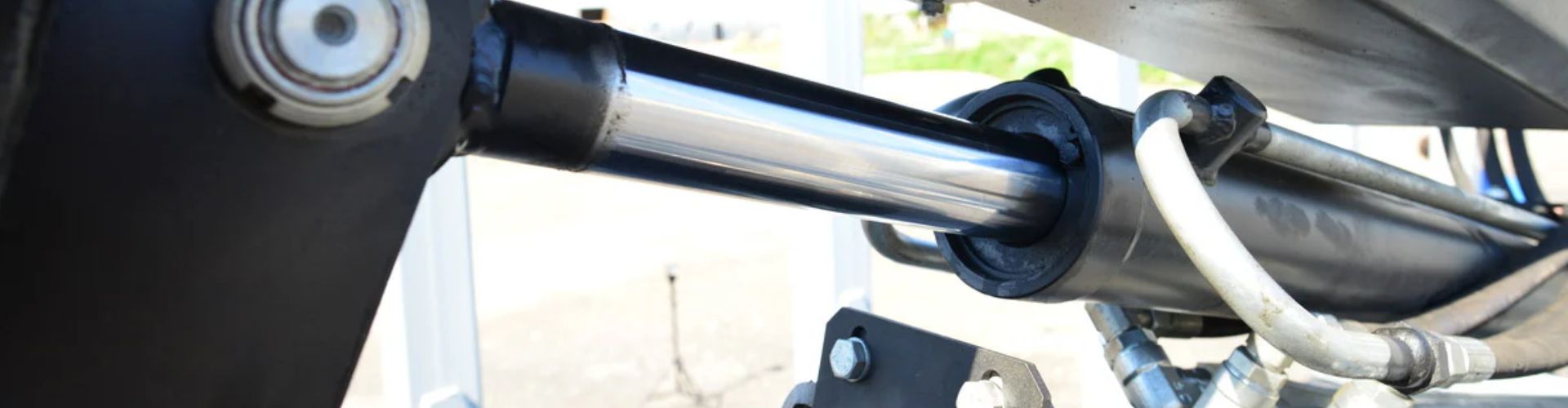
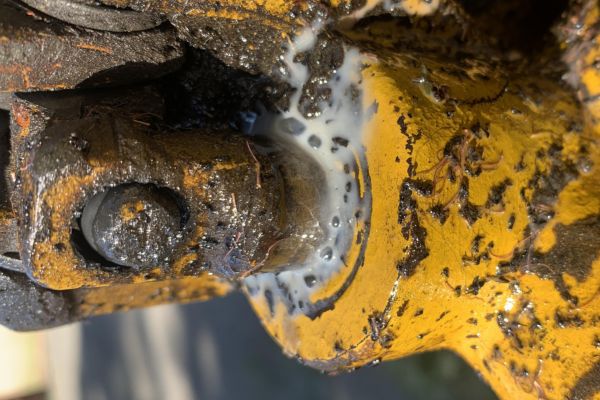
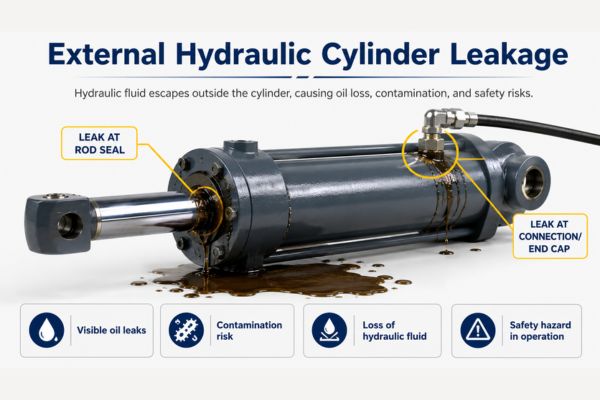
External hydraulic cylinder leakage occurs when hydraulic fluid escapes from the cylinder or its connections into the surrounding environment. You may find wet oil, drips, streaks, or oil-soaked dirt around the rod, gland, ports, end cap, or welded areas.
Where Does External Oil Usually Appear?
The first wet point normally provides the best clue after you clean and cycle the cylinder. Oil can travel across a surface, so the lowest wet point is not always the original source.
- Rod and gland interface
- Port fittings and hose connections
- End-cap seals or tie-rod joints
- Barrel, weld, or damaged metal surface
What Should You Check Before Replacing A Rod Seal?
Inspect the rod finish, gland alignment, guide bushing, return pressure, and mounting geometry before fitting another seal. A scratched, corroded, bent, or side-loaded rod can quickly damage a new sealing lip.
| Inspection Point | Possible Finding | Likely Action |
| Rod surface | Scoring, rust, or damaged coating | Repair or replace the rod |
| Gland area | Worn seal or guide | Rebuild and check alignment |
| Port connection | Loose or damaged seal | Correct the connection |
| Welded area | Crack or porosity | Stop operation and inspect |
What Is Internal Hydraulic Cylinder Leakage?
Internal hydraulic cylinder leakage occurs when oil passes across an internal sealing boundary without leaving the cylinder. In a double-acting cylinder, worn piston seals or a damaged barrel can allow oil to move from the higher-pressure chamber toward the lower-pressure chamber.
Which Components Can Allow Internal Bypass?
Piston sealing surfaces are common suspects, but they are not the only possible internal paths. Hydraulic cylinder design determines which components must be checked.
- Piston seals and wear rings
- Scored or distorted cylinder bore
- Loose piston-to-rod connection
- Internal passages, cushion valves, or integrated valves
What Does Internal Leakage Do To Performance?
Internal bypass reduces the pressure difference available to move or hold the piston. The cylinder may lose force, move slowly, fail to hold position, or generate heat through continuous pressure loss.
| Internal Condition | Possible Effect | Diagnostic Meaning |
| Piston-seal bypass | Drift or reduced force | Suspect internal sealing loss |
| Scored barrel | Repeated seal failure | Inspect the complete bore |
| Loose piston | Irregular movement | Check mechanical attachment |
| Internal valve leak | Poor holding | Isolate the valve function |
How Does Internal And External Hydraulic Cylinder Leakage Differ?
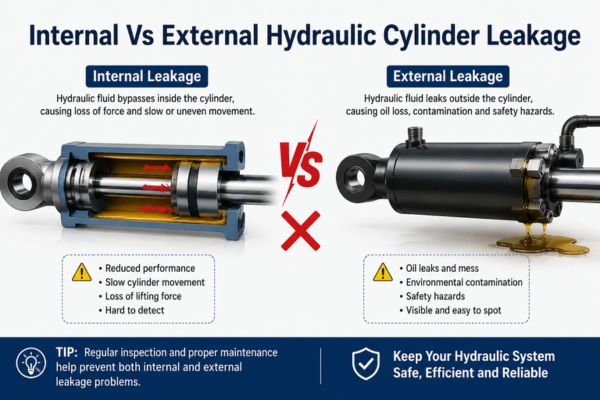
Internal and external hydraulic cylinder leakage differ mainly in where the oil goes: external leakage leaves the assembly, while internal leakage remains inside and crosses a sealing boundary. External leakage is usually visible; internal leakage is identified through performance changes and controlled testing.
Which Signs Separate The Two Leak Types?
Visible oil directs you toward external sealing points, while unexplained drift or force loss raises suspicion of internal bypass. Both leak types can exist at the same time.
- Visible oil or falling reservoir level suggests external loss.
- A dry cylinder with drift suggests internal system leakage.
- Rod damage can contribute to external and internal wear.
- Heat and slow movement are nonspecific supporting signs.
What Is The Fastest Initial Comparison?
Clean the assembly, observe the first wet area, and record how the cylinder behaves under a controlled load. Treat this as a screening step rather than a final diagnosis.
| Comparison | External Leakage | Internal Leakage |
| Oil location | Outside the cylinder | Inside the cylinder or valve circuit |
| Visibility | Usually visible | Usually hidden |
| Common symptom | Wet rod, fitting, cap, or weld | Drift, low force, or poor holding |
| Confirmation | Locate the first wet point | Perform isolation and pressure tests |
What Causes External Hydraulic Cylinder Leakage?
External hydraulic cylinder leakage is commonly caused by damaged seals, poor rod condition, incorrect installation, excessive side load, contamination, or abnormal pressure. A leaking rod seal may therefore be the failed component but not the original cause.
Why Do Rod Seals Fail Prematurely?
Rod seals depend on a smooth, aligned surface and a controlled pressure environment. Repeated early failure usually means another operating condition is damaging the seal.
- Scratched, pitted, corroded, or bent rod
- Worn guide bushing or excessive side load
- Contamination trapped beneath the wiper
- Excessive backpressure, heat, or pressure spikes
Which Installation Problems Should You Inspect?
Check whether the cylinder mounts, pins, load path, and hose routing allow free axial movement. Misalignment can force the rod against one side of the gland and produce uneven wear.
| Root Cause | Damage Pattern | Corrective Focus |
| Side loading | One-sided guide and seal wear | Correct mounting geometry |
| Rod scoring | Repeated lip damage | Restore rod surface |
| Contamination | Abrasive tracks and oil sludge | Improve filtration and wiping |
| Pressure abnormality | Extruded or torn seal | Check circuit pressure |
What Causes Internal Hydraulic Cylinder Leakage?
Internal hydraulic cylinder leakage is commonly caused by piston-seal wear, barrel scoring, contamination, excessive temperature, pressure shock, or incorrect seal selection. Wear-ring failure and misalignment can also let the piston contact and damage the bore.
How Do The Barrel And Piston Seals Work Together?
The piston seal needs a correctly finished, round, and undamaged bore to maintain chamber separation. A new seal cannot compensate for a deep score or distorted barrel.
- Piston seals maintain the pressure difference.
- Wear rings guide the piston and prevent metal contact.
- Bore finish supports sealing and lubrication.
- Clean oil limits abrasive internal damage.
Which Operating Conditions Accelerate Internal Wear?
High temperature can reduce oil viscosity and alter seal behavior, while contamination creates abrasive paths across the sealing surface. Pressure spikes and incompatible materials can deform, harden, or damage the seal.
| Operating Condition | Possible Damage | Inspection Priority |
| Dirty oil | Abrasive seal and bore wear | Oil and filter condition |
| Excessive heat | Seal degradation and thinner oil | Temperature and cooling |
| Pressure shock | Seal extrusion or fracture | Relief and cushion settings |
| Wrong material | Swelling, hardening, or cracking | Fluid and temperature compatibility |
Which Symptoms Reveal Hydraulic Cylinder Leakage?
Hydraulic cylinder leakage may appear as visible oil, falling fluid level, drift, reduced force, slow movement, unstable motion, or higher operating temperature. No single performance symptom proves cylinder leakage because pumps, valves, restrictions, air, and mechanical loads can produce similar behavior.
Which Symptoms Deserve Immediate Attention?
Stop and assess the equipment when leakage affects load control, creates a spray, or appears at a structural weld. Never use your hand to search for a pressurized pinhole leak.
- Unexpected load movement or rapid drift
- High-pressure mist, spray, or damaged hose connection
- Oil at a cracked weld or damaged barrel
- Sudden loss of force or uncontrolled motion
Which Symptoms Need Further Isolation?
Slow movement, heat, noise, and weak lifting require system-level checks before you condemn the cylinder. Compare the behavior in both directions and record pressure, temperature, load, and oil condition.
| Symptom | Possible Cylinder Cause | Other Possible Cause |
| Load drift | Piston-seal bypass | Control or counterbalance valve leak |
| Low force | Internal bypass | Pump or relief-valve problem |
| Jerky motion | Seal friction or damage | Air, contamination, or side load |
| High temperature | Internal pressure loss | Relief flow or cooling failure |
How Do You Test Hydraulic Cylinder Leakage Safely?
You test hydraulic cylinder leakage safely by securing the load, releasing stored pressure, inspecting externally, and then following an approved isolation and pressure-test procedure. Testing should be performed by qualified personnel with rated gauges, blocking devices, and the machine service information.
What Must Happen Before Any Pressure Test?
Mechanically support raised equipment and keep people outside the movement zone. Do not skip this step: a hydraulic valve or cylinder must never be the only support beneath a suspended load.
- Lower or mechanically block the load.
- Shut down and release residual pressure.
- Wear suitable eye, hand, and skin protection.
- Use cardboard or detection tools, not hands, near suspected sprays.
What Does A Controlled Diagnostic Sequence Include?
Begin with a clean visual inspection and operational check, then isolate circuit sections according to the manufacturer’s procedure. Do not loosen a pressurized hose or cap a moving load without an engineered method.
| Test Stage | Purpose | Safety Requirement |
| Clean inspection | Locate external origin | Depressurize before cleaning |
| Drift observation | Confirm unwanted movement | Mechanically secure the load |
| Pressure comparison | Identify pressure loss | Use correctly rated instruments |
| Circuit isolation | Separate cylinder from valve leakage | Follow approved service procedure |
Can Valve Problems Mimic Hydraulic Cylinder Leakage?
Yes, control-valve, counterbalance-valve, load-holding-valve, or relief-valve problems can mimic hydraulic cylinder leakage. A drifting load confirms that pressure is escaping somewhere, but it does not identify the cylinder as the source.
Why Can A Dry Cylinder Still Drift?
Oil can leak across a valve spool, damaged seat, contaminated poppet, or internal manifold passage while the cylinder remains functional. Replacing piston seals will not repair a leaking control element.
- Worn directional-valve clearances
- Contaminated counterbalance or check valve
- Incorrect relief-valve setting
- Leaking integrated valve or manifold seal
How Do You Separate A Valve Fault From A Cylinder Fault?
Use the equipment manufacturer’s isolation procedure to test the cylinder and valve circuit independently under controlled conditions. Interpret pressure change together with movement, load direction, oil temperature, and the cylinder’s area difference.
Why Does Hydraulic Cylinder Leakage Return After Repair?
Recurring hydraulic cylinder leakage usually means the repair addressed the damaged seal but missed the condition that damaged it. Common unresolved causes include rod scoring, bore damage, misalignment, contamination, excessive temperature, pressure spikes, and incorrect materials or assembly dimensions.
What Should A Proper Rebuild Inspect?
A proper rebuild evaluates hard parts, guide clearances, surfaces, seals, and the operating circuit. Here is what changes the result: every damaged component should lead to a root-cause question.
- Measure the rod, bore, gland, and guide clearances.
- Inspect rod coating and bore finish.
- Confirm seal material and orientation.
- Review filtration, pressure, temperature, and mounting.
Which Quality Checks Reduce Repeat Failure?
After repair, verify dimensions, assembly cleanliness, smooth operation, pressure holding, and external sealing with an approved test procedure. Record the original damage pattern so future inspections can identify recurrence.
| Repeated Failure | Often-Missed Cause | Corrective Check |
| Rod-seal leak | Scored rod or side load | Surface and alignment |
| Piston-seal bypass | Damaged or distorted bore | Bore measurement and finish |
| Extruded seal | Excess pressure or clearance | Circuit pressure and tolerances |
| Hardened seal | Heat or incompatibility | Temperature and material review |
When Does Hydraulic Cylinder Leakage Require Replacement?
Hydraulic cylinder leakage requires replacement when structural damage, severe wear, unavailable parts, repeated failure, or repair cost makes a safe rebuild impractical. Repair is often reasonable when the barrel, rod, mounts, and critical dimensions can be restored and verified.
Which Damage Can Make Replacement Safer?
Cracked structural areas, badly distorted barrels, severely bent rods, damaged mounting points, and uncertain previous repairs deserve careful engineering review. The decision is not only financial: a load-holding cylinder must return to a verifiable safe condition.
- Structural crack or questionable weld integrity
- Deep bore damage beyond repair allowance
- Rod damage that cannot be safely restored
- Obsolete design without suitable parts or data
What Information Should You Use For The Decision?
Compare application risk, downtime, repair scope, test capability, replacement availability, and remaining service expectations. For a custom replacement, provide mounting, bore, rod, stroke, retracted length, ports, pressure, speed, load, fluid, and environment.
| Decision Factor | Repair May Fit | Replacement May Fit |
| Damage | Serviceable wear surfaces | Structural or extensive damage |
| Verification | Complete inspection and testing available | Safe condition cannot be verified |
| Parts | Correct parts and specifications available | Parts or data unavailable |
| Business impact | Reliable rebuild meets schedule | New unit lowers downtime risk |
Conclusion
External leakage puts oil outside the cylinder, while internal leakage allows pressure to escape across an internal sealing boundary. Visible oil helps locate external faults, but drift, low force, slow movement, and heat require controlled diagnosis because valves, pumps, restrictions, air, and mechanical problems can create similar symptoms.
Start with safe visual inspection, protect the load mechanically, record operating symptoms, and isolate the cylinder from the valve circuit using an approved procedure. If you need help reviewing cylinder specifications, failure patterns, replacement dimensions, or testing requirements, contact us today. Reliable hydraulic equipment is built by finding the cause of pressure loss—not by replacing the first damaged part you see.
Frequently Asked Questions
Can I Confirm Internal Leakage From Cylinder Drift Alone?
No. Drift confirms that the load-holding system is losing pressure, but the leakage path may be inside the cylinder, control valve, counterbalance valve, or manifold.
What’s The Best First Check For An External Leak?
Clean the cylinder and observe where fresh oil first appears during a controlled cycle. Check the rod, gland, fittings, end closures, and welds without touching suspected high-pressure sprays.
How Do I Know If The Rod Seal Is The Root Cause?
You cannot know from visible oil alone. Inspect rod finish, alignment, guide wear, contamination, backpressure, and pressure spikes before deciding that the seal itself caused the failure.
Can I Test A Loaded Cylinder By Disconnecting A Hose?
No. A suspended load can move suddenly, and trapped pressure can cause injection injury; secure the equipment mechanically and follow the manufacturer’s approved isolation procedure.
What’s The Best Information To Send For A Replacement Cylinder?
Send bore, rod diameter, stroke, retracted length, mounting dimensions, port details, working pressure, speed, load direction, fluid, temperature, and environmental conditions. Clear drawings and measured dimensions are more reliable than photos alone.