Choose the hose by calculating the inside diameter from maximum flow and target velocity, then verify pressure, fittings, length, and installation space. A correct hydraulic hose size is not determined by the machine port alone.
You install a new hose that threads onto the excavator perfectly, but the attachment now moves slowly and the oil runs hotter. The connection fits, yet an undersized bore restricts flow, wastes energy, and can increase downtime. The solution is a simple sizing process that separates hose ID from port and thread size.

Should Hydraulic Hose Size Match The Port Size?
No, hydraulic hose size should match the required flow, while the port size determines how the assembly connects. A reducer or adapter can join different sizes, but every restriction must still pass the design flow without excessive pressure loss.
Why Can A Correct Thread Still Give Poor Performance?
The thread can fit while the hose bore remains too small. Here is the important distinction: connection geometry and flow capacity are separate specifications.
- Hose ID controls fluid velocity.
- Port and thread size control connection compatibility.
- The smallest internal passage can restrict the whole circuit.
What Should You Confirm Before Choosing The Hose?
Start with the circuit function and maximum flow, then identify both end connections. Do not order from a photograph or outside diameter alone.
- Maximum flow in L/min or GPM
- Pressure, return, suction, or case-drain duty
- Port thread, sealing face, and fitting angle
| Item | What It Determines | Common Mistake |
| Hose ID | Velocity and flow capacity | Copying the port size |
| Port size | Equipment connection | Treating it as hose ID |
| Fitting bore | Local restriction | Checking thread only |
How Do You Calculate Hydraulic Hose Size?
You calculate hydraulic hose size with D = 4.61 × √(Q ÷ v) when flow is in L/min, velocity is in m/s, and inside diameter is in mm. The result is an initial bore requirement that you round to an available hose size and then verify against system conditions.
What Does Each Part Of The Formula Mean?
The formula converts flow and target velocity into the circular passage needed to carry the oil. Put simply: higher flow needs a larger bore, while allowing higher velocity produces a smaller calculated bore.
D= required inside diameter in mmQ= maximum flow in L/minv= selected fluid velocity in m/s
How Should You Use The Calculated Result?
Use the maximum expected flow, not a convenient average, and select a realistic velocity for that line type. Round up when the result falls between standard sizes, then recalculate actual velocity.
- Confirm the flow source.
- Calculate the minimum ID.
- Check the next standard size.
What Velocity Should You Use For Hydraulic Hose Size?
The right hydraulic hose size uses a lower target velocity for suction lines, a moderate velocity for return lines, and a higher velocity for pressure lines. These ranges are starting points, so long runs, cold oil, and sensitive inlet conditions may require lower values.
Which Velocity Ranges Are Practical Starting Points?
Common design ranges help you make a first selection before checking pressure loss. Keep this in mind: suction lines are especially sensitive because excessive inlet velocity can contribute to pump starvation and cavitation.
- Suction lines: about 0.5–1.2 m/s
- Return lines: about 1.5–3 m/s
- Pressure lines: about 3–6 m/s
When Should You Choose A Lower Velocity?
Choose the lower end of the range when oil is cold or viscous, the hose is long, or the circuit runs continuously. Also lower the target when elbows, quick couplings, and compact valve passages add resistance.
- Long routing distance
- Low ambient temperature
- High-viscosity fluid or continuous duty
How Does Flow Rate Change Hydraulic Hose Size?
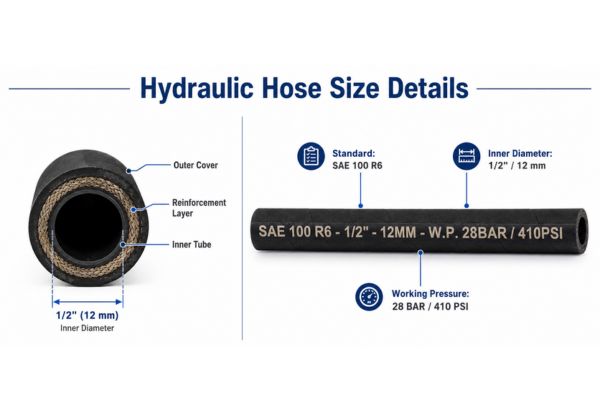
For 85 L/min at a 5 m/s target, hydraulic hose size calculates to about 19 mm ID. A 16 mm ID carries the same flow at roughly 7.0 m/s, while a 19 mm ID lowers it to roughly 5.0 m/s.
Why Is The Smaller Hose Less Suitable?
The smaller bore forces the oil to move faster and normally increases friction loss. Now the difference becomes clear: a few millimeters of ID can materially change velocity because flow area depends on the diameter squared.
- 16 mm ID: approximately 7.0 m/s
- 19 mm ID: approximately 5.0 m/s
- Same flow: 85 L/min
Is 19 Mm Automatically The Final Answer?
No; 19 mm is the flow-based starting point, not final approval. You must still verify the hose’s working pressure, impulse capability, fitting bore, bend radius, fluid compatibility, and total route.
- Confirm the actual hose ID in the datasheet.
- Check every component’s pressure rating.
- Review routing before ordering the assembly.
What Happens When Hydraulic Hose Size Is Too Small?
An undersized hydraulic hose size raises velocity and usually increases pressure loss, heat generation, and local stress. The machine may respond slowly because part of the pump’s energy is being spent pushing oil through restrictions.
Which Warning Signs Can You Observe?
Look for changes that appear after a hose replacement or during high-flow operation. Watch what happens under load: an assembly can look normal at idle and still become restrictive at full flow.
- Slower cylinder or motor movement
- Higher temperature near the hose or coupling
- Unusual noise, vibration, or elevated return pressure
How Do You Confirm The Hose Is The Restriction?
Compare pressure and temperature on both sides under controlled conditions, using rated instruments and safe procedures. Inspect quick couplings, elbows, and fitting stems because the narrowest component may be responsible.
- Verify actual flow and oil temperature.
- Measure differential pressure where practical.
- Compare every effective bore in the flow path.
| Symptom | Possible Sizing Link | Check First |
| Slow movement | Excessive flow restriction | Actual hose ID |
| Local heat | Pressure loss | Fitting and coupling bore |
| Noise or vibration | High velocity or aeration | Line type and routing |
Can Hydraulic Hose Size Be Too Large?
Yes, hydraulic hose size can be unnecessarily large even when flow loss is low. A larger assembly costs more, weighs more, needs a wider bend radius, and may be difficult to route safely in a compact machine.
What Problems Come From Oversizing?
Oversizing is mainly a packaging and cost problem, although extra internal volume can also affect some fast-response circuits. There is another trade-off: forcing a large hose into a tight route can damage it sooner than using the correctly sized flexible assembly.
- Higher hose and fitting cost
- Larger minimum bend radius
- More weight and movement load on ports
- Greater risk of rubbing in confined spaces
How Do You Find A Practical Upper Limit?
Choose the smallest standard bore that meets velocity and pressure-loss targets without compromising safety. Confirm that the hose can move through its full operating range without twisting, kinking, stretching, or touching sharp edges.
- Check the manufacturer’s bend-radius limit.
- Model or measure the installed route.
- Allow slack for movement without excessive loops.
| Larger Size Effect | Potential Benefit | Potential Cost |
| Lower velocity | Less line loss | Larger routing envelope |
| More internal volume | More flow capacity | Slower dynamic response in some circuits |
| Larger fittings | Wider passages | More weight and expense |
How Do Dash Numbers Define Hydraulic Hose Size?
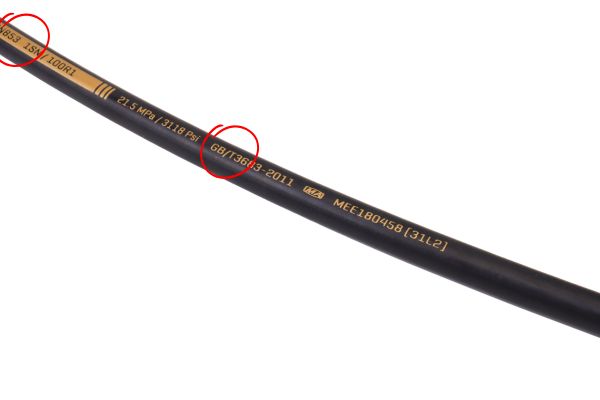
You should read hydraulic hose size from the stated nominal ID or dash size, then confirm the manufacturer’s actual dimensions. In the common dash system, the number generally represents sixteenths of an inch, so -08 corresponds to 8/16 inch, or 1/2 inch nominal ID.
Why Should You Avoid Measuring The Outside Diameter?
Outside diameter varies with reinforcement layers, cover thickness, and hose construction. This is where buyers get caught: two hoses can have similar outside diameters but different bores and pressure capabilities.
- Use the layline and datasheet first.
- Treat OD as an installation dimension.
- Treat ID as the main flow dimension.
How Do You Round A Calculated ID?
Normally choose the next available nominal ID above the calculated minimum, then verify actual velocity and pressure drop. Never assume that every supplier’s nominal metric label equals the exact measured bore.
- Convert units before comparing sizes.
- Check the specific hose series.
- Recalculate with the listed actual ID when available.
How Does Length Affect Hydraulic Hose Size?
Longer hydraulic hose size selection requires a pressure-drop check because resistance accumulates along the route. Length alone does not justify a fixed rule such as “one size larger after five meters,” since flow, viscosity, fittings, and temperature also matter.
Which Parts Of The Route Add Resistance?
Count the full flow path, not only the flexible hose. The hidden issue is often local: compact quick couplings and multiple elbows can contribute substantial loss even when the main hose bore is adequate.
- Straight hose length
- Elbows and adapters
- Quick-disconnect couplings
- Valve blocks and filters
When Should You Increase The Bore?
Increase the bore when the calculated total pressure loss exceeds the circuit’s acceptable limit or produces unwanted heat and backpressure. Recalculate with the next standard ID and confirm that pressure rating and routing remain acceptable.
- Define an allowable pressure-loss target.
- Use fluid properties at operating temperature.
- Include local and straight-run losses.
Does Pressure Rating Affect Hydraulic Hose Size?
Yes, hydraulic hose size must satisfy both flow and the working-pressure rating for that exact hose series and ID. Larger sizes within one series may carry different pressure ratings, so never copy the rating from another size.
Which Pressure Number Should You Use?
Use maximum allowable working pressure for selection, including the system’s maximum setting and expected dynamic duty. Do not miss this point: burst pressure is a destructive test value, not permission to operate above working pressure.
- Normal operating pressure
- Relief-valve setting
- Pressure spikes and impulse frequency
- Lowest-rated assembly component
Why Must You Check The Complete Assembly?
The safe assembly rating is limited by its lowest-rated hose, fitting, adapter, or coupling. Fluid temperature, compatibility, bend radius, and crimp specifications must also remain within the approved limits.
- Match hose and fitting families.
- Use the specified crimp diameter.
- Verify pressure at the selected ID.
Can Fittings Undermine Hydraulic Hose Size?
Yes, hydraulic hose size can be correct while a small fitting bore, mismatched thread, or restrictive quick coupling still limits the circuit. Treat the hose assembly as one flow path and verify every connection before production.
What Should You Measure On Each Fitting?
Check both mechanical compatibility and the effective internal passage. A thread may screw in partly and still have the wrong pitch, seat, or sealing method.
- Thread diameter and pitch
- Straight or tapered thread form
- Seat angle and sealing face
- Minimum internal bore
What Is The Final Pre-Order Check?
Record the system data on one specification sheet and have the assembly details reviewed before bulk purchasing. For unfamiliar equipment, use drawings, gauges, and measured samples instead of relying on appearance.
- Confirm flow, pressure, fluid, and temperature.
- Confirm hose ID, length, and bend radius.
- Confirm both fitting ends and crimp data.
| Final Check | Required Evidence | Why It Matters |
| Flow capacity | Maximum flow and target velocity | Prevents restriction |
| Pressure safety | Working-pressure ratings | Prevents unsafe selection |
| Connection | Thread and seal dimensions | Prevents leaks and mismatch |
| Installation | Route and bend-radius check | Prevents mechanical damage |
Conclusion
Choosing the right hose means solving four connected questions: how much oil must pass, how fast it should move, what pressure the assembly must withstand, and how it will connect and route. Start with maximum flow, calculate the required ID, choose a standard size, and then verify pressure, fittings, length, fluid, and installation limits.
For distributors, OEMs, and maintenance teams, a clear specification reduces wrong orders, field rework, and avoidable downtime. Share your flow, pressure, hose length, fluid, temperature, and end-connection details when you contact us today, and we can help you define a practical hose and fitting configuration. Reliable hydraulic systems begin with components selected for the real circuit—not with the size that merely looks familiar.
Frequently Asked Questions
Can I Choose A Hose By Copying The Old One?
Sometimes. You can copy the old hose only when it is confirmed as the correct original specification; if performance was poor or the hose was modified, verify flow, ID, pressure, length, and both fitting ends first.
What’s The Best Velocity For A Pressure Hose?
For most pressure lines, 3–6 m/s is a practical starting range. Continuous duty, long runs, cold oil, or pressure-sensitive circuits usually justify selecting toward the lower end and checking total pressure loss.
How Do I Know If My Hose Is Too Small?
Check for a consistent restriction pattern. High calculated velocity, excessive differential pressure, local heat, noise, or slower response at full flow can indicate an undersized hose, but safe measurements must rule out restrictive fittings and valves.
Can I Use Burst Pressure As My Operating Limit?
No. Select from the rated working pressure of the complete assembly; burst pressure is a laboratory failure threshold and must never be treated as usable operating capacity.
What’s The Best Information To Send Before Ordering?
Send complete operating and connection data. Include maximum flow, maximum pressure, fluid, temperature, length, hose movement, and fitting details for both ends; photos help, but thread diameter, pitch, seat type, and port specifications are more reliable.