The main difference in a 4SP vs 4SH hydraulic hose comparison is how each hose type combines bore size, working-pressure capability, construction limits, and routing requirements. Both are spiral-wire-reinforced hoses for demanding hydraulic service, so steel-wire layer count alone does not decide which one fits an application. The correct choice comes from comparing the exact hose data with the circuit’s pressure, flow, temperature, fluid, movement, and available space. This approach prevents a common selection error: treating a familiar designation as proof that a hose will fit, crimp, and perform correctly in a specific assembly.
What Do 4SP and 4SH Mean?
They belong to the same spiral-wire hose family
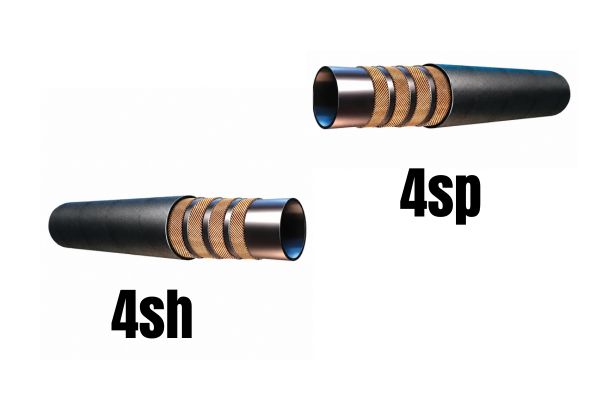
4SP and 4SH identify rubber-covered hydraulic hose types reinforced with four spiral layers of high-tensile steel wire. They are covered by the EN 856 family and are also addressed by the ISO 3862 spiral-wire hose specification. Their shared construction makes both suitable candidates for high-pressure hydraulic circuits, but it does not make them identical. The designation must be read together with the hose size, working-pressure rating, cover type, temperature and fluid limits, and assembly instructions.
A standard designation is not a complete part number
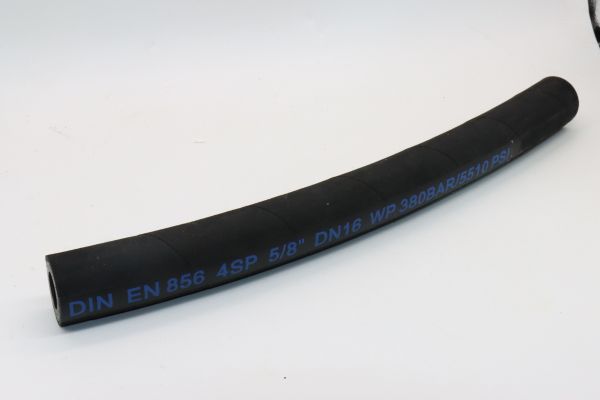
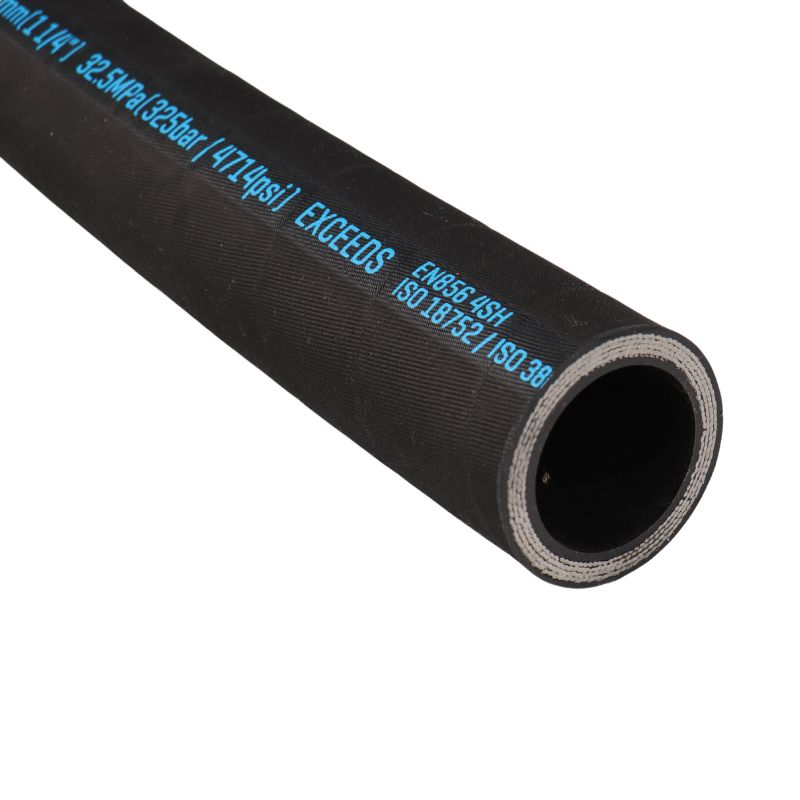
The standard defines performance and dimensional requirements for a hose category, while the finished product is determined by its manufacturer, series, materials, and approved coupling system. Two hoses carrying the same designation may differ in outside diameter, flexibility, abrasion resistance, or assembly method while still falling within the relevant requirements. For replacement work, record the complete layline and part number rather than writing only “4SP” or “4SH” on a maintenance request.
How Does Working Pressure Affect the Choice?
4SH is generally positioned for higher pressure capability than 4SP across many overlapping bore sizes, but the useful comparison must be made at the same hose ID and within the same verified product data. Working-pressure ratings normally change as bore size changes, so a pressure statement taken from one size cannot be applied to the whole range. A selection is valid only when the chosen size meets the circuit requirement under the stated operating conditions.
Burst pressure is a destructive qualification value and is not an acceptable normal operating level. Start with the maximum system working pressure, then consider transient peaks, pressure impulse, temperature, machine movement, and the lowest-rated component in the hose assembly. If the circuit demand approaches the limit of a candidate hose, do not create an informal safety margin from the burst rating; select a hose and coupling system with a suitable published working rating.
Pressure information should also be traceable. Record the source document, revision, hose series, size, and assembly combination used for the decision. A value copied from an old label, a reseller table, or another bore is not controlled data. When the equipment produces frequent shocks or uncertain peaks, confirm the real circuit demand before assuming that a nominal system setting represents the hose’s full duty.
Hose ID must come from flow requirements
The correct bore is selected from flow, acceptable fluid velocity, pressure drop, circuit response, and equipment requirements. A smaller hose may appear to offer a stronger pressure rating, but reducing the bore can increase velocity, heat generation, energy loss, and pressure drop. Increasing the bore without checking the rating and routing can create the opposite problem: a hose that carries the required flow but is too large, too difficult to route, or insufficiently rated for the circuit.
Available size range is part of product selection
4SP and 4SH ranges do not always begin and end at the same bore sizes. In practice, 4SP may be available for some smaller lines, while 4SH becomes especially relevant where a larger bore must retain substantial pressure capability. That is a selection pattern, not a universal substitution rule. Confirm that the exact candidate size exists, then compare its pressure, outside diameter, bend radius, weight, fitting availability, and assembly method.
Is 4SP More Flexible Than 4SH?
Bend radius is product- and size-specific
It is unsafe to assume that every 4SP hose bends more tightly than every 4SH hose. Some products show a smaller minimum bend radius for one type at a particular size, while other sizes may be equal or favor the other type. Compact and enhanced-flexibility products can also perform differently from standard constructions. The only reliable answer comes from the current data sheet for the exact hose series and bore, compared under the same stated conditions.
Routing quality matters as much as the published limit
Minimum bend radius is a limit, not a recommended target for every installation. The hose needs enough straight length near the fitting, enough slack for movement, and protection from twisting, crushing, abrasion, and hot surfaces. A route that forces the hose around a bracket or pulls sideways on the ferrule can damage an otherwise suitable assembly. Selection and routing guidance in SAE J1273 reinforces why routing and component matching must be considered together.
A moving hose also needs a route that respects its natural bending plane. Twisting the hose during installation can make the reinforcement work against the intended bend, while an assembly that is too short transfers movement into the fitting interface. Use guards and clamps to control motion without creating a new rubbing point, and recheck the route through the machine’s full operating range.
What Other Conditions Can Override the Pressure Comparison?
Fluid, temperature, and environment affect suitability
A hose can have adequate pressure capability and still be wrong for the application. Tube and cover materials must tolerate the hydraulic fluid, additives, ambient environment, and operating temperature. Water-based fluids, biodegradable fluids, aggressive additives, compressed gases, fire-resistant fluids, and cleaning chemicals may require additional confirmation. The standard itself places responsibility on the user to establish fluid compatibility rather than assuming every listed hydraulic fluid is interchangeable.
Impulse, movement, and external damage change service demands
A stable industrial circuit and a mobile machine with repeated shock loading can impose very different fatigue conditions at the same indicated pressure. Evaluate impulse frequency, vibration, articulation, abrasion, ozone, heat exposure, and possible impact before choosing between 4SP and 4SH. A structured hose-selection review should organize these conditions, but the final decision must follow the current controlled data for the selected hose and equipment.
How Should You Compare 4SP and 4SH Step by Step?
Build the requirement before comparing hose labels
Start with the machine rather than the existing hose cover. Record the required flow, line function, operating pressure, peak behavior, fluid, temperature, movement, and routing envelope. Confirm whether equipment specifications, regulations, or fire-resistance requirements restrict the acceptable hose type. This prevents a higher-looking pressure class from distracting attention from an incorrect bore, fluid incompatibility, or impossible bend radius.
Use the following decision sequence:
- Confirm line function, required flow, and the correct hose ID.
- Establish working pressure and credible transient peaks from reliable equipment information.
- Identify temperature, fluid, impulse, movement, abrasion, and environmental requirements.
- Compare exact 4SP and 4SH candidates at the required bore.
- Check outside diameter, minimum bend radius, weight, and routing clearance.
- Confirm an approved fitting, ferrule, preparation method, and crimp specification.
- Verify any equipment, regulatory, fire-resistance, or application-specific requirements.
Choose by verified fit, not by a simple hierarchy
Choose 4SP when the exact product meets the pressure and environmental requirements, fits the available route, and has a validated assembly system. Choose 4SH when the required bore needs performance that the available 4SP candidate cannot provide and the 4SH product also satisfies routing and compatibility requirements. If neither standard type meets the complete duty, review another validated hose class or an application-specific construction rather than forcing either designation into the system.
| Selection question | What to verify | Why it matters |
|---|---|---|
| Can the hose carry the required flow? | Hose ID and circuit velocity limits | An incorrect bore can create heat, pressure drop, or poor response |
| Can it handle the circuit demand? | Dynamic working pressure, peaks, and impulse duty | Burst pressure is not an operating target |
| Will it fit the route? | Outside diameter, bend radius, movement, and clearance | Poor routing can damage the hose near the fitting |
| Is it compatible with the medium? | Tube material, fluid, additives, and temperature | Chemical or thermal damage can weaken the hose |
| Can it be assembled correctly? | Fitting series, ferrule, preparation, dies, and crimp data | Similar size does not prove component compatibility |
Why Are Fitting and Crimp Data Part of Hose Selection?
The assembly is only as valid as its component combination
The hose standard does not provide universal approval for any fitting attached to that hose. ISO 3862 states that its scope does not include end-fitting requirements, while ISO hose assembly practices cover selection, routing, fabrication, installation, replacement, maintenance, and storage. The hose, fitting stem, ferrule, and crimp process must therefore be treated as a documented system rather than separate parts that happen to share a dash size.
A replacement must match both hose end and equipment port
First identify the hose-side requirements: construction, ID, fitting series, insertion depth, skive or no-skive method, die selection, and final crimp specification. Then confirm the equipment-side connection, including thread form, diameter, pitch, male or female configuration, seat angle, and sealing method. A similar-looking JIC, BSP, NPT, ORFS, Metric, DIN, or other connection is not proof of interchangeability, and thread sealant cannot correct a wrong thread or damaged sealing face.
Do not mix components simply because they can be physically assembled. A stem may enter the hose and a ferrule may crimp without producing the compression, retention, or sealing performance required by the approved system. If controlled assembly data is unavailable, stop the substitution process and obtain a documented combination instead of using a trial crimp as proof of compatibility.
What Information Should Be Recorded Before Replacement?
A complete record prevents the next selection from becoming guesswork
Photographs are useful for initial identification, but they cannot replace dimensions, layline information, and assembly data. Record the old assembly before disposal and keep the approved replacement details with the machine record. This reduces repeated measuring, avoids unclear purchasing requests, and makes later inspection easier.
Collect the information relevant to the application:
- Hose layline, standard, series, ID, dash size, and existing part number
- Line function, working pressure, peak behavior, fluid, and temperature
- Assembly length, fitting orientation, movement, bend locations, and abrasion points
- Thread form, diameter, pitch, seat angle, sealing method, and port details
- Fitting stem, ferrule, preparation method, crimping machine, dies, and valid crimp data
- Required approvals and whether the assembly is for immediate repair or maintenance stock
Make the final decision from current controlled data
The correct 4SP vs 4SH hydraulic hose choice is the exact hose that carries the required flow, meets the circuit’s dynamic pressure demand, tolerates the fluid and temperature, fits the route, and has an approved fitting and crimp system. 4SH often provides greater pressure capability in overlapping sizes, but it is not automatically the right replacement, and 4SP is not automatically the more flexible option. Before removing or inspecting any assembly, stop the equipment, release hydraulic pressure and stored energy, and follow the equipment and component safety procedures.
Frequently Asked Questions
Can 4SH replace 4SP when the hose ID is the same?
Only after the complete assembly has been validated. Check working pressure, outside diameter, bend radius, fluid and temperature limits, fittings, ferrule, preparation, and crimp data.
Does 4SH always have a higher working-pressure rating?
It often does at overlapping sizes, but the exact result depends on bore, product series, and published data. Never apply one size’s rating to an entire hose range.
Is 4SP always easier to bend?
No. Minimum bend radius varies by product and size, and enhanced-flexibility constructions can change the comparison.
Can I select a hose using burst pressure?
No. Select with the published dynamic working-pressure rating and account for peaks, impulse, temperature, and the lowest-rated assembly component.
Can 4SP and 4SH use the same crimp fitting?
Only if valid assembly data approves that exact hose-and-fitting combination. A shared dash size or similar appearance does not confirm compatibility.