
Choose bulk hose components when your operation has approved hose-and-fitting combinations, suitable crimping equipment, trained operators, reliable quality controls, and sufficient production demand. Alternatively, buy hydraulic hose assemblies when outsourcing offers better production consistency, clearer supplier responsibilities, or greater flexibility in meeting demand. Deciding between bulk components and finished assemblies involves more than comparing unit prices. In-house assembly requires validated component compatibility, proper crimping procedures, and documented inspections, while purchasing finished assemblies still requires accurate specifications and incoming quality checks.
Make Technical Approval the First Gate
No commercial advantage can compensate for an unapproved hose assembly. Before comparing labor or freight, identify the exact hose series, fitting and ferrule series, size, preparation method, crimper, die set, crimp specification, inspection requirements, and application limits. The data must cover the components and process actually proposed.
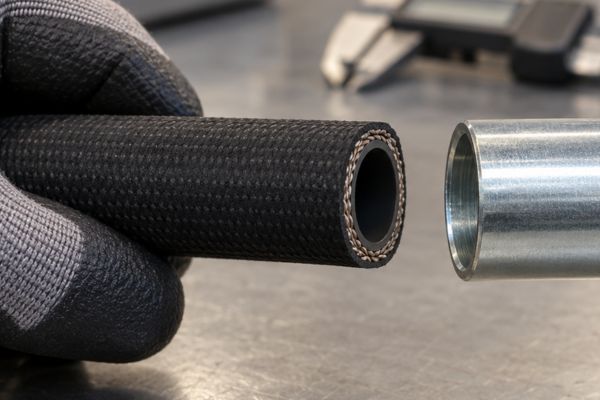
Bulk supply requires a complete assembly system
Buying bulk hose and fittings creates inventory, not validated assemblies. The in-house operation needs current combination-specific instructions for cutting, skiving when required, cleaning, insertion, tooling, crimping, finished measurement, marking, inspection, and testing where applicable. Matching dash sizes or apparent fit does not establish compatibility.
The application review remains separate. Fluid, temperature, working pressure and impulses, routing, bend radius, movement, abrasion, electrical properties where relevant, and equipment requirements can limit the assembly. The complete assembly is constrained by its least-suitable component and by the approved combination.
Finished supply still needs a controlled specification
A finished assembly should be ordered by a complete, revision-controlled description. It may include hose and fitting part numbers or approved performance requirements, end types, orientation, length definition, cleanliness, protection, marking, inspection, records, and application limits. A purchase order that says only “same as sample” transfers uncertainty rather than responsibility.
Understand What In-House Assembly Requires
In-house assembly can shorten internal response time and support varied lengths, but it creates a manufacturing process that must be maintained. Equipment purchase is only one part. Tooling coverage, calibration, preventive maintenance, operator authorization, document control, contamination control, traceability, and nonconformity handling continue for as long as assemblies are made.
Equipment and process controls
The operation may need hose storage, suitable cutting equipment, skiving tools where applicable, cleaning equipment, insertion aids, a crimper approved for the combinations, complete die sets, measuring tools, marking, protective caps, and safe material handling. The exact list depends on the approved system and product mix. Improvised equipment or a generic crimper setting is not an acceptable substitute for current data.
Process records should connect each finished assembly to its hose, fittings, crimp specification, operator, equipment, inspection, and date or batch. Maintain the crimper and measuring devices under controlled schedules. If the system uses digital data, control access and revisions so an old saved favorite cannot silently remain in production.
People and utilization
Skilled labor includes more than minutes at the crimper. Staff must identify components, read specifications, inspect materials, set up tools, handle exceptions, control contamination, and recognize when not to assemble. Training and authorization need renewal when products, equipment, or procedures change.
Low utilization can make competence and equipment condition harder to maintain, while high utilization can expose bottlenecks and require backup capacity. The useful question is not a universal annual volume; it is whether your real product mix provides enough consistent, controlled work to support the process and its fixed obligations.
Define What Finished-Assembly Supply Includes
Buying complete assemblies can transfer execution of the fabrication process, but it does not automatically transfer every technical or commercial risk. The buyer still establishes application requirements, approves the assembly specification, reviews changes, inspects deliveries, and controls installation. The supplier’s documented scope must be clear.
Records and responsibility
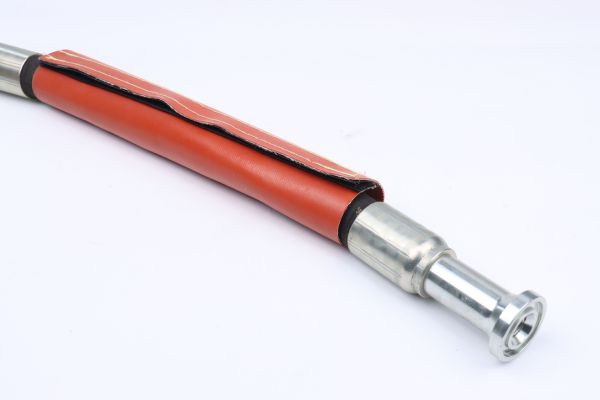
Request the evidence appropriate to the program: exact assembly identity, hose and fitting traceability, controlled fabrication data, inspection results, marking, packaging, and change notification. Do not assume every supplier offers the same records or testing. State the requirement and evaluate the actual response without claiming unverified capability.
Define responsibility for errors in buyer-supplied dimensions, supplier substitutions, transit damage, installation damage, application mismatch, and fabrication nonconformity. Legal and commercial allocation depends on the agreement and local requirements; this article does not provide a guarantee. A practical responsibility matrix helps both sides identify missing information before an order.
Compare the Two Operating Models
The comparison should reflect your real assembly mix, quality system, lead-time needs, and evidence burden. A hybrid model may be appropriate: a controlled set of common assemblies made in-house and specialized, low-frequency, or high-risk assemblies purchased finished. Each route still needs explicit approval.
| Decision area | Bulk components and in-house assembly | Finished hose assemblies |
| Technical data | Operation maintains approved combinations and current crimp data | Buyer specifies assembly; supplier’s controlled process must be documented as required |
| Equipment | Cutting, preparation, cleaning, crimping, dies, measurement, maintenance | Mainly receiving inspection, storage, and installation tools |
| Labor | Setup, assembly, inspection, records, maintenance, training | Specification, order review, receiving, supplier coordination |
| Product mix | Flexible for covered combinations and lengths | Efficient when repeat specifications are stable or specialist processes are needed |
| Utilization | Fixed capability must be maintained regardless of volume | Cost is more directly tied to ordered assemblies, subject to terms |
| Quality records | Generated and retained internally | Requested, reviewed, and linked to delivered assemblies |
| Inventory | Hose, fittings, ferrules, consumables, and obsolete combinations | Finished SKUs, length/orientation variants, and service stock |
| Responsibility | Internal team owns fabrication execution | Responsibilities are shared according to specification and agreement |
| Capacity risk | Equipment downtime or staff availability | Supplier capacity, lead time, transport, and communication |
Do not score a model as better simply because it has fewer rows of work. Some obligations move rather than disappear. Finished supply reduces fabrication activity but increases the importance of specification and external change control.
Build an Editable Cost Model
Cost comparison should use editable inputs rather than a universal break-even volume. Separate fixed annual capability costs, variable fabrication costs, inventory effects, and purchased-assembly costs. Include the administrative and quality work that is often hidden outside the component price.
Core formulas
For in-house assembly, use:
Annual in-house cost = annualized equipment and maintenance + training and document control + inventory carrying and obsolescence + (assemblies × component cost) + (labor hours × loaded labor rate) + scrap/rework + quality and record costs
For finished supply, use:
Annual finished-supply cost = assemblies × purchased assembly price + freight and import costs + order administration + receiving and quality review + inventory carrying + nonconformity and expedite costs
Keep taxes, duties, currency, finance, and legal assumptions with the organization responsible for them. The model supports comparison; it does not guarantee savings.
Explicitly illustrative numbers
The following values are purely illustrative, not market data or a recommendation. Replace every input with verified internal quotations and time records. Suppose a program models 600 assemblies, 10 minutes of direct assembly labor each, a $36 per hour loaded labor input, $18 average components per assembly, and $7,500 in annualized equipment, maintenance, training, quality, and inventory overhead. Its editable in-house model is: components 600 × $18 = $10,800; direct labor 600 × 10/60 × $36 = $3,600; plus fixed inputs $7,500; illustrative total $21,900, before any separately modeled scrap or expedite events.
Suppose the comparison uses an illustrative finished price of $34 per assembly, plus $1,800 combined freight, receiving, and administration inputs. The editable result is 600 × $34 + $1,800 = $22,200. The small modeled difference does not prove either choice. Changing product mix, labor time, utilization, freight, fixed-cost horizon, or quality workload can reverse it, and technical approval remains a prerequisite.
Run sensitivity cases instead of relying on the single result. Replace the illustrative assembly volume with low, expected, and peak demand; vary direct labor time by product family; and test planned equipment downtime or expedited finished supply as separate inputs. Keep one version that excludes uncertain costs and another that states them openly. This shows which assumptions actually drive the choice and which differences are too small to support a durable decision.
Work Through a Hypothetical Program Decision
Consider a clearly hypothetical organization with frequent standard-length assemblies and occasional specialized assemblies. It owns a crimper, but its current tooling and data cover only part of the requested mix. A finished-assembly proposal covers the specialized items, while the organization is considering bulk purchase for everything to reduce order lines.
A defensible hybrid result
The team first maps each assembly to an approved combination, tooling, operator competence, and record process. Common items already inside the controlled system remain candidates for in-house production. Specialized items with missing dies, preparation tools, or combination data remain finished-supply candidates until a formal capability project closes those gaps.
The cost model is run separately for each family because averaging can hide low-use tooling and complex labor. The team also tests capacity during peak periods and the effect of equipment downtime. It chooses a hybrid plan based on documented coverage rather than assuming that ownership of a crimper authorizes every assembly.
Gather Inputs and Set Decision Rules
Reliable inputs come from time studies, equipment records, current quotations, inventory history, quality records, and the actual assembly schedule. Use a representative period that includes normal and peak demand. Separate confirmed data from assumptions so the model can be updated.
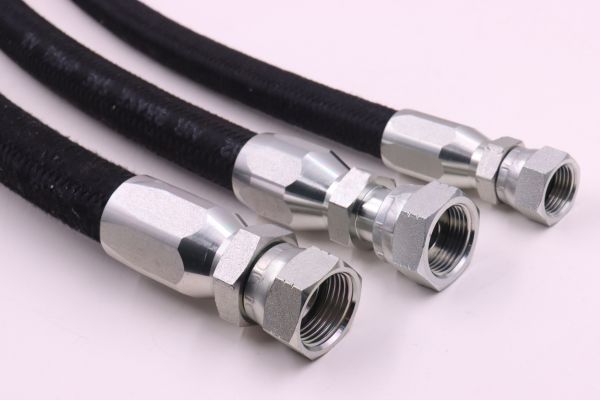
Decision checklist
Before approving bulk components, confirm:
- Exact approved hose, fitting, ferrule, crimper, die, and crimp-data combinations
- Equipment condition, maintenance, calibration, backup capacity, and safe operating procedures
- Operator competence, authorization, staffing coverage, and supervision
- Cutting, preparation, cleaning, marking, inspection, testing, and traceability controls
- Inventory storage, shelf-life controls where applicable, obsolescence, and substitution process
Before approving finished assemblies, confirm:
- Complete drawing or purchase specification, length definition, orientation, ends, materials, and application limits
- Required traceability, fabrication, inspection, testing, cleanliness, marking, and packaging records
- Change notification, deviation approval, lead-time basis, freight, receiving, and nonconformity workflow
- Internal installation, storage, receiving inspection, and service-record responsibilities
Set stop rules for missing technical data, uncontrolled substitutions, expired or obsolete instructions, unavailable tooling, and unresolved application conditions. A commercial deadline should not override them.
Avoid Misleading Comparisons
Common errors include comparing raw components with a finished delivered assembly, ignoring setup and quality time, treating existing equipment as free, and using one average labor time for every hose family. Buyers also omit inventory obsolescence from bulk supply or omit freight and receiving from finished supply. These omissions create a precise-looking but incomplete result.
Keep the model and scope honest
Do not assume a universal scrap rate, savings percentage, or break-even quantity. Use actual records and run sensitivity cases for volume, mix, utilization, labor, freight, lead time, and fixed-cost horizon. Record who owns each input and when it was updated.
Avoid assigning supplier capabilities that have not been verified. A finished-assembly quotation should be evaluated against the stated evidence requirements, not against a generic belief that external fabrication is automatically more controlled. Likewise, in-house proximity does not make an assembly technically approved.
Conclusion
The bulk components vs finished hose assemblies decision should follow technical authorization, not precede it. In-house assembly fits operations that can maintain approved combinations, equipment, tooling, skilled labor, cleanliness, inspection, traceability, and enough suitable utilization. Finished supply fits programs where a controlled external fabrication scope provides better capacity, specialization, or responsibility, while the buyer still owns specification and receiving controls. Compare the models with editable, verified cost inputs that include fixed capability, labor, inventory, quality, freight, administration, and change risk. Do not apply a universal break-even volume or assume component ownership permits unvalidated crimping. The next step is to map each assembly family to its approval evidence and run the cost model with actual internal records and quotations.
Frequently Asked Questions
Does owning a hydraulic crimper justify buying bulk components?
No, the crimper is only one element of an approved assembly process. You also need covered hose-and-fitting combinations, correct dies, current specifications, trained operators, maintenance, inspection, and records.
Are finished hose assemblies always more expensive?
No, the result depends on product mix, volume, labor, equipment utilization, inventory, freight, quality work, and commercial terms. Compare complete editable costs rather than component and assembly unit prices alone.
Can one operation use both purchasing models?
Yes, a hybrid model can assign covered, repeatable families to in-house production and specialized or low-frequency items to finished supply. Each family needs its own approval and responsibility path.
Should emergency demand determine the decision?
Emergency needs can influence capacity and stock planning, but they do not authorize an unapproved combination or rushed assembly. Model urgent demand separately and preserve technical stop rules.
What is the best break-even volume for in-house assembly?
There is no universal break-even volume. Calculate it from verified fixed and variable costs, actual mix and utilization, quality workload, and the time horizon your organization uses.