
Select the fitting family from the exact hose series and its approved assembly data, not from the words “braided” or “spiral” alone. One-piece fittings for spiral or braided hydraulic hose may differ because reinforcement architecture changes hose-end stiffness, ferrule engagement, preparation, crimp response, and routing behavior. A shared dash size or similar port end does not prove that a stem-and-ferrule design can transfer between the two constructions. The practical decision is therefore side by side: identify how each hose is built, confirm which fitting series is approved for it, and then verify preparation, tooling, crimp, pressure, impulse, fluid, temperature, and installation conditions as one system.
Start with the Approved Hose-and-Fitting Pair
Braided hose and spiral hose are broad construction families, not complete part specifications. A fitting selected only by reinforcement label can still be wrong for the hose manufacturer, series, size, cover, tube, or exact reinforcement package. Begin with the controlled hose identity and locate the fitting series explicitly approved for it.
For braided hose, the approved family must engage the particular braid arrangement and hose wall defined by that series. For spiral hose, the approved family must account for its layered reinforcement and end preparation. Neither side should borrow a fitting simply because the stem enters the hose or the ferrule appears to fit over the cover.

The port end and hose end answer different questions
The connection side controls thread form, diameter, pitch, straight or tapered form, male or female arrangement, seat, sealing face, and O-ring location. The hose side controls stem geometry, ferrule design, preparation, insertion, and crimp. A correct JIC, ORFS, BSP, NPT, Metric, or flange connection does not prove the hose tail is suitable.
A one-piece design means the stem and ferrule are preassembled, attached, or retained together, with details varying by series. It may reduce separate ferrule selection, but it does not guarantee hose compatibility, correct crimping, pressure suitability, or leak-free service.
Reinforcement Architecture Changes the Hose End
Braided and spiral reinforcement support pressure through different wire arrangements. That architecture affects stiffness, changes how the hose wall moves under radial compression, and influences how the fitting captures the reinforcement. Selection must respond to the exact construction rather than a generalized claim that one type is always stronger.
Braided hose response
Wire-braided hose uses one or more braided reinforcement layers whose crossing wires create a flexible structure. The exact wire, braid angle, layer count, and intermediate materials vary by series. At the hose end, the approved stem and ferrule must compress and support that structure without relying on a universal geometry.
Braided construction may suit routing that benefits from its series-specific flexibility, but bend radius still comes from current hose data. Flexibility does not authorize a tight bend next to the ferrule, twisting during installation, or use below the stated minimum bend radius.
Spiral hose response
Spiral hose uses reinforcement layers laid in alternating directions rather than a braided crossing pattern. The resulting hose can behave differently in stiffness, OD, and compression at the end. Its fitting family may use geometry and preparation intended to engage that particular multilayer wall.
Spiral construction should not be described as automatically superior or automatically required for every severe application. Pressure impulse, routing, machine movement, temperature, fluid, and applicable equipment requirements determine suitability. The selected hose and fitting combination must be approved for those conditions.
| Selection factor | Braided-hose side | Spiral-hose side | Required control |
| Reinforcement | Crossing braid architecture varies by series | Alternating spiral layers vary by series | Confirm exact hose construction |
| Hose OD behavior | Depends on cover, braid, and series tolerances | Depends on cover, spiral pack, and series tolerances | Use current series data, not dash size alone |
| End preparation | May be skive or no-skive when specified | May require different preparation by series | Follow exact approved instructions |
| Fitting engagement | Stem and ferrule must suit the braid package | Stem and ferrule must suit the spiral package | Use the listed fitting family |
| Crimp data | Series-specific tooling and final target | Series-specific tooling and final target | Do not transfer settings |
| Routing | Confirm bend, movement, and support needs | Confirm stiffness, bend, movement, and support needs | Check the installed route |
| Impulse demand | Evaluate against approved assembly data | Evaluate against approved assembly data | Do not infer performance from construction name |
Ferrule and Stem Design Must Match the Wall
The fitting stem supports the hose internally while the ferrule compresses it externally. Their profiles, engagement lengths, serrations or related features, and compression zones form a designed pair. The hose wall between them is not a passive spacer; its tube and reinforcement influence retention and sealing behavior.
With braided hose, the approved design must engage the braid without damaging the tube or leaving inadequate capture. With spiral hose, the design must accommodate the specified multilayer structure and preparation. A ferrule used for one family may contact another hose at the wrong location or apply an unsuitable compression pattern.
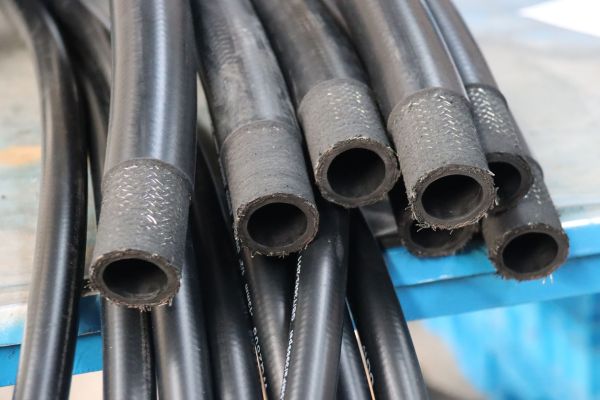
Physical assembly is not compatibility evidence
A stem may slide into both hoses of the same nominal ID, and a ferrule may fit over both ODs. That observation only shows physical clearance before crimping. It does not establish validated retention, internal bore condition, pressure impulse performance, or service suitability.
Do not mix a stem from one family with a ferrule from another unless controlled data explicitly defines the combination. The preassembled nature of a one-piece fitting helps preserve its intended pair, but part identity and revision still need confirmation before assembly.
Skive and No-Skive Preparation Are Series Decisions
Skive and no-skive are preparation instructions, not universal labels for all braided or all spiral hoses. Some approved systems remove a defined amount of cover or other material so the ferrule engages the intended layer. Other systems are designed for assembly without that removal. The applicable current instructions control the decision.
For a braided series, never assume no-skive because another braided hose used that method. For a spiral series, never assume skiving depth or tool settings from a different construction. Removing too much, too little, or the wrong layer changes the material captured under the ferrule and may damage the reinforcement.
Preparation control should include:
- Exact hose and fitting series identification.
- Approved skive or no-skive instruction and tool method.
- Hose cut quality and cleanliness requirements.
- Controlled insertion depth or insertion mark.
- Ferrule position, die set, crimp location, and final inspection data.
These fields must come from current hose, fitting, and crimp-equipment information. There is no universal insertion length, die, crimp diameter, or preparation depth for either construction family.
Routing and Impulse Conditions Affect the Choice
Fitting compatibility answers whether a hose end can be assembled under approved data; application suitability asks whether the completed assembly belongs in the machine. Reinforcement architecture influences bend behavior and response to impulse, but the selection still depends on the rated complete assembly and installed route.
Braided hose may be easier to route in some applications, subject to its specified minimum bend radius and movement limits. Spiral hose may be selected where its approved series meets demanding pressure or impulse conditions, but its stiffness and routing space can create installation constraints. These are conditional observations, not universal performance rankings.
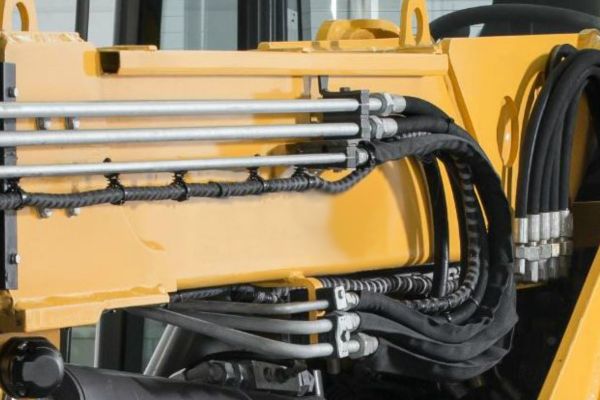
Protect the area near the fitting
Both constructions can be damaged by a bend beginning too close to the fitting, torsion, abrasion, unsupported weight, or motion that repeatedly loads the connection. A stiffer hose forced into a small space can push side load into the fitting. A more flexible route can still fail if it rubs, kinks, or twists.
Review the entire installed path: port alignment, straight allowance near the fitting, minimum bend radius, movement envelope, clamps, abrasion points, heat, and service access. A different hose construction may require a different length or elbow orientation even when the ports do not change.
Follow a Decision Path from Hose Series to Assembly
The safest selection sequence narrows the decision in the correct order. It prevents a familiar fitting or convenient stock item from driving the hose choice backward.
- Define the application inputs: pressure and impulse conditions, fluid, temperature, environment, routing, movement, and applicable equipment requirements.
- Select an exact hose series whose current data addresses those conditions.
- Identify the approved one-piece fitting family and exact hose-side size for that hose series.
- Confirm connection standard, thread, seat, seal, orientation, and installation clearance at each port.
- Retrieve current preparation, insertion, tooling, die, crimp, and inspection instructions.
- Verify the finished assembly, route, and application under the organization’s approved process.
Pressure suitability is limited by the lowest-rated component in the complete assembly or circuit, including hose, fitting, adapter, port, coupling, or other component. Selecting a spiral hose does not raise the rating of a lower-rated fitting or port. Selecting a braided hose does not reduce the need to account for impulse, temperature, and external damage.
Check Substitution Risks and Common Mismatches
Changing from braided to spiral hose, or from spiral to braided hose, is an engineering change rather than a catalog synonym. The substitution can alter OD, bend radius, fitting family, preparation, crimp data, routing, length, and equipment clearance. Review each affected field before ordering or assembly.
Common mismatch scenarios include:
- Keeping the old fitting because the new hose has the same dash size.
- Selecting by port connection while ignoring the hose-tail series.
- Transferring a skive or no-skive method between unrelated hoses.
- Reusing die and crimp settings because the ferrule appears similar.
- Replacing braided hose with spiral hose without checking routing space and bend behavior.
- Assuming spiral construction automatically permits a higher system pressure.
Before substitution, prepare the old and proposed hose part identities, construction data, OD and bend information, fitting series, port requirements, assembly instructions, and application conditions. If an approved combination or required data is missing, place the change on hold rather than building a trial by feel.
Receiving and warehouse controls should change with the technical decision. Keep braided and spiral hose series distinguishable in the item master, labels, storage location, and assembly traveler; otherwise an approved engineering choice can be lost during picking. Record the applicable fitting family beside the full hose series instead of maintaining a generic “fits this dash” note. When either component revision changes, review the linked preparation and crimp documents before the next batch. This traceability does not prove application suitability, but it prevents an operator from silently substituting a visually similar hose or fitting after the original selection has been approved.
Conclusion
Braided or spiral hoses require fitting decisions based on their exact series, not a broad reinforcement label. Compare how each hose wall is built, then confirm the stem and ferrule designed to engage it, the required preparation, and the current crimp and inspection data. Follow with an application check covering pressure impulse, fluid, temperature, routing, bend radius, movement, and installation space. A shared dash size, physical fit, or matching port end cannot establish compatibility, and no fitting or crimp setting should transfer without an approved basis. The reliable way to select one-piece fittings for spiral vs braided hydraulic hose is to document the complete hose-and-fitting pair and its assembly process. Prepare those records before substitution, purchasing, or production release.
FAQ
Can a spiral-hose fitting be used on braided hose of the same dash size?
Only if current approved data explicitly lists that exact hose-and-fitting combination. Matching dash size or physical fit does not prove correct ferrule engagement or crimp behavior.
Does spiral hose always require skiving?
No, preparation depends on the exact hose and fitting system. Follow the current series instructions rather than assigning skive or no-skive by reinforcement category.
Is spiral hose always better for pressure impulse?
No construction is automatically better for every application. Compare approved assembly ratings and test basis, then account for routing, temperature, fluid, movement, and the lowest-rated component.
Can the same fitting series cover several braided hoses?
It may when controlled manufacturer data explicitly approves each combination. Do not infer coverage from brand, OD, dash size, or similar appearance.
What should be reviewed when changing from braided to spiral hose?
Review the exact hose series, fitting family, preparation, insertion, die and crimp data, bend radius, route, finished length, pressure and impulse conditions, fluid, temperature, and installation clearance. Hold the change when required approval data is unavailable.