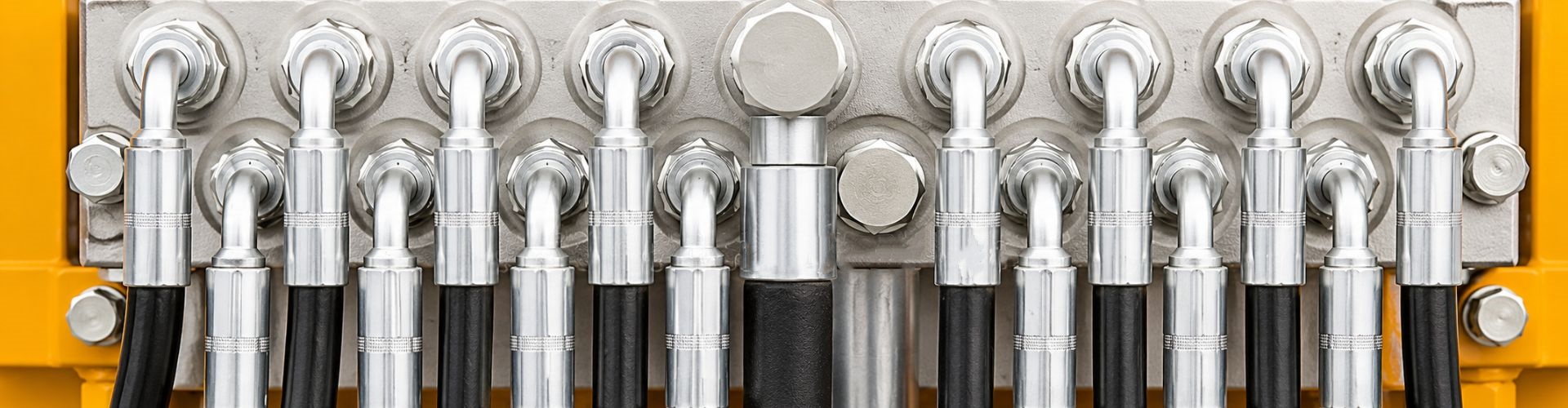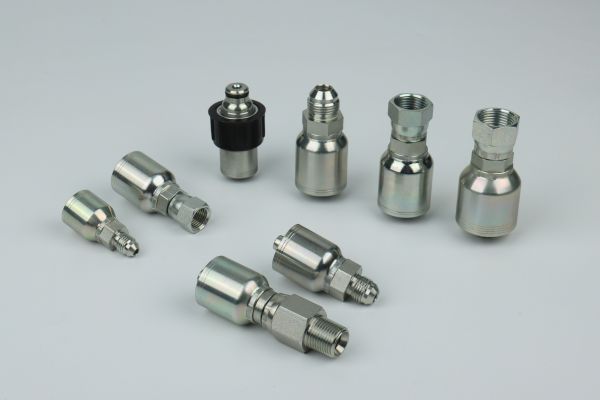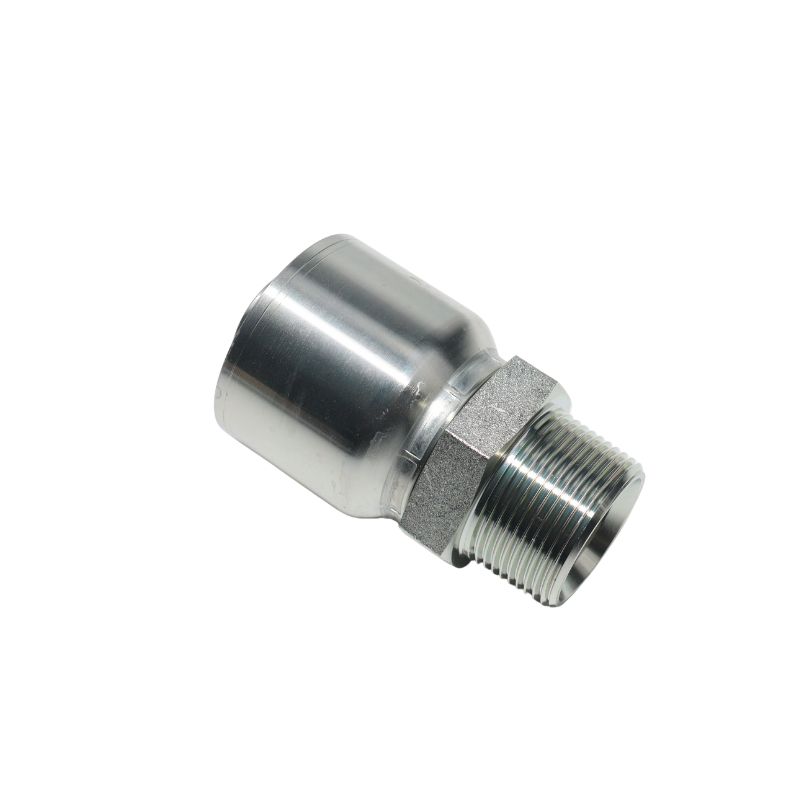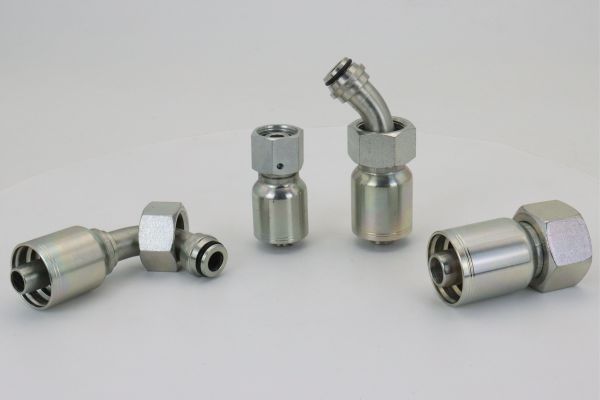
Parker 43 style crimp fittings protection should focus on threads, sealing faces, O-ring areas, swivel nuts, flange faces, stems, ferrules, and exposed edges that can be damaged by impact, abrasion, contamination, and moisture. Ocean shipment, warehouse movement, partial-carton picking, and counter storage can change a fitting’s condition after final inspection. A torn carton is not automatically a product defect, while an intact carton does not prove that critical surfaces escaped damage.
Critical Surfaces Concentrate Shipping and Storage Risk
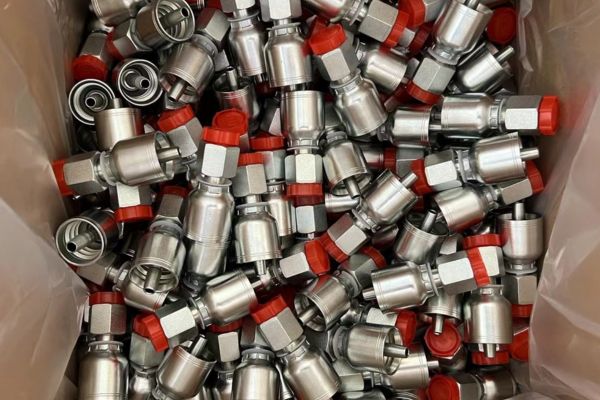
Fittings are compact, relatively heavy parts with hard edges and closely spaced functional features. When they move against each other, a small contact area can carry impact or abrasion directly to a thread crest, seat, face, groove, or nut.
Functional damage may be visually small
A shallow carton scuff may have no effect on the product, while a small raised mark on a sealing face can matter during connection. The location, geometry, and approved acceptance requirement determine significance. Inspectors should therefore identify the affected feature rather than classifying condition by the apparent size of the mark alone.
Metal-to-metal contact can create both surface damage and loose particles. Fittings with different shapes may concentrate load on protruding threads, elbows, flanges, or swivel nuts. Repeated vibration can rub finish from contact points and transfer debris into bores or grooves, even if no single transport event appears severe.
Protection is a continuous chain
Final inspection establishes a condition; packaging should preserve it through loading, transport, unloading, receiving, storage, and picking. Protection can fail later when caps are removed and not replaced, inner packs are opened in dusty areas, or loose returns enter new-stock bins. The warehouse process therefore matters as much as the original pack.
Protection does not prove the fitting is technically suitable. The buyer must still verify connection standard, dimensions, material, sealing method, hose series, crimp data, pressure, temperature, fluid, and application. Packaging controls arrival condition; they do not establish compatibility.
Threaded Areas Need Shape-Specific Protection
Male and female threads require different protective approaches because their exposed edges and cavities face different hazards. The protective component should match the intended connection without becoming a source of damage.
Male threads are exposed to impact and abrasion
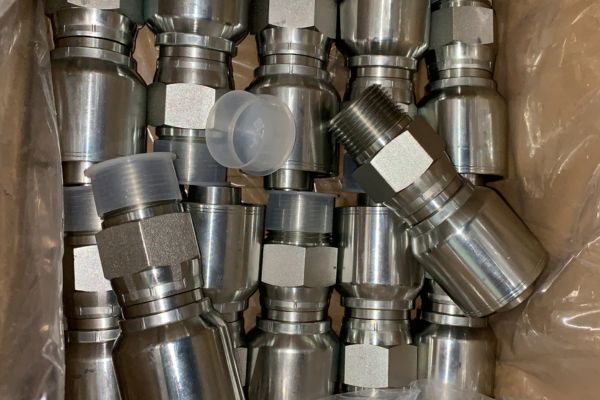
Male thread crests, first threads, and adjacent cones or O-ring features can strike nearby fittings or carton walls. A protector should shield the critical geometry and remain secure under expected handling without cutting, cross-threading, or leaving debris. A cap that is too tight, misaligned, or made for another thread may damage the very area it is meant to protect.
Inspect the protector before removing it. A cracked cap, pushed-in end, or unusual contact mark can indicate load transfer to the connection. After removal, check the thread entry, crests, sealing feature, and cleanliness under suitable lighting; do not force a mating part to judge whether impact damage is acceptable.
Female threads can trap contamination
Female threads inside a nut or body may be partly shielded from direct impact but can collect dust, fibers, metal particles, moisture, or broken packaging. A plug or cap should protect the cavity without contacting the seat incorrectly, displacing an O-ring, or binding the swivel nut. The selected form depends on the actual connection and assembly.
Do not assume a freely rotating female nut means the threads arrived undamaged. Inspect accessible threads, thread entry, sealing seat, and nut condition separately. Thread form, diameter, pitch or TPI, taper, seat, and sealing method also require their own technical verification.
Sealing Faces and O-Ring Areas Need Clean Contact Protection
Sealing features deserve priority because scratches, dents, raised material, corrosion, or contamination may disrupt the intended interface. Protection should prevent direct contact while avoiding pressure on delicate seals or edges.
Flare seats, flat faces, and grooves
Flare or cone seats require protection from point impact and abrasive particles. ORFS and other flat faces present a broad contact surface that can rub against adjacent parts. O-ring grooves need clean edges and freedom from chips, fibers, corrosion, and deformation that could pinch or cut the specified seal.
A protector that covers only the thread but leaves the face exposed may be inadequate for some connections. Conversely, a plug inserted too deeply may contact a seat or groove. Define the arrival condition to be preserved, then use a shape-compatible solution rather than one generic cap across all SKUs.
O-rings must not be loaded or displaced
When an O-ring is preinstalled, protection should avoid twisting, pinching, flattening, cutting, or pushing it out of its groove. Visual inspection can confirm presence, position, and obvious damage, but it cannot identify material or exact size. Those characteristics require controlled specifications and evidence.
Do not replace a visibly damaged O-ring based only on appearance or apparent fit. Verify the specified size, material, groove, fluid, temperature, pressure, and application requirements, and use an approved rework procedure. Otherwise, the attempt to restore packaging condition may introduce an untraceable seal.
| Critical area | Main shipping or storage hazard | Protection objective |
| Male thread and end feature | Impact, abrasion, crossed cap, debris | Shield crests and adjacent sealing geometry |
| Female thread and seat | Contamination, plug contact, nut impact | Keep cavity clean without loading the seat or nut |
| ORFS or flat face | Scratching, rubbing, embedded particles | Prevent direct contact and preserve clean surface |
| O-ring and groove | Displacement, pinching, cuts, contamination | Retain the specified seal without pressure or debris |
| Flange face and edge | Broad-face abrasion, corner impact, moisture | Isolate face and stabilize heavy geometry |
| Stem and ferrule | Bending, dents, mixing, internal debris | Separate parts and preserve hose-side identity |
Swivel Nuts and Flange Faces Need Stable Packaging
Swivel and flange fittings have movable or broad exposed geometry that can shift loads within a package. Their protection must control the whole fitting, not only the threaded opening.
Swivel assemblies can bind after impact
A female swivel nut can strike adjacent parts, deform at an edge, collect debris, or become loaded by a poorly fitting cap. After transport, inspect rotational feel, localized binding, apparent looseness, axial condition, retention, thread entry, and sealing seat under the approved method. Do not force, lubricate, or disassemble the nut to make it feel acceptable.
Packaging should keep heavy fittings from repeatedly hitting the nut. Orientation, dividers, trays, wrapping, or other separation may help depending on size and geometry. No universal axial-play or rotational-resistance limit should be created from a receiving impression; use the controlled drawing and baseline.
Flanges distribute weight but expose broad faces
Flange faces and edges can rub across large areas or carry concentrated impact at corners. Bolt-hole regions and sealing interfaces may also collect particles. Stabilize the fitting so the face does not act as a bearing surface for other components during transport or stacking.
Moisture control may be important depending on material, finish, route, and storage conditions, but no packaging method can guarantee a universal storage life. Inspect for staining, corrosion, barrier damage, and trapped moisture evidence. Do not translate a corrosion-test value directly into field life without appropriate technical basis.
Inner Packaging and Carton Separation Reduce Movement
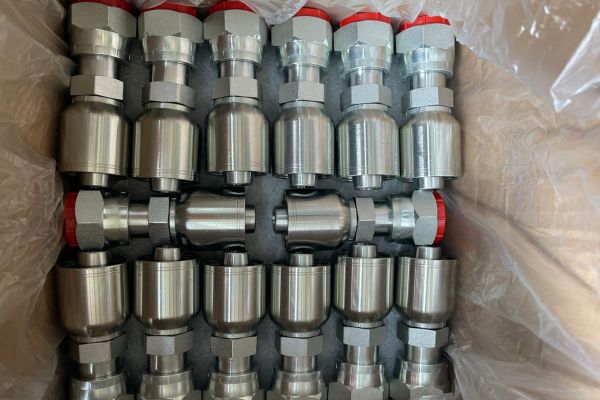
Effective packaging manages part identity, contact, movement, contamination, and load. An attractive outer carton cannot compensate for loose heavy components inside.
Select methods from actual hazards
Inner bags can isolate dust but may not stop impacts. Dividers can reduce contact but may collapse under weight or abrasion. Trays can control orientation but must support the fitting without loading a sealing face. Wraps, plugs, caps, and other methods each have limitations, so the combination should reflect geometry, mass, quantity, shipment method, and handling.
Review carton fill and empty space. Excess movement increases collision risk, while excessive compression can transfer force through caps, nuts, elbows, or flange faces. The solution should maintain protection after normal carton movement and allow receiving staff to identify SKUs without dumping mixed parts onto a bench.
Keep models and batches separated
Similar Parker 43-style models may differ at the port end, hose side, angle, O-ring, nut, or flange. Inner labels and physical separation reduce mixing during packing and receiving. If multiple SKUs share a carton, the packaging plan should show how each inner quantity and identity reconciles with the packing list.
Useful package controls may include:
- Correct cap or plug matched to the connection geometry
- Separation that prevents harmful metal-to-metal contact
- Stable orientation for elbows, swivels, and flanges
- Closed inner packs that limit dust and loose debris
- Readable SKU, quantity, batch, and carton labels
- Carton structure suitable for the part weight and route
- Defined method for re-protecting inspected or partially picked stock
Receiving Inspection Must Trace Arrival Condition
Receiving should preserve evidence before cleaning, repacking, or moving stock into bins. The purpose is to determine whether critical areas remain acceptable and whether a pattern requires broader containment.
Inspect from the outside inward
Begin with shipping unit, pallet if applicable, carton number, labels, external damage, moisture evidence, and carton closure. Then review inner packaging, SKU separation, part movement, cap or plug condition, and visible contact marks. Photograph context before removing items so a later reviewer can connect product findings to packaging.
Inspect threads, seats, faces, O-ring areas, nuts, flanges, stems, ferrules, and internal passages using nondamaging methods. Keep uninspected, accepted, and held quantities separate. Do not blow unknown debris toward people or use an unapproved cleaner that may spread contamination or affect a seal.
Distinguish package damage from product disposition
A crushed corner may justify expanded inspection without automatically rejecting every fitting. An undamaged box may still contain abrasion from loose packing. Record the actual product condition, affected package, batch, and quantity, then apply the approved acceptance and sampling plan.
When damage appears, check nearby units and similar package positions for a pattern. Preserve caps, bags, dividers, and cartons needed for investigation. Clean or rework only under an authorized procedure; removing visible evidence before documentation makes cause and scope harder to determine.
Warehouse Storage Can Undo Shipment Protection
Arrival acceptance is not the end of protection. Open cartons, partial quantities, bin contact, humidity, dust, and frequent counter handling can degrade fittings over time.
Maintain identity and critical-surface coverage
Store fittings so caps and plugs remain in place, labels stay with the parts, and different SKUs or batches cannot mix. Bins should prevent heavy pieces from dropping onto faces or threads. When staff remove an item for inspection or sale, they should avoid placing exposed connections on dirty or abrasive surfaces.
Returned, used, or unidentified fittings should never be placed into new stock. Their internal cleanliness, damage, material, and service history are unknown. A quarantine location is simpler than trying to reconstruct identity after mixing.
Review storage conditions and stock rotation
Consider moisture, temperature, chemicals, washdown, outdoor exposure, dust, vibration, and stacking as they apply to the facility and product. No fixed storage-life guarantee can be inferred without product and packaging data. Periodic review should prioritize slow-moving open packs, damaged protection, corrosion evidence, missing labels, and repeatedly handled SKUs.
Stock rotation also supports inspection because older packages can be used before protection degrades, subject to approved requirements. Record repacking or protection changes where traceability matters, especially for product held across multiple replenishment cycles.
Common Protection Mistakes Hide Functional Risk
Protection errors often look small until they affect a sealing or identification feature. The receiving decision should focus on preserved function and traceability, not on whether the package still looks presentable.
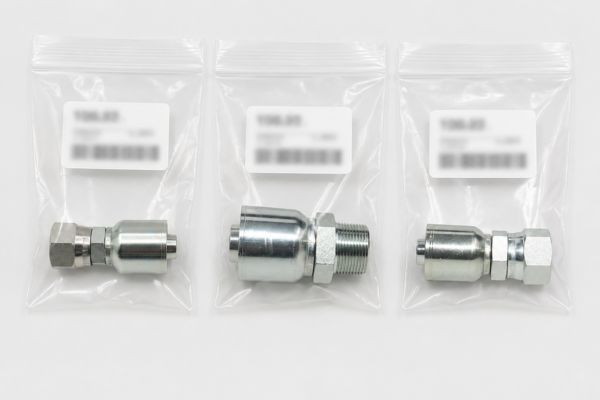
Mistakes to avoid
Do not use a cap simply because it can be pushed onto the connection. Do not tape directly across functional surfaces, let adhesive contact threads or seals, or pack heavy flanges loose with small swivels. Do not leave protective components off after taking photos or performing inspection.
Avoid treating finish rub marks and sealing-face scratches as equivalent, or rejecting a carton solely because of cosmetic damage. Do not install fittings with damaged threads, sealing faces, flange faces, O-ring grooves, missing retention, or severe corrosion without appropriate evaluation.
Neutral protection checklist
Before releasing stock, confirm:
- Correct SKU, connection, angle, hose side, revision, and batch
- Male and female threads have suitable, nondamaging protection
- Seats, ORFS faces, flange faces, grooves, and O-rings are clean and protected
- Swivel nuts remain retained and move according to the approved check
- Stems, ferrules, edges, and bores show no unacceptable impact or debris
- Inner packs control contact, movement, contamination, and SKU separation
- Carton condition, quantities, labels, and packing list reconcile
- Arrival findings and photographs remain linked to package and batch
- Open warehouse stock is reprotected, identified, and separated
Conclusion
Parker 43 style crimp fittings protection must preserve the small functional areas that determine connection condition, sealing integrity, cleanliness, and product identity. Match caps and plugs to actual geometry, keep heavy parts from striking threads, faces, nuts, flanges, stems, and ferrules, and use inner packaging that controls both movement and SKU separation. At receiving, inspect from carton to critical surface before cleaning or repacking, then distinguish cosmetic package damage from possible functional nonconformity through approved criteria. Continue the same controls in warehouse bins and partial packs. Before installation, hold any fitting with questionable threads, sealing faces, flange faces, O-ring grooves, retention, contamination, or severe corrosion for appropriate evaluation; good packaging alone never proves technical or application suitability.
FAQ
Does every hydraulic fitting need a protective cap?
Not necessarily in the same form, because connection geometry, exposure, packaging, and agreed requirements differ. The protection method must preserve critical areas without damaging them.
Can a cap fit tightly and still be wrong?
Yes, excessive or incorrect engagement can damage threads, contact a seat, displace an O-ring, or load a swivel nut. Match the protector to the actual connection.
Should a carton with exterior damage be rejected automatically?
No, exterior damage should trigger documented inspection and possibly broader containment. Product disposition depends on the actual condition and approved acceptance criteria.
Are finish rub marks always functional defects?
No, location, severity, material, finish requirement, and functional consequence determine significance. Marks on threads, sealing features, or corrosion protection require more careful evaluation than harmless carton scuffs.
How should open cartons be stored after receiving?
Keep fittings identified, separated, clean, and reprotected under the warehouse procedure. Prevent mixed SKUs, exposed connections, moisture, dust, impacts, and returns from entering new stock.