
Mining machinery prefers 4-wire spiral hoses because they offer the superior structural integrity and impulse resistance required to withstand extreme pressure spikes and abrasive environments found in heavy-duty extraction. You face constant pressure to keep operations running, but a single hose burst can halt production for hours, costing thousands in lost revenue. These failures often stem from using standard braided hoses that fatigue under the intense pulsation of mining equipment. By switching to high-performance spiral reinforcement, you eliminate the weak points in your hydraulic system and ensure your fleet remains operational under the most grueling conditions.
What Defines 4-Wire Spiral Hoses?
These hoses are specialized hydraulic conduits featuring four layers of high-tensile steel wire wrapped in a spiral pattern to provide maximum pressure resistance. The construction of 4-wire spiral hydraulic hoses ensures that the wires remain parallel to each other, which prevents the internal friction often found in braided alternatives.

Is The Spiral Design Better Than Braiding?
The spiral design is significantly more robust than braiding for high-pressure applications. In a spiral configuration, the wires do not cross over one another, which minimizes wire-on-wire wear during pressure cycles.
- No wire crossing points.
- Reduced internal heat generation.
- Increased resistance to wire fatigue.
How Do Four Steel Layers Provide Strength?
Each of the four steel layers is wrapped at a specific angle to balance the internal forces of the hydraulic fluid. This multi-layered approach allows the hose to maintain its shape even when subjected to extreme hydraulic surges.
| Feature | Spiral Construction Detail |
| Reinforcement | 4 Layers of High-Tensile Steel |
| Wire Alignment | Parallel Spiral Wrap |
| Core Material | Oil-Resistant Synthetic Rubber |
Why Does Mining Need 4-Wire Spiral Hydraulic Hoses?
Mining environments demand 4-wire spiral hydraulic hoses because the equipment operates at extreme pressures while being subjected to constant external abrasion and impact. The high-frequency pressure pulses in mining equipment can quickly destroy lower-grade hoses, leading to dangerous fluid leaks.
Does Surface Mining Require Extreme Durability?
Surface mining involves massive machinery like haul trucks and loaders that operate 24/7. These machines rely on 4-wire spiral hydraulic hoses to manage the immense power required to move tons of earth and rock.
- Protection against flying debris.
- Resistance to high UV exposure.
- Capability to handle high-flow volumes.
How Do 4-Wire Spiral Hydraulic Hoses Beat 2-Wire Options?
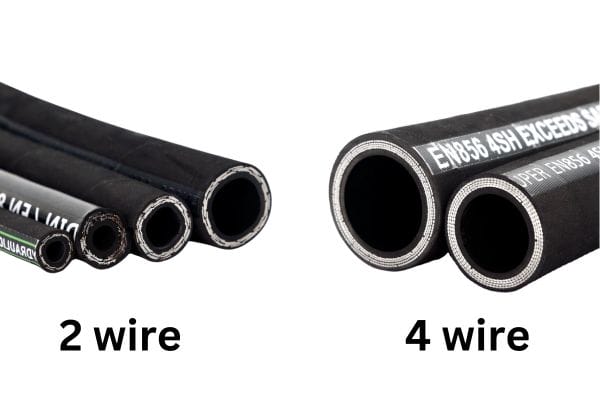
These hoses outperform 2-wire braided versions by utilizing a spiral structure that prevents wire fatigue and allows for significantly higher working pressures. While 2-wire hoses are common in light industrial use, 4-wire spiral hydraulic hoses are the standard for heavy mining duty.
Why Do Braided Hoses Fail Under High Pulsation?
Braided hoses fail because the overlapping wires rub against each other whenever the pressure changes. This friction creates “notches” in the steel, which eventually lead to wire breakage and hose bursts.
- Braided wires cross at angles.
- Movement causes internal sawing action.
- Lower impulse cycle ratings.
How Does Spiral Construction Prevent Wire Fatigue?
Spiral construction keeps each wire layer isolated and parallel, allowing the hose to expand and contract smoothly. This design significantly increases the number of impulse cycles the hose can survive before failure.
| Performance Metric | 2-Wire Braided | 4-Wire Spiral |
| Working Pressure | Lower (e.g., 2,500 PSI) | Higher (e.g., 6,000 PSI) |
| Impulse Life | ~200,000 Cycles | ~1,000,000+ Cycles |
| Pressure Spikes | Poor Resistance | Excellent Resistance |
What Is The Build Of 4-Wire Spiral Hydraulic Hoses?
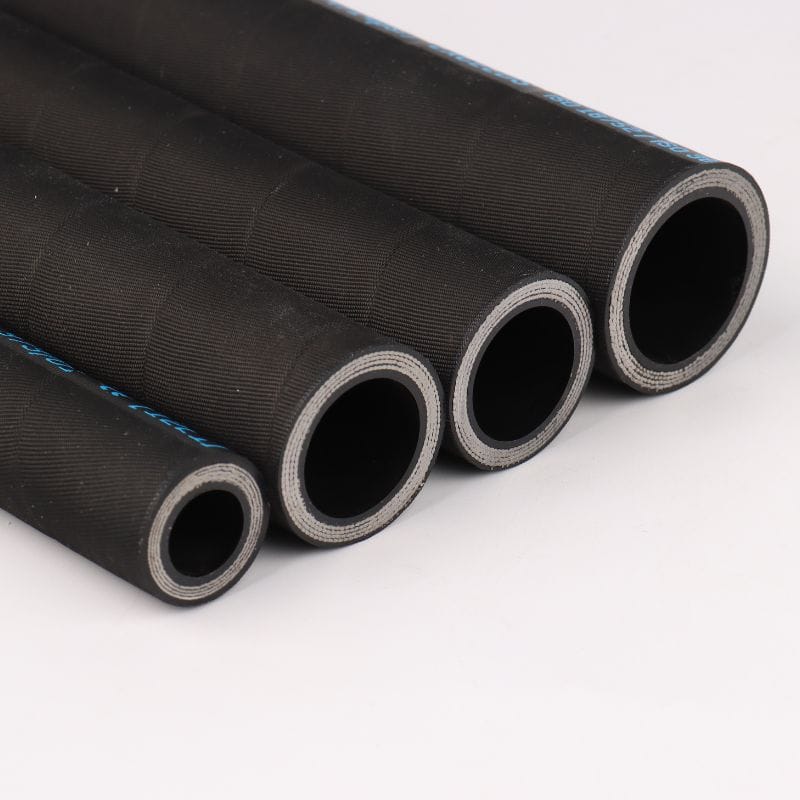
The construction of 4-wire spiral hydraulic hoses consists of a synthetic rubber inner tube, four alternating layers of spiral steel wire, and an abrasion-resistant outer cover. This multi-stage build is engineered to keep hydraulic fluid contained under immense force while resisting external damage.
What Role Does The Inner Tube Play?
The inner tube is the first line of defense, designed to be compatible with various hydraulic fluids. It must remain flexible and leak-proof even when exposed to high temperatures and chemically aggressive oils.
- Oil-resistant synthetic rubber.
- Smooth bore for efficient flow.
- Temperature stability from -40°C to +121°C.
Is The Outer Cover Resistant To Abrasion?
The outer cover is typically made from specialized rubber compounds that can withstand being dragged over jagged rocks. This layer protects the critical steel reinforcement from moisture, which could otherwise cause rust and structural failure.
| Hose Component | Primary Function |
| Inner Tube | Fluid containment and compatibility |
| Reinforcement | Pressure and impulse resistance |
| Outer Cover | Environmental and abrasion protection |
The integration of these three components creates a hose that is far more than the sum of its parts.
Understanding the internal architecture of your hoses helps you appreciate their durability, allowing you to trust your equipment when pushing it to its maximum operational limits in the field.
What Are The PSI Specs For 4-Wire Spiral Hydraulic Hoses?
These hoses typically handle working pressures ranging from 4,000 to over 6,000 PSI, depending on the specific SAE or EN standard they meet. High-pressure 4-wire spiral hydraulic hoses are essential for modern mining systems that require high force density to operate heavy actuators.
Can These Hoses Handle Over 6,000 PSI?
Many premium 4-wire spiral hoses are rated for 6,000 PSI constant working pressure across all sizes. This allows for standardized system designs where pressure doesn’t need to be de-rated for larger hose diameters.
- SAE 100R12 (Medium-High Pressure).
- SAE 100R13 (High Pressure).
- SAE 100R15 (Extreme Pressure).
What Are The Typical SAE And EN Standards?
International standards like SAE J517 and EN 856 define the minimum performance requirements for these hoses. Mining operators usually look for EN 856 4SP or 4SH ratings to ensure the hoses meet rigorous safety benchmarks.
| Standard Type | Common Rating | Typical Working Pressure |
| EN 856 | 4SP | 3,600 – 6,500 PSI |
| EN 856 | 4SH | 3,600 – 6,000 PSI |
| SAE 100R12 | R12 | 2,500 – 4,000 PSI |
Do 4-Wire Spiral Hydraulic Hoses Handle Pressure Spikes?
Yes, the spiral configuration allows 4-wire spiral hydraulic hoses to absorb sudden pressure surges and millions of impulse cycles without the wires crossing. Mining machinery often experiences “spikes” when a bucket hits a hard rock, and only spiral hoses can reliably dampen these shocks.

What Is Impulse Resistance In Heavy Machinery?
Impulse resistance is the ability of a hose to withstand rapid cycles of low and high pressure. In mining, these cycles happen every few seconds, which can quickly fatigue the metal reinforcement in standard hoses.
- Absorbs mechanical vibration.
- Resists “surging” from pump strokes.
- Maintains diameter under load.
How Do Spiral Layers Manage Constant Surges?
The spiral layers act like a spring, expanding slightly to take the hit of a pressure spike and then returning to their original shape. Because the wires don’t rub, they don’t generate the heat that usually degrades rubber components.
| Cycle Type | Impact on Hose | Spiral Advantage |
| Static Pressure | Constant Tension | High tensile strength |
| Impulse Spikes | Rapid Expansion | No wire-on-wire friction |
| Vibration | Mechanical Stress | Flexible steel structure |
Are 4-Wire Spiral Hydraulic Hoses MSHA Certified?
Most high-quality versions of 4-wire spiral hydraulic hoses come with MSHA certification to ensure flame resistance for underground use. This certification is a legal requirement in many jurisdictions to prevent hydraulic oil fires from spreading in confined mining environments.
Why Is Flame Resistance Critical Underground?
In an underground mine, a fire can be catastrophic due to limited ventilation and escape routes. MSHA-certified hoses are made with self-extinguishing covers that prevent the hose from contributing to a fire’s fuel load.
- Self-extinguishing rubber compounds.
- Reduced smoke toxicity.
- Strict testing for ignition resistance.
How Do Regulatory Standards Improve Safety?
Standards like MSHA or the Mine Safety and Health Administration ensure that every hose installed meets a baseline for safety. This oversight reduces the risk of accidents caused by substandard materials that might fail under heat or pressure.
| Safety Standard | Region/Type | Requirement |
| MSHA | USA/International | Flame-resistant cover |
| EN 856 | Europe | Pressure & Impulse specs |
| SAE J517 | Global | Material & Build quality |
Where Are 4-Wire Spiral Hydraulic Hoses Used In Mines?
They are predominantly found in high-pressure applications such as hydraulic roof supports, large excavator booms, and heavy-duty drilling rigs. 4-wire spiral hydraulic hoses are the lifeblood of the most powerful machines on a mine site.
Do Hydraulic Roof Supports Require These Hoses?
Longwall mining uses massive hydraulic shields to hold up the mine roof while coal is extracted. These shields require hoses that can handle immense static loads and sudden shifts in ground pressure without failing.
- High-pressure feed lines.
- Control system connections.
- Emergency bypass circuits.
How Do Large Excavators Benefit From 4-Wire Tech?
Excavators used in mining are much larger than construction models and operate at higher pressures. Their boom and bucket cylinders require 4-wire spiral hoses to handle the rapid, high-force movements needed to dig through solid rock.
| Machine Type | Key Application | Benefit |
| Excavator | Main Pump to Valve | Extreme flow handling |
| Drill Rig | Rotary Head Drive | Vibration resistance |
| Haul Truck | Steering and Braking | Critical system reliability |
How To Select The Best 4-Wire Spiral Hydraulic Hoses?
Selecting the right hose involves matching the pressure requirements, fluid compatibility, and bend radius to the specific demands of your mining equipment. High-performance 4-wire spiral hydraulic hoses must be paired with the correct fittings to ensure a leak-free connection.
What Fittings Are Compatible With Spiral Hoses?
Spiral hoses require permanent crimp fittings that can bite through the outer cover or onto the wire reinforcement. These are often referred to as “interlock” fittings and are designed to prevent “blow-offs” under high pressure.
- Bite-the-wire crimp style.
- Two-piece or one-piece options.
- High-carbon steel construction.
Does The Bend Radius Impact Installation?
While spiral hoses are stiffer than braided hoses, modern engineering has improved their flexibility. You must ensure the routing of the hose doesn’t exceed the manufacturer’s recommended minimum bend radius to prevent kinking.
| Selection Criteria | Importance | Mining Tip |
| Pressure Rating | Critical | Always match or exceed pump PSI |
| Fluid Compatibility | High | Check for biodegradable oil use |
| Bend Radius | Moderate | Use 90-degree fittings for tight spots |
Conclusion
The right hydraulic solution is the backbone of a successful mining operation, ensuring that your high-value assets remain operational in the most punishing conditions on Earth. We have shown how 4-wire spiral technology solves the issues of premature fatigue and catastrophic bursts. If you need expert guidance on outfitting your fleet or require durable components that meet global safety standards, we are here to help. Please contact us today to discuss your specific mining requirements and see how our expertise can drive your productivity forward.
Frequently Asked Questions
Can I use 2-wire braided hoses on my mining excavator?
No, you should not use them for high-pressure lines. Mining excavators generate pressure spikes that exceed the impulse capacity of braided hoses, which will likely lead to rapid failure and safety risks.
What is the best way to prevent abrasion on spiral hoses?
The best option is to use a hose with a high-density polyethylene (HDPE) outer sleeve or a specialized “tough” cover. These additions provide a physical barrier against the grinding action of rocks and debris.
How do I know if my hose is MSHA certified?
You must check the layline printed on the side of the hose. Certified hoses will clearly display the MSHA logo or a specific certification number, indicating they meet flame-resistance requirements.
Is a 4-wire spiral hose more expensive than a braided one?
Yes, it generally is more expensive upfront. However, the significantly longer service life and reduced risk of downtime make it a much more cost-effective choice for mining machinery in the long run.
How often should I inspect my hydraulic hoses in a mine?
The best practice is to perform a visual inspection at the start of every shift. Mining environments are highly dynamic, and a hose that was fine yesterday could be damaged by falling rock or mechanical interference today.