
Heavy machinery often suffers from intense hydraulic “hammering” that can easily rupture standard equipment during operation. You face severe risks of unexpected downtime, dangerous safety hazards, and expensive fluid loss when your hydraulic lines cannot withstand these surges. The specialized engineering of the R13 spiral hose provides the robust solution needed to absorb and distribute the energy of severe pressure pulses effectively.
R13 spiral hose handles severe pressure pulses by utilizing parallel steel wire layers that eliminate the internal friction points found in traditional braided reinforcements.
Why does R13 spiral hose handle severe pressure pulses?
An R13 spiral hose manages extreme pressure surges because its spiral reinforcement allows internal wires to slide rather than shear against one another. This sliding action is vital for systems where rapid valve closures or heavy load shifts create massive energy spikes. Think about it: a hose that can’t move internally will crack under the strain of constant hammering.

How does spiral wire design prevent friction?
In a spiral configuration, the wires remain parallel to each other within each individual reinforcement layer. This prevents the “sawing” effect common in braided hoses where crossing wires rub together under pressure.
- Parallel wire alignment.
- Reduced internal abrasion.
- Lower heat generation.
Why is the constant 5,000 PSI rating vital?
This specific hose standard maintains a constant working pressure across all sizes to simplify your machine’s safety calculations. You no longer have to worry about pressure drops as the hose diameter increases in your system.
- Uniform performance across sizes.
- Predictable burst ratings.
| Feature | R13 Spiral Benefit |
| Mechanical Action | Sliding layers prevent wire shearing |
| Pressure Rating | Constant 5,000 PSI for all sizes |
| Friction Level | Minimal internal heat buildup |
The consistency of the 5,000 PSI rating makes this hose the gold standard for heavy-duty system safety.
How does the construction of R13 spiral hose differ?
The R13 spiral hose is constructed with four to six layers of high-tensile steel wire wound in alternating directions for maximum structural integrity. This multi-layered “cage” prevents the hose from expanding or ballooning when hit by a sudden 5,000 PSI pulse. You get a hose that stays rigid and powerful when your machinery needs it most.
What are the benefits of multi-layer reinforcement?
Having up to six layers of steel provides a massive safety factor against catastrophic failure in the field. These layers act as a shield, ensuring that if one wire fatigues, the remaining structure holds the pressure.
- Multiple layers of high-tensile steel.
- Alternating spiral directions.
- Enhanced resistance to volumetric expansion.
How does the inner tube resist high fluid velocity?
The oil-resistant synthetic rubber tube is designed with an ultra-smooth surface to minimize fluid turbulence and heat. This smooth flow is essential for maintaining high velocity during intense pulse cycles without degrading the rubber.
- Smooth internal surface.
- Oil-resistant elastomer.
- Minimized friction at the wall.
| Component | Construction Detail |
| Reinforcement | 4-6 layers of high-tensile steel |
| Inner Tube | Oil-resistant synthetic rubber |
| Mechanical Strength | Resists hose ballooning under load |
The combination of multi-wire layers and a smooth inner tube creates a balanced environment for high-pressure fluid transfer.
Why is R13 spiral hose better than braided designs?
R13 spiral hose outperforms braided designs by distributing mechanical stress evenly across the entire wire surface rather than concentrating it at wire intersections. In a braided hose, every point where wires cross is a potential failure site during a pulse. You significantly increase your system’s lifespan by moving to a spiral design that eliminates these micro-shear points.
Why do braided hoses fail during pressure spikes?
The “over-under” pattern of a braid creates stress concentrations that lead to wire fatigue and snapping over time. When a severe pulse hits, these intersections act like scissors, slowly cutting through the reinforcement.
- Concentrated stress at intersections.
- Micro-shearing during pulses.
- Faster wire fatigue cycles.
How does spiral geometry reduce localized fatigue?
Because the wires in a spiral hose never cross, the tension from a pressure surge is spread uniformly across every inch of wire. This uniform load distribution is why spiral hoses last hundreds of thousands of cycles longer than braided alternatives.
- Even stress distribution.
- No wire-on-wire cutting action.
- Extended impulse life.
| Factor | Braided Hose | Spiral Hose |
| Stress Points | High (at intersections) | Low (uniform) |
| Pulse Resistance | Moderate | Excellent |
| Service Life | Shorter in high-cycle use | Significantly longer |
Spiral geometry is the primary reason why high-pressure systems can operate for years without reinforcement failure.
What standards must an R13 spiral hose meet?
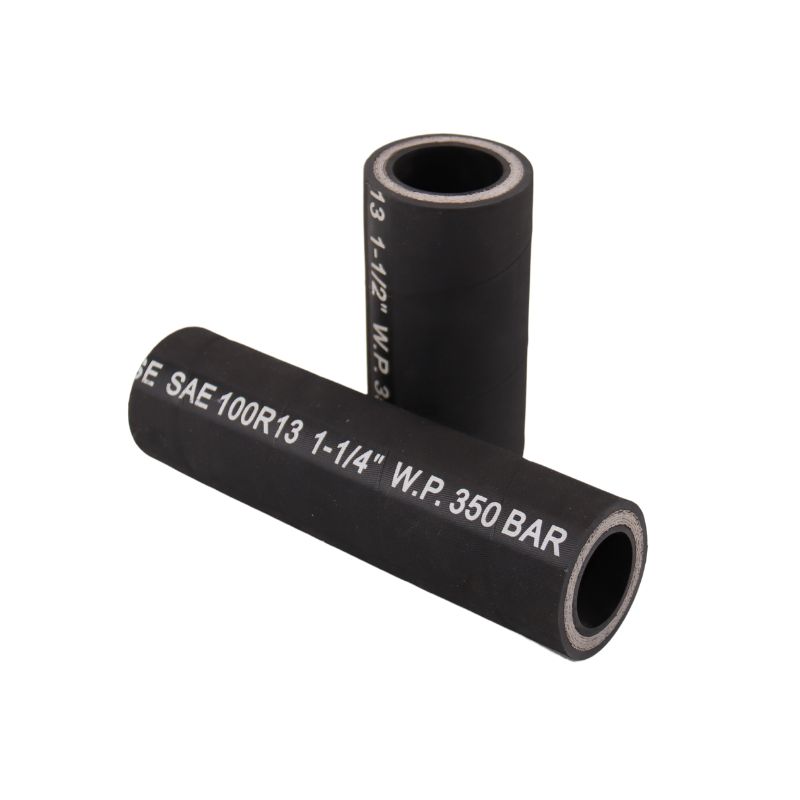
Every R13 spiral hose must meet the SAE 100R13 specification, which requires the hose to survive at least 500,000 impulse cycles at 120% of its working pressure. These tests are performed while the hose is bent at its minimum radius to simulate the harshest possible working conditions. You can trust that an R13 hose has been laboratory-proven to handle the vibrations of a drill rig or excavator.
How are impulse life cycles tested in labs?
Technicians subject the hose to rapid-fire pressure spikes while maintaining high oil temperatures to accelerate potential wear. This ensures the material can handle the “worst-case scenario” on your job site without bursting.
- 500,000+ cycle minimum requirement.
- Testing at 120% to 133% of working pressure.
- High-temperature fluid simulation.
Does the safety factor prevent catastrophic bursts?
The R13 standard requires a 4:1 safety factor, meaning the burst pressure must be at least four times higher than the working pressure. This massive buffer protects your operators and equipment if the system experiences an unintended surge beyond 5,000 PSI.
- 20,000 PSI minimum burst pressure.
- Protection against accidental surges.
- Industry-leading safety benchmarks.
| Specification | SAE 100R13 Requirement |
| Impulse Cycles | Minimum 500,000 cycles |
| Safety Factor | 4:1 (Burst to Working) |
| Test Temperature | Elevated fluid heat (120°C+) |
Can R13 spiral hose manage extreme temperature shifts?
An R13 spiral hose maintains its critical elastic properties even when internal oil temperatures soar or ambient conditions drop to sub-zero levels. Temperature extremes can make standard rubber brittle, but R13 compounds are engineered to remain flexible under pressure. You need this thermal stability to ensure the hose continues to absorb pulses without cracking during seasonal changes.
How does heat resistance preserve rubber integrity?
High-heat hydraulic oil can “cook” a standard hose, making the inner tube hard and prone to leaking. R13 hoses use specialized elastomers that resist thermal aging, keeping the seal tight against your fittings.
- Resistance to rubber hardening.
- Maintained elasticity at 121°C.
- Prevention of internal tube cracking.
Why is cold flexibility crucial for winter startup?
On a frozen job site, a stiff hose can crack the moment the pump sends the first pressure pulse through the line. R13 hoses are often rated for -40°C, ensuring they can flex and damp pulses even during a cold morning startup.
- Arctic-grade rubber compounds.
- Resistance to brittle fractures.
- Smooth performance in winter.
| Temperature Range | R13 Performance Result |
| Extreme Heat | Stays elastic and seals tightly |
| Extreme Cold | Avoids brittle cracking and snaps |
| Thermal Cycling | Resists fatigue from temperature shifts |
Which fittings work best with R13 spiral hose?
You must use interlock fittings with an R13 spiral hose to ensure the high-pressure connection is physically locked to the steel reinforcement layers. Standard “skive” or “no-skive” braided fittings are not strong enough to hold a 5,000 PSI pulse on a heavy spiral hose. You need a fitting that can withstand the same “hammering” that the hose itself is designed to absorb.
Why are interlock ferrules necessary for safety?
Interlock ferrules feature a “bite” that goes through the outer cover to grip the steel wire directly, preventing the hose from blowing off. This mechanical lock is the only way to safely secure a high-pressure spiral assembly.
- Direct wire-to-fitting contact.
- Permanent mechanical lock-in.
- Prevention of high-pressure blow-offs.
How do high-pressure adapters prevent leaks?
Utilizing precision-machined adapters ensures that the transition from your hose to the valve manifold remains leak-free under vibration. High-quality adapters use JIC or ORFS sealing surfaces to maintain a dry connection during severe pulsing.
- Precision thread matching.
- Vibration-resistant sealing.
- High-pressure alloy construction.
| Fitting Type | Recommended Use |
| Interlock Ferrule | Required for all R13 spiral hoses |
| JIC / ORFS Seals | Best for pulse and vibration resistance |
| Steel Adapters | Must match 5,000 PSI working pressure |
How does bend radius affect R13 spiral hose life?
Maintaining the correct minimum bend radius for your R13 spiral hose is essential to prevent the internal steel layers from “gapping” or separating. If you force a spiral hose into too tight a curve, you create a weak spot where a pressure pulse can easily cause a rupture. You must route your hoses carefully to ensure they can flex naturally without stressing the internal reinforcement.
Can tight bends cause wire layer separation?
When you over-bend a spiral hose, the wires on the outer edge of the curve are stretched while the inner ones are compressed. This misalignment makes the hose vulnerable to failure because the wires can no longer distribute pulse energy evenly.
- Risk of internal gapping.
- Uneven wire tension.
- Reduced burst pressure at the bend.
How does proper routing reduce fitting fatigue?
A hose that is routed with enough slack can absorb machine movement without pulling on the metal fittings. Proper routing prevents the “lever” effect that often leads to leaks at the connection point during high-pressure pulses.
- Reduced tension on ferrules.
- Minimized vibration transfer.
- Longer assembly service life.
| Routing Rule | Operational Benefit |
| Respect Bend Radius | Prevents wire gapping and weak spots |
| Avoid Twisting | Keeps spiral layers in perfect alignment |
| Use Proper Clamping | Stops hoses from rubbing and wearing |
Careful installation is just as important as the quality of the hose itself for preventing premature hydraulic failure.
When should you replace an R13 spiral hose?
You should replace an R13 spiral hose as soon as you see signs of “sweating” at the fittings, cover bubbles, or if the hose remains permanently curved after removal. Even the best spiral hose has a finite lifespan based on its impulse cycle rating. You save money by performing preventive replacements rather than dealing with the cleanup and repair of a sudden burst in the field.

What visual signs indicate internal wire damage?
You can often spot a failing hose before it bursts by looking for “bubbles” in the outer cover, which indicate that the inner tube has leaked. Exposed or rusted steel wires are another immediate sign that the structural integrity of your hose is compromised.
- Bubbles or blisters on the cover.
- Exposed or frayed steel reinforcement.
- Leaks or “weeping” at the crimp.
How does preventive replacement save on costs?
Replacing a worn hose during scheduled maintenance costs a fraction of what you would pay for emergency repairs and lost hydraulic fluid. You keep your machinery running and your operators safe by sticking to a strict service-hour replacement schedule.
- Avoids emergency downtime.
- Prevents massive fluid loss.
| Sign of Wear | Recommended Action |
| Cover Bubbling | Immediate replacement required |
| Exposed Wire | Replace to prevent rust failure |
| Permanent “Set” | Replace during next service window |
Is R13 spiral hose compatible with all fluids?
An R13 spiral hose is designed with an oil-resistant synthetic rubber inner tube that is compatible with most petroleum-based hydraulic fluids and biodegradable oils. It is critical that you verify your specific fluid type, as some synthetic esters or phosphate esters require different tube materials like EPDM or PTFE.
Does the inner tube material prevent degradation?
The high-grade elastomers used in R13 hoses are engineered to resist “swelling” or softening when exposed to hot hydraulic oil. This resistance ensures the tube remains a solid foundation for the steel spiral layers above it.
- Chemical compatibility with oils.
- Resistance to material softening.
- Long-term seal integrity.
How does structural stability stop hose ballooning?
The R13’s heavy reinforcement acting as a rigid cage ensures that the inner tube never expands enough to thin out its walls. This structural stability is what allows the hose to handle 5,000 PSI pulses without losing its internal diameter or fluid velocity.
- Low volumetric expansion.
- Maintained internal diameter.
- Concentrated fluid power delivery.
Conclusion
Selecting the right hydraulic components is the only way to safeguard your heavy machinery against the destructive power of pressure pulses. By utilizing R13 spiral hoses, you solve the problems of frequent line ruptures, dangerous fluid leaks, and expensive equipment downtime. Our vision is to provide world-class hydraulic solutions that keep your operations running at peak efficiency in the most demanding environments. If you are ready to upgrade your system’s reliability and safety, please contact us today to speak with a technical expert.
FAQ
Can I use R13 hose for low-pressure applications?
Yes, but it is often unnecessary and more expensive than using a braided hose for systems under 3,000 PSI.
What’s the best way to verify R13 hose quality?
Check for SAE 100R13 branding on the cover and ensure the manufacturer provides pulse test certifications.
How do I know if my R13 hose is failing?
Look for visual signs like cover blisters, weeping at the fittings, or exposed wires that are starting to rust.
Can I mix different brands of spiral hose and fittings?
No, it is highly recommended to use a matched system from one manufacturer to ensure the interlock fitting seals correctly.
What’s the best maintenance schedule for high-pressure lines?
You should perform daily visual inspections and replace hoses every 2,000 to 4,000 service hours depending on cycle intensity.