A one-piece hydraulic fitting trial order should start with familiar, repeatedly needed SKUs whose hose compatibility, connection geometry, crimp data, and application limits can all be verified. Do not begin with an entire catalog or select parts only because their unit prices are attractive. The first group should represent real demand while remaining simple enough to inspect, assemble, label, and reorder without unresolved assumptions. This approach makes the trial useful: it tests whether each fitting can move safely from purchase specification to incoming inspection, hose assembly, stock control, and repeat ordering.
What Should the First Trial Order Prove?
Test a repeatable purchasing process, not a box of samples
The trial should prove that a defined fitting can be specified, received, identified, assembled, inspected, and reordered consistently. A sample that looks correct on arrival has not yet passed this test. The purchasing record, label, part number, physical dimensions, hose-side compatibility, and assembly instructions must describe the same item, or a larger order will multiply uncertainty rather than reduce cost.
Keep the limits of one-piece construction clear
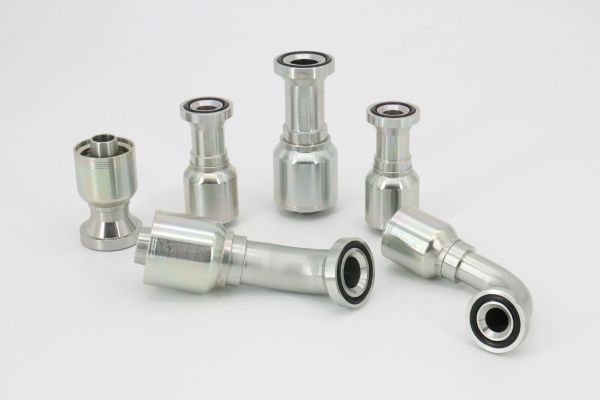
A one-piece hydraulic hose fitting normally combines or fixes the fitting body or stem and ferrule as one assembly component; the exact construction varies by series. This arrangement can reduce errors caused by selecting a separate loose ferrule, but it does not make the fitting compatible with every hose of the same dash size. It also does not prove the connection end, material, pressure suitability, or crimp setting, so the one-piece fitting trial-order process must verify the complete assembly system.
Which SKU Categories Belong in the First Trial?
Start with proven, technically complete demand
The best starting candidates are existing parts with repeated sales, repair, or production demand and a specification that can be checked without guessing. Use order history, service records, equipment population, local connection standards, and seasonal demand to identify the recurring group. A SKU is not ready merely because it is common elsewhere; it must fit the hoses, ports, crimping equipment, and applications your operation actually supports.
Prioritize candidates with all of the following evidence:
- a complete existing part number or controlled technical description;
- repeat demand from more than one job, assembly, or stocking cycle where possible;
- a known hose manufacturer, series, construction, and size;
- a defined thread, seat, seal, material, finish, and fitting orientation;
- current crimp data applicable to the hose, fitting, and available equipment.
Favor configurations that make comparison easy
Among equally relevant candidates, straight fittings with familiar end connections are often easier to measure, assemble, store, and compare than elbows, unusual drops, jump sizes, or special port combinations. Common local hose sizes and connection families such as JIC, ORFS, NPT/NPTF, BSPP/BSPT, or Metric may belong in the trial, but only where your records support them. The practical goal is a compact, representative group—not an arbitrary number of SKUs—and the method used to identify fast-moving one-piece fitting stock should determine which configurations deserve priority.
Which Models Should Be Excluded at the Start?
Delay high-consequence and poorly defined applications
Do not use the first trial to resolve safety-critical, high-impulse, unusually hot, chemically aggressive, highly corrosive, or otherwise high-consequence applications unless an established qualification process already covers them. The same caution applies when failure could create uncontrolled movement, injection-injury exposure, environmental release, or extensive equipment damage. These parts require application-specific engineering and verification, not a commercial sample check built around price and appearance.
Exclude or quarantine candidates with these gaps:
- an unreadable hose layline or unknown hose construction;
- no valid fitting-series and crimp-data relationship;
- an uncertain thread pitch, seat angle, sealing face, or mating port;
- a cross-reference based only on a photo, brand number, or similar dimensions;
- unknown pressure, temperature, fluid, vibration, material, or finish requirements.
Avoid rare complexity until the basic process works
Special elbows, uncommon orientation requirements, mixed standards, nonstandard lengths, unusual materials, and low-frequency sizes may be legitimate products, but they create more variables during a first evaluation. Introduce them after the basic receiving, identification, assembly, and traceability process has worked on simpler recurring items. If a rare part has urgent commercial importance, give it a separate validation plan instead of letting it distort the acceptance criteria for ordinary stock.
How Do You Turn Demand Data Into a Shortlist?
Rank evidence, value, and risk separately
Build the shortlist from internal facts rather than supplier catalog order. Review demand frequency, number of applications served, stockout consequences, replenishment difficulty, current error history, and technical completeness. Keep commercial value separate from technical readiness: a high-volume candidate with missing crimp data is commercially important but not yet approved for a trial assembly. Use a simple scorecard that shows both the evidence and its source, and do not let a high total score hide a failed mandatory check such as unknown hose compatibility, an uncertain sealing method, or unavailable crimp instructions.
| Selection factor | Strong first-trial candidate | Weak first-trial candidate |
|---|---|---|
| Demand evidence | Repeated, traceable use in current work | Assumed popularity without local records |
| Technical identity | Complete part, thread, seat, seal, hose, and crimp data | Photo, partial number, or nominal size only |
| Inspection | Dimensions and markings can be checked with available tools | Acceptance depends on unavailable gauges or unknown criteria |
| Assembly | Existing hose, crimper, dies, and procedure support the combination | Requires an unverified hose or improvised crimp setup |
| Consequence | Controlled, noncritical evaluation route is available | Failure consequence is high or cannot be contained |
| Reorder value | The SKU would be stocked or purchased again if approved | No clear owner, use case, or future quantity |
Define every SKU beyond its short description
“Female JIC -8 straight” is not a complete purchasing specification. The record should connect the end configuration and connection size to the hose size, fitting series, stem and ferrule design, material, finish, applicable drawing or standard, and packaging label. If a branded part number is used for cross-reference, treat it as a search key rather than proof of interchangeability; the one-piece fitting cross-reference method still requires a controlled dimensional and functional comparison.
What Must Be Verified Before the Order Is Placed?
Confirm the hose side and crimp system first
The fitting series must be supported for the exact hose construction and size. Record the hose manufacturer and full series, hose ID or dash size, reinforcement, required preparation, fitting family, crimping machine, die set, insertion requirement, crimp diameter and measurement location, plus any applicable inspection limits. Parker’s hydraulic hose and fitting catalog likewise explains that hose tails and ferrules are not automatically standardized across manufacturers, so a similar-looking component does not establish compatibility.
Use the current technical source for the exact combination rather than copying a diameter from a related SKU. Equal dash size does not mean equal wall, reinforcement position, stem profile, ferrule compression, or assembly procedure. The six hose-compatibility checks for one-piece fittings should be completed before any candidate is released for crimping.
Confirm the connection and application independently
Define male or female form, thread outside or inside diameter, pitch or TPI, straight or tapered form, seat angle, sealing face, O-ring or washer arrangement, and fitting orientation. Then confirm working pressure, temperature, fluid, impulse, vibration, corrosion exposure, routing, and applicable equipment requirements. The finished assembly is limited by its lowest-rated component or interface and by service conditions, not by the fitting’s catalog rating alone.
How Should Trial Samples Be Inspected and Assembled?
Use written incoming checks before crimping
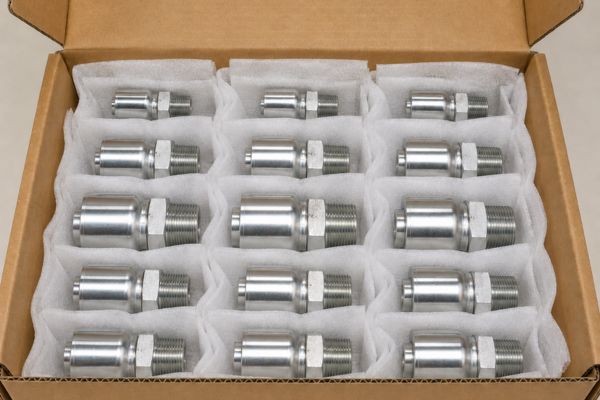
Establish acceptance criteria before the shipment arrives, then keep each sample tied to its inquiry line, drawing revision, part number, and inspection status. Verify quantity, labels, markings, material or finish documents where required, critical dimensions, thread and seat geometry, seal details, stem, ferrule, bore, plating coverage, contamination, deformation, and protective packaging. The sample quantity should follow the inspection and validation plan for that part rather than a universal rule, because a dimensional comparison, an assembly evaluation, and any formally required testing may consume or preserve samples differently. Do not mix approved samples with general inventory until the evaluation record is complete.
The incoming check should answer three questions:
- Is this the exact item described in the purchase specification?
- Do its measurable connection and hose-side features match the approved reference?
- Can the sample identity be traced through assembly, inspection, and the reorder decision?
Assemble only under the defined procedure
Use the specified hose, preparation method, crimper, dies, insertion depth, crimp target, and inspection method. Record actual observations without inventing a pressure, burst, impulse, or pull test; any required test must follow the applicable hose, fitting, equipment, regulatory, or controlled internal procedure and use suitable guarded equipment. Shut down and isolate hydraulic pressure and stored energy during service work, and never use an operating machine as an improvised test stand for an unapproved fitting.
When Should the Trial Expand, Change, or Stop?
Approve each SKU on evidence, not an average result
One successful item cannot approve the rest of the trial order because different sizes, ends, hose tails, and orientations can have different failure paths. For every SKU, record whether dimensions, marking, hose fit, assembly behavior, finished inspection, packaging identity, and required documentation passed. Classify deviations by their actual effect; a wrong seat or unsupported crimp combination is not balanced out by acceptable appearance on other lines.
Use a simple disposition:
- Expand: all required evidence agrees, assembly and inspection pass, demand remains valid, and the SKU can be reordered unambiguously.
- Correct and retest: the requirement is valid, but a defined and traceable nonconformance must be corrected before approval.
- Stop: identity, compatibility, application suitability, or required validation remains unresolved, or the candidate no longer has a sound demand case.
Convert approval into controlled stock data
An approved record should link the purchasing code, source code, complete technical description, hose range, crimp-data source, inspection characteristics, label format, storage location, and limitations on use. Keep the approved sample or measurement report under the chosen traceability process so later receipts can be compared against the same reference. Assign ownership for updating the record when a drawing, source, hose series, crimp specification, material, finish, or packaging identification changes, since an earlier approval does not automatically cover a revised product. This step prevents a technically successful trial from failing commercially through mixed bins, ambiguous descriptions, or repeat orders placed from an incomplete shorthand name.
Final Trial-Order Decision
The first one-piece hydraulic fitting trial order should contain recurring, fully specified SKUs that work with a known hose-and-crimp system and can be inspected using defined criteria. Let demand records choose the thread families, sizes, and orientations; let technical evidence decide whether each candidate is ready. Delay unusual, safety-critical, or poorly documented models until a suitable qualification route exists. Before requesting the order, prepare the complete fitting list, hose manufacturer and series, connection dimensions, seat and seal details, material and finish requirements, operating conditions, crimping equipment, current crimp data, expected future quantity, and acceptance record; expand only the SKUs that pass individually and remain commercially useful.
Frequently Asked Questions
How many one-piece fitting SKUs should be included in the first trial?
There is no universal number; choose the smallest group large enough to represent verified recurring demand and produce a clear purchase decision without overloading the inspection and assembly process.
Should the trial include both straight and elbow fittings?
Include elbows only when demand and orientation data justify them; where demand is similar, straight fittings usually remove drop length and angular orientation variables from the first comparison.
Can the lowest-priced high-volume fitting be tested first?
Only if its complete specification, hose compatibility, crimp data, application limits, and acceptance method are already defined; price does not compensate for missing technical evidence.
Can one approved sample authorize all sizes in the same fitting series?
No. Each ordered SKU needs the required dimensional, labeling, assembly, and documentation checks because size and end-configuration changes can introduce different requirements.
When is a trial order unnecessary?
A new commercial trial may add little value when the exact SKU is already approved under a current controlled process, but changes in source, design, material, finish, hose system, or application can require renewed evaluation.