Before approving a Parker one-piece fitting replacement, verify the exact original part, hose and fitting series, connection geometry, sealing method, material, operating conditions, and applicable crimp data. A part number or a similar-looking 43 Series fitting can identify a candidate, but it does not prove that another part is interchangeable. The replacement must work on both sides: it must mate correctly with the equipment port and form a documented hose assembly with the specified hose, ferrule, crimper, dies, and procedure. If any safety-critical link remains unsupported, stop the substitution rather than treating a cross-reference as approval.
Why Is a Cross-Reference Not Final Approval?
A part number narrows the search
The complete catalog number is the best starting point because it can identify the fitting family, end configuration, connection size, hose size, material option, and geometry associated with the original product. Record the number exactly, including every prefix or suffix, and compare it with the current catalog rather than relying on a bin label or shortened internal code. A number copied from an old invoice may refer to a different revision, material, market, or hose assembly than the part now on the bench. If the number is incomplete, keep the line open and combine catalog research with measurements, photos, hose markings, and mating-port evidence instead of filling the missing characters from a visually similar item.
Interchangeability requires evidence for the complete assembly
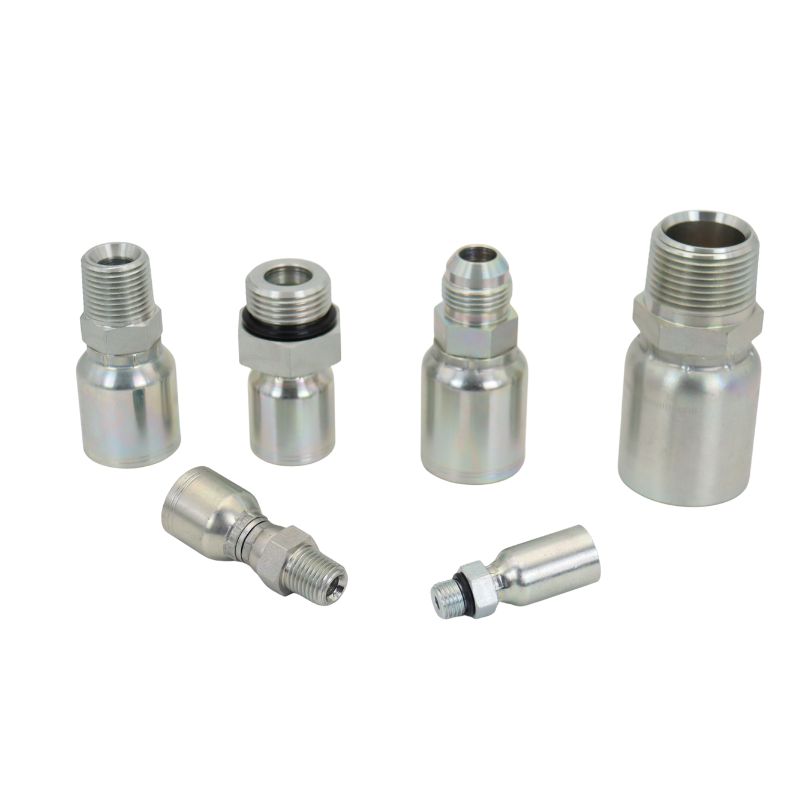
A cross-reference table normally compares commercial identifiers; it cannot by itself confirm the hose tail, ferrule behavior, crimp process, seal material, or application limits. Treat the result as a candidate to be checked, not as permission to assemble or sell the part. The one-piece fitting cross-reference process should show what is confirmed, what differs, and what remains unresolved before purchasing makes an equivalence claim.
Which Original Parker Details Must Be Identified?
Confirm the product series and construction
Do not assume that every permanent one-piece fitting belongs to the same family. Catalogs distinguish fitting series and connect them to defined hose ranges, end configurations, and assembly equipment; common catalog references may include different families for braided, spiral, thermoplastic, PTFE, or other hose constructions. Determine whether the original is a permanent crimp fitting, field-attachable fitting, adapter, or another component, because these categories use different structures and procedures.
Record the original identity before searching for a candidate:
- complete part number and current product-series designation;
- straight, 45-degree, 90-degree, flange, or other configuration;
- port-end size, hose-end size, and any jump-size relationship;
- material and finish suffixes, O-ring or seal details, and readable markings;
- controlled drawing, catalog page, crimp table, and revision or publication date.
Inspect the old part without assuming it was correct
The removed fitting is useful physical evidence, but it may be worn, deformed, mislabeled, or part of an earlier incorrect repair. Photograph the entire fitting, thread, sealing face, ferrule, hose layline, and installed orientation before disposal, then inspect the mating port as well. If the old part conflicts with the equipment parts list or current data, resolve that conflict instead of copying the visible component automatically. Preserve witness marks and damage notes separately from nominal dimensions, because cross-threading, over-tightening, corrosion, or a crushed seal can change the geometry you are trying to identify.
Does the Replacement Match the Equipment Connection?
Verify thread, seat, and seal as separate attributes
Identify whether the connection is male or female, then measure the relevant thread diameter and pitch or TPI and determine whether it is straight or tapered. Separately identify the seat angle, face geometry, flare, cone, O-ring groove, bonded seal, washer, or thread-interference sealing method. JIC, ORFS, NPT/NPTF, BSPP/BSPT, Metric, DIN, JIS, ORB, and flange connections are not interchangeable merely because the threads start or their nominal sizes appear close.
Use a controlled comparison with these fields:
| Attribute | Original evidence | Candidate requirement |
|---|---|---|
| Thread | Form, diameter, pitch/TPI, taper, male/female | Same specified mating geometry |
| Seal | Seat angle, face, groove, O-ring, washer, or thread seal | Same intended sealing method and compatible seal |
| Shape | Straight or elbow, drop length, orientation, swivel behavior | Fits the installed space without hose twist or side load |
| Dimensions | Overall length, hex, shoulder, bore, and critical clearances | Meets drawing and equipment constraints |
| Condition | Undamaged threads and sealing surfaces | No burrs, corrosion, deformation, or missing seals |
A fitting that screws in can still be wrong
Partial engagement can hide a thread-form or pitch mismatch, while full thread engagement can still pull together the wrong sealing surfaces. Forcing the joint may damage the equipment port, flatten a metal seat, cut an O-ring, or produce a narrow contact line that leaks after pressure, impulse, or vibration begins. Follow a measured one-piece fitting thread-mismatch check and never use sealant to compensate for an incorrect thread, seat, face, or damaged port.
Is the Hose Side an Approved Combination?
Match the exact hose and fitting series
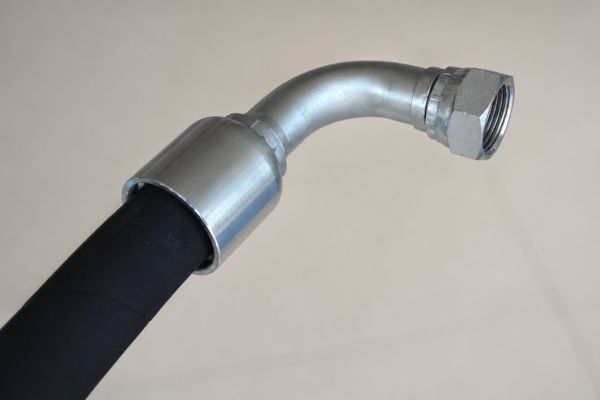
Confirm the hose manufacturer, full series designation, construction, hose ID or dash size, reinforcement, cover, and required preparation. Equal dash size does not prove that two hoses use the same stem profile, ferrule design, insertion depth, crimp diameter, or skive procedure. A one-piece format only means the fitting stem and ferrule are preassembled or fixed as one component; it does not make the hose side universal.
Its guidance warns against assembling hose with another manufacturer’s fitting unless the combination has the required approval and validation. Therefore, “Parker-style” dimensions or the same series number used by another source cannot replace documented hose-and-fitting authorization.
Use the correct crimper, dies, and current data
Crimp diameter, measurement position, die selection, insertion depth, skive or no-skive preparation, and inspection criteria must come from current data for the exact hose, fitting, size, and assembly equipment.
Do Material and Service Conditions Still Match?
Compare material, finish, seals, and fluid
Verify the body, nut, ferrule, plating or other finish, and every elastomeric seal against the original requirement and application. Carbon steel, stainless steel, brass, and different coating systems are not ranked by one universal “best” choice; selection depends on fluid compatibility, corrosion exposure, temperature, mechanical load, conductivity, contamination limits, and regulatory requirements. A similar salt-spray claim or visual color does not establish equal field life or equivalent material performance. Request traceable material and finish evidence when the specification requires it, and make sure the candidate’s O-ring or other seal compound is suitable for the fluid and temperature rather than assuming equal dimensions mean equal compatibility.
Rate the complete assembly, not the fitting alone
Working suitability depends on the lowest-rated component or interface and on pressure, impulse, temperature, fluid, routing, bend radius, vibration, external load, and environment. Compare the candidate’s documented limits with the actual application and the equipment manufacturer’s requirements. Do not transfer a catalog pressure value from one size, end configuration, material, or fitting family to another, and do not assume that a successful low-pressure connection check qualifies the assembly for service.
How Should a Candidate Replacement Be Verified?
Inspect samples against written acceptance criteria
Before ordering production quantities, define what a sample must prove and keep each piece linked to its source code, candidate part number, drawing revision, and inspection status. Check markings, packaging identity, critical dimensions, thread gauges, seat and seal geometry, material or finish documentation where required, stem, ferrule, bore, edges, contamination, and visible defects. Keep approved reference samples or measurement reports under controlled identification so later receipts can be compared without repeating the original search. The controlled trial-order method for one-piece fittings prevents an unresolved candidate from entering normal inventory.
Prepare the sample review before parts arrive:
- Approved original specification and candidate drawing.
- Measurement method, gauges, tolerances, and responsible inspector.
- Defined hose, preparation, crimper, dies, and crimp-data source.
- Required assembly inspection and any applicable formal validation procedure.
- Pass, correct-and-retest, or reject rules for every SKU.
Test only under an applicable procedure
Do not invent a pressure, burst, impulse, or pull-test value as a shortcut to qualification. Any required testing must follow the applicable hose, fitting, equipment, regulatory, or approved internal procedure and use suitable guarded equipment and trained personnel. A candidate that assembles smoothly may still lack evidence for fatigue, impulse, fluid, temperature, or environmental suitability, so record the exact scope of what the sample test did and did not prove.
What Should the Replacement Approval Record Contain?
Link the approved use to specific conditions
The record should connect the original reference, replacement code, drawings, verified dimensions, connection standard, hose manufacturer and series, fitting series, crimp specification, material, finish, seals, application limits, sample or validation evidence, and approval owner. State any restrictions by hose size, machine, equipment, fluid, temperature, pressure, or end configuration. This prevents an approval for one specific combination from being extended silently to every size or shape in a related commercial family. Add revision control and a reapproval trigger for changes in source, drawing, hose construction, crimp data, material, finish, seal, tooling, or application so an older decision cannot authorize a materially different product.
Stop when the evidence chain is incomplete
Reject or quarantine the candidate when the original cannot be identified, the hose-and-fitting combination lacks the required authorization, connection measurements conflict, crimp data is missing, or the service conditions exceed documented limits. Also stop if a damaged old fitting is the only reference or if a brand cross-reference is offered without drawings and traceable technical data. The cost difference between parts cannot justify an unsupported substitution in a high-consequence hydraulic assembly.
Final Replacement Decision
A reliable one-piece fitting replacement starts with the exact original series and part number but does not end there. Verify the equipment-side thread, seat, seal, shape, and clearances; then confirm the hose manufacturer and series, fitting family, crimper, dies, current crimp data, materials, seals, and service conditions. Treat a cross-reference as a candidate until written specifications, sample inspection, and the applicable approval or validation route agree. Before requesting a quote, prepare the original number, photos, drawing, hose layline, connection measurements, operating conditions, equipment details, material requirements, expected quantity, and acceptance plan; if one critical link remains uncertain, do not approve the substitution.
Frequently Asked Questions
Does the same Parker-style part number prove interchangeability?
No. A similar numbering pattern can help identify geometry, but interchangeability still requires verified connection, hose, crimp, material, application, and approval evidence.
Can another fitting be crimped onto Parker hose with a crimper?
Not based on physical fit alone; follow Parker’s current written guidance, listed tooling and combinations, and any required authorization, analysis, and validation before mixing manufacturers.
Can one approved replacement cover every size in the same series?
No. Each SKU or formally defined family needs evidence covering its size, end configuration, hose relationship, crimp data, material, and intended service.
Is the old fitting enough to identify the replacement?
No. Use it as evidence, but confirm the mating port, hose layline, part number, drawings, and current manufacturer data because the old assembly may be damaged or previously mismatched.
Can a permanentfitting be removed and reused?
Not to reuse permanent crimped or swaged fittings or their parts; inspect and replace the complete assembly according to the applicable procedure.