
Hydraulic service centers fear hydraulic fitting stockouts because one missing hose end can block completion of an otherwise routine assembly. The correct hose, crimper, technician, and second fitting may all be available, yet the job cannot leave the bench until both ends match the equipment and the hose system. The delay then spreads beyond the value of the missing part: equipment remains down, purchasing starts an emergency search, freight and receiving work increase, and pressure grows to accept a visually similar substitute. Stock availability is therefore a service-capacity issue, not merely a warehouse target.
Why Can One Missing Fitting Stop the Entire Repair?
A hose assembly is only usable when every interface is correct
A replacement hose must connect to the equipment at both ends, fit the available route, and use components supported by the hose and crimp system. Thread form, seat angle, sealing method, orientation, material, and hose-tail design all affect whether the finished assembly can be released. The missing end may also prevent the center from promising length, orientation, or delivery time because changing to another fitting can alter assembly dimensions and routing.

One-piece fittings reduce one error but not the range problem
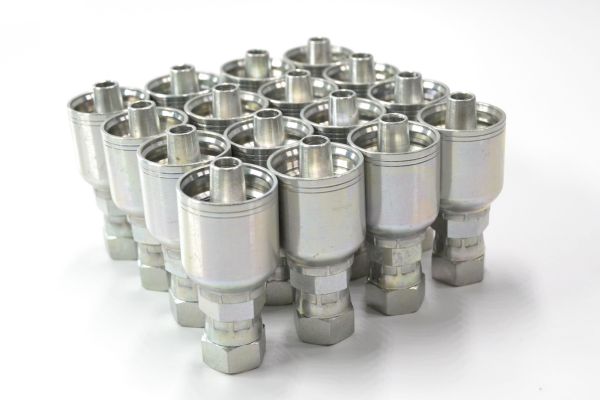
A one-piece hydraulic hose fitting normally has its fitting body or stem and ferrule preassembled or fixed as one component, although construction varies by series. This can reduce the chance of choosing a separate ferrule that does not belong with the stem. It does not reduce every required thread, size, hose series, angle, or material to one universal SKU, so a service center can still have a full-looking shelf and lack the exact fitting needed for the repair in front of it.
What Costs Begin After a Stockout?
The first delay creates several transactions
Once the bin is empty, staff must confirm the shortage, check open orders, search other locations, request quotations, compare cross-references, arrange freight, receive the shipment, and reschedule assembly work. A small fitting may therefore create multiple administrative and handling steps before it reaches the bench. If the hose has already been cut or the machine is waiting, the job also occupies work-in-process space and requires another setup later.
The stockout can produce costs that are easy to miss:
- emergency freight, split shipments, and repeated small-order charges;
- time spent calling, cross-referencing, transferring, receiving, and rebooking;
- idle bench capacity and jobs delayed behind the incomplete assembly;
- another site visit, equipment teardown, or installation appointment;
- lost work when the repair is moved to another service source.
Equipment downtime continues outside the shop
The operational cost belongs mainly to the machine owner, but it shapes how the service center is judged. A disabled machine may hold a production step, maintenance schedule, vehicle, or seasonal task, while the center can provide no reliable completion time until the correct fitting is secured. Repeated missed completion times also weaken future planning because customers may stop sharing forecasts or sending routine work when they expect every uncommon end to create an open-ended wait.
Why Is a Fast Substitute Often the Wrong Response?
Similar appearance does not prove connection compatibility
Under time pressure, a fitting that threads in partway or resembles the old part can appear to be a practical solution. It may still have the wrong pitch, taper, seat, sealing face, O-ring arrangement, elbow drop, or connection standard. Forcing mismatched components can damage the port or create partial sealing contact that leaks when pressure, impulse, temperature, or vibration begins; a controlled thread-mismatch identification process is safer than an urgent visual guess.
The hose side and crimp data must also agree
Correct equipment-side geometry does not prove that the hydraulic fitting stem and ferrule match the hose. Confirm hose manufacturer, series, construction, hose ID or dash size, fitting series, insertion requirement, preparation, crimper, dies, crimp diameter, measurement location, and inspection method from current applicable data. An emergency substitute that lacks this evidence can turn a stockout into a damaged hose, failed inspection, pull-off risk, leakage, contamination, rework, and another shutdown.
Which Fitting Stockouts Hurt the Most?
Core and critical-service SKUs deserve different attention
Core fittings recur across many routine assemblies and normally justify local stock with a defined minimum and reorder point. Critical-service items may move less often but repeatedly block repairs on common equipment or have a long, unreliable replenishment route. The fast-moving one-piece fitting stock framework separates demand frequency from service consequence so annual volume does not hide a low-volume item that repeatedly stops complete jobs.
| Demand and risk pattern | Typical stock action | Why a stockout matters |
|---|---|---|
| Frequent, diversified demand | Hold locally and replenish by trigger | Several routine assemblies depend on it |
| Moderate demand, high repair impact | Hold controlled service stock | One absence can extend equipment downtime |
| Predictable seasonal demand | Build before the service window | Late replenishment misses the useful period |
| Rare demand, short reliable lead time | Order on demand or pool regionally | Local stock may not earn its carrying cost |
| Unclear specification or crimp support | Do not stock as approved | Availability would create unsafe confidence |
A broad catalog is not the same as useful availability
Stocking every catalog variant ties cash and space to low-use parts while core bins can still empty. Useful coverage comes from complete SKU history, local equipment and hose systems, repair frequency, stockout records, lead time, seasonality, and approved alternatives. Straight fittings may be common, but a missing swivel, elbow orientation, jump size, special seal, or local Metric/BSP variation can still stop the assembly; each center must derive its range from actual work. Review complete assemblies rather than fitting counts alone, since a large quantity of one end does not provide coverage when the matching second end or compatible hose series is repeatedly absent.
How Should Stock Be Set Without Creating Dead Inventory?
Separate minimum, reorder point, and safety stock
The minimum is the operating floor the center intends to protect, the reorder point is the stock position that starts replenishment, and safety stock covers a justified level of demand or lead-time variation. Set them by SKU from expected use during replenishment, open commitments, lead-time history, pack quantity, seasonality, and stockout consequence. Do not copy one number across all hose sizes and connection families or treat a large emergency order as permanent demand.
Track stock position using:
- usable on-hand quantity, excluding quarantine and unidentified returns;
- confirmed inbound supply and realistic arrival dates;
- committed quantities for open repairs and scheduled work;
- expected consumption before the next replenishment opportunity;
- approved protection for variability or service-critical demand.
Pool slow variants while keeping core items near the bench
If several branches or mobile units operate within a practical transfer area, less common fittings can be pooled while core same-day items remain local. This works only when part numbers, descriptions, labels, units, bin status, and transfer time are reliable. A fitting located elsewhere but not visible in the system, mixed under a vague description, or unable to arrive before the promised repair time does not provide real coverage. Test the transfer route before relying on it for critical service, document actual arrival performance, and define who owns reservation, dispatch, receiving, and stock-balance correction.
What Should Happen During an Actual Stockout?
Triage the job without skipping safety or identification
First confirm the exact connection, hose, fitting series, orientation, material, application, and crimp requirement; then check local stock, quarantine status, approved branch stock, and open supply. Shut equipment down, release hydraulic pressure and stored energy, and follow the equipment and component manufacturers’ procedures before removing or inspecting an assembly. Never search for a pinhole leak with a hand, disconnect a pressurized line, patch a failed hose, or install an unverified fitting simply to restore operation. Keep the old assembly and mating-port evidence available until the replacement specification is resolved.
Use a controlled escalation order:
- verify the original part and mating port rather than copying a damaged fitting;
- check approved internal stock and branch-transfer options;
- check an already approved alternative or specified inter-series adapter;
- obtain a candidate cross-reference with drawings and technical data;
- quarantine the job when compatibility or required authorization remains unresolved.
Record the unmet demand even when no sale occurs
Sales history alone cannot show a job that was lost, delayed, transferred, or completed elsewhere because the fitting was unavailable. Record the requested SKU, quantity, equipment or job category, date, action taken, emergency cost, promised-time effect, and whether demand later converted. These records separate a recurring stock gap from a one-time unusual request and give future reorder decisions evidence that ordinary invoice history misses.
How Can Repeat Stockouts Be Prevented?
Correct the cause, not every minimum quantity
A stockout can come from an incorrect reorder point, delayed supply, sudden demand, a mislabeled bin, duplicate part records, a return placed in the wrong location, unrecorded consumption, or a technically rejected shipment. Raising every minimum treats these different failures as one problem and can create excess without improving availability. Review each event by cause, then change the demand forecast, lead-time assumption, label, source plan, inspection release, or reorder control that actually failed. Track whether the correction prevents recurrence at the next demand cycle; otherwise, the same shortage can return under a different emergency purchase order without improving the inventory system.
Validate new sources before counting them as backup
A quotation or catalog cross-reference is not available stock until the alternative has passed connection, hose compatibility, material, application, crimp, sample, receiving, and approval checks. Use a controlled one-piece fitting trial order for recurring gaps and keep samples separate from approved inventory. The one-piece fitting cross-reference method should make missing evidence visible so an urgent future repair does not discover that the backup is unusable. Record the approved scope by SKU and application so one verified size or hose combination is not extended silently to a whole product family.
Final Stockout Decision
Hydraulic fitting stockouts matter because service centers sell completed, safe hose assemblies, not isolated pieces. Protect the verified core and critical-service SKUs that repeatedly determine whether a job can leave the bench, while ordering rare or uncertain items through a controlled route. Set replenishment from actual demand, lead time, commitments, seasonality, and service consequence; record lost and delayed jobs as well as sales. Before adding stock, confirm connection geometry, hose and fitting series, material, application, and current crimp data; when a shortage occurs, use approved transfers or alternatives and stop if compatibility remains uncertain—speed cannot justify another failure.
Frequently Asked Questions
Should a service center stock every thread standard it may encounter?
No. Stock complete verified SKUs supported by local demand and service risk, while maintaining an identification and sourcing route for rare or unfamiliar standards.
Can adapters prevent all fitting stockouts?
No. Approved adapters can bridge specific standards, but they add length and sealing interfaces and must suit pressure, material, routing, and equipment requirements.
Is emergency freight always cheaper than holding more fittings?
No. Compare freight, handling, delayed work, downtime impact, demand frequency, and carrying risk by SKU rather than applying one answer to every fitting.
How should a shop count a fitting that is in quarantine?
Treat it as unavailable until receiving inspection or technical approval releases it, because unverified physical stock cannot safely support a promised repair.
Does one-piece construction eliminate ferrule-related stockouts?
It can remove the separate loose-ferrule selection for that fitting design, but the center still needs the correct hose size, fitting series, thread, seal, orientation, material, and crimp data.