One-piece fitting emergency stock should first cover verified combinations tied to critical equipment, recurring failures, supported hose inventory, and the available crimp process. It should not begin with the largest assortment or the most familiar thread sizes. A fitting helps during an emergency only when its connection standard, port dash, hose dash, fitting series, geometry, and assembly data match the failed position. Prioritization therefore combines Equipment Criticality, Failure Frequency, Downtime Consequence, Existing Hose Inventory, Available Crimp Equipment, Lead Time, and Substitution Risk.
Emergency Stock Must Create Repair Capability
The purpose of emergency inventory is to shorten the time from a verified failure to a safe, supportable hose assembly. Physical pieces on a shelf are not the same as repair capability.

Count only fittings that can become approved assemblies
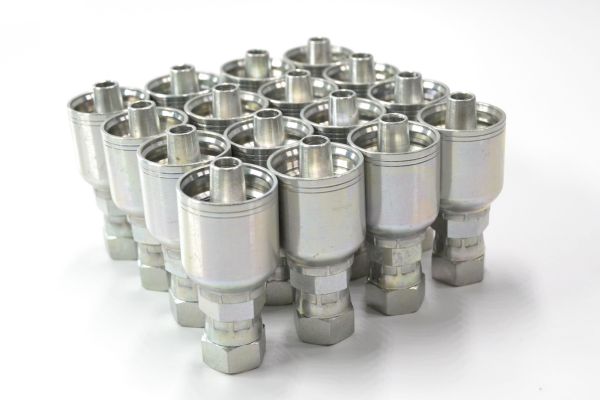
A one-piece fitting has its body or stem and ferrule preassembled, attached, or retained together, but exact construction varies by series. That arrangement may reduce separate ferrule picking; it does not prove compatibility with a hose or crimper. Usable emergency stock needs a known hose manufacturer and series, hose construction and dash, Verified Fitting Series, preparation method, Available Crimp Equipment, die set, current crimp specification, and defined finished-assembly checks.
This boundary explains why more inventory does not automatically create stronger emergency response. Mixed bins, uncertain series, obsolete finishes, or fittings unsupported by the local hose and crimp system can increase search time and false confidence. Exclude damaged, unidentified, or technically unsupported pieces from the usable count until they are resolved.
Define the emergency before ranking parts
An emergency is not simply any request marked urgent. Define which equipment functions create an immediate production, safety, environmental, or service consequence when a hose fails and which assets have redundancy or a planned alternative. Also identify who can isolate the system, confirm the fitting, build the assembly, and approve return to service. Stock without this operating path may move a fitting faster while leaving the repair decision incomplete.
The response must never bypass safety. Stop the equipment, isolate the hydraulic circuit, release pressure and stored energy, secure raised or suspended loads, follow lockout requirements, and use the equipment and component manufacturers’ procedures. Never check suspected pinhole leakage by hand, remove a pressurized fitting, or install a near match because downtime is accumulating.
Rank Equipment Criticality and Failure Frequency Separately
Equipment Criticality shows how serious a stoppage is; Failure Frequency shows how often a verified fitting need occurs. Keeping the factors separate prevents frequent low-impact repairs from crowding out rare but consequential failures.
Evaluate Downtime Consequence and redundancy
For each machine or hydraulic function, record what stops when it fails, whether a safe redundant asset or process exists, and whether the repair can be scheduled. Downtime Consequence may include an entire line stopping, a mobile service unit becoming unavailable, or a critical attachment being unable to complete its work. Do not invent a universal downtime cost or service target; use the organization’s verified operating evidence.
Criticality alone does not justify stocking an uncertain item. The connection, hose side, geometry, and assembly method must be verified before an SKU becomes emergency coverage. If the application is critical but the fitting identity remains unresolved, the correct action is to complete technical identification and establish a controlled sourcing plan, not to place an ambiguous part in the core bin.
Separate repeat failures from repeat consumption
Failure Frequency should come from confirmed repair records, not purchase totals alone. Repeated purchases can reflect wrong picks, duplicate orders, routing damage, contamination, or a fitting series that was never approved. A useful record ties the issued fitting to equipment, position, failure cause, Connection Standard, Port Dash, Hose Dash, configuration, hose and fitting series, and successful assembly verification.
Review repeated failures for root causes before normalizing them as stock demand. Abrasion, movement, heat, inadequate bend allowance, installation twist, or external impact may continue consuming fittings even when inventory is full. Emergency stock reduces supply delay; it cannot correct the condition causing the hose assembly to fail.
Match Stock to Existing Hose and Crimp Capability
Existing Hose Inventory and Available Crimp Equipment determine which fitting combinations a repair team can actually use. A thread match at the port is insufficient when the hose tail is unsupported.
Verify the hose and fitting series as one system
Record the exact hose manufacturer, hose series, construction, reinforcement, Hose Dash, and relevant outside-diameter information required by the controlled procedure. Then link that hose to the Verified Fitting Series and ferrule design. Equal dash size is only a nominal size relationship; it does not prove that two hose constructions accept the same stem, ferrule compression, preparation, or crimp dimension.
Emergency bins should not mix fittings from different series under a generic hose-size label. Use part identity and controlled compatibility records that the assembly operator can retrieve quickly. When the repair shop changes hose series, fitting series, or suppliers, revalidate the affected inventory rather than assuming the previous emergency matrix still applies.
Confirm the process, tools, and current data
Available Crimp Equipment includes more than the machine name. Confirm that the correct die set, machine capacity, calibration or maintenance status, preparation tools, measuring equipment, and current manufacturer crimp data are accessible to the person doing the work. A fitting that requires unavailable tooling or an unverified procedure belongs outside immediate emergency capability.
Before considering an SKU usable, confirm:
- exact hose and fitting-series identity, including ferrule design;
- skive or no-skive preparation and insertion method from current data;
- crimp machine, die set, setup, measurement location, and inspection method;
- application pressure, fluid, temperature, routing, and environmental requirements;
- authorization and traceable assembly record required before return to service.
Build Complete Connection, Dash, and Geometry Combinations
Emergency selection works at the combination level: connection standard plus Port Dash, Hose Dash, fitting series, and physical configuration. Omitting any one of these attributes creates stock that may fit only part of the repair.
Keep the port and hose sides distinct
Connection Standard should include the features needed to distinguish JIC, ORB, NPT, NPTF, BSPP, BSPT, Metric, ORFS, or another system used locally. Confirm gender, diameter, pitch or TPI, straight or tapered form, seat, sealing face, and O-ring location as applicable. Port Dash identifies the connection side; Hose Dash identifies the hose side, and the two values cannot be assumed to match.
Do not use a photo, old number, or apparent engagement as final acceptance. Similar threads and sealing forms can be confused, while a correct thread on the wrong seal can still leak. Thread sealant cannot correct a wrong standard, seat, taper, pitch, damaged thread, or cross-threading.
Plan Straight versus Elbow Demand from real positions
Straight versus Elbow Demand must be based on verified installation positions. Stocking only straight fittings may leave no usable repair when a 45-degree or 90-degree end is needed to clear a frame, valve, tire, articulation point, or neighboring hose. Forcing a straight end into that position can create an immediate bend, hose twist, abrasion, side loading, or interference during movement.
Elbow coverage also needs orientation information. Two assemblies with the same port and hose dash may require different angles or relative orientation to route correctly. Record configuration, swivel behavior where applicable, clearance, bend direction, and movement envelope instead of treating all elbows as interchangeable.
Use Lead Time and Substitution Risk to Set Priority
Lead Time and Substitution Risk modify priority after technical need has been established. Long supply exposure can strengthen the case for coverage, but it cannot turn an uncertain fitting into a safe substitute.
Apply a practical ranking model
| Priority factor | Evidence to review | Effect on emergency priority |
| Equipment Criticality | Function lost, redundancy, safe repair window | Higher consequence strengthens immediate coverage |
| Failure Frequency | Verified repair records by position | Repeated supported demand strengthens core coverage |
| Downtime Consequence | Operational impact and recovery path | Difficult recovery raises exposure |
| Hose and crimp capability | Existing Hose Inventory, Verified Fitting Series, equipment, dies, current data | Unsupported combinations cannot be emergency-ready |
| Connection and geometry | Port Dash, Hose Dash, standard, Straight versus Elbow Demand | Incomplete combinations do not cover the position |
| Lead Time and Substitution Risk | Replenishment evidence and validated alternatives | Long lead time or high mismatch risk strengthens controlled coverage |
Use the table as a decision record, not a numerical scoring formula. A high-frequency item for noncritical equipment may belong in planned replenishment, while a lower-frequency verified item with severe Downtime Consequence and long Lead Time may justify Backup Stock. The decision should remain explainable from current evidence.
Treat substitution as a technical review
Substitution Risk is high when candidate fittings have similar appearance but uncertain thread, sealing, hose compatibility, material, geometry, or crimp data. A replacement part number or cross-reference is useful only as a lead for verification. Final approval still requires the complete connection and assembly requirements to match.
Where a validated alternative exists, record its scope and limitations rather than assuming universal interchangeability. Where no safe substitute exists, document the supply route, technical information required for ordering, and escalation owner. This prepares the response without encouraging improvised installation.
Separate Four Inventory Classes
Four classes prevent emergency items, routine demand, and rare technical parts from competing under one label. Classification controls attention and replenishment; it does not prescribe a fixed quantity.
Define each class by purpose
- Emergency Core Stock: verified combinations for critical or consequential positions with supported hose and crimp processes and a credible likelihood of urgent use.
- Backup Stock: verified, lower-frequency combinations justified by criticality, difficult Lead Time, limited redundancy, or high Substitution Risk.
- Planned Replenishment Stock: predictable or routine demand that can be restored through the normal purchasing cycle without relying on emergency reserves.
- Special-Order Items: rare, application-specific, obsolete, unresolved, or unsupported combinations requiring technical confirmation before purchase.
An item should move between classes when equipment, repair history, hose inventory, crimp capability, lead time, or validated alternatives change. Emergency Core Stock should not become ordinary issue stock without review, and Planned Replenishment Stock should not be described as emergency coverage merely because it is physically nearby.
Keep classification and quantity decisions separate
First decide whether the fitting is technically usable and which class reflects its purpose. Only then consider quantity using verified consumption timing, replenishment behavior, current usable stock, shelf condition, and operating exposure. This order prevents a purchasing minimum or discounted pack from defining the emergency strategy.
Review open orders and duplicate locations before replenishment. Excess emergency stock can create obsolescence, mixed series, damaged threads, lost traceability, and slower picking. A smaller, clearly identified matrix backed by hose and crimp data often provides more real capability than shelves filled with uncertain near matches.
Control Common Errors With a Priority Checklist
The most damaging errors are treating all urgency as equal, ranking by frequency alone, and counting unsupported pieces as available. A concise review should expose those gaps before a failure occurs.
Verify the complete emergency record
For every proposed item, document:
- Equipment Criticality, Failure Frequency, Downtime Consequence, redundancy, and repair owner;
- Existing Hose Inventory, hose series and construction, Available Crimp Equipment, die set, and current procedure;
- Verified Fitting Series, Connection Standard, sealing method, Port Dash, and Hose Dash;
- straight, 45-degree, or 90-degree form, orientation, routing, clearance, and movement;
- Lead Time, validated alternative, Substitution Risk, inventory class, and evidence review date.
Conclusion
Emergency readiness comes from verified repair combinations, not the number of fittings on a shelf. Rank needs through Equipment Criticality, Failure Frequency, Downtime Consequence, Existing Hose Inventory, Available Crimp Equipment, and the exact fitting series. Complete each candidate with Connection Standard, Port Dash, Hose Dash, straight or elbow geometry, current crimp data, Lead Time, and Substitution Risk. Then separate Emergency Core Stock, Backup Stock, Planned Replenishment Stock, and Special-Order Items so routine consumption does not hide critical exposure. Remove mixed, damaged, unidentified, and unsupported pieces from usable availability. A disciplined one-piece fitting emergency stock plan reduces identification and supply delay while preserving the thread, seal, hose, routing, and assembly controls required for a safe repair.
Frequently Asked Questions
Should every fitting used on critical equipment be Emergency Core Stock?
No, criticality is only one factor. The fitting identity, likelihood of urgent need, supported hose and crimp process, lead time, and available recovery options must also justify immediate coverage.
Can mobile repair inventory use the same priorities as a central workshop?
Not automatically, because vehicle space, service territory, equipment mix, and access to crimp equipment differ. Apply the same decision factors but classify only combinations the mobile operation can identify and assemble correctly.
How should an emergency fitting with an expired or superseded crimp document be handled?
Remove it from usable emergency status until current controlled data confirms the combination. A familiar historical procedure is not a substitute for an applicable current specification.
Does a short supplier lead time eliminate the need for Backup Stock?
Not necessarily, because actual availability, operating hours, transport constraints, and Substitution Risk may still leave exposure. Use verified replenishment performance rather than a quoted lead time alone.
Can a reusable fitting replace a stocked one-piece fitting during an emergency?
Only if the reusable system is specifically approved for the hose and application and its installation procedure is followed. The different construction should not be treated as an automatic or temporary substitute.