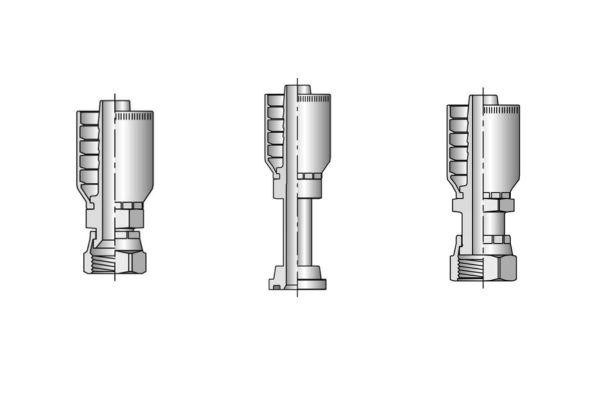
78 series one-piece fittings are permanent crimp hose fittings used with specified high-pressure steel-wire spiral hoses. They combine a fitting stem and ferrule in a preassembled unit, allowing the hose to be inserted and crimped using the prescribed equipment and assembly procedure.
The key to selection is the complete combination: hose model, hose size, fitting part number, and crimp specification. The series number alone does not establish hose compatibility, connection type, or working pressure.
What Are 78 Series One-Piece Fittings?
A preassembled stem and ferrule
“One-piece” describes the way the fitting is supplied and handled during hose assembly. The stem and ferrule are already combined, so the assembler does not need to select a separate loose ferrule.
It does not necessarily mean that the entire fitting is machined from a single piece of metal. Depending on the connection, the fitting may also include a swivel nut, sealing element, or other retained components.
The preassembled construction simplifies component picking, especially in workshops handling several fitting families. However, the correct fitting must still be matched to the hose. A convenient construction cannot compensate for an unsuitable stem profile or ferrule design.

A permanent crimp connection
During assembly, the ferrule is compressed around the hose according to a specified crimp procedure. The hose, stem, and ferrule then form a permanent connection.
These fittings should not be treated as reusable hose ends. A fitting removed from an old assembly is not a sound basis for making a new assembly by crimping it again.
For replacement work, identify the required configuration and use new components that are approved for the selected hose. Reusing a damaged or previously crimped fitting introduces uncertainty into a connection intended for pressure service.
Which Hoses Are Associated with the 78 Series?
Check the complete hose designation
Published catalog references associate the 78 series with hose models including 781, 782TC, and 782ST. These references provide a starting point for identification, but the exact hose size and applicable assembly data must also be checked.
Keep the full hose designation in the inquiry and assembly record. Writing only “782 hose” removes information that may matter when locating the correct specification.
Some references are historical. A listing can establish that a combination appeared in a particular catalog without confirming that every listed item remains available today. For a current order, confirm product availability and obtain the applicable technical information.
A hose standard does not establish compatibility
A hose marked SAE 100R13 is not automatically compatible with every 78 series fitting.
Hoses meeting the same standard can differ in outside diameter, rubber thickness, reinforcement arrangement, and other construction details. Those differences affect insertion, compression, sealing, and retention.
The same limitation applies to descriptions such as “four-wire spiral hose” or “high-pressure hydraulic hose.” They identify broad product characteristics, not a validated assembly combination.
Do not extend approval for one named hose to another brand’s R13, 4SP, or 4SH hose without supporting compatibility and assembly information. Likewise, hoses such as 787 and 797 should not be assigned to the 78 series simply because they are also high-pressure spiral hoses.
What Does No-Skive Mean?
No outer-cover removal for the approved combination
No-skive assembly means that removing the hose’s outer cover is not required for the approved hose and fitting combination.
This can simplify preparation by removing a separate cover-stripping step. The benefit depends on using the specified hose, fitting, and assembly method.
No-skive should not be interpreted as a universal instruction for any hose that fits inside the ferrule. The preparation requirements belong to the exact assembly combination.
Preparation still affects assembly quality
Even when skiving is unnecessary, the hose must be cut, cleaned, and inserted correctly.
An uneven cut can interfere with positioning. Contamination left inside the hose can enter the hydraulic system. Incomplete insertion can compromise the connection even when the finished crimp diameter appears acceptable.
Before assembly, confirm the insertion depth or locating method and apply the required external reference mark. Follow the applicable instructions for any assembly aids; do not add lubricants or other materials based solely on workshop habit.
Connection Types and Fitting Shapes
Identify the sealing interface
Cataloged 78 series configurations include connection types such as JIC 37°, ORFS, NPTF, BSPP 60° cone, metric heavy-series 24° cone, and selected flange forms. Availability varies by part number, size, and catalog range.
Each connection must be identified by its complete geometry and sealing method.
| Connection type | Main identification checks |
| JIC 37° | Thread dimensions, 37° seat, and male or female form |
| ORFS | Thread dimensions, flat sealing face, and O-ring arrangement |
| NPTF | Tapered-thread form, size, and specified assembly requirements |
| BSPP 60° cone | Parallel thread dimensions and 60° cone sealing geometry |
| Metric heavy-series 24° cone | Thread, series, cone geometry, and seal arrangement where applicable |
| Flange | Head dimensions, sealing arrangement, and mating clamp or bolt pattern |
A matching thread is only one part of the check. The sealing surfaces and any required seals must also match.
Select the shape for the installation
Straight, 45-degree, and 90-degree configurations serve different routing needs. Some connections may also have short, long, or other dimensional variants.
Choose the shape using the actual equipment layout. Check installation length, elbow drop, clearance, tightening access, and the direction in which the hose must leave the connection.
For flange fittings, identify the exact flange form rather than assuming that visually similar heads are interchangeable.
A swivel nut generally allows the nut to turn during installation. It does not mean the fitting is designed to rotate continuously while the equipment operates.
Understanding Sizes and Part Numbers
Read hose dash sizes correctly
Hose-end dash sizes commonly express nominal inside diameter in sixteenths of an inch.
| Hose dash size | Nominal hose inside diameter | Inch-to-millimeter equivalent |
| -12 | 3/4 inch | 19.05 mm |
| -16 | 1 inch | 25.40 mm |
| -20 | 1-1/4 inches | 31.75 mm |
| -24 | 1-1/2 inches | 38.10 mm |
| -32 | 2 inches | 50.80 mm |
These conversions explain the hose-end designation. They do not indicate that every connection type is offered in every listed size.
Actual hose dimensions and tolerances must be taken from the hose specification.
Keep connection size separate from hose size
A fitting part number may contain both a connection-end size code and a hose-end size code. The two codes can be different, and they do not necessarily describe dimensions in the same way.
A connection size code must be interpreted using the relevant connection table. It should not automatically be converted into a thread outside diameter.
When ordering, list the connection standard and actual thread specification separately from the hose inside diameter. This is especially useful when replacing a fitting whose part number is incomplete or difficult to read.
Confirm suffixes as well. Depending on the catalog, they may distinguish features such as hex dimensions, material, or another product variation.
Pressure, Temperature, and Material Selection
Avoid a single pressure claim for the entire series
Some cataloged hose models associated with the 78 series have a listed working pressure of 5,000 psi, approximately 345 bar. That is a hose specification within a defined catalog scope, not a universal rating for every 78 series fitting or finished assembly.
The selected fitting, connection end, hose, seals, and validated assembly must all suit the service conditions.
Record normal working pressure and relevant pressure peaks. Where applicable, review repeated pressure cycling, vibration, and movement.
Burst pressure is a destructive-test value. It must not be presented as the allowable working pressure. Similarly, a passed pressure check does not establish fatigue performance across all operating conditions.
Confirm seals, materials, and environmental limits
Temperature limits depend on more than the hose. Seals and other components may impose a narrower operating range.
Confirm the fluid, operating temperature, ambient temperature, and any nearby heat sources. Where an O-ring is required, establish its material, dimensions, and compatibility with the service conditions.
Material and surface-treatment claims also need product-specific support. Do not infer a steel grade, stainless steel grade, plating chemistry, or corrosion-test performance from appearance.
For flange orders, clarify whether seals, clamps, and bolts are included or supplied separately. Missing accessories can delay installation even when the fitting itself is correct.
Crimping and Assembly Requirements
Use data for the exact combination
There is no single crimp diameter for the entire 78 series.
The assembly instructions should identify the hose model and size, fitting part number, preparation method, insertion requirement, machine, tooling, target crimp dimensions, tolerance, and measurement location.
A die set or machine setting used for another fitting series cannot be transferred simply because the ferrules look similar.
When changing component sources, confirm the assembly data for the components actually supplied. A dimensional cross-reference does not automatically authorize the use of another product’s crimp settings.
Inspect the first assembly before continuing
Before repeating production, check the first assembly against the specified requirements.
Confirm component identity, insertion, crimp measurements, finished length, and fitting orientation. Inspect for visible damage and verify the required cleanliness.
Use the defined measuring locations. A measurement taken outside the specified area may not indicate whether the crimp is acceptable.
If the assembly falls outside the acceptance criteria, hold it and investigate the cause before continuing. Do not assume that an additional crimp will correct the problem unless an approved procedure specifically permits it.
Selecting a Replacement Assembly
Check routing as well as connection dimensions
A replacement must fit the equipment without forcing the hose into position.
Check the hose approach direction, minimum bend radius, movement, abrasion exposure, and clearance from hot or moving parts. A different elbow length can change the route even when the thread and nominal angle match.
Where both ends use elbows, specify their relative orientation using an agreed drawing or measurement convention.
Also agree on the assembly-length reference before cutting. A clear measurement definition helps prevent a replacement from arriving too short or too long.
Treat cross-references as identification aids
A cross-reference helps locate a possible replacement. It does not prove every aspect of interchangeability.
Confirm what the comparison covers: connection geometry, installation dimensions, hose-side design, approved hose combinations, crimp process, and relevant performance evidence.
Equipment categories such as construction machinery, mining equipment, or industrial hydraulic systems provide application context. They do not establish that a particular circuit requires a 78 series fitting. The decision still depends on the hose and operating conditions.
What to Send with an Inquiry
Provide a complete technical description
An accurate inquiry helps the supplier select the correct configuration and identify missing information before quotation.
Include:
- Complete fitting part number, if available.
- Hose manufacturer, full model, and inside diameter.
- Connection standard, size, and sealing method.
- Straight or angled configuration.
- Critical dimensions and installation restrictions.
- Working pressure, fluid, and temperature.
- Available crimp equipment and required assembly data.
- Quantity, delivery requirements, and traceability needs.
For an unidentified replacement, add clear photographs of the full fitting, connection face, markings, and hose layline. Support the photographs with measurements.
Agree on the delivery scope
Before ordering, confirm the supplied material, finish, seals, accessories, marking, and packaging requirements.
For assembled hoses, include the finished length, elbow orientation, inspection requirements, and any specified testing. For loose fittings, confirm that the required compatibility and crimp information will be available to the assembly shop.
For repeat orders, retain the approved specification. Any proposed substitution should be checked against that record before it reaches production.
Conclusion
78 series one-piece fittings provide a permanent crimp connection for specified high-pressure spiral hose combinations. Their preassembled construction simplifies component handling, while no-skive preparation applies within the approved assembly scope.
Reliable selection starts with the exact hose model and size, followed by the fitting configuration, sealing interface, installation dimensions, and crimp requirements. Pressure, temperature, materials, and seals must be assessed for the actual assembly.
Keep those details together in the purchase and assembly records. A complete specification makes the correct product easier to order, assemble, inspect, and replace.
Frequently Asked Questions
Are 78 series one-piece fittings suitable for every R13 hose?
No. A shared hose standard does not establish fitting compatibility. Confirm the exact hose model, size, fitting, and assembly specification.
Does one-piece mean the fitting is made from one solid piece of metal?
No. It describes the preassembled stem-and-ferrule arrangement used during hose assembly. Other components may still be present.
Does no-skive mean that no hose preparation is required?
No. It means outer-cover removal is unnecessary for the approved combination. Cutting, cleaning, insertion, and other specified preparation steps still apply.
Are all 78 series fittings rated to 5,000 psi?
No. A pressure listed for a particular hose cannot be assigned to the whole fitting family. Confirm the limits of the exact fitting and complete assembly.
Can a swivel fitting rotate continuously during operation?
A swivel nut normally assists installation by allowing the nut to turn. It should not be treated as a continuous rotary connection unless the product is specifically designed and rated for that purpose.