Replacing a hydraulic hose may seem simple: match the diameter, measure the length, and choose fittings that connect to the machine. But finding the right hydraulic hose takes more than matching the old assembly’s appearance.
Hoses with similar outside diameters can have different inside diameters, pressure ratings, fluid compatibility, and bend limits. The fittings must also match both the equipment connections and the hose used in the assembly.
Before ordering or making a replacement, check the hose size, operating conditions, fittings, assembly length, and routing. If the old hose repeatedly failed in the same place, investigate the cause before putting the new assembly into service.
Make the Equipment Safe Before Removing the Hose
Before inspecting or removing a hydraulic hose, trained personnel should follow the equipment’s shutdown and energy-isolation procedures. Residual pressure must be released and verified according to those procedures, and raised components must be properly supported.
Turning off the machine does not necessarily mean all pressure has been released. Do not loosen a fitting to check whether a line is pressurized, and do not use your hand to search for a leak.
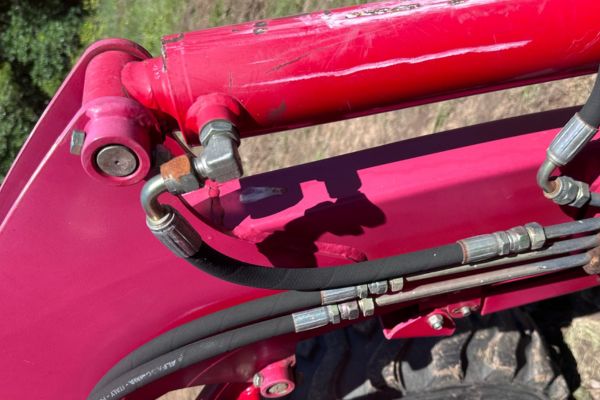
Once the equipment is safe to inspect, record the hose’s position and routing before removal. Photos can help show how the assembly was installed, where the fittings point, and whether the hose contacted nearby parts.
Check the Inside and Outside Diameter
When someone asks for a hose with the “same diameter,” the first question is: which diameter?
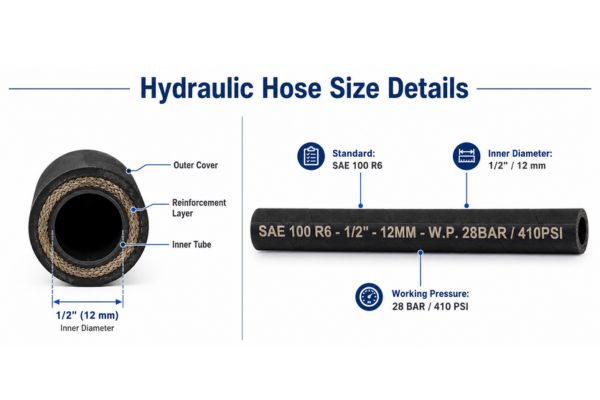
The inside diameter is the size of the passage through the hose. It must suit the flow requirements of the hydraulic circuit. If the passage is too small for the application, pressure loss may increase as fluid moves through it.
The outside diameter is the measurement across the outside of the hose. It affects whether the hose fits through guards and openings, sits correctly in existing clamps, and has enough clearance from other components.
Two hoses can look similar from the outside while having different inside diameters or construction. Measuring the outside with a caliper is useful, but it does not identify every hose specification.
Start with the original assembly number, machine parts information, or hose markings when they are available. If the markings are damaged or missing, record the information you can identify and ask a qualified hose assembly professional to help confirm the specification. Do not select a hose by appearance alone.
Confirm the Working Pressure of the Complete Assembly
Hoses with the same inside diameter do not necessarily have the same working pressure rating. The replacement must be suitable for the pressure conditions of the application.
Working Pressure Is Not Burst Pressure
A hose may be described using more than one pressure value. Maximum working pressure and burst pressure are different measurements.
The higher burst pressure figure must not be treated as the normal operating limit. Use the working pressure specified for the relevant hose type and size, together with the applicable assembly information.
Also, the pressure shown on a gauge during normal operation may not describe every condition in the system. Pressure can change briefly as equipment operates, and an existing gauge may not capture every peak. Consult the machine documentation and use appropriate measurements when the pressure conditions are uncertain.
Check the Hose and Fittings Together
The part installed on the machine is a hose assembly: a hose with a fitting attached at each end. A suitable hose alone does not establish that the completed assembly is suitable.
Confirm that the hose, fittings, and any other coupling components are an appropriate, validated combination. Then check the assembly’s applicable working pressure rating against the equipment’s requirements. The rating of the completed assembly is subject to its components and the specified combination; do not rely on the hose marking alone.
Check the Fluid, Temperature, and Application
Pressure is only one part of hose selection. A replacement also needs to suit the fluid it carries and the conditions around it.
Identify the Fluid
Different hoses and sealing materials are intended for different fluids. Record the actual fluid used in the system and check its compatibility with the hose inner tube, fittings, and any relevant seals.
A hose that is suitable for one hydraulic fluid should not automatically be assumed suitable for another. Use the applicable product information to confirm compatibility.
Consider Fluid and Ambient Temperatures
Check both the temperature of the fluid inside the hose and the temperature of the surrounding environment. A hose routed near a heat source may experience conditions that differ from those elsewhere on the machine.
Compare the application conditions with the temperature limits and guidance for the specific hose and assembly components. A higher pressure rating does not replace a temperature or fluid compatibility check.
Identify Suction Applications
If the hose is used on a suction line, confirm that it is suitable for the vacuum conditions of that application. A hose selected only by pressure rating may not have the required resistance to collapse under negative pressure.
Use the product information for the specific hose type and size to confirm its suitability.
Identify the Fittings at Both Ends
A hose assembly has two different connection questions:
- Does each fitting connect correctly to the equipment?
- Is each fitting suitable for the hose and the assembly process?
Both need to be answered.
Check the Connection to the Equipment
At the equipment end, identify the connection type, thread specification, and sealing method. Some connections seal on a metal seat, while others use a seal such as an O-ring.
A fitting that appears to thread into a port is not automatically the correct match. The thread and the sealing surfaces both need to be compatible with the mating connection. Do not use the fact that a nut starts to turn as the only identification method.
Record the details of both ends. One end may be different from the other, even on the same assembly.
Useful information includes:
- The connection type and thread specification, if known.
- Male or female configuration.
- Straight, 45-degree, or 90-degree fitting shape.
- Fixed or swivel construction.
- The sealing method or seat type.
- Clear photos of the threads and sealing areas.
Photos help with identification, but they may not be enough to confirm a connection on their own. Measurements and equipment or fitting documentation may also be needed.
Check the Hose-to-Fitting Combination
The end attached to the hose must match the specific hose and the applicable assembly method. The hose, fitting, ferrule where applicable, and crimping parameters need to be confirmed together.
Parts that look close in size are not necessarily an approved combination. Crimping them tightly does not prove that the assembly meets the required specification. The assembly should be made by personnel with the appropriate equipment, instructions, and ability to verify the result. Manufacturer technical guidance also cautions against assuming that components from different fitting manufacturers are interchangeable.
Can an Old Hose Fitting Be Reused?
A permanent crimp fitting removed from an old hose should not be crimped onto a new hose. Reusable fittings are a different type of product and should be handled only according to the instructions for that specific fitting and hose combination.
If you are unsure which type is installed, record the fitting information and have it identified before preparing the replacement.
Measure the Assembly Length and Record the Fitting Orientation
“Make it the same length” sounds straightforward, but first establish what is being measured.
The length of the hose section alone is different from the length of the completed assembly with both fittings attached. When recording an assembly length, also record where the measurement starts and ends. Use the assembly drawing or the applicable manufacturer’s measurement method to confirm the correct reference points.
If the old hose is damaged or its original routing was unsuitable, its measured length should be treated as reference information. Check the equipment documentation and the actual installation requirements before finalizing the new assembly.
Check the Full Range of Movement
A hose can appear long enough when the machine is parked and still become tight, rub against another part, or bend too sharply as the equipment moves.
For a hose connected to a moving component, consider the full range of movement and the available space throughout that movement. The routing must also account for the hose’s specified length change under pressure and avoid contact with surrounding parts.
Parker’s safety guidance identifies length change, bend radius, abrasion, and routing as factors to consider when selecting and installing hose assemblies.
Check Bend Radius
Every hose has a minimum bend radius specified for its type and size. Bending it more tightly than allowed can affect its service life.
Pay particular attention to bends close to the fittings. A hose should not be forced into a sharp bend simply to make it fit the available space. Confirm the permitted bend radius in the relevant product information and review the routing if the space is insufficient.

Record Elbow Orientation
If both ends use angled fittings, their relative orientation matters. The angles need to suit the way the assembly connects to the equipment.
Photograph the original installation and record the fitting directions. Do not twist the hose body to force the fittings into position. If the orientation or routing is unclear, confirm it against the drawing or with the person making the assembly.
Look for the Cause of the Old Hose Failure
Replacing a damaged hose without checking why it failed can leave the same problem in place.
If the old hose repeatedly wore through at the same point, inspect the surrounding area. The hose may be contacting a frame, guard, clamp, or another component during operation. Also check whether the hose’s path and support arrangements match the equipment requirements.
Other observations worth recording include:
- Damage near a fitting.
- A sharply bent section.
- Signs that the hose was twisted during installation.
- Contact with nearby components.
- Damage close to a heat source.
- Wear at a clamp or protective sleeve.
These observations do not establish a failure cause by themselves. They give the maintenance team useful information to investigate before the replacement is put into service.
What If the Old Hose Marking Is Missing?
A missing or unreadable marking does not mean you should guess the hose specification. Start by collecting the information that is available.
- Find the equipment details. Record the machine make, model, and hose location.
- Check the parts information. Look for an original hose assembly number, part number, or drawing.
- Photograph the assembly. Include the full hose, each fitting, any remaining markings, and the installation location.
- Record the measurements. Note the hose dimensions and assembly length, including the points used to measure it.
- Describe the application. Include the known working pressure, fluid, temperatures, and whether the line is used for suction.
- Record the routing. Note moving components, tight spaces, contact points, and the relative direction of angled fittings.
- Mark unknown details as unconfirmed. Have them checked against reliable product and equipment information.
For example, a machine model, fitting photos, and an old assembly number may help narrow down the replacement. They do not necessarily confirm every detail of the assembly. Any uncertainty about the hose, fitting connection, or operating conditions should be resolved before the specification is finalized.
Hydraulic Hose Replacement Checklist
Use this checklist to organize the information needed for an assembly review.
| Item | Information to Record |
| Equipment | Make, model, and hose location |
| Original assembly | Part number, assembly number, or drawing, if available |
| Hose identification | Visible markings, hose type, and size |
| Hose dimensions | Inside diameter and outside diameter |
| Pressure conditions | Required working pressure and known pressure changes |
| Fluid | Type of fluid carried by the hose |
| Temperature | Fluid temperature, ambient temperature, and nearby heat sources |
| Application | Pressure line, suction line, or other identified service |
| Fitting at each end | Connection type, thread, sealing method, and fitting shape |
| Assembly length | Length and the measurement start and end points |
| Elbow orientation | Relative direction of angled fittings |
| Routing | Movement, bend space, clamps, guards, and nearby parts |
| Old hose condition | Damage location and any repeated wear |
| Supporting information | Drawings, measurements, and clear photos |
| Quantity | Required quantity and any additional assembly numbers |
If a value is unknown, leave it marked “to be confirmed.” An incomplete but accurate record is more useful than a complete list based on guesses.
Common Mistakes to Avoid
When preparing a replacement assembly, avoid these common shortcuts:
- Matching only the outside diameter. The inside diameter and construction may be different.
- Copying a length without recording the measuring points. The same number can describe different measurements.
- Using burst pressure as the working limit. Check the specified working pressure.
- Assuming a fitting is correct because it starts to thread in. The connection and sealing method must also match.
- Mixing hose and fitting components without confirming the combination. Use applicable assembly instructions and validated components.
- Checking the hose only with the machine parked. Consider the complete range of movement.
- Ignoring repeated abrasion. Investigate the contact point before installing the new assembly.
Frequently Asked Questions
Can I replace a hydraulic hose with one that has the same inside diameter?
The same inside diameter is one useful starting point, but it does not confirm that the replacement is suitable. The working pressure, fluid, temperature, fittings, assembly rating, and installation conditions also need to be checked.
Is a higher-pressure hose always a suitable replacement?
No. A higher working pressure does not automatically make a hose suitable for the fluid, temperature, fittings, bend space, or suction conditions. Check the complete assembly against the application and the applicable product information.
Can I identify a fitting by thread diameter alone?
A thread diameter can help narrow down the possibilities, but it may not be enough to identify the complete connection. Thread details and the sealing method also need to be confirmed using measurements and appropriate reference information.
Should the new hose be exactly the same length as the old one?
The old assembly can provide a useful reference, but the measurement method and installation requirements matter. Check the drawing or manufacturer’s instructions, record the measuring points, and consider the equipment’s full range of movement. If the old hose was poorly routed or repeatedly damaged, review those issues before copying it.
Can I use the old fittings on a new hose?
A permanent crimp fitting from an old hose should not be crimped onto a new hose. A fitting designed to be reusable is a different product and must be checked and handled according to its specific instructions.
What should I provide for a hose assembly review?
Provide the equipment details, original part or assembly number, hose markings, clear photos of both fittings, assembly length and measuring points, and known operating conditions. If you have a drawing or a list of several assembly numbers, include those as well.