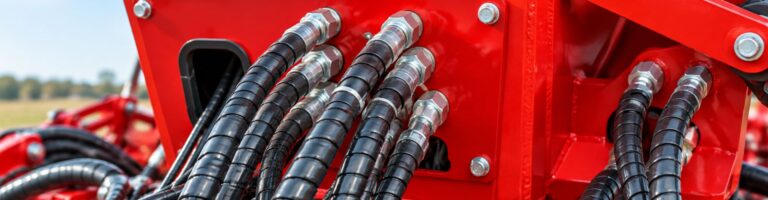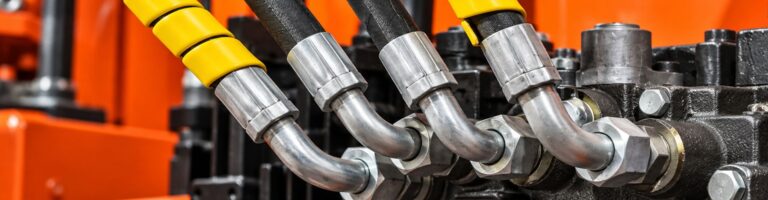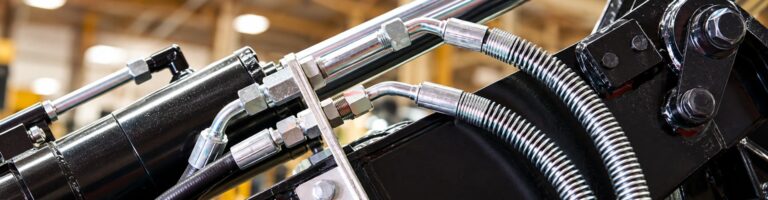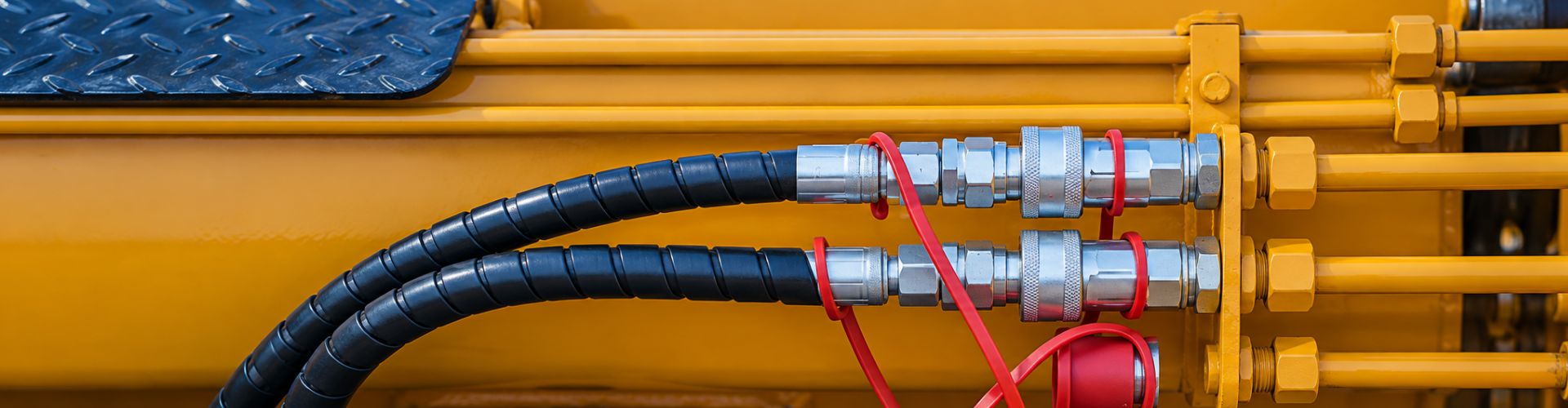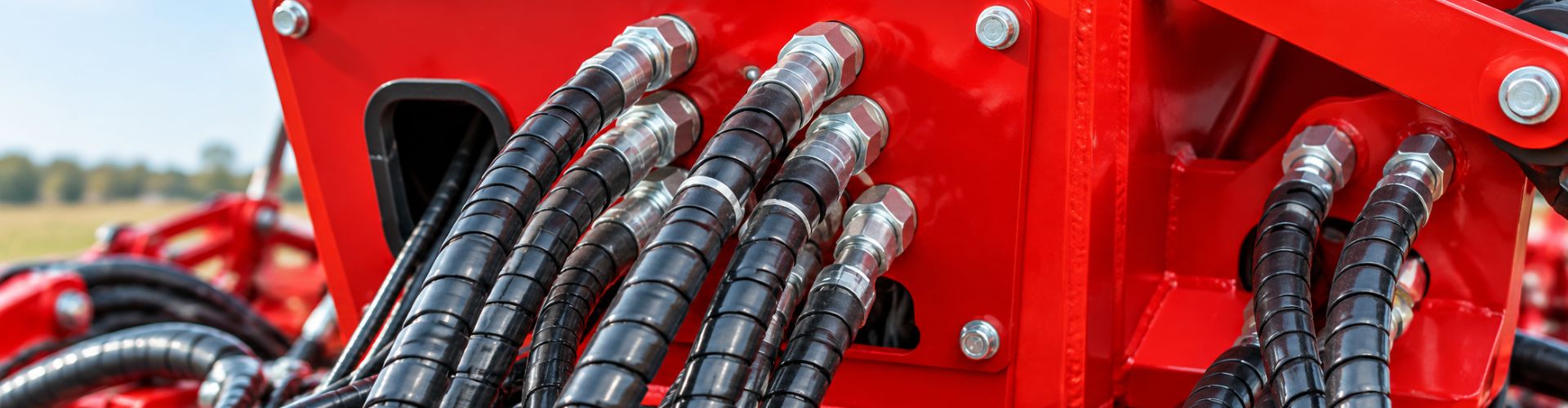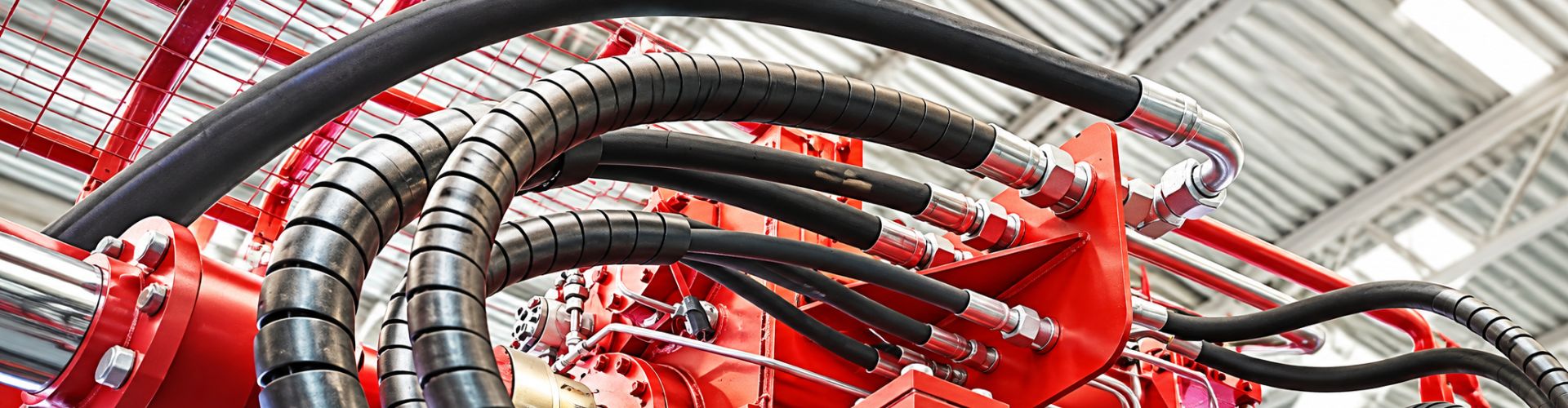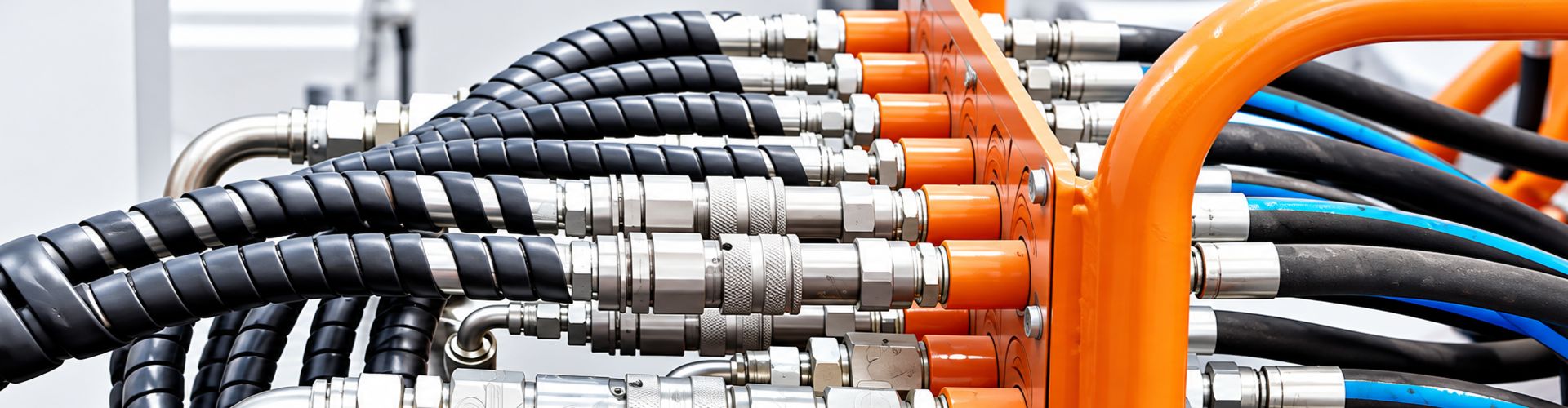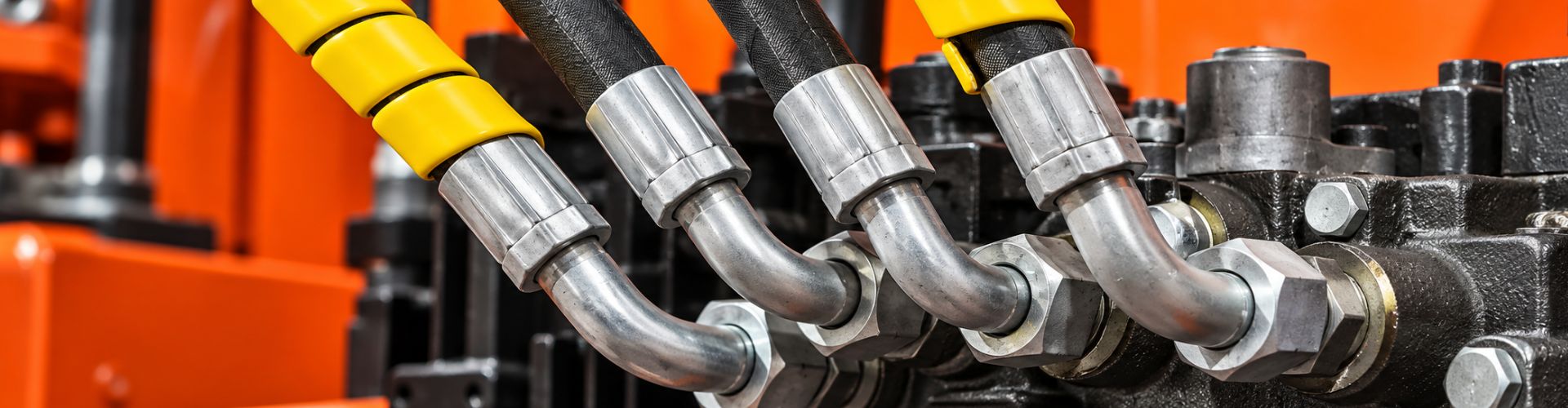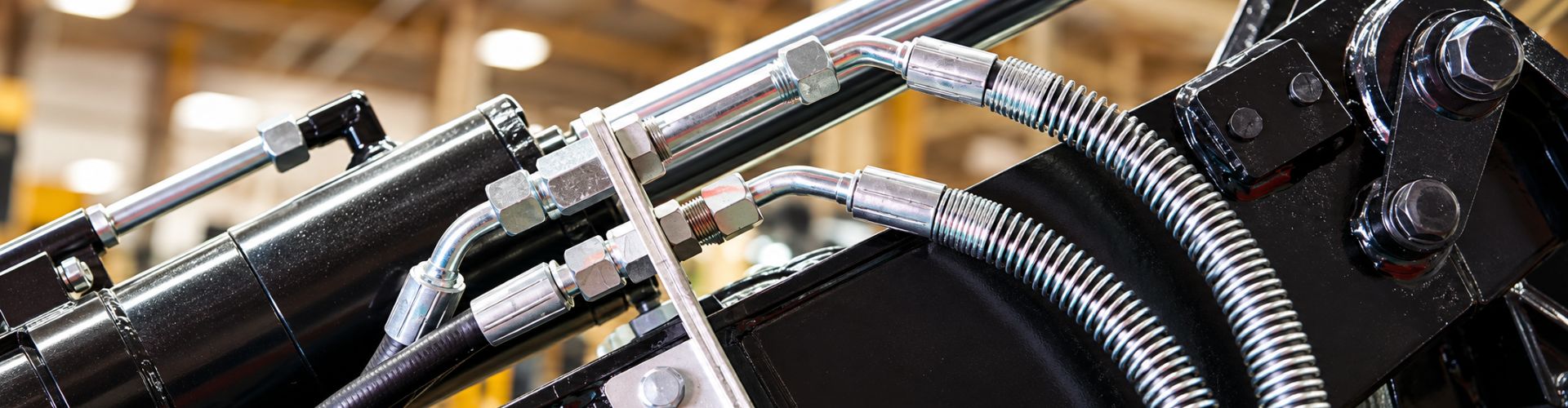
A tractor can use several different hydraulic connection systems at the same time. The remote couplers at the rear of the tractor, the ports on a loader valve, the ends of a hose assembly, and the connections on an imported attachment may all follow different standards.
Common connections include agricultural quick couplers, JIC 37-degree flare, ORFS, SAE O-ring boss, NPT or NPTF pipe threads, BSP threads, and metric 24-degree fittings. Which types appear on a particular tractor depends on the equipment manufacturer, model, production market, hydraulic circuit, and attachment.
Hydraulic fittings provide the joints between hoses, rigid tubes, pumps, valves, cylinders, motors, filters, coolers, and external implements. They do not generate hydraulic power; the pump performs that function. The fittings create controlled flow paths between the components while containing system pressure.
It helps to divide tractor connections into three groups.
The first group is the hose or tube connection. Examples include JIC 37-degree flare, ORFS, DIN 24-degree cone, and BSP 60-degree cone connections. These interfaces seal at a flare, cone, cutting ring, or O-ring rather than at the thread itself.
The second group is the component port. SAE O-ring boss, ISO 6149 metric ports, BSPP ports, and tapered pipe ports may be found on pumps, control valves, cylinders, and manifolds. The fitting end inserted into the component must match the port standard and sealing method.
The third group is the quick coupler. These couplers allow an implement hose to be connected to or removed from a tractor without dismantling the hose assembly. Agricultural couplers may follow ISO 5675 or another manufacturer-specified profile, while some implements use ISO 16028 flat-face couplers.
A single adapter can combine two different interfaces. For example, one end may be SAE ORB for a valve port while the other is JIC male for a hose connection. Each end must therefore be identified separately.
JIC fittings seal through metal-to-metal contact between two 37-degree surfaces. The straight UN or UNF thread draws the two surfaces together but is not the primary sealing surface.
These fittings are commonly found on hoses, rigid tubing, adapters, valves, and cylinders used on North American agricultural and mobile equipment. Straight, elbow, tee, bulkhead, swivel, and adjustable port configurations are available.
Identification requires more than reading the thread size. SAE 45-degree flare, JIS 30-degree flare, and some other cone connections can appear similar. Before ordering, confirm the thread outside diameter, threads per inch, 37-degree sealing seat, tube or hose size, and male or female configuration.
A damaged flare seat should not be repaired by applying thread tape. Sealant on the threads does not correct scratches, deformation, misalignment, or contamination at the metal sealing surface.

An ORFS connection seals at the flat face of the male fitting. The male face contains an O-ring, and the female swivel face compresses the seal as the nut is tightened. The straight thread provides clamping force rather than sealing along the thread.
ORFS connections are used where control of external leakage is important and where the system is exposed to vibration, pressure cycles, or repeated assembly. Their suitability still depends on the fitting series, size, material, O-ring compound, temperature, fluid, and complete assembly rating.
ORFS should not be confused with SAE O-ring boss. ORFS places the O-ring on the flat mating face between two line connections. ORB uses an O-ring near the stud threads to seal a fitting into a machined component port.
When replacing an ORFS fitting, inspect the flat face, O-ring groove, swivel nut, thread, and mating face. The correct O-ring material and dimensions must be used; a visually similar seal is not sufficient.
SAE O-ring boss, commonly abbreviated ORB, is a straight-thread port connection. The O-ring sits between the fitting stud and the chamfer or sealing area of the component port. Adjustable elbows and tees may also use a backup washer and locknut so that the fitting can be oriented before final tightening.
ORB connections are commonly found on valves, pumps, cylinders, manifolds, and hydraulic motors. They should not be identified from the straight thread alone because JIC and ORFS fittings may use related UN or UNF thread sizes while sealing at completely different surfaces.
For identification, record the thread size, threads per inch, stud style, O-ring location, port geometry, and whether the fitting is adjustable or nonadjustable. Never replace an ORB fitting with a JIC fitting merely because the threads appear to engage.
NPT and NPTF are tapered pipe-thread connections. As the male thread enters the female port, increasing thread interference holds the joint together. Conventional NPT assembly normally requires a suitable thread sealant to fill the helical leakage path and lubricate the threads.
NPTF is a related dryseal thread form used in many fluid-power components. NPT and NPTF should not be treated as identical labels on a drawing or purchase order. Confirm the specified standard, size, gender, engagement, and sealing instructions for the component.
Tapered pipe threads can create radial stress in a port, especially when installed in cast, plastic, or thin-wall components. Overtightening can crack the port or permanently deform the threads. They are also less suitable for connections that require frequent disassembly.
Do not apply tape or pipe compound indiscriminately. The sealant must be compatible with the hydraulic fluid, temperature, fitting material, and contamination requirements. Keep excess material away from the first thread so that it is less likely to enter the hydraulic circuit.
Quick couplers connect the tractor’s remote hydraulic outlets to loaders, mowers, balers, log splitters, trailers, and other implements. Unlike a threaded adapter, a quick coupler must match the mating profile as well as the nominal body size.
ISO 5675 covers general-purpose quick-action hydraulic couplers used to transmit hydraulic power between agricultural tractors and machinery. It applies to implement hydraulic lines rather than tractor braking circuits. The standard addresses the interface and operating requirements, but the product specification must still confirm size, pressure rating, flow, valve arrangement, material, and connection ends.
Flat-face couplers are also found on some tractor attachments and mobile equipment. ISO 16028 specifies an interchangeable flush-face interface, but an ISO 16028 plug does not mate with an ISO 5675 agricultural socket. Similar body size does not establish compatibility.
Before selecting a tractor coupler, verify:
– Coupler standard or series
– Nominal body size
– Male plug or female socket
– Plug nose and locking-groove profile
– Ball, poppet, or flat-face valve design
– Hose-end or port-end thread
– Rated working pressure and flow
– Pressure drop requirement
– Connection and disconnection conditions
– Seal material
– Dust-cap or dust-plug requirement
Residual pressure in the tractor or implement line can prevent an otherwise compatible coupler from connecting. Do not solve this by striking the valve or forcing the halves together. Depressurize the circuit using the equipment manufacturer’s approved procedure.
Start with the tractor or implement documentation. Record the manufacturer, model, serial-number range, connection location, and the part number shown in the hydraulic parts diagram. A part number is useful, but it should be checked against the dimensions and connection details of the physical component.
Next, determine what kind of connection is being identified. Is it a hose end, component port, tube connection, adapter, swivel, or quick coupler? A hose assembly may have a JIC female swivel on one end and an agricultural quick-coupler plug on the other, so both ends must be described separately.
For a threaded connection, record:
– Male or female thread
– Straight or tapered geometry
– Outside or inside diameter
– Threads per inch or metric pitch
– Flare, cone, face, O-ring, or port seal
– Hose or tube size
– Fitting shape and orientation
– Material and surface finish
For a quick coupler, measure the body size and identify the plug profile, locking groove, valve style, and connection under the coupler body. Photographs should show the side profile, nose, locking groove, internal valve, thread end, and any stamped markings.
A fitting that screws together or a coupler that partially inserts is not automatically interchangeable. Confirm the complete connection before pressurizing the system.

Thread size and hose size are separate specifications. For example, a fitting may have a -8 JIC connection and a hose stem intended for a different dash size. Both ends must match the assembly design.
The working pressure of the completed connection is limited by its lowest-rated component. That component may be the hose, hose fitting, adapter, coupler, port, O-ring, tube, or attachment. Ratings can also change with fitting size, operating temperature, pressure impulse, vibration, and assembly method.
Quick couplers must be checked for flow as well as pressure. A coupler with the correct thread and pressure rating may still create excessive pressure drop or heat if its nominal body size and flow capacity are too small for the implement circuit.
Do not reuse a published pressure value from another size or material in the same product family. Verify the rating for the exact part number and evaluate the complete hose or tube assembly under the tractor’s operating conditions.
Carbon-steel fittings with a corrosion-resistant surface finish are common in tractor hydraulic power circuits because they combine strength, machinability, and practical cost. The finish should be selected for exposure to moisture, fertilizer, cleaning chemicals, mud, road salt, and outdoor storage.
Stainless steel may be appropriate where corrosion resistance is a primary requirement, but it should not automatically replace carbon steel. Cost, material pairing, galling risk, component availability, and the full pressure rating must be reviewed.
Brass is more commonly associated with selected low-pressure, lubrication, instrumentation, air, or auxiliary connections than with the main high-pressure hydraulic power circuit. Its use should be confirmed from the original specification rather than selected only because it resists corrosion.
Material choice does not correct an incompatible thread or sealing interface. Connection standard, material, finish, seal compound, and operating conditions must be evaluated together.
The tractor brand alone is not enough to identify every fitting. Different models from the same manufacturer may use different suppliers, port standards, quick-coupler profiles, or hose assemblies. Specifications can also change by production year and destination market.
When replacing or cross-referencing a fitting, provide the tractor manufacturer, model, serial-number range, production market, hydraulic function, original part number, and photographs of the complete connection. If the part belongs to an implement, record the implement details separately from the tractor.
A North American tractor may commonly use SAE connections, while an imported attachment may use BSP or metric ends. In this situation, a properly specified transition adapter is safer than forcing two similar-looking threads together or modifying the original component.
Condition | What to verify |
Outdoor moisture | Fitting material, plating and corrosion protection |
Fertilizer or chemical exposure | Material, coating and seal compatibility |
Low or high temperature | Hose, O-ring, fluid and fitting temperature limits |
Dust and mud | Coupler caps, cleaning procedure and sealing-face protection |
Vibration and pressure impulse | Connection type, support, hose routing and rated assembly |
Frequent attachment changes | Coupler profile, seal condition and contamination control |
Long outdoor storage | Corrosion, hose aging and protective caps |
High implement flow | Coupler body size and acceptable pressure drop |
A useful cross-reference request should identify every connection rather than relying on one photograph or a general tractor description.
Provide:
– Tractor and implement manufacturer
– Model and serial-number range
– Original part number
– Location and hydraulic function
– Thread or coupler standard
– Connection size on each end
– Hose or tube size
– Sealing surface
– Fitting shape and orientation
– Material and surface finish
– Working pressure, fluid and temperature
– Quantity required by part number
– Drawing, sample, catalog page, or clear photographs
For a hose assembly, include the overall length, fitting orientation, hose specification, protection requirements, and markings. For a coupler, include the plug or socket profile, body size, valve type, locking groove, and threaded connection.
Correct identification begins with the sealing surface and interface standard, not just the apparent thread diameter. The fitting must also match the hose or tube size, component port, pressure and flow requirements, seal material, and operating environment.
For replacement or recurring purchasing, document each connection by part number and specification. This reduces the risk of receiving a fitting that threads into place but does not seal, carry the required flow, or mate with the tractor’s existing coupler.
Hydraulic fittings are used to connect hydraulic hoses and components, enabling the transmission of fluid to power tractor attachments.
Common hydraulic fittings in tractors include JIC, BSP, NPT, and ORFS (O-Ring Face Seal) fittings.
O-ring fittings are preferred because they provide a secure, leak-free seal and can handle high-pressure applications typical in tractors.
Yes, brass fittings are sometimes used in tractor hydraulic systems, especially in lower-pressure applications, due to their corrosion resistance.
Yes, agricultural equipment often uses quick-connect fittings and swivel fittings for easy attachment and detachment of hydraulic lines.
Choose the right hydraulic fittings based on the tractor’s hydraulic system pressure, hose size, and connection requirements to ensure compatibility and efficiency.
Find out more about Topa Blog and learn more about specialized hydraulic fittings.