A purchase order for one-piece fittings starts a financial cycle that is easy to underestimate.
The shop approves quantities, commits cash, waits for production and delivery, receives the fittings, checks and stores them, and then waits again until customer demand consumes those parts. The money invested in a fitting does not become useful operating cash again simply because the carton arrives. That fitting must first become part of a completed hose assembly, the assembly must be sold, and the customer must eventually pay.
Follow the Cash from Purchase Order to Paid Hose Assembly
Purchase Approval Is the First Cash Commitment
The cash cycle begins before the fittings arrive.
Once a purchase order is approved, the shop has committed part of its purchasing capacity to a defined group of SKUs and quantities. Depending on payment terms, the actual payment may occur immediately, after production, before shipment, or according to an agreed credit period. However, the commercial decision has already reduced flexibility.
Money allocated to 500 pieces of one fitting cannot simultaneously be used for another hose series, payroll, freight, tooling, emergency purchasing, or a faster-moving product family.
This is particularly important for smaller hose shops because purchasing decisions are often made from a limited working-capital pool. A single oversized order can consume more cash than expected even when every fitting in the shipment is technically correct.
Suppose a shop needs 50 pieces of a fitting but orders 300 because the larger quantity reduces the quoted unit price. The difference between 50 and 300 pieces is not only “extra inventory.” It is cash that has been assigned to future demand that may take months to appear.
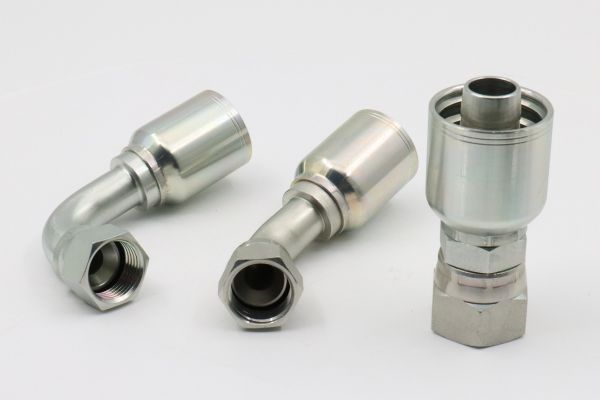
The fitting may eventually sell. The cash-flow issue is the time required to reach that sale.
Receiving Inventory Does Not Complete the Cycle
When fittings reach the warehouse, they become physical assets, but they are still not liquid cash.
Before they can support a customer job, the shop may need to:
- verify the part number;
- confirm the thread and sealing type;
- check the port-dash and hose-dash combination;
- inspect appearance and surface treatment;
- update inventory quantities;
- assign or confirm bin locations;
- separate approved stock from questionable stock;
- match the fitting to valid hose and crimp information.
A product sitting in an unopened carton may technically be owned by the shop, but it is not yet positioned for efficient use.
Poor receiving control can extend the financial cycle further. If fittings are placed in the wrong bins, labeled inconsistently, mixed with similar parts, or entered incorrectly into the inventory system, staff may purchase the same product again because they cannot confidently see what is already available.
That creates a particularly expensive form of overstock: inventory purchased not because demand required it, but because inventory control failed.
Customer Use Is Only Part of the Return
The fitting finally becomes productive when a customer job consumes it.
It is selected, matched to the correct hose, installed according to the assembly specification, crimped using valid data, and included in a finished hose assembly.
Even then, the cash cycle may not be complete.
If the customer buys on account, the shop still waits for payment. This means the real purchasing cycle may look like:
PO approval → payment → production → transit → receiving → storage → customer demand → hose assembly → invoice → customer payment
For frequently used fittings, these steps may move quickly. For slow-moving SKUs, the storage stage can dominate the entire cycle.
That is why inventory purchasing should be reviewed in terms of time as well as price.
Inventory Has Value, but It Is Not the Same as Available Cash
Productive Inventory Supports Hose-Shop Service
Calling inventory “cash tied up” should not imply that fitting stock is undesirable.
A hose shop without sufficient inventory may lose urgent repair work, disappoint repeat customers, or leave critical equipment waiting for a connection that could have been stocked.
One-piece fittings provide operating value because they allow the shop to respond quickly to known demand.
Common fittings may justify regular stock because they support:
- repeat hose assemblies;
- local agricultural equipment;
- construction machinery;
- workshop maintenance;
- industrial hydraulic systems;
- emergency field repairs;
- existing customer fleets.
In these situations, inventory helps generate revenue.
The challenge is not to eliminate inventory. It is to distinguish between inventory that actively supports customer demand and inventory that consumes cash without a clear use pattern.
Liquidity Changes from One SKU to Another
Two fittings with the same purchase value can have completely different financial behavior.
Imagine that a shop holds $1,000 worth of a common straight fitting and another $1,000 worth of a special 90-degree fitting.
If the straight fitting is consumed every week, much of that $1,000 may repeatedly move through hose jobs and back into receivables or cash.
If the special elbow is used twice per year, most of the second $1,000 may remain on the shelf.
The purchase value is equal, but the liquidity is different.
This distinction matters because working capital is affected by the speed at which stock becomes customer revenue.
Inventory Carries More Than Product Cost
The cash commitment also extends beyond the factory price.
Stored fittings may involve:
- international or domestic freight;
- customs and import charges;
- receiving labor;
- inspection time;
- storage space;
- bin management;
- counting;
- relabeling;
- inventory-system maintenance;
- future verification;
- potential obsolescence.
A fitting can therefore be technically usable and still become commercially inefficient when it remains inactive for too long.
For owners and purchasing teams, the useful question is not whether inventory has value. It clearly does.
The question is whether the amount being held is proportionate to expected use and service importance.
Purchasing Depth and Replenishment Frequency Affect Cash Differently
Deep Orders Reduce Ordering Frequency but Increase Commitment
Purchasing depth refers to how many pieces of one SKU are bought at a time.
A deep order can make sense when demand is stable. It may reduce ordering frequency, simplify replenishment, improve freight efficiency, or support better supplier pricing.
However, every additional piece increases the amount of cash committed before that fitting has been sold.
Consider a common fitting used at approximately 20 pieces per month.
If the shop purchases 40 pieces, the order represents about two months of expected consumption.
If it purchases 200 pieces, the order represents approximately ten months of expected consumption.
The second order may have a lower unit price, but it also requires the shop to finance much more future demand immediately.
If actual usage falls from 20 pieces per month to 10, the 200-piece order may now represent almost 20 months of inventory.
This is how a commercially attractive volume discount can become a long-term working-capital commitment.
Smaller Orders Reduce Depth but Increase Dependence on Supply
The opposite approach is frequent, smaller replenishment.
This keeps less cash concentrated in each SKU and may allow the shop to respond more quickly to changing demand.
But smaller orders are not automatically better.
They can increase exposure to:
- supplier delays;
- freight fluctuations;
- production scheduling;
- minimum order values;
- shipping disruptions;
- receiving workload;
- repeated purchasing administration.
If a shop uses 30 fittings per month and normally needs 20 days to replenish them, ordering only five pieces at a time would not be practical.
Purchasing frequency must therefore be linked to realistic supply conditions.
Cash efficiency cannot be considered separately from availability.
The Best Order Pattern Depends on the SKU
A useful purchasing policy may be different for each fitting family.
A fast-moving fitting with stable history may justify deeper stock because it is likely to convert into customer jobs quickly.
A variable-demand fitting may be better managed with smaller replenishment quantities.
A rare but emergency-critical fitting may need a protected minimum stock.
A rare and easily sourced fitting may be suitable for special-order purchasing.
The important point is that purchasing depth should reflect how that specific fitting behaves rather than applying one quantity rule to the entire one-piece fitting range.
MOQ Can Create Very Different Cash-Flow Results
MOQ Is Easier to Absorb on Fast-Moving Fittings
Minimum order quantity becomes less restrictive when the shop can consume the quantity quickly.
Suppose the supplier requires an MOQ of 100 pieces.
For a fitting used 50 times per month, the order represents roughly two months of demand. That may be perfectly reasonable.
For another fitting used five times per month, the same MOQ represents approximately 20 months of demand.
The MOQ has not changed. The financial result has.
This is why MOQ should always be reviewed against realistic SKU-level consumption.
A purchasing team that focuses only on whether an MOQ is “high” or “low” can miss this distinction.
The more useful question is:
How many months of credible demand does this MOQ represent?
Slow-Moving Does Not Automatically Mean Unnecessary
A low usage rate does not always justify removing a fitting from inventory.
Some slow-moving one-piece fittings may be important because they support:
- specialized agricultural machinery;
- imported equipment;
- older machine fleets;
- emergency breakdown repairs;
- customers with unusual hydraulic standards;
- jobs with high downtime costs.
For these fittings, the purpose of holding stock is not high turnover. It is risk protection.
However, this does not mean the shop should purchase ten times the amount necessary for emergency coverage.
If two pieces are sufficient to protect the likely repair requirement, buying 50 because of an inflexible MOQ creates a very different financial decision.
The shop should distinguish between the reason for stocking the fitting and the quantity purchased.
Mixed-SKU Orders May Reduce Excess Depth
Where suppliers allow it, mixed-SKU ordering can help reduce cash concentration.
Instead of buying a full MOQ for every low-volume configuration, the purchaser may distribute an order across several useful fittings.
For example, rather than purchasing 100 pieces each of five slow-moving elbows, the buyer may be able to combine the requirement into a mixed order containing smaller quantities of each.
This can improve coverage while avoiding deep stock in one configuration.
However, mixed-SKU purchasing should not become an excuse to add parts without evidence of demand.
A mixed carton full of weak-demand items is still overstock.
The benefit comes from matching individual quantities more closely to practical usage.
Segment One-Piece Fittings by Demand and Job Consequence
Fast-Moving and Stable Fittings
These are often the easiest products to stock confidently.
They may include commonly used straight fittings or standard connections repeatedly used by local customers.
Because consumption is regular, deeper purchasing may be reasonable when supported by history.
The buyer should still consider open POs and total stock, but demand uncertainty is relatively low.
Variable-Demand Fittings
Some fittings sell regularly but unpredictably.
One month may be busy and the next quiet.
These products may justify moderate safety stock combined with smaller replenishment quantities where supplier conditions allow.
The objective is to avoid interpreting a temporary spike as permanent demand.
Slow but Emergency-Critical Fittings
These products may have very little annual movement but high service importance.
If one missing fitting can prevent a critical machine from returning to operation, eliminating it purely because of low turnover may damage customer service.
For these SKUs, the shop can define a deliberate protected quantity.
That quantity should be based on the likely emergency requirement rather than an arbitrary large stock level.
Slow and Easily Sourced Fittings
A low-frequency fitting with dependable short lead time may not need regular shelf stock at all.
It may be suitable for special-order treatment.
This frees working capital without creating the same shortage risk as a difficult-to-source product.
The decision depends on actual sourcing reliability, not assumptions.
Build a Cash-Aware Purchasing Review
Review Both Financial Exposure and Availability
A practical purchasing review does not need to become a complicated accounting model.
The goal is to connect each physical inventory decision to two questions:
- How much cash will this purchase commit, and for how long?
- What happens operationally if the fitting is unavailable?
A simple review can use the following structure:
| Purchasing Situation | Cash Effect | Availability Effect | Key Question |
| Deep order for a fast-moving fitting | Larger commitment now but relatively quick expected consumption | Strong stock coverage | Does usage history justify the quantity after inbound stock is counted? |
| High MOQ for a slow-moving fitting | Cash may remain inactive for a long period | Protects against special-order delays | Is the fitting truly critical or simply infrequent? |
| Frequent small replenishment | Less cash committed per order | Greater dependence on reliable lead time | Can the supplier and freight route support the frequency? |
| Consolidated multi-SKU shipment | More inventory arrives at one time | Broader coverage | Does freight saving justify the additional stock months? |
| Reordering while stock is inbound | Risk of duplicate commitment | Can create excessive stock | What is already confirmed on open POs? |
| Cutting emergency inventory | Releases cash immediately | May expose urgent jobs | What is the verified consequence of a stockout? |
Conclusion
One-piece fitting purchasing affects hose-shop cash flow because the money committed to inventory may remain unavailable for weeks or months before the fitting contributes to a completed, paid hose assembly. The financial cycle begins when the shop commits to the purchase, not when the fitting reaches the shelf.
Frequently Asked Questions
How does MOQ affect hose-shop cash flow?
MOQ determines the minimum quantity a shop must purchase from a supplier. Its financial effect depends on how quickly the fitting is consumed.
Is a lower one-piece fitting unit price always better?
No. A lower price per fitting may require a much larger total order. The shop should compare total cash commitment, expected usage, existing inventory, open purchase orders, freight effects, and stockout consequences.
Should slow-moving fittings always be removed from stock?
No. Some low-volume fittings are important because they support specialized equipment or urgent repairs. These may justify protected emergency inventory.
How should open purchase orders affect a new fitting order?
Confirmed open PO quantities should be treated as inventory on the way.
They cannot replace physical stock for an immediate hose assembly, but they should be included in the purchasing calculation. Ignoring inbound quantities can lead to duplicate orders and excessive stock when multiple shipments arrive.
Is freight consolidation always good for fitting purchasing?
No. Consolidating shipments may reduce freight cost and administrative work, but it can also encourage the shop to purchase several extra months of inventory.