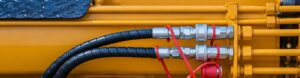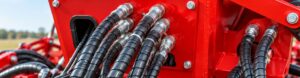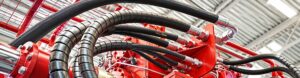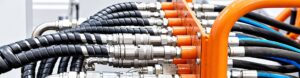
Improper hydraulic hose routing drastically shortens hydraulic cylinder life by introducing severe mechanical tension, localized thermal spikes, and accelerated seal degradation. When a flexible lines layout is poorly planned, it transforms simple fluid conduits into structural liabilities that actively sabotage the entire linear actuator assembly. Field technicians frequently diagnose premature rod score marks and fluid leaks that stem directly from poorly supported line configurations rather than native component defects.
Why Does Improper Hose Routing Trigger Premature Cylinder Failure?
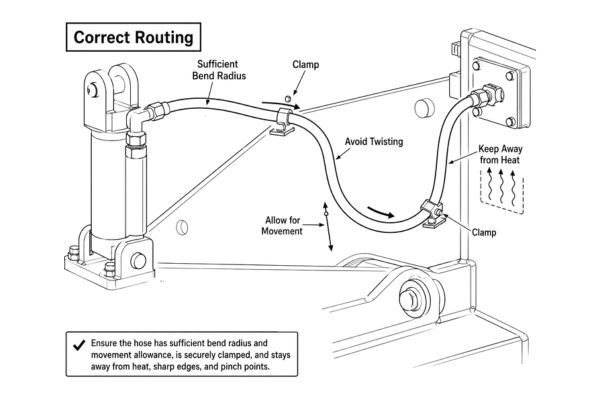
Improper routing shortens component lifespans by introducing intense lateral side loads directly onto the cylinder rod seals and bushings. When flexible lines pull unevenly against a moving port, they act as mechanical levers that misalign the internal piston assembly. This structural distortion forces the moving rod to rub heavily against the primary guide sleeve. Precision hose routing ensures your system stays perfectly centered during high-pressure cycles.
What Is the Core Mechanism of Radial Loading Stress?
This side pull concentrates friction forces on one side of the internal guide sleeve, ruining the smooth path of the rod.
- Bushing Deformity: The internal guide sleeve deforms rapidly under continuous uneven friction.
- Seal Distortion: Fluid channels open up across the low-pressure side of the packing gland.
Keeping your lines properly aligned prevents these costly radial loads from destroying your internal actuator tolerances.
How Does Side Pull Disrupt Internal Alignment?
Unplanned line movement exerts an intense leverage force that bends the chrome rod and scores the primary throat seals.
- Chrome Flaking: Microscopic cracks form on the hardened rod surface due to heavy friction spikes.
- Contaminant Tracking: Environmental grit bypasses the distorted wiper and destroys the inner seals.
Using a proper layout shields your polished components from abrasive wear, saving you thousands in premature rebuild costs.
| Operational Stress Vector | Structural Failure Mode | Estimated Component Life Drop |
| Uncontrolled Line Pull | Asymmetric Gland Wear | Service Life Reduced By 60% |
| Fluid Restrictive Bends | Localized Cavitation | Component Efficiency Drops 25% |
How Do Tight Bend Radii Accelerate Internal Component Wear?
Tight bend radii accelerate internal component wear by creating severe fluid restrictions and intense backpressure spikes at the hydraulic cylinder port entry. Forcing high-velocity oil through sharp curves converts kinetic energy into heat and violent fluid turbulence. This restrictive layout starves the actuator cylinder of smooth, uniform flow. Maintaining sweeping paths keeps fluid moving naturally and eliminates premature component wear.
What Limits Fluid Flow Efficiency Near Cylinder Ports?
Sharp angles directly upstream of the actuator port turn smooth fluid movement into highly destructive, churning vortices.
- Boundary Layer Decay: The smooth oil film disappears, leaving raw steel components exposed to friction.
- Upstream Cavitation: Exploding vapor bubbles micro-pit the inner surfaces of the end caps.
Using generous line curves ensures a steady delivery of fluid while protecting internal metal surfaces from cavitation.
How Do Kinked Conduits Create Destructive Backpressure?
A restricted fluid loop forces the main system pump to work significantly harder, sending sharp shockwaves straight into the cylinder body.
- Pressure Wave Fatigue: Chronic pressure pulses fracture brittle carbon-filled Teflon wear bands.
- Ring Migration: Broken guide ring segments jam between the piston head and the inner wall.
Correcting these tight line configurations keeps your system pressure balanced and prevents internal guide ring breakdowns.
| Bend Layout Profile | Port Velocity Change | Internal Cavitation Risk |
| Sub-Standard Curve | 180% Increase | High Surface Pitting |
| Sharp 90-Degree Adapter | 290% Increase | Extreme Metal Erosion |
What Causes Mechanical Abrasion in Poorly Routed Hydraulic Lines?
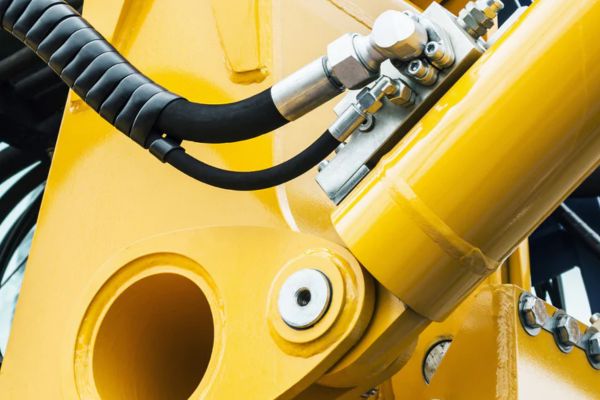
Mechanical abrasion occurs when unsecured lines rub continuously against the rigid steel frame or the cylinder barrel during operation. Every time the system pressurizes, the line flexes and acts like a saw blade against nearby metallic surfaces. This constant grinding thins out the structural walls of both the hose sheathing and the cylinder shell. Precision hose routing completely isolates your lines to stop abrasive friction.
How Does Structural Friction Wear Down Actuator Barrels?
Constant rubbing strips away protective outer paint layers, allowing deep rust and abrasive pitting to compromise the outer cylinder barrel.
- External Wall Thinning: Micro-abrasions reduce the pressure-containing thickness of the steel tube.
- Stress Concentrations: Structural weak spots form along the barrel, risking a catastrophic casing burst.
Installing robust mounting brackets keeps lines separated from the cylinder casing, preserving its structural integrity.
What Happens When Outer Sheaths Disintegrate Completely?
Once the tough synthetic rubber jacket wears away, environmental moisture and grit attack the high-tensile steel wire reinforcement layers underneath.
- Braid Corrosion: Moisture turns the high-strength steel reinforcement into brittle iron oxide.
- Tensile Strength Loss: The line loses its capacity to withstand heavy cyclic pressure surges.
Preventing outer jacket destruction is the absolute simplest way to keep your external lines from bursting unexpectedly.
| Contact Zone Profile | Casing Wear Rate | Catastrophic Burst Risk |
| Unsecured Line on Barrel | High Surface Grinding | Severe Structural Hazard |
| Loose Rubber Sleeve | Moderate Paint Scuffing | Progressive Fatigue Warning |
How Does Operating Overpressure Intensify Defective Line Rigging?
Excessive operating pressure causes poorly rigged lines to stiffen, straighten out violently, and apply massive physical forces to the hydraulic cylinder mounts. This sudden jerking motion yanks the cylinder rod sideways, destroying the internal alignment and ruining the primary gland seals. High-pressure lines can actually contract up to four percent in total length when pressurized, pulling connected fittings out of spec.
Why Do High-Pressure Cycles Cause Line Contraction?
When internal pressure spikes, the high-tensile steel wire braids inside the line swell radially, which causes the overall hose length to shorten significantly.
- Radial Expansion Force: The line expands outward, forcing the wire braids to contract lengthwise.
- Axial Gland Strain: The shortened line pulls hard against the cylinder port, distorting the threads.
Leaving a healthy amount of line slack completely isolates your critical cylinder mounting hardware from destructive contraction forces.
How Does Structural Shock Destroy Cylinder Rod Mounts?
The violent jerking motion of an over-tightened line sends massive structural shockwaves straight into the cylinder trunnions and clevis pins.
- Hole Ovalization: Rigid clevis eyes stretch out of round, introducing damaging mechanical play.
- Pin Shearing: Continuous fatigue micro-cracks the heavy steel mounting pins until they snap.
Ensuring proper line slack shields your heavy-duty mounting hardware from sudden pressure shocks.
| Pressure Load Level | Total Linear Contraction | Induced Component Strain |
| 2,000 PSI Standard | 1.5% Length Reduction | 110 Lbs Component Stress |
| 4,500 PSI Peak Surge | 3.8% Length Reduction | 420 Lbs Component Stress |
Why Do Thermal Hotspots Attack Misaligned Hydraulic Assemblies?
Lines routed too close to hot exhaust manifolds or engine blocks transfer intense radiant heat directly into the cylinder fluid supply loop. This localized thermal buildup degrades the hydraulic oil, lowering its viscosity until the fluid film can no longer protect internal moving parts. Precision hose routing keeps your lines isolated from high-heat zones to preserve oil thickness and protect internal components.
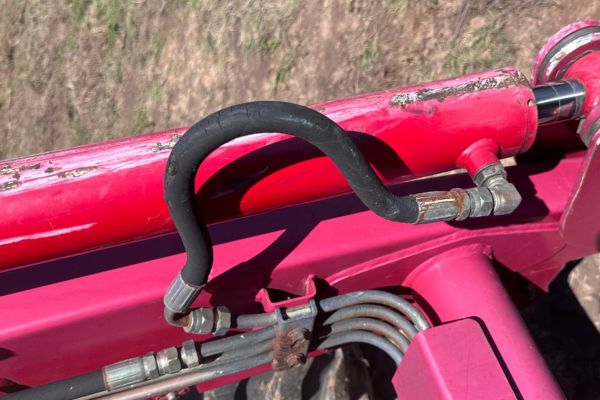
How Does Radiated Heat Degrade Internal Fluid Film?
Excessive heat breaks down the complex anti-wear additives inside your hydraulic oil, leaving internal cylinder surfaces vulnerable to scuffing.
- Additive Breakdown: Vital anti-wear chemicals break apart under high thermal stress.
- Viscosity Collapse: The oil thins out completely, failing to maintain a protective barrier.
Keeping your lines cool preserves the vital lubricating film required to protect moving steel components.
Why Do Brittle Cylinder Seals Blow Out Under Load?
Continuous exposure to high temperatures bakes standard Nitrile or Polyurethane seals until they lose their elasticity and turn hard as plastic.
- Elastomer Baking: Chemical bonds harden permanently, destroying the seal’s native flexibility.
- Micro-Fissure Development: Small cracks appear along the sealing lip under standard pressure cycles.
Keeping your line layouts cool preserves seal flexibility, ensuring tight fluid retention and dependable cylinder operation.
| Ambient Thermal Zone | Fluid Viscosity Rating | Expected Seal Lifespan |
| 120°F Controlled Run | 46 cSt Ideal Lubrication | 8,000 Full Operating Hours |
| 210°F Exhaust Proximity | 12 cSt Critical Thinning | 1,200 Full Operating Hours |
How Does Ambient Torsional Stress Compromise Cylinder Seals?
Twisting a high-pressure line during installation creates severe internal torsional stresses that try to untwist the line as it pressurizes. This rotational force transfers straight into the cylinder port fittings, loosening the connection and skewing the internal gland alignment. A twisted line layout restricts internal fluid flow and forces the cylinder to operate under high structural strain.
What Is the Root Cause of Fitting Torque Failures?
When a twisted line expands under pressure, it exerts a massive rotational force that backs off the port retention nuts.
- Force Transference: The pressurized line acts as a wrench, loosening the port adapter nuts.
- O-Ring Extrusion: Loosened fitting threads allow the rubber sealing ring to pinch.
Eliminating line twist during installation keeps your port adapters tight and eliminates messy external fluid leaks.
How Does Line Twisting Rupture Reinforced Walls?
A twisted line cannot distribute internal pressure stresses evenly across its internal high-tensile steel wire braid reinforcement layers.
- Uneven Braid Tension: One side of the wire braid carries the full pressure load while the other sags.
- Wire Fatigue: Overstressed reinforcement wires snap rapidly under cyclic pressure waves.
Keeping your lines perfectly aligned ensures your reinforcement layers share the pressure load evenly, maximizing system reliability.
| Installed Twist Angle | Loosing Torque Exerted | Thread Connection Status |
| 5-Degree Micro-Twist | 14 Ft-Lbs Active Force | Minor Seal Seepage Risk |
| 15-Degree Severe Twist | 48 Ft-Lbs Active Force | High Fitting Back-Off Risk |
What Safeguards Prevent Heavy Equipment Hose Whipping Disasters?
Using robust structural anchors and whip checks keeps high-pressure lines from thrashing violently if a connection suddenly breaks. Unsecured line failures can severely damage nearby cylinder rods, denting the outer barrels and causing immediate fluid loss. Precision hose routing incorporates heavy-duty safety clamps that keep failed lines completely contained.

How Do Line Restraints Protect Delicate Cylinder Rods?
Heavy-duty mounting brackets hold lines firmly in place, preventing them from whipping outward and striking the polished cylinder rod during operation.
- Kinetic Suppression: Strong steel brackets absorb the violent energy of a ruptured line instantly.
- Rod Impact Elimination: Restraints prevent heavy metal line ends from scratching the exposed rod.
An unexpected line failure can turn into a major disaster if not properly secured with structural anchors.
Why Are Secondary Support Clamps Critical for Mobile Gear?
Mobile machinery operates under constant vibration that quickly loosens port connections if the weight of the line is left unsupported.
- Vibrational Dampening: Clamps absorb engine and terrain vibrations before they reach the fittings.
- Weight Relief: Brackets carry the heavy line weight, keeping the port connections stress-free.
Adding robust secondary support clamps is a low-cost upgrade that completely isolates your cylinder fittings from damaging operational vibrations.
| Restraint Safety Profile | Maximum Line Deflection | Cylinder Rod Impact Risk |
| No Restraints Installed | Exceeds 6.5 Feet Travel | Absolute Component Rupture |
| Intermediate Clamping | Less Than 8 Inches Travel | Low Side-Scuff Probability |
How Do Incorrect Fitting Angles Compromise System Flow Dynamics?
Using improper elbow fittings forces fluid to make sharp, restrictive turns that generate intense heat directly inside the cylinder port area. This heat spike thins out your hydraulic fluid, reducing its ability to lubricate the moving piston rod guide bands. Choosing the correct fitting angles ensures smooth fluid delivery, keeping running temperatures down and protecting internal components.
What Triggers Severe Fluid Turbulence at Cylinder Inlets?
Forcing high-velocity fluid through a poorly matched fitting creates massive eddies that erode the internal metal walls of the cylinder port.
- Boundary Layer Washing: High-speed turbulent fluid strips away the protective oxide film inside the port.
- Thread Area Thinning: Cavitation slowly eats away the metal walls supporting the primary port threads.
Selecting smooth, swept elbow fittings ensures a steady delivery of fluid while protecting internal port connections.
How Do Incorrect Adapters Induce Mechanical Stress?
Forcing a mismatched line onto an improper fitting angle pulls the entire hose assembly tight, putting a heavy side load on the cylinder rod gland.
- Gland Pre-Loading: The pulled line exerts a constant sideways force on the port adapter threads.
- Wiper Boot Distortion: The rod wiper seal deforms, allowing environmental grit to enter the cylinder.
Using the right fitting angles ensures your lines sit naturally, completely eliminating the side loads that cause premature cylinder leaks.
| Fitting Angle Selection | Fluid Velocity Spike | Internal Wall Erosion Rate |
| Mismatched Sharp 90° | 240% Velocity Increase | Severe Material Washing |
| Smooth Swept 45° Elbow | 45% Velocity Increase | Negligible Surface Wear |
Why Must Routing Layouts Account for Dynamic Cylinder Stroke?
Failing to plan for the full movement of a cylinder rod pulls lines tight at full extension or kinks them during retraction. These repeated structural strains break the internal wire reinforcements of the line, leading to a sudden blowout under pressure. Precision hose routing uses calculated travel loops that handle full movement smoothly, protecting both the line and the cylinder mounts from fatigue.
How Does Extension Tension Damage Cylinder Glands?
When a cylinder extends fully without enough line slack, the line pulls tight like a guitar string, putting a massive bending force on the rod gland.
- Full-Stroke Gland Pull: The taut line acts as a heavy lever, trying to rip the port out of the cylinder head.
- Bushing Shape Distortion: The internal bronze rod guide ring squashes out of round under the heavy pull.
Leaving a healthy amount of line slack completely isolates your critical cylinder mounting hardware from destructive contraction forces.
What Triggers Hose Binding Disasters During Retraction?
If a line loop is too long or unsupported, it can sag and get pinched inside the moving steel linkages of the machinery during retraction.
- Linkage Contact Pinching: The sagging line drops straight into the scissor joints of the moving frame.
- Outer Structural Crushing: The heavy steel frame crushes the line, flattening its wire reinforcement layers.
Using proper line tracking guides ensures your fluid conduits flex safely along a planned path, completely eliminating the risk of pinching.
| Cylinder Stroke Position | Line Tension Level | Rod Gland Alignment Status |
| Full Extension (Too Short) | 580 Lbs Radial Pull | Critical Axis Displacement |
| Mid-Stroke (Proper Slack) | 15 Lbs Residual Tension | Perfect Concentric Path |
Conclusion
Optimizing your line configurations is absolutely essential for preventing premature component wear and maximizing the life of your high-pressure cylinders. Throughout this failure analysis, we have shown how improper rigging introduces damaging side loads, intense thermal spikes, and destructive fluid turbulence. By fixing tight bends, eliminating line twist, and leaving enough slack for full stroke movement, you protect your guide bushings, preserve critical rod seals, and keep your machinery running reliably.
Our team is ready to analyze your specific system challenges and supply robust, field-tested parts designed to completely eliminate your maintenance headaches. Let us help you protect your heavy equipment investment and build a more reliable, efficient fluid system—contact us today to optimize your machinery.
FAQ
Can I use standard tie wraps to secure high-pressure hydraulic lines?
No, standard plastic tie wraps lack the structural strength to handle the heavy pulsing and weight of pressurized fluid lines. They quickly snap under normal operating vibrations, letting lines sag against moving parts and cause severe component damage. You must use heavy-duty steel clamps lined with rubber cushions to hold lines firmly.
What’s the best way to determine if a line has too much twist?
Look closely at the lay line printed along the outer jacket of the hose during installation. If this printed line twists around the hose like a corkscrew instead of running perfectly straight, the line is under heavy torsional stress. You need to loosen the fitting ends, realign the line so the lay line is straight, and retighten the connections.
How do I know if a bend radius is too tight for my system?
Check the manufacturer’s technical datasheet for the minimum bend radius of your specific line, and measure the inside curve of the bend with a radius gauge. If the measured curve is smaller than the manufacturer’s specification, the line is kinked, restricting fluid flow and creating intense internal heat. You must replace the tight bend with a smooth, swept elbow fitting.
Can I install protective sheathing over a line that is already showing wire damage?
No, you must replace the damaged line immediately because exposed or broken reinforcement wires mean the line has lost its structural strength. Adding a sleeve over a frayed wire braid only hides a serious safety hazard that could explode violently under normal system pressure. Protective sheathing should only be used on brand-new lines.
How much extra line slack should I leave to handle full cylinder movement?
You should leave an extra five to eight percent of total hose length beyond the straight distance between ports to handle structural contraction and full cylinder travel safely. This extra slack prevents the line from pulling tight at full extension, isolating the cylinder rod gland from damaging side loads. Properly calculated line loops ensure smooth, stress-free movement throughout the entire operating cycle.