Hydraulic hose problems in forestry machinery are primarily caused by extreme mechanical abrasion, high-pressure impulse cycles, severe environmental exposure, and improper installation practices. Imagine operating a heavy-duty log loader deep in the woods during a peak harvesting window when a sudden pressure drop stalls your entire operation. A single ruptured fluid line can instantly halt production, leak expensive fluids into pristine forest soil, and expose your crew to severe mechanical safety hazards. To eliminate these costly operational bottlenecks, timber harvesting crews must implement systematic hose selection, routing optimization, and proactive wear-protection protocols.
Why Does External Abrasion Destroy Forest Equipment Hoses?
External abrasion destroys forest equipment hoses because constant physical contact with tree branches, rocky terrain, and moving machine components rapidly wears down the outer protective rubber cover. When this outer jacket is completely stripped away, the high-tensile steel wire reinforcement layers are directly exposed to ambient moisture and mechanical friction.
If you do not address this surface wear immediately, the inner tube will eventually rupture under normal working pressures. Many logging operators struggle with hydraulic hose problems because they underestimate how fast dense underbrush can saw through standard rubber enclosures.
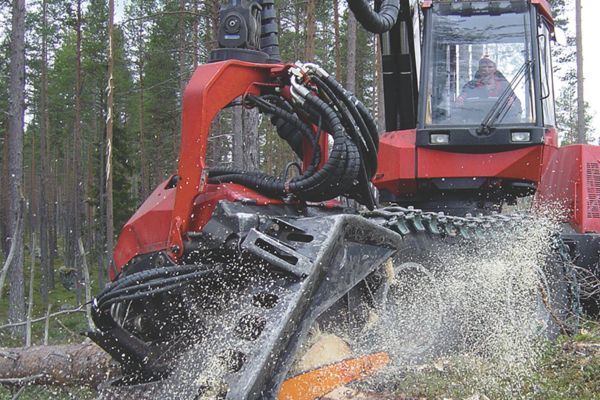
Is Friction From Moving Booms Navigating Underbrush Preventable?
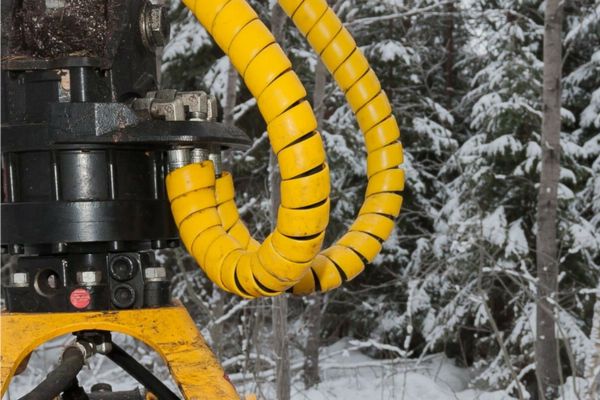
Friction from moving booms is highly preventable if you install heavy-duty plastic spirals or textile sleeves over vulnerable fluid lines. These protective layers act as a sacrificial shield that absorbs the harsh scraping forces instead of allowing them to degrade the structural wire braid.
- High-density polyethylene wrapping offers superior impact resistance against heavy falling limbs.
- Textile sleeves provide excellent multi-hose bundling options to prevent cross-line friction.
- Spring guards deliver maximum protection against jagged rock edges in mountainous logging zones.
What Is The Best Shielding Choice For High-Wear Tree Harvester Areas?
The best shielding choice involves utilizing ultra-tough sleek coatings that eliminate surface friction entirely during fast cycles. These factory-applied modifications dramatically lower the friction coefficient when hoses rub together inside tight boom articulations.
- Specialized abrasion-resistant covers extend standard component lifespan up to several hundred times.
- Molded plastic track systems isolate multiple lines preventing random twisting dynamics.
- Heavy steel wrap serves best where flying wood debris strikes components continuously.
Securing these specialized protective layers ensures your machinery remains active during demanding production shifts.
| Shielding Type | Abrasion Resistance | Flexibility Impact | Primary Application Area |
| Polyethylene Spiral | High | Minimal | Exposed Boom Articulations |
| Textile Sleeve | Medium | None | Multi-Hose Bundles |
| Steel Spring Guard | Extreme | Moderate | Ground-Level Rock Protection |
How Do Pressure Spikes Induce Internal Component Failure?
Pressure spikes induce internal component failure by generating rapid hydraulic shocks that exceed the maximum rated working limits of the fluid conductor. These intense spikes occur when control valves are suddenly closed or heavy log loads shift abruptly during handling operations.
The repetitive flexing caused by these micro-shocks fatigues the internal steel reinforcement structure over time. This structural weakening creates microscopic cracks within the inner liner, eventually causing catastrophic fluid loss during routine work cycles.
Can Rapid Valve Cycling Break Internal Steel Wire Braids?
Rapid valve cycling can definitely fracture internal steel wire braids due to the intense pressure waves traveling through the core circuit. These high-velocity fluid surges force the hose to expand and contract violently within fractions of a second.
- Continuous hydraulic shocks degrade the bond between the inner rubber tube and metal reinforcement layers.
- Accelerated wire fatigue leads to localized structural weak spots near rigid end terminations.
- Uncontrolled pressure surges can easily double the nominal system operating pressures instantly.
Installing electronic dampeners or shock-absorbing valves helps stabilize these internal pressure waves effectively.
How Do Operators Detect Hidden Internal Core Degradation Early?
Operators can detect hidden internal core degradation early by conducting regular diagnostic pressure tests and monitoring sudden temperature variances across lines. When an inner liner begins to fail internally, localized turbulence generates measurable heat signatures before external fluid leaks appear.
- Digital flow meters pinpoint internal bypass conditions caused by microscopic core ruptures.
- Handheld thermal cameras reveal hot spots where restricted internal fluid pathways develop.
- Scheduled oil analysis catches tiny rubber particles shedding from degrading inner tubes.
What Role Does Extreme Temperature Play In Hose Degradation?
Extreme temperature plays a massive role in hose degradation by stripping the rubber compounds of their natural elasticity and structural flexibility. When logging machinery operates in freezing winter conditions, standard rubber components become highly brittle and prone to cracking upon bending.
Why Does Hardening Of Inner Tubes Lead To Catastrophic Splitting?
Hardening of the inner tube leads to catastrophic splitting because the baked rubber can no longer flex naturally as the machine moves. When a hardened line is subjected to high-pressure pulses, it fractures like glass rather than absorbing the stress.
- Baked inner tubes develop deep longitudinal cracks that allow fluid to reach wire braids.
- Loss of plasticizers causes the outer cover to split when exposed to tight bends.
- Stiffened materials pull away from steel fittings, inducing dangerous end-coupling leaks.
Selecting specialized climate-resilient hoses prevents this rapid thermal structural destruction.
How Do Cold Weather Operations Impact Core Component Flexibility?
Cold weather operations reduce core component flexibility by causing standard synthetic rubber formulations to stiffen significantly near their freezing thresholds. If a stiffened assembly is forced to bend during cold starts, the inner core can fracture instantaneously.
- Sub-zero environments require specialized low-temperature outer skins to maintain full flex capacity.
- Improper warmup routines put massive mechanical stress on frozen elastomeric structures.
- Ice accumulation on exposed lines adds dead weight and restricts natural bending radiuses.
Implementing proper pre-heating procedures ensures your fluid lines survive harsh winter harvesting climates.
| Thermal Environment | Primary Effect | Risk Level | Mitigation Strategy |
| Extreme Heat (>100°C) | Inner Tube Hardening | Severe | External Heat Sleeves & Oil Coolers |
| Sub-Zero Cold (<-30°C) | Cover Brittle Cracking | High | Low-Temp Synthetic Rubber Lines |
| Temperature Cycling | Fitting Seal Expansion | Medium | Flange Joints with Viton Seals |
Why Does Improper Routing Cause Premature Mechanical Snagging?
Improper routing causes premature mechanical snagging because poorly positioned fluid lines hang too far below the vehicle chassis or stick out past protective steel plating. As a result, moving tree branches or logging debris can easily catch the line and rip it away.
Twisting a line during installation also drastically reduces its ability to withstand high working pressures. Correct routing layout ensures that all fluid conductors bend along natural paths without experiencing unnecessary structural strain.
Can Correct Clamp Placement Eliminate Destructive Whip Action?
Correct clamp placement completely eliminates destructive whip action by securing loose lines tightly against structural steel frames. When lines are unsupported over long spans, high-pressure pulses cause them to move violently and strike adjacent metals.
- Heavy-duty polypro clamps prevent line migration without pinching the outer rubber cover.
- Strategic spacing keeps multiple lines neatly organized and prevents cross-line abrasion.
- Rubber-cushioned mounts absorb structural vibrations generated by high-displacement piston pumps.
Utilizing proper mounting hardware ensures your assembly stays exactly where it belongs.
How Do Adjustments In Line Length Prevent Severe Kinking Failures?
Adjustments in line length prevent severe kinking failures by providing just enough slack to accommodate full mechanical travel without creating hanging loops. If a line is cut too short, it experiences massive tensile stress when the boom extends fully.
- Adding an extra five percent length compensates for structural changes under high pressures.
- Proper slack keeps the bend radius well above specified corporate minimum standards.
- Optimized geometry prevents lines from being pinched inside moving scissor links.
Refining your measurement techniques eliminates unnecessary mechanical tension and extends assembly operational life.
| Routing Error | Immediate Consequence | Long-Term Threat | Corrective Action |
| Too Short | Tensile Pulling | Fitting Blow-Off | Re-cut with 5% Extra Length |
| Excessive Slack | Hanging Loops | External Debris Snagging | Install Intermediate Clamps |
| Twisted Layout | Core Structural Strain | Linear Wall Rupture | Align Lay-Line Before Clamping |
How Does Chemical Incompatibility Weakness Rupture Inner Tubes?
Chemical incompatibility weakness ruptures inner tubes because selecting the wrong rubber compound causes a destructive chemical reaction with the hydraulic fluid. When an incompatible fluid flows through the line, it breaks down the synthetic polymers, causing the inner tube to soften, swell, or dissolve completely.
Why Do Biodegradable Oils Require Specialized Synthetic Materials?
Biodegradable oils require specialized synthetic materials because their chemical additives can aggressively break down standard nitrile rubber compounds over extended periods. As the eco-friendly fluid degrades, it produces acidic byproducts that attack the internal lining of standard lines.
- Advanced bio-fluids demand specialized fluoroelastomer or customized polymer inner cores.
- Standard rubber liners swell up when exposed to synthetic esters, reducing internal flow.
- Chemical degradation degrades fitting seals, leading to slow and costly environmental leaks.
Consulting fluid compatibility charts before system assembly prevents unexpected internal component breakdowns.
How Does Internal Core Degradation Contaminate Valves?
Internal core degradation contaminates valves by releasing thousands of microscopic rubber particles directly into the high-pressure fluid stream. These loose rubber fragments travel straight to your control valves, clogging small pilot orifices and jamming delicate spools.
- Particulate contamination causes sudden valve sticking, resulting in erratic boom movements.
- Eroded rubber particles accelerate wear inside high-dollar hydrostatic piston motors.
- Clogged inline filters trigger system bypass modes, recirculating dirty oil through components.
Selecting chemically stable components keeps your entire hydraulic circuit free of destructive debris.
Why Does Incorrect Fitting Selection Lead To Blow-Off Failures?
Incorrect fitting selection leads to blow-off failures because using unmatched or improperly sized end components prevents the crimper from forming a reliable, permanent mechanical bond. Under high working pressures, the intense force can easily push a mismatched fitting right off the end of the line.
This creates an immediate, highly dangerous blowout that spills hot oil and stops production instantly. Always check that your hydraulic fittings match the exact hose series specified by the manufacturer.
Can Mixing Different Component Brands Compromise The Crimp Joint?
Mixing different component brands compromises the crimp joint because every manufacturer uses unique wall thicknesses, steel hardness levels, and teeth profiles on their shells. When you mix brands, the crimping teeth may not bite into the wire reinforcement correctly.
- Incompatible shells can crush the internal steel braid, creating a major weak point.
- Under-crimped fittings slide off smoothly when the system hits peak pressure loads.
- Over-crimped components fracture the inner core, causing slow leaks behind the shell.
Sticking to an engineered, single-source component system ensures maximum safety and reliability.
What Structural Signs Indicate An Unsafe Or Incomplete Bite?
Structural signs that indicate an unsafe or incomplete bite include visible slippage marks where the metal shell joins the rubber cover, along with uneven crimp diameters across the fitting surface. If the crimper dies are worn out, the shell will not compress evenly around the internal wire braid.
- Tiny rubber bubbles squeezing out from the back of the shell indicate over-compression.
- A visible gap between the factory stop mark and the shell proves poor insertion depth.
- Microscopic metal flaking shows that the crimping pressure exceeded the steel’s structural limits.
Catching these tiny visual defects during assembly inspection keeps dangerous blow-offs out of your logging sites.
| Fitting Flaw | Root Cause | Immediate Operational Risk | Preventative Measure |
| Brand Mixing | Unmatched Shell Teeth | High-Pressure Component Blow-Off | Use Single-Source Matching Sets |
| Shallow Insertion | Incomplete Hose Seating | Sudden Fitting Separation | Mark Insertion Depth Before Crimping |
| Over-Crimping | Incorrect Die Settings | Inner Core Wire Braid Fracture | Calibrate Digital Crimpers Daily |
How Do Installation Torque Mistakes Compromise Structural Integrity?
Installation torque mistakes compromise structural integrity by causing severe twisting strain along the body of the fluid line during final tightening. When a technician tightens a fitting without using a backup wrench, the entire line twists along its linear axis.
This built-in torsional stress weakens the metal wire reinforcement layers before the system even turns on. A twisted line can lose up to ninety percent of its pressure capacity, making it highly vulnerable to premature failure.
Why Does Torsional Stress Reduce Internal Pressure Capacity So Fast?
Torsional stress reduces internal pressure capacity quickly because twisting forces the interwoven steel reinforcement wires to bunch up unevenly. Instead of sharing high-pressure loads equally, a few twisted strands take all the stress and break early.
- Twisted wire braids cannot expand and contract naturally during high-pressure cycles.
- Torsional strain tears the inner rubber lining away from the metal reinforcing layers.
- Misaligned connections place heavy bending loads on rigid fitting threads, causing them to strip.
Using a dual-wrench tightening technique eliminates this hidden structural strain completely.
How Can Technicians Use Lay-Lines To Prevent Built-In Twisting?
Technicians can use factory lay-lines to prevent built-in twisting by visually checking that the printed text runs perfectly straight along the entire length of the line. If the text winds around the line like a spiral, the assembly is twisted and must be loosened and realigned.
- A straight lay-line shows the internal wire braid is perfectly aligned.
- Bright, high-visibility lay-lines make inspection fast and easy in dark machine bays.
- Checking line alignment after final torque ensures there is no hidden twisting stress.
Training your shop team to use lay-lines eliminates installation errors and prevents premature field failures.
| Installation Action | Visual Indicator | Structural Outcome | Reliability Impact |
| Dual-Wrench Method | Perfectly Straight Lay-Line | Zero Torsional Stress | Maximum Component Lifespan |
| Single-Wrench Torque | Spiraled, Twisted Lay-Line | Heavy Internal Braid Strain | High Risk of Early Rupture |
| Hand Tight Only | Visible Gap at Threads | Thread Vibrational Back-Out | Low-Pressure Fitting Leak |
Why Does Moisture Exposure Accelerate Wire Braid Corrosion?
Moisture exposure accelerates wire braid corrosion because any break or cut in the outer rubber cover allows water, salt, and wet sawdust to reach the high-tensile carbon steel wires. Once water gets trapped inside, it reacts with the steel to form rust, which eats away at the wire thickness.
Can Trapped Wet Sawdust Corrode Internal Metal Braids Secretly?
Trapped wet sawdust can definitely corrode internal metal braids secretly because damp wood debris holds moisture right against the damaged parts of the outer cover. The organic acids found in rotting wood debris speed up the rusting process, eating through steel wires much faster than plain water alone.
- Damp wood debris packs tightly into hose bundles, keeping them wet for weeks.
- Hidden rust can reduce the burst pressure of high-tensile steel by more than half.
- Corroded wires become brittle and snap easily during normal high-pressure spikes.
Regularly cleaning out debris build-up from internal machine compartments prevents this hidden corrosion.
What Specialized Coatings Best Resist Severe Weather Rusting?
The best specialized coatings use heavily galvanized steel wire or advanced zinc-nickel plating on the end fittings to resist rust in wet environments. These advanced coatings act as a sacrificial shield, preventing moisture from attacking the underlying steel structure.
- Zinc-nickel plating offers superior rust protection compared to standard gold chromate finishes.
- Specialized synthetic covers block water from soaking into the internal braided wire layers.
- Polyurethane jackets stand up to wet conditions and resist scraping better than standard rubber.
Using rust-resistant components keeps your equipment running smoothly through wet, rainy harvesting
What Maintenance Practices Prevent Sudden Field Failures?
Maintenance practices prevent sudden field failures by using scheduled visual inspections, digital tracking tools, and timely component replacements to catch small wear signs before they turn into major breakdowns. Replacing components based on hours worked rather than waiting for them to break keeps your machinery running reliably.
Can Scheduled Inspections Identify Minor Cover Scuffs Early?
Scheduled inspections identify minor cover scuffs early by spotting areas where lines are rubbing against frames or other components before the steel wires get damaged. Finding these spots early lets you add protective sleeves or adjust clamps to stop the wear.
- Daily walk-arounds catch loose mounting bolts before lines shift out of place.
- Checking components when the system is hot reveals tiny leaks that close up when cold.
- Writing down component wear trends helps your team plan repairs during regular downtime.
Catching small wear signs early prevents unexpected breakdowns during busy harvesting windows.
How Does Digital Tagging Simplify Asset Lifecycle Tracking?
Digital tagging simplifies asset lifecycle tracking by using rugged RFID tags or QR codes attached to each assembly to store its exact installation date, part number, and service history. Maintenance teams can scan the tag with a smartphone to see exactly how long the component has been in service.
- Digital records tell you exactly when a high-pressure line is nearing its safe age limit.
- Scanning tags makes ordering replacement parts fast and accurate, with no mistakes.
- Tracking component life helps you spot design flaws or areas that break too often.
Using digital tracking tools helps logging managers run a smart, low-cost preventative maintenance program.
| Maintenance Task | Recommended Frequency | Key Tool Used | Main Operational Benefit |
| Visual Walk-Around | Every Shift / Daily | Flashlight & Eyes | Catches Loose Clamps and Fresh Cover Scuffs |
| Digital Tag Scan | Monthly | RFID / QR Smart Reader | Tracks Component Age and Schedule Replacements |
| System Pressure Check | Every 250 Hours | Inline Gauges | Spots Internal Pump and Circuit Pressure Spikes |
Conclusion
Hydraulic hose problems in forestry machinery can be thoroughly controlled by choosing the right components, routing them carefully, and sticking to a strict preventative maintenance program. This technical guide has shown how external scraping, intense pressure spikes, extreme weather, and installation mistakes cause fluid lines to break down early. By using tough protective sleeves, matching fittings correctly, and running regular inspections, you can stop these common issues before they cause costly downtime.
Partnering with a reliable, expert manufacturer ensures your heavy machinery stays strong and productive through the toughest logging conditions. If you need rugged, high-performance fluid parts built for extreme environments, contact us today to protect your machinery from unexpected field failures.
Frequently Asked Questions
Can I mix different brands of hoses and fittings?
No, you should never mix different brands of hoses and fittings because each manufacturer designs their components to work together as a matching system.
What’s the best way to protect a hose from tree branch scraping?
The best way to protect your lines from branch scraping is to install heavy-duty polyethylene spiral wraps or tough textile sleeves over the fluid lines. These extra layers act as a strong sacrificial shield that absorbs external impacts and scraping forces, keeping the main outer rubber cover completely safe.
How do I know if an internal tube has started to degrade?
You can spot early internal tube degradation by using handheld thermal cameras to check for unusual hot spots caused by fluid turbulence, or by running regular oil analysis to catch tiny rubber particles.
How often should I inspect fluid lines on a tree harvester?
You should visually inspect your fluid lines at the start of every shift. A quick daily check lets you spot loose mounting clamps, minor cover scuffs, and tiny leaks early, allowing you to fix small problems before they turn into major breakdowns in the woods.
What is the main cause of fitting blow-offs after installation?
The main cause of fitting blow-offs is a poor crimp joint caused by using mismatched components, wrong crimper settings, or not inserting the fitting deep enough into the tube.