
Customize hydraulic fitting packaging only when it improves identification, protection, channel handling, or repeat-order control enough to justify ongoing artwork and inventory complexity. A logo alone rarely solves a warehouse or resale problem. The hydraulic fitting packaging and branding decision should compare standard supplier identification, customer-specific labels, and a fuller private-label program against actual SKU volume, package quantities, sales channels, revision frequency, and recurring cost.
Put Identification and Protection Before Brand Appearance
Packaging has to preserve the product and tell users what it is before it communicates a brand. If those first two functions fail, polished artwork can increase confidence in the wrong or damaged item.

Define the operational problem
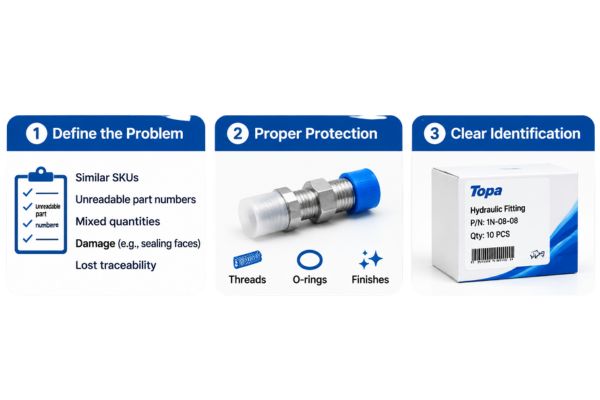
Start with evidence from receiving, storage, picking, resale, and returns. Determine whether errors come from similar SKUs, unreadable part numbers, mixed quantities, damaged sealing faces, lost traceability, or inconsistent channel labels. A branding project should target a named problem rather than beginning with a box design.
Protection must follow the exact product, storage environment, transport route, and required shelf conditions. Threads, sealing faces, O-rings, finishes, and clean internal passages may need different controls. Do not assume that individual bags, caps, oil, desiccants, or sealed cartons are suitable for every material and destination; use controlled product and packaging requirements.
Keep technical identity independent
A branded label cannot prove thread type, sealing method, hose compatibility, material, pressure suitability, or application approval. Preserve the approved part number, revision, traceability fields, and original manufacturer reference where the control system requires them. A private code may support the channel, but it must map unambiguously to the technical product definition.
Choose From Three Practical Levels of Customization
Most programs can begin with one of three levels and expand only when business evidence supports it. The levels are not quality grades; they represent increasing control and recurring management.
Standard identification
Standard supplier labels and packaging can be sufficient when products are sold in original form, SKU turnover is uncertain, order quantities are small, or the distributor needs maximum flexibility. This option minimizes custom artwork and obsolete branded stock. The buyer still needs documented requirements for identity, package quantity, protection, carton mapping, and traceability.
Customer label or fuller private label
A customer-specific label adds internal part numbers, barcodes, language, location, or channel information while retaining a relatively standard package. It can improve receiving and picking without redesigning every packaging layer. A fuller private-label program may add brand marks, artwork systems, bags, inner boxes, cartons, inserts, and coordinated product markings, but it requires tighter version, trademark, stock, and approval control.
Build a Label Hierarchy That Prevents Contradictions
Each packaging level should answer a different question while sharing one product identity. Repeating uncontrolled data across more surfaces creates more opportunities for conflict.
Map product, inner pack, carton, and pallet
Define which data appears on the fitting, individual package, inner pack, master carton, and pallet or shipment label. Product identity and any required traceability should remain consistent through the hierarchy. Higher levels may add quantity, carton number, destination, or handling data without changing the product description.
Useful controlled fields may include:
- approved product and customer part numbers;
- revision or effective artwork version where required;
- connection or size description using the approved naming convention;
- package quantity and unit of measure;
- lot, batch, or other traceability field when applicable;
- barcode type and encoded data definition;
- handling, storage, or regulatory text supported by verified requirements;
- brand and trademark elements approved by their authorized owners.
Test scanning and human reading
A barcode is useful only if it encodes the intended value, scans in the actual workflow, and matches the human-readable text. Test labels at receiving, shelf location, picking, and dispatch with the relevant systems. Do not use color alone to identify similar hydraulic connections, because lighting, printing, color vision, and later packaging changes can make it unreliable.
Match Package Quantities to the Sales Channel
Package quantity should reflect how products are counted, stored, sold, and replenished. One quantity does not fit counter sales, branch transfers, equipment kits, and bulk warehouse orders equally well.
Study real order and picking patterns
Review line quantities, broken-pack frequency, branch demand, shelf capacity, and return behavior by SKU. A smaller pack may simplify counter sales but increase labels and handling. A larger pack may reduce packing work but force frequent opening, recounting, and repacking for low-volume channels.
Keep unit of measure explicit. Distinguish pieces, bags, inner packs, cartons, and kits in item masters, labels, purchase orders, packing lists, and inventory systems. Many apparent shortages are actually conversion or partial-pack errors rather than missing product.
Allow variation without uncontrolled artwork
Use a common approved label template with controlled variable fields when channels need different quantities or languages. Separate fixed artwork from order-specific data so a quantity change does not require redesigning brand elements. The print and approval system must still ensure that variables correspond to the correct SKU and package level.
Compare Value, Cost, and Operational Complexity
Customization creates recurring work as well as a first artwork project. Evaluate the full operating model, including approvals, files, labels, inventory, change control, and obsolescence.
| Program level | Best-supported need | Main controls | Recurring burden | Stop condition |
| Standard labeling | Flexible supply and clear original identity | Package quantity, protection, traceability, carton mapping | Reconcile supplier labels with internal item master | Standard data cannot support receiving or channel requirements |
| Customer label | Internal SKU, barcode, language, or branch workflow | Data map, template, scan test, revision, print verification | Maintain variable data and label stock | Label creates conflicting identity or weak traceability |
| Full private label | Stable branded range and controlled resale experience | Trademark approval, complete artwork hierarchy, product mapping, samples, revisions | Manage files, packaging inventory, minimum runs, and obsolescence | SKU demand or product definition is too unstable |
Build an editable cost model
Include artwork, plates or tooling where applicable, label and package inventory, setup, printing, inspection, handling, storage, write-off risk, and change administration. Compare these with measurable workflow effects such as fewer relabeling steps or clearer channel identification. Do not invent a universal volume threshold, payback, or sales gain.
The owner should be able to change demand, revision frequency, package quantities, and scrap assumptions. If the decision works only under one optimistic forecast, begin with a lower customization level and collect evidence.
Also compare the inventory effect of packaging materials with the fittings they identify. Printed bags, cartons, inserts, and labels may have different purchase quantities, storage needs, and revision exposure than the product. A slow-moving fitting can therefore leave more obsolete artwork stock than expected, while a common template with controlled variable data may serve several SKUs without merging their identities. Record which packaging item belongs to which product revision and who authorizes consumption, rework, or disposal after a change. This turns packaging inventory into a visible part of the decision instead of an ignored marketing expense.
Control Artwork and Product Revisions Together
Artwork approval should occur after the product identity and packaging requirements are stable. Otherwise, attractive files may become obsolete before the first repeat order.
Use one approval object
Create an artwork specification that names the exact SKU scope, package level, dimensions, materials, colors if controlled, fixed text, variable fields, barcode data, language, and source files. Record reviewers for technical identity, brand ownership, regulatory text, operations, and printing as relevant. Approval of a visual PDF alone does not prove that encoded data, package quantity, or product mapping is correct.
Link each released artwork to its product and packaging revisions. When a part number, finish, traceability field, package quantity, legal text, or brand element changes, perform an impact review before reuse. Preserve superseded versions and define the effective point for new labels and packages.
Validate a physical sample
Inspect a representative printed sample for legibility, adhesion, placement, scanning, data accuracy, and interaction with the package. Confirm that artwork does not cover required markings or damage protective features. A sample approves only the defined materials, process, data, and scope; later changes need review according to their impact.
Test the sample through the real sequence, not only on a presentation table. Receive it against a purchase order, scan it into the item master, store it in the intended bin, pick a partial quantity if that is normal, and reconcile the inner pack with the master carton. Ask a user who did not design the artwork to identify the product and package quantity. Record ambiguous wording, poor contrast, barcode failures, label lifting, and conflicts between package levels, then close those issues before release. The test should verify operational accuracy, not predict sales or product performance.
Use a Transparent Hypothetical Decision
Assume a hypothetical distributor sells many hydraulic fitting SKUs through branches and a smaller branded resale channel. Warehouse staff need internal barcodes, but demand for several new sizes is uncertain. No supplier capability, sales increase, or cost saving is assumed.
Select different levels by evidence
For high-turnover, stable SKUs, the team evaluates a customer label using one controlled template, internal part number, barcode, and package quantity aligned with branch picks. For uncertain sizes, it keeps standard identification and applies controlled warehouse location labels rather than buying branded package inventory. A limited resale family enters a separate private-label pilot after trademark and artwork approval.
The pilot checks scan accuracy, receiving time, broken packs, picking questions, label errors, and obsolete stock. One SKU changes package quantity during the trial, so the team updates the variable data and revision record without silently reusing an old carton label. Expansion depends on verified workflow results and stable demand, not on visual preference.
Mistakes and Next-Action Checklist
Customization fails when brand elements move faster than product and data control. The most expensive result may be correctly printed packaging that identifies the wrong component.
Prevent common mistakes
- approving a logo before freezing the SKU-to-product map;
- removing original identity or traceability without an approved replacement;
- printing technical claims, certifications, or suitability statements without evidence;
- encoding a different value from the human-readable label;
- using one package quantity for every channel without demand analysis;
- mixing artwork revisions or consuming obsolete labels without disposition;
- assuming a supplier has a service or trademark permission that was never confirmed.
Start with the operational problem, current item master, channel demand, package quantities, protective requirements, and label hierarchy. Compare standard, customer-label, and full private-label options using editable costs and revision risk. Run a small physical and workflow trial, reconcile every label level to the product, and expand only after the recurring process remains accurate.
Conclusion
Worthwhile packaging customization solves an identification, protection, channel, or repeat-order problem that standard packaging cannot address efficiently. Begin with verified product identity and protective requirements, then choose the lowest customization level that meets the need. Standard labels preserve flexibility; customer labels can improve barcodes and warehouse flow; full private label requires stable demand, approved trademarks, coordinated artwork, and disciplined revision control. Compare package quantities and recurring costs across the actual sales channels, including obsolescence and administration rather than only printing price. Validate physical samples and the complete operational data flow before expansion. A controlled hydraulic fitting packaging and branding program should make the right product easier to recognize and handle without hiding its technical identity.
FAQ
Is a custom logo enough to create a private-label program?
No. A controlled program also needs product mapping, artwork scope, package hierarchy, traceability, approval, and revision rules.
Should every fitting receive an individual branded bag?
Not automatically. Protection, package quantity, demand, channel workflow, and recurring handling should determine the useful packaging level.
Can a customer barcode replace the original part number?
Only when an approved data map preserves unambiguous technical identity and required traceability. The barcode and readable text must agree.
When should artwork be revised?
Review artwork whenever product identity, variable data, package quantity, required text, brand elements, or packaging materials change. The impact determines whether a revision is required.
How should a distributor test customization before scaling?
Use a limited, stable SKU group and verify physical protection, label accuracy, scanning, receiving, picking, channel use, and obsolete-stock risk before expansion.