
NPT one-piece fitting identification requires a group of matching observations, measurements, gauge checks, and hose-side records; outside diameter or a tapered appearance cannot confirm the order alone. The process must distinguish Nominal Pipe Size from Measured Outside Diameter, verify Thread Pitch or TPI and Thread Taper, identify Male or Female Connection, and rule out NPTF, BSPT, and other candidates. It must then add Hose Dash, Fitting Series, and Straight, 45-Degree, or 90-Degree Configuration.
NPT Identity Requires More Than a Tapered Appearance
NPT is identified by a defined combination of thread form, pitch, taper, size designation, and connection behavior. Seeing a thread become narrower toward its end is only an initial clue.

Distinguish NPT, NPTF, and BSPT candidates
NPT and NPTF are related tapered pipe-thread systems, but they should not be treated as identical labels or accepted solely from apparent engagement. Their intended thread and sealing requirements must be checked against applicable controlled data. BSPT is also tapered, yet it belongs to a different thread system; another tapered thread may look close in a photograph or begin to engage before its form, pitch, or taper produces an incorrect fit.
A thread name is not a complete order description. Identify whether sealing is intended through the tapered thread interface and whether the port, component instructions, or application requires a particular sealant or assembly method. Do not confuse that behavior with a flare, cone, flat face, or O-ring seal elsewhere in a hydraulic system.
Use appearance and markings only for preliminary screening
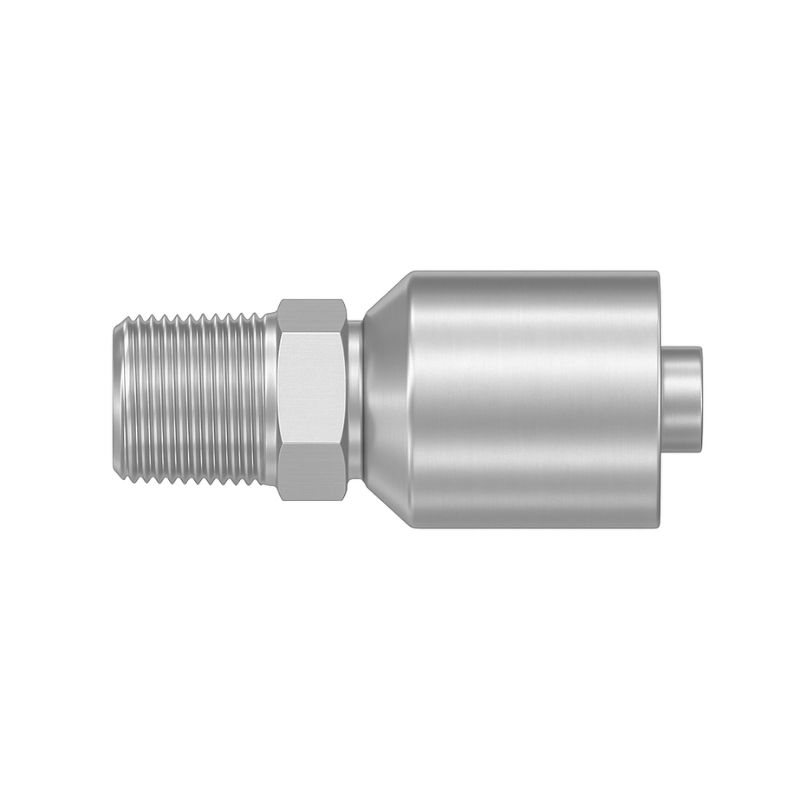
Clear photographs of the complete fitting, thread profile, hose tail, and any markings can narrow the candidate list. An old part number may also lead to a drawing or catalog record. Neither source proves the installed component is original, undamaged, correctly marked, or compatible with the current hose and port.
Preliminary identification means the evidence supports further checking as NPT; final acceptance means all relevant thread, connection, hose, geometry, material, and application requirements agree with controlled reference data. Keep those decisions separate in the inspection record. This prevents a tentative visual guess from becoming an approved purchase description.
Nominal Pipe Size Is Not the Caliper Diameter
Nominal Pipe Size is a standardized designation, not a direct statement of the Measured Outside Diameter at a thread crest. A caliper reading must be compared with authoritative reference data together with pitch and taper before a nominal designation is assigned.
Understand what the measurement represents
On a Male Connection, a caliper can record an outside diameter at a documented axial location; on a Female Connection, access and contact geometry differ, so the relevant inside measurement needs an appropriate method and reference. Because the thread is tapered, a reading taken near the end will not equal one taken farther along the thread. Coating, burrs, wear, damage, dirt, and imperfect jaw placement can also change the result.
The measured value therefore describes a particular part at a particular location, not the name of the size. Record the instrument, location, thread condition, and whether the connection is male or female. Then use verified NPT reference data to evaluate the candidate instead of rounding the caliper result to a familiar pipe size.
Avoid forcing one measurement into a size chart
A diameter can eliminate some candidates, but it cannot confirm Thread Pitch or TPI, Thread Taper, or thread form. Selecting a nominal size from diameter alone may produce an order that appears close yet damages the port, has inadequate engagement, or leaks. If a measurement lies between expected candidates or the thread is damaged, stop and use additional inspection rather than choosing the nearest designation.
Do not derive missing dimensions from an online image, an unidentified sample, or another hydraulic fitting that “looks the same.” This article deliberately provides no universal NPT values; final comparison should use current, authoritative technical data appropriate to the inspection and application.
Each Inspection Tool Confirms a Different Feature
Calipers, pitch gauges, thread gauges, and inspection records are complementary. No single tool proves the complete identity, and every tool must be suitable, serviceable, and used according to its instructions.
Match the tool to the question
| Tool or record | What it can support | What it cannot prove alone |
| Caliper | Measured Outside Diameter or another accessible dimension at a recorded location | Nominal Pipe Size, pitch, taper, or final thread standard |
| Thread pitch gauge | Candidate Thread Pitch or TPI through physical profile comparison | Diameter, taper, full thread form, or application suitability |
| Appropriate thread gauge | Conformance of specified thread features when the correct gauge and method are used | Hose compatibility, fitting series, geometry, or condition outside the gauged feature |
| Inspection record | Traceable combination of observations, tools, values, photos, references, and decision | Accuracy when the underlying measurement or reference is wrong |
Use a pitch gauge only after cleaning the thread without altering it. The gauge leaf should seat consistently across usable threads; do not select the leaf that contacts at one point while gaps remain elsewhere. Record TPI for inch-thread candidates or the applicable pitch expression for other candidates rather than using the words “coarse” or “fine.”
Check taper through a controlled method
Thread Taper should be evaluated using a suitable gauge or a documented measurement method and verified reference. A visual narrowing, changing caliper reading, or partial engagement is not by itself proof of the required taper. The appropriate method depends on whether the connection is male or female and what inspection equipment is available.
Never force an unknown fitting into a port as a thread gauge. Partial engagement can occur between mismatched tapered systems, and added torque can cross-thread or permanently damage both components. If a correct gauge, clean usable thread, or reliable reference is unavailable, record the limitation and keep the result preliminary.
Gender, Hose Side, and Geometry Complete the Fitting Identity
Correctly identifying the pipe thread still does not identify the complete one-piece fitting. The order must include connection gender, hose-side compatibility, and physical configuration.
Record Male or Female Connection precisely
State Male or Female Connection from the actual port end being ordered, not from the mating component or a casual description such as “male hose.” Record relevant swivel behavior, hex or wrench features, and any sealing or orientation detail that affects installation. A female port on the machine does not mean the removed hose fitting should be described as female.
Confirm thread condition at the same time. Flattened crests, torn threads, corrosion, contamination, cross-threading, or previous over-tightening may distort measurements and make the sample unsuitable for final gauging. A damaged sample can still supply clues, but the record must show why further reference or a sound mating component is needed.

Separate Hose Dash from the port designation
Hose Dash is the nominal hose-side size and must not be copied from Nominal Pipe Size or a port-dash description. Confirm the hose manufacturer, Hose Series, Hose Construction, reinforcement, and dash, then identify the approved Fitting Series, stem, ferrule, Crimping Machine, Die Set, and current crimp data. Equal dash values do not prove hose and fitting compatibility.
Also specify Straight, 45-Degree, or 90-Degree Configuration. For elbows, record the hose-tail direction, orientation, clearance, and swivel or fixed behavior where relevant. The right NPT thread on the wrong angle can make installation impossible or force a hose into excessive bend, twist, abrasion, or movement interference.
Follow a Step-by-Step Identification Process
A controlled sequence preserves evidence and prevents early assumptions from shaping later measurements. Complete the thread decision before translating it into a purchasing description, but retain the hose side and geometry throughout the inspection.
Stage 1: make safe, clean, and document
Before removal, stop the equipment, isolate the hydraulic circuit, release pressure and stored energy, secure raised or suspended loads, and follow applicable lockout and equipment-manufacturer instructions. Never touch a suspected injection leak or loosen a fitting to “see whether pressure remains.” Mark hose orientation and capture installation clearance before moving the assembly if those details could be lost.
After safe removal, protect the port and clean the sample using a method that does not reshape the threads. Photograph the entire fitting, connection end, hose side, markings, and damage. Record the equipment position, mating-port information, old number as an unverified lead, Male or Female Connection, and Straight, 45-Degree, or 90-Degree Configuration.
At this stage, collect:
- equipment and hydraulic position, mating component, and safe-removal record;
- complete-fitting, thread, hose-tail, marking, and orientation photographs;
- connection gender, visible sealing behavior, thread condition, and configuration;
- hose layline, manufacturer, series, construction, Hose Dash, and current fitting series if known;
- measuring tools, reference documents, inspector, and traceability identifier.
Stage 2: measure independent thread features
Measure the accessible diameter with a suitable caliper and record the exact location and condition. Check Thread Pitch or TPI with an appropriate pitch gauge, then evaluate Thread Taper with the correct gauge or documented method. Do not adjust a measurement simply because it conflicts with the expected NPT candidate; the conflict is evidence that the assumption, sample, or method needs review.
Compare diameter, pitch or TPI, taper, gender, and thread form with current authoritative references. Deliberately compare plausible alternatives, including NPTF and BSPT, rather than stopping when one NPT feature appears to match. If the sample is worn or damaged, use a verified drawing, sound port data, suitable gauge results, or other controlled evidence before final acceptance.
Stage 3: confirm the whole fitting and decision status.
Once the thread candidate is supported, confirm Nominal Pipe Size from the verified reference, then add Hose Dash, Fitting Series, ferrule, configuration, material, finish, and critical dimensions. Review application pressure, temperature, fluid, environment, and routing; the lowest-rated component limits the complete assembly. Confirm the current hose and crimp procedure rather than assuming one-piece construction guarantees assembly suitability.
Mark the result as accepted only when every required field has evidence. If the thread is likely NPT but taper gauging is unavailable, or the hose series cannot be identified, state the unresolved point and keep the record preliminary. A controlled incomplete result is safer than a complete-looking order built on guesses.
Thread Sealant Has a Narrow, Defined Role
Thread sealant can support a correctly identified and prepared threaded joint when the applicable instructions permit it. It cannot change thread geometry or restore damaged engagement.
Follow the specified product and application method
Use only a sealant compatible with the component instructions, hydraulic fluid, temperature, and system requirements. Apply it by the specified method so excess material does not enter the hydraulic circuit or interfere with intended engagement. Sealant selection and application are separate from thread identification.
Do not treat leakage after assembly as automatic proof that more sealant is needed. The cause may be incorrect thread identity, damaged surfaces, contamination, inadequate or excessive engagement, component distortion, or another leak path. Depressurize and inspect safely rather than tightening or adding sealant without diagnosis.
Know what sealant cannot correct
Thread sealant cannot repair a Wrong Thread Standard, Wrong Pitch, Incorrect Taper, Cross-Threading, or Damaged Threads. It also cannot correct an incorrect nominal size, a male/female ordering error, or a poor mating port. Using sealant to hide mismatch may delay visible leakage while leaving unreliable engagement and further port damage.
Reject a fitting that requires force to start, binds unexpectedly, or shows abnormal engagement. Do not use temporary installation as an identification method. Return to the measurement and gauge record, examine the mating component, and resolve the discrepancy through controlled technical data.
Prevent Order Errors With a Final Information Checklist
Most bad orders preserve only a thread label and omit the evidence behind it. The purchasing description should allow another qualified person to verify the candidate without handling the original sample.
Review common failure points
Common errors include treating Measured Outside Diameter as Nominal Pipe Size, calling every tapered thread NPT, estimating TPI from a photo, and copying an old number without checking revision or application. Other mistakes are describing the mating port’s gender instead of the fitting, equating Hose Dash with port size, and omitting elbow orientation. Sealant is then misused to compensate for a mismatch that should have been stopped at inspection.
Before order approval, confirm:
- accepted thread standard and decision status, Nominal Pipe Size, Measured Outside Diameter with location, Thread Pitch or TPI, and Thread Taper evidence;
- Male or Female Connection, thread condition, sealing method, mating-port identity, and applicable reference;
- Hose Dash, Hose Manufacturer, Hose Series, Hose Construction, Fitting Series, ferrule, and current crimp data;
- Straight, 45-Degree, or 90-Degree Configuration, orientation, swivel behavior, clearance, and critical dimensions;
- material, finish, pressure, fluid, temperature, application, photographs, gauge record, and approval traceability.
Conclusion
Reliable identification comes from several independent features agreeing, not from a familiar appearance or one caliper reading. Preserve the installation evidence, distinguish Nominal Pipe Size from Measured Outside Diameter, and verify Thread Pitch or TPI, Thread Taper, gender, thread condition, and sealing behavior with suitable tools and current references. Deliberately rule out NPTF, BSPT, and other candidates before final acceptance. Then complete the order with Hose Dash, Fitting Series, ferrule, Straight, 45-Degree, or 90-Degree Configuration, material, application, and controlled crimp data. Never force engagement or use sealant to conceal mismatch. Keep the inspection record with the approved order for future verification. A documented NPT one-piece fitting identification process prevents bad orders while protecting the port and the finished hose assembly.
Frequently Asked Questions
Can a mating port be used to identify an unknown fitting?
It can provide supporting evidence when the port identity is verified and both components are undamaged. Do not test an uncertain candidate by forcing it into the port or treating partial engagement as proof.
What if a pitch gauge fits more than one candidate?
Use diameter, taper, thread form, gender, and authoritative references to resolve the candidates. A pitch match alone cannot establish the final standard.
Should coating be removed before measuring a thread?
Do not remove or alter coating unless an approved inspection procedure requires it. Record the surface condition and account for it through the applicable measurement method and reference.
Can a replacement be ordered from the machine model alone?
No, equipment models may have production changes, optional components, imported attachments, or prior repairs. Verify the installed connection, hose side, configuration, and application data.
Is a thread ring or plug gauge enough for final order approval?
No, a correct gauge result addresses specified thread features but not Hose Dash, Fitting Series, configuration, material, or application suitability. The complete fitting record still needs approval.