
NPTF and NPSM threads are not interchangeable simply because both use American pipe-thread dimensions. An NPTF connection has tapered threads intended to create a pressure-tight dryseal thread interface, while an NPSM hose connection uses straight threads and normally seals through a mechanical seat rather than the threads. Choosing the right one-piece fitting therefore requires confirmation of the mating port, thread taper, pitch, gender, seat, and sealing method—not just nominal pipe size.
NPTF and NPSM Solve Different Connection Problems
NPTF uses a tapered dryseal thread
NPTF means National Pipe Taper Fuel, commonly described as a dryseal tapered pipe thread. Its male and female threads taper, so tightening produces increasing interference between the thread forms. The dryseal form is designed to reduce the spiral leakage path by controlling contact at the thread crests and roots, although the applicable equipment or component instructions may still require a compatible sealant or lubricant.
The connection is therefore made and sealed primarily at the tapered thread interface. Proper engagement matters: insufficient tightening may leave a leak path, while excessive tightening can distort or crack a port, damage threads, or make later removal difficult. An NPTF one-piece hose fitting must also match the hose series and crimp specification; correct port threads do not establish hose-end compatibility.
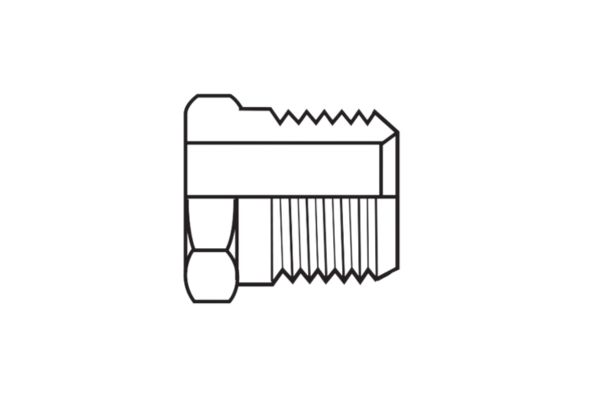
NPSM uses a straight thread and a seat
NPSM means National Pipe Straight Mechanical. In hydraulic hose connections, a female NPSM swivel commonly mates with a male pipe-thread adapter or component that provides the correct sealing seat. The straight threads pull the connection together, but the fluid seal is normally created where the internal mechanical seat contacts the mating nose—not along the thread flanks.
This division of labor is the central difference: NPSM threads retain and load the joint, while the seat seals it. A thread gauge may show that the diameter and pitch are plausible, yet the connection can still leak if the male nose, female seat geometry, surface condition, or engagement length is wrong. Never treat an unidentified straight pipe thread as NPSM until the sealing structure has also been verified.
NPTF vs NPSM: The Differences That Control Selection
Compare taper, movement, and sealing location
NPTF and NPSM can share nominal pipe sizes and thread pitches, which explains why they are often confused at a busy assembly bench. Their thread diameters relate to pipe-thread conventions rather than directly matching the stated nominal size. The decisive features are taper versus straight form, the presence and geometry of a sealing seat, the mating component, and the specified assembly method.
| Selection point | NPTF | NPSM hose connection |
|---|---|---|
| Thread form | Tapered dryseal pipe thread | Straight mechanical pipe thread |
| Primary sealing location | Interference within the threaded joint | Mechanical seat inside the connection |
| Common hose-end form | Male rigid pipe end; female versions also exist | Female swivel with internal seat |
| Rotation during tightening | Fitting or mating component turns into tapered port | Swivel nut turns while hose stem can remain oriented |
| Main identification evidence | Taper, diameter, TPI, gender, thread form | Straight diameter, TPI, gender, internal seat, mating nose |
| Typical selection reason | Direct connection to a specified tapered pipe port | Serviceable swivel connection where the specified male end provides the matching seat |
| Frequent error | Confusing NPTF with NPT or another tapered thread | Assuming any straight female pipe thread will seal on any male pipe end |
An NPSM swivel can simplify installation because tightening the nut does not require rotating the entire hose. That can help avoid hose twist and preserve elbow orientation. It does not make NPSM universally preferable: if the equipment has a specified NPTF port and no suitable seated adapter, the connection requirements are different.

Similar names do not prove interchangeability
NPTF should not be collapsed into the broader label “NPT” during final selection. NPT and NPTF are both tapered pipe-thread families, but their defined thread forms and sealing expectations are not identical. A connection may appear to assemble, yet appearance and initial engagement do not prove that the joint conforms to the required standard or will seal reliably under pressure and temperature cycling.
NPSM must also be separated from NPSF, NPSI, BSPP, metric parallel, and other straight-thread systems. Comparable outside diameters can occur across different standards, while pitch, flank angle, seat geometry, and sealing method differ. Use the exact designation shown in current port, adapter, equipment, or fitting documentation whenever it is available.
Identify the Existing Connection Before Choosing a Fitting
Measure the thread instead of judging the photograph
A clear photograph helps distinguish a male rigid end from a female swivel and reveals whether a cone or seat may be present. It cannot reliably determine thread standard or final part number. Dirt, wear, camera angle, coatings, and the small amount of taper involved can make NPTF and NPSM look deceptively similar.
Use a suitable caliper to measure the male outside diameter or female inside diameter without damaging the thread. Check pitch with a thread-pitch gauge and record threads per inch. For a male thread, compare diameters at separated points along the thread: a meaningful change supports a tapered form, while a nearly constant diameter supports a straight form, subject to measurement access, tolerances, and wear.
Inspect the seat and mating component as a pair
After the basic thread check, inspect beyond the first thread. A female NPSM swivel should have the intended internal seat, and its mating male component must present the corresponding nose or seat in serviceable condition. Scratches, dents, corrosion, embedded debris, or mismatched geometry at that interface can cause leakage even when the nut threads smoothly onto the male end.
For an NPTF connection, verify that the mating port is the specified compatible tapered thread and that adequate engagement is possible without bottoming or excessive force. Do not use thread sealant as evidence that two unidentified threads are compatible. Sealant cannot correct the wrong pitch, thread form, standard, damaged port, or missing mechanical seat.
Choose the Thread From the Port and Installation Needs
Select NPTF only for a confirmed tapered-thread interface
Choose an NPTF hose-end fitting when the mating component calls for that thread and the application permits the required installation method. Confirm nominal pipe size, gender, pitch, port condition, material compatibility, pressure and temperature suitability, engagement requirements, and any specified sealant or lubricant. Follow the component or equipment manufacturer’s tightening method because a universal turn count or torque value is not valid for every size, material, coating, port design, and reuse condition.
A rigid male NPTF hose end may be awkward where the completed hose cannot rotate freely. Screwing it into a port can twist the hose, disturb elbow orientation, or create routing stress unless assembly order and available movement are controlled. In those situations, a specified adapter or swivel connection may be the sounder design, but it must be approved for the equipment rather than improvised at the repair bench.
Select NPSM when the complete seated joint is specified
Choose an NPSM female swivel when the mating male end provides the correct seat and the connection is specified for that interface. The swivel is useful where installation access, hose orientation, or future disconnection makes rotation of the entire assembly undesirable. Verify that the nut can engage fully without cross-threading and that the seat contacts correctly before the nut or another feature bottoms out.
Do not select NPSM merely because its nut threads onto a male NPTF component. Some NPSM swivel connections are designed to mate with particular male pipe ends, but successful thread engagement alone does not verify the seat, pressure rating, or manufacturer-approved combination. Check the fitting and adapter data for the actual pairing, especially when mixing brands or replacing an unidentified legacy assembly.
The Port Thread Is Only Half of a One-Piece Fitting Selection
Match the hose tail to the exact hose construction
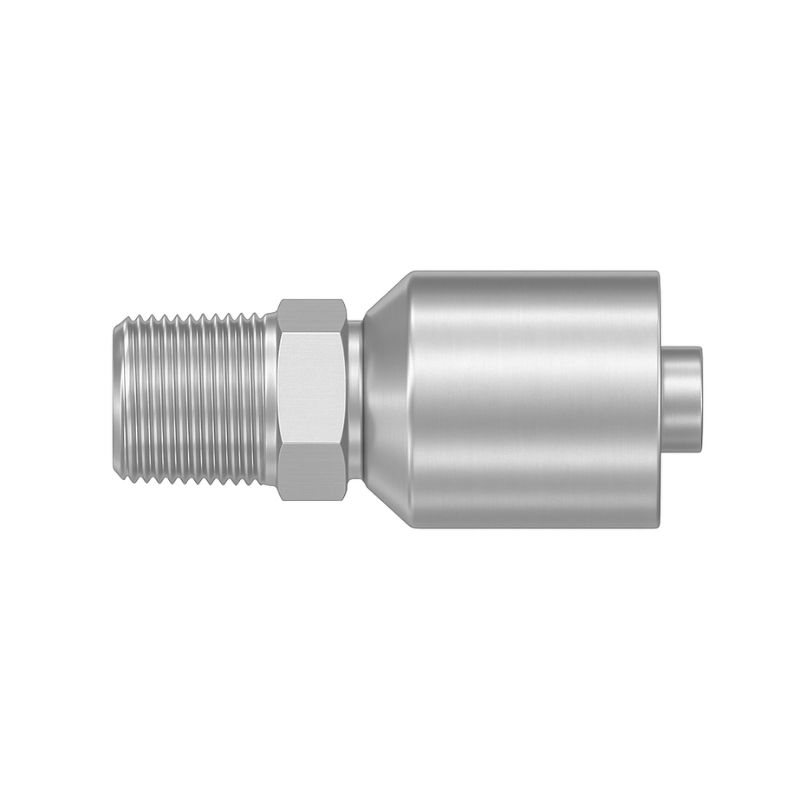
Once the connection end is identified, confirm the other side of the one-piece fitting: the stem and retained ferrule that attach to the hose. The fitting series must be approved for the specific hose manufacturer, series, construction, and size. Equal dash size does not guarantee equal outside diameter, reinforcement response, stem fit, ferrule compression, or crimp performance.
Obtain the current crimp data for that exact combination. It may define hose preparation, skive or no-skive procedure, insertion depth, die selection, crimp diameter and tolerance, measurement location, and inspection requirements. Neither NPTF nor NPSM changes these hose-end rules, and there is no universal crimp diameter that applies to every one-piece fitting of a nominal size.
Keep thread sealing separate from hose retention
The connection end and crimped hose end perform different jobs and fail in different ways. Leakage at an NPTF thread can result from incompatible threads, damaged thread form, poor engagement, an unsuitable sealing procedure, or a cracked port. Leakage at an NPSM connection more often directs attention to the mechanical seat, alignment, contamination, mating nose, or tightening procedure.
By contrast, leakage between the hose and ferrule, fitting pull-out, or a rupture beside the ferrule requires review of hose compatibility, insertion, preparation, crimp dimensions, tooling, and routing loads. Increasing the crimp cannot repair a thread or seat leak. Applying more sealant cannot repair a wrong crimp or damaged hose reinforcement.
Common Misidentification Errors and Their Consequences
A connection that screws together may still be wrong
The most dangerous shortcut is using successful hand engagement as the acceptance test. Different pipe-thread forms can start together for several turns, and a straight female nut may travel along a tapered male thread. That does not establish the intended load path or sealing contact, and forcing the connection can damage both parts while hiding the original identification evidence.
Another error is copying only the old fitting’s visible dimensions. The removed part may already be an incorrect substitution, its seat may be worn, or its thread may have been deformed through over-tightening. Identify the equipment port and mating geometry independently, then compare the old component against current technical data before reproducing the assembly.
Wrong selection creates more than a visible drip
A mismatched connection may leak immediately, loosen during vibration, damage the port, or fail after pressure and temperature cycles. Escaping hydraulic fluid can cause injection injuries, contaminate products or soil, create slip and fire hazards, and remove enough fluid to damage equipment. Hose twist introduced during installation can also shorten assembly life away from the thread itself.
Before inspection or replacement, shut the equipment down, isolate it, release hydraulic pressure and stored energy, and follow the equipment and component manufacturers’ safety procedures. Never use a hand to search for a pinhole leak. If testing is required, use a defined test procedure, suitable guarded equipment, controlled access, and stated acceptance criteria.
A Practical NPTF-or-NPSM Decision Workflow
Make each selection answer a verifiable question
The fastest reliable decision is a short chain of evidence, not a guess based on the old nut. Stop if any answer conflicts with the port or component documentation. For safety-critical or unidentified equipment, refer the decision to the responsible technical authority rather than creating a hybrid connection in the field.
- Establish whether the required fitting is male, female, rigid, or swivel, and record the hose orientation and available installation movement.
- Measure thread diameter and TPI, then determine whether the thread is tapered or straight using appropriate gauges, dimensional data, and multiple-point measurements.
- Locate the sealing feature: tapered thread interface for NPTF, or the specified mechanical seat and mating nose for an NPSM hose connection.
- Confirm the exact standard and nominal size from current fitting, adapter, port, or equipment data; do not stop at the generic description “pipe thread.”
- Check material, finish, fluid, pressure, impulse, temperature, vibration, routing, and applicable safety requirements.
- Match the one-piece fitting series to the exact hose series and size, then obtain the applicable crimp and inspection data.
- Make a controlled sample or first-piece assembly where required, inspect thread and seat condition, verify crimp dimensions, and retain the identification record.
Prepare enough information for technical confirmation
For a replacement or quotation, provide the hose manufacturer and series, hose size, fitting style, orientation, and existing part number if legible. Add clear photographs of the complete fitting, thread, and sealing area; measured thread diameter; TPI; taper or straight-thread finding; male or female form; and seat details. Include the mating port or adapter identification because a loose hose end does not tell the complete sealing story.
Choose the Sealing System, Not Just the Thread Name
The correct choice between an NPTF vs NPSM one-piece fitting starts with the mating connection. Use NPTF for a confirmed compatible tapered dryseal interface and NPSM for a specified straight-thread mechanical connection with the correct mating seat. Then verify hose series, fitting series, application limits, installation method, and current crimp data; a correct thread on an incompatible hose assembly is still the wrong part.
Frequently Asked Questions
Can an NPSM female swivel be installed on any male NPTF thread of the same size?
No; thread engagement does not prove that the internal NPSM seat matches the male nose or that the complete pairing is approved. Verify the fitting and adapter geometry, ratings, and manufacturer data.
Do NPTF threads always work without sealant?
Not necessarily; “dryseal” describes the thread form, not a universal installation instruction. Use only the sealant, lubricant, and tightening procedure specified for the component, fluid, material, and application.
Can I distinguish NPTF from NPSM with a pitch gauge alone?
No; they may share TPI at the same nominal size. You must also establish taper versus straight form, gender, diameter, sealing feature, and mating connection.
Is an NPSM swivel automatically better for vibration?
No; a swivel can prevent installation twist, but vibration suitability depends on the complete fitting, hose, routing, support, mating seat, pressure cycles, and application requirements. A swivel nut is not a live rotary joint unless specifically designed as one.
Can I reuse an NPTF port after removing the old fitting?
Reuse depends on the applicable component instructions and the condition and dimensions of the port. Inspect for deformation, cracking, galling, corrosion, contamination, and damaged threads, and replace or repair only through an authorized procedure.