Threads play a crucial role in industrial applications, providing secure and leak-proof connections in various systems. Among the different types of threads, the National Pipe Thread (NPT) stands out due to its widespread use and reliability. This comprehensive guide aims to offer an in-depth understanding of NPT threads, from their design and specifications to their applications and best practices for installation and maintenance.
NPT identifies the American National Standard Taper Pipe Thread, commonly described as National Pipe Taper. It is an inch-based tapered thread used on pipes, fittings, and equipment connections.
An NPT designation identifies the nominal pipe size and thread pitch, not the measured diameter of the threaded end. For example, 1/4-18 NPT means a nominal 1/4-inch pipe thread with 18 threads per inch.
The taper produces progressively tighter engagement during assembly. For a pressure-tight NPT connection, use a suitable thread sealant and follow the applicable component installation instructions.
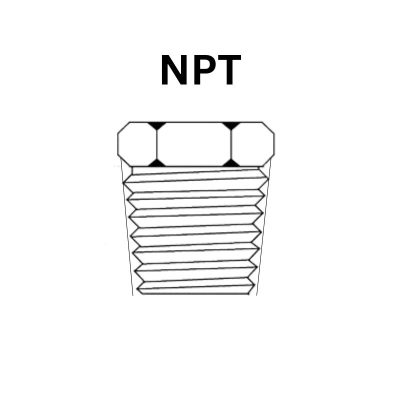
NPT dimensions and gauging requirements are covered by ASME B1.20.1. The thread has a 60° profile and a diameter taper of 1 in 16.
On an external NPT thread, the diameter becomes smaller toward the free end and larger toward the fitting body. The matching internal thread is also tapered.
A 1:16 diameter taper means the diameter changes by one unit over sixteen units of axial distance. It is not a 1:16 change in radius.
The corresponding half-angle is approximately 1°47′, measured between the tapered surface and the thread axis. This angle is different from the 60° thread-profile angle.
The sealing mechanism of NPT threads is primarily mechanical. As the male and female threads are tightened, the taper forces the thread crests and roots into closer contact. This close fit restricts the path for fluid or gas to escape, effectively sealing the connection. The reliability of this seal can be further enhanced by using thread sealants or tapes, which fill in any microscopic gaps between the threads and add an extra layer of protection against leaks.
NPT threads are ubiquitous in various industries due to their robustness and ease of use. Some common applications include:
Oil and Gas: NPT threads are extensively used in pipelines and refineries, where their ability to provide leak-proof connections is critical.
Plumbing: In both residential and commercial plumbing systems, NPT threads ensure secure connections for water supply and waste removal.
Hydraulic Systems: The high-pressure environments of hydraulic systems rely on the dependable seal provided by NPT threads.
Fire Protection: Fire sprinkler systems use NPT threads to ensure that water can be reliably delivered in case of an emergency.
NPT threads are characterized by their tapered design, which is critical for creating a tight seal. The taper causes the threads to become progressively tighter as they are screwed together, enhancing the seal and preventing leaks. The threads are cut into both male and female components, with the male thread being the external thread and the female thread being the internal thread.
TPI refers to the number of thread peaks per inch of length. This measurement is crucial for determining the thread’s fineness or coarseness. A higher TPI indicates finer threads, while a lower TPI signifies coarser threads. In NPT threads, TPI helps ensure that the threads fit correctly and securely.
Pitch
The pitch of a thread is the distance between corresponding points on adjacent threads. It is typically measured in millimeters for metric threads or as a reciprocal of TPI for imperial threads. Pitch is vital for ensuring that threads align properly when engaged.
Flank
The flank is the surface between the crest and root of a thread. It plays a crucial role in the strength and load distribution of the thread. Properly designed flanks ensure that the threads can handle the stresses and loads they are subjected to without failing.
Crest
The crest is the top surface of the thread. It is the highest point on the thread profile. The crests of NPT threads, when engaged, make initial contact and begin the sealing process as the threads are tightened.
Root
The root is the bottom surface of the thread. It is the lowest point in the thread profile, opposite the crest. The root’s shape and smoothness are critical for preventing stress concentrations that could lead to thread failure.

Tolerance and fit are critical aspects of NPT thread design. These parameters ensure that threads manufactured by different producers are compatible and can be used interchangeably. Tolerance refers to the permissible variation in thread dimensions, while fit describes how tightly the male and female threads engage with each other. The American National Standards Institute (ANSI) and the American Society of Mechanical Engineers (ASME) provide detailed specifications for NPT threads under the ANSI/ASME B1.20.1 standard.
The standard specifies:
Thread Angle: 60 degrees
Pitch Diameter: The average diameter where the thread thickness equals the space between the threads
Minor and Major Diameters: The smallest and largest diameters of the thread, respectively
As matching NPT threads are tightened, the taper increases contact and engagement between their flanks. However, this does not guarantee that every potential leakage path at the crests and roots is closed.
A suitable sealant is therefore part of a pressure-tight NPT assembly. It fills leakage paths and may also provide lubrication, depending on the product. Select it for the fluid, temperature, component materials, and installation requirements.
PTFE tape is one option, but it is not the only option and is not suitable for every application. Liquid or paste sealants may be specified instead. Follow the fitting and sealant instructions, including application location, quantity, and any curing requirements.
More tightening does not necessarily produce a better connection. Excessive engagement can damage the threads or overstress the female component.
Use the applicable assembly procedure rather than one universal torque or turn count. Do not use additional sealant to compensate for a mismatched thread or visibly damaged component.
An adapter may have NPT at one end and JIC, ORB, or another connection at the other. Apply the sealing method required by each end. A sealant requirement at the NPT end does not mean that sealant belongs on every thread of the adapter.
NPTF is a Dryseal thread covered by a separate standard. Its controlled crest and root geometry is intended to close leakage paths through thread contact.
Do not interpret “Dryseal” as a universal instruction to assemble without sealant. Follow the component manufacturer’s instructions for sealing and lubrication, particularly where material pairing or reassembly affects performance.
NPT and NPTF should be identified from the specification and appropriate inspection requirements rather than appearance alone. A mixed connection does not establish Dryseal performance.
NPSM is a straight pipe-thread system used for mechanical connections. The actual sealing feature depends on the connection design and may involve a mating seat or other specified element.
Do not connect an unidentified straight female thread to an NPT male simply because it starts to engage. Check the full connection geometry.
NPT and BSP threads differ in geometry and dimensional requirements. NPT uses a 60° thread profile, while BSP uses a 55° profile.
BSPT/ISO 7 thread-sealing connections and BSPP parallel-thread connections also have distinct requirements. Some nominal sizes share a TPI value, so pitch alone cannot establish compatibility.
System | Thread Form | Selection Requirement |
NPT | Tapered | Correct size, pitch, sealant, and assembly |
NPTF | Tapered Dryseal | Specified thread geometry and manufacturer procedure |
NPSM | Straight | Complete mechanical connection and sealing feature |
BSPT / ISO 7 | Defined taper/parallel combinations | Correct ISO 7 designation and mating combination |
BSPP | Parallel | Specified seat, washer, O-ring, or other sealing feature |
Accurate measurement and identification of NPT threads are crucial to ensuring a proper fit and optimal function in piping systems. Utilizing the correct tools and techniques allows for the precise verification of thread specifications, which is essential for maintaining the integrity and reliability of threaded connections.
Thread Gauges:
Function: Thread gauges are precision instruments designed to measure the thread pitch and taper. They come in various types, such as plug gauges for internal threads and ring gauges for external threads.
Usage: To use a thread gauge, insert the gauge into the thread or over the threaded area and check for a match. The gauge should fit snugly without excessive force. This process helps confirm that the thread pitch and taper conform to NPT standards.
Calipers:
Function: Calipers, including digital and vernier types, are versatile measuring tools used to measure the diameter and length of threads accurately. They can measure both the internal and external dimensions of the threads.
Usage: Place the caliper jaws on the thread and adjust until they touch the crests of the threads. For internal measurements, insert the caliper jaws into the female thread. For external measurements, place the jaws around the male thread. Calipers can measure major, minor, and pitch diameters, as well as the thread length.
Inspect the cleaned connection and determine whether it is male or female. Look for taper, but treat appearance as a preliminary clue.
For a male thread, caliper readings at separated axial positions can help distinguish taper from a straight thread. This is an identification check, not a substitute for standard taper inspection.
Use an inch thread-pitch gauge and compare several threads. Record the TPI value, then check it against the suspected nominal size.
The pitch gauge does not verify every aspect of thread form, tolerance, or effective engagement.
Measure an undamaged external thread with the caliper square to its axis. Record where the reading was taken.
For an internal thread, an opening measurement is only a preliminary reference. Do not compare it directly with a chart column intended for male thread diameter.
Use markings, drawings, or catalog references to support identification. Do not force an unknown fitting into a port as a measurement method.
Ordinary calipers do not directly verify NPT pitch diameter. Acceptance inspection uses the specified gauges and procedures.
NPT L1 plug gauges are used for internal threads and L1 ring gauges for external threads. Results are interpreted relative to the defined reference plane, not simply by whether the gauge feels snug.
L1 gauging does not inspect every feature throughout the wrench-engagement length. Supplemental checks may be required by the standard and inspection plan.
Despite the inherent reliability and effectiveness of NPT threaded connections, various issues can arise that compromise their performance. Understanding these potential problems and implementing regular inspection and maintenance practices can help ensure the longevity and functionality of NPT threads.
Cause: Leaks in NPT threaded connections are often the result of improper installation, damaged threads, or inadequate use of thread sealant. Over-tightening or under-tightening the threads can also lead to leaks.
Prevention:
Ensure threads are clean and free from debris before assembly.
Apply an appropriate thread sealant or Teflon tape to fill any gaps.
Tighten the threads according to manufacturer specifications, avoiding excessive force.
Inspect threads for damage before use, and replace any components with visible wear or deformation.
Cause: Cross-threading occurs when the threads of the male and female components are not properly aligned during assembly. This misalignment can damage the threads and compromise the seal.
Prevention:
Start threading by hand to ensure proper alignment before using tools.
Avoid forcing the threads if resistance is encountered; back off and realign.
Use thread guides or alignment tools if available to assist with proper engagement.
Cause: Galling is a condition where metal surfaces weld together under pressure, causing the threads to seize and potentially strip or break. This is more common with stainless steel and other high-strength materials.
Prevention:
Apply lubricants or anti-seize compounds to reduce friction during assembly.
Use proper installation techniques, avoiding over-tightening.
Consider using materials or coatings less prone to galling for high-stress applications.
Understanding NPT threads is fundamental for professionals working with industrial piping systems. These threads are integral to ensuring secure, leak-proof connections in a wide range of applications, from plumbing and hydraulic systems to oil and gas pipelines and fire protection networks. Armed with the knowledge from this comprehensive guide, readers are well-prepared to utilize NPT threads effectively in their projects, ensuring long-lasting and dependable performance. We encourage readers to share this post with colleagues and industry peers to spread valuable knowledge about NPT threads. If you have any questions or need further information, please leave a comment or reach out to us.
NPT stands for National Pipe Thread, a U.S. standard for tapered threads used on threaded pipes and fittings.
NPT threads create a seal through their tapered design, which causes the threads to tighten and wedge together as they are screwed in, forming a mechanical seal that prevents leaks.
NPTF (National Pipe Taper Fuel) threads are designed to provide a dry seal without the need for sealants, thanks to their modified thread form. NPT threads typically require a sealant for a leak-proof connection.
NPT threads can be identified by their taper and measured using thread gauges and calipers to check for the correct taper angle, pitch, and diameter as specified in ANSI/ASME B1.20.1 standards.
Leaks in NPT threaded connections can be caused by improper installation, damaged threads, or insufficient use of thread sealant. Ensuring proper cleaning, alignment, and tightening of threads can help prevent leaks.
No. Dryseal describes the thread design. Actual sealing and lubrication requirements depend on the product and manufacturer’s instructions.