
Imagine you are standing next to an industrial tractor during peak harvest season. A hydraulic line bursts, spraying oil across the hot engine block, instantly halting operations and costing thousands of dollars in unscheduled downtime. This high-stakes crisis demands a rapid fix, but rushing the assembly process without inspecting the incoming components usually leads to a repeat failure within hours. By implementing a standardized inspection framework prior to connecting new hoses, you can eliminate early seal extrusion and ensure long-term operational safety in the most demanding environments.
Why Is Pre-Installation Inspection Critical For Hydraulic Hoses?
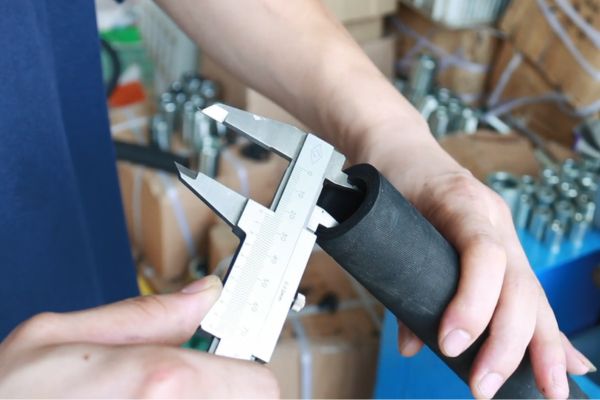
Pre-installation inspection is critical because it identifies manufacturing defects, shipping damages, and specification mismatches before the component is pressurized under high load. Catching these hidden flaws early prevents premature component failure and safeguards personnel from dangerous fluid injection injuries. When you take the time to evaluate the assembly before installation, you establish a reliable technical baseline for the machine’s entire fluid power circuit.
What Costly Breakdown Risks Do Field Teams Avoid?
Operational teams avoid sudden blowout risks, repetitive labor costs, and severe environmental contamination penalties by inspecting components thoroughly before deployment.
- Prevention of high-pressure fluid injection accidents that threaten shop technicians.
- Elimination of repeated teardown cycles caused by installing defective components.
- Reduction of oil cleanup costs and expensive machinery downtime during peak production windows.
The Structural Role Of Visual Inspections
Visual inspections serve as your first line of defense against sub-assembly quality variations that bypass automated manufacturing checks.
- Identification of internal tube cracks or blistering caused by improper storage conditions.
- Detection of surface oxidation on carbon steel fitting shells before deployment.
- Verification of permanent crimp line markers to ensure correct sleeve positioning.
Taking these steps ensures your repair matches industrial equipment standards perfectly. By carefully verifying these exterior markers, you gain absolute certainty that the underlying reinforcement layer remains structurally intact and ready for high-vibration environments.
| Inspection Point | Primary Threat Detected | Action Required |
| Component Shell | Micro-cracks and material flaws | Scrap the affected fitting immediately |
| Inner Tube | Internal scaling and structural blistering | Flush the hose line or replace assembly |
| Crimp Sleeve | Uneven compression or sleeve slippage | Recrimp according to manufacturer charts |
How Do You Verify Hose Length And Bend Radius Specs?
You verify hose length and bend radius specs by measuring the assembly in a flat layout and comparing its physical parameters against the machine’s dynamic movement envelope. Accurate measurements must account for structural contraction under full system pressure to prevent the fitting from pulling out of its terminal bracket. Ensuring correct routing configuration prevents early mechanical binding during tight operational turns.
Can Wrong Hose Length Cause Failure Under Pressure?
Yes, an incorrectly sized hose will quickly experience structural failure because hydraulic lines naturally contract up to four percent when full pressure is applied.
- Terminal fitting pull-out caused by excessive linear contraction under load spikes.
- Extreme structural strain concentrated at the hose-to-coupling transition zone.
- Accelerated wire braid fatigue resulting from continuous mechanical tensioning.
Leaving a proper physical buffer ensures the line moves naturally without stress.
Verifying Minimum Bend Radius To Prevent Kinks
Verifying the minimum bend radius prevents inner tube restriction and localized wire braid fatigue near high-vibration joint areas.
- Kinking of the inner polymer liner that restricts standard volumetric oil flow.
- Separation of the outer rubber cover from the underlying steel reinforcement layers.
- Concentration of thermal energy at the point of maximum fluid restriction.
Using a proper layout template keeps your system running within safe design parameters. Maintaining this minimum radius preserves the volumetric flow rate and prevents early thermal breakdown of the inner core.
| Measurement Parameter | Standard Operational Limit | Adjustment Guideline |
| Dynamic Slack Allowance | 5% to 8% of total physical length | Add length if lines stretch tight at maximum travel |
| Minimum Bend Radius | Matches specific SAE J517 guidelines | Increase routing loop size if kink lines form |
| Fitting Insertion Depth | Full seating against the internal stop | Verify insertion depth marks prior to final swaging |
What Inside Contamination Risks Should Repair Teams Check?
Repair teams must check for internal contamination risks by looking for cutting debris, rubber dust, polymer shavings, and storage moisture hidden inside the inner core. These particulate contaminants migrate rapidly into sensitive valve spools, causing catastrophic component scoring and system-wide pressure losses. Prior to connecting new hoses, executing an internal cleanliness audit is mandatory to protect precision hydrostatic pumps.
Why Microscopic Particles Destroy Sensitive Valves?
Microscopic manufacturing particles destroy sensitive hydraulic valves by jamming tightly inside fine tolerances and creating severe internal bypass leaks.
- Scoring of precision-ground valve spools that degrades overall system pressure control.
- Clogging of pilot orifices that causes unpredictable machinery movements on the field.
- Accelerated wear of piston pump swashplates due to continuous abrasive circulation.
Ensuring absolute internal cleanliness extends the active service life of your entire hydraulic infrastructure.
Implementing Effective Flushing Protocols Before Use
Implementing effective flushing protocols removes manufacturing residue and environmental dust completely before the system is cycled under pressure.
- Launching ultra-clean foam projectiles through the line using an industrial pneumatic launcher.
- Executing a high-velocity fluid flush using filtered oil that meets ISO 4406 standards.
- Sealing both ends with clean plastic caps until the exact moment of tool attachment.
Using these sanitization techniques ensures no damaging particulate enters your clean hydraulic reservoir. This proactive cleaning step ensures that initial startup friction does not score the highly polished internal components of your machine.
| Contaminant Category | Typical Field Source | Remediation Technique |
| Abrasive Rubber Dust | Hose cut-off saw operations | Launch abrasive-cleaning foam projectiles |
| Metallic Shavings | Improper fitting crimping or deburring | Execute high-velocity fluid flushing |
| Particulate Ingress | Uncapped storage on open shop shelves | Apply targeted solvent wash and cap ends |
How Do You Ensure Proper Thread Fitting Compatibility?
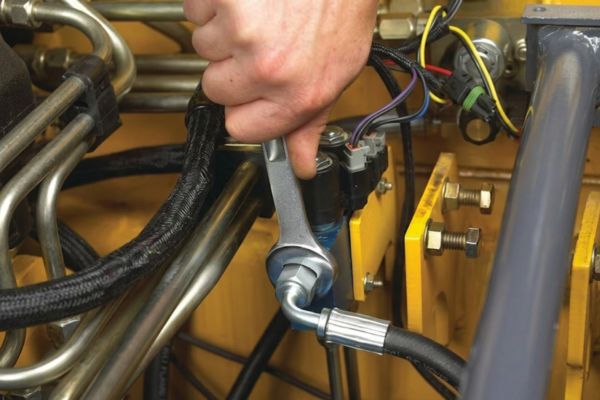
You ensure proper thread fitting compatibility by identifying the specific thread standard with precision calipers and pitch gauges instead of relying on a visual match. Mismatched threads will strip under torque or create hidden gaps that lead to high-pressure leaks when operational vibration increases. Verifying the sealing mechanism ensures a reliable connection that handles continuous thermal cycling.
How To Identify Mismatched Thread Forms Accurately?
You identify mismatched thread forms accurately by measuring the outside diameter and calculating the exact number of threads per inch.
- Measurement of thread crest pitch using a specialized leaf-style pitch gauge.
- Verification of seat angle configurations using a precision center angle gauge block.
- Checking for parallel versus tapered profiles using a digital vernier caliper tool.
Using correct tracking tools eliminates guesswork and ensures a reliable mechanical joint.
Selecting The Right O-Ring Face Seals Natively
Selecting the right O-ring face seals natively provides an absolute, leak-free elastomeric joint that withstands high-vibration environments perfectly.
- Inspection of the elastomeric seal compound to ensure full chemical compatibility with your fluid.
- Verification that the O-ring groove profile is completely free of machining burrs.
- Proper lubrication of the seal face prior to executing final assembly torque.
This specialized interface style provides superior protection against sudden pressure spikes in heavy construction equipment. Selecting this resilient configuration ensures your connections remain completely leak-free despite continuous mechanical vibration.
| Thread Standard Family | Sealing Mechanism Type | Recommended Assembly Torque |
| SAE J1453 (ORFS) | Elastomeric O-Ring Face Seal | Torque to specific nominal spec based on size |
| SAE J514 (JIC 37°) | Metal-to-Metal Mated Cone Seat | Apply the flats-from-finger-tight calculation |
| DIN 2353 (Metric) | 24-Degree Cutting Ring Bite Interface | Execute one full turn past the initial feel point |
Why Must You Examine The Hose Outer Cover Integrity?
You must examine the hose outer cover integrity to ensure that the protective synthetic rubber layer is free of deep gouges, exposed wire braids, or weather cracks. Any breach in this exterior shield allows water and corrosive chemicals to penetrate directly into the high-tensile steel reinforcement wires. Catching outer cover damage early prevents hidden rust from weakening the structural integrity of the assembly.
What Outer Cover Scratches Signal Core Wire Damage?
Deep cover scratches that penetrate down to the textile friction layer signal that the underlying steel reinforcement has been exposed to environmental degradation.
- Complete exposure of the metallic reinforcement matrix to ambient humidity and chemical spray.
- Separating rubber layers that indicate the assembly has been subjected to excessive bending force.
- Localized cover bubbling that highlights an active pinhole leak in the inner core.
Scrapping compromised lines immediately keeps your field operations safe from sudden burst hazards.
Guarding Against Early Abrasion In Harsh Environments
Guarding against early abrasion requires installing specialized protective shielding over areas that frequently contact moving machine parts.
- Installation of heavy-duty nylon abrasion sleeves to block localized mechanical rubbing.
- Application of silicone-coated fiberglass fire sleeves near ultra-high temperature exhaust manifolds.
- Utilization of spring steel wire guards to deflect flying debris in mining applications.
Protecting the exterior cover keeps your critical fluid systems running reliably in extreme conditions. This added protection layer buffers your assembly against unexpected impacts from external job site hazards.
| Protective Shield Type | Primary Environmental Threat | Ideal Field Application |
| HDPE Spiral Wrapping | Constant mechanical abrasion and friction | Excavator boom arm hydraulic routing lines |
| Fiberglass Fire Sleeving | Extreme radiant heat and open flame | Engine compartment fuel and oil circuits |
| Spring Steel Guards | Impact from flying rock fragments | Under-chassis aggregate transport machinery |
What Maximum Working Pressure Metrics Require Validation?
You validate maximum working pressure metrics by checking the permanent layline print on the hose cover against the machine’s maximum relief valve setting. The component’s rated capacity must meet or exceed the highest pressure spikes generated during heavy lifting operations. Never guess these specifications, as over-pressurizing an underrated line can cause an immediate burst.
Does Working Pressure Match System Spike Levels?
Yes, the component’s rated working pressure must always match or exceed the maximum dynamic pressure spike levels recorded during extreme operational loading.
- Permanent structural deformation of the inner steel wire reinforcement grid due to over-pressurization.
- Accelerated degradation of the internal elastomer compound caused by repeated pressure shocks.
- Instantaneous coupling separation resulting from operating above nominal design capacities.
Verifying your circuit specifications ensures your system handles demanding field workloads safely.
Understanding Burst Factors For Enhanced Field Safety
Understanding burst factors allows you to maintain a reliable 4:1 safety margin between the nominal working limit and the absolute failure point.
- Protection of nearby technicians from sudden high-velocity oil releases.
- Prevention of structural casing failures in nearby precision control valves.
- Compliance with international safety directives governing high-pressure fluid power systems.
Adhering to these engineering parameters keeps your job site safe and efficient. This design safety factor gives you peace of mind when the machine operates at its absolute mechanical limit.
| Hose Specification Line | Rated Working Pressure | Absolute Minimum Burst Pressure |
| SAE 100R2 Type AT | 4,000 PSI nominal limit | 16,000 PSI absolute structural failure point |
| SAE 100R12 Spiral | 4,000 PSI heavy-duty | 16,000 PSI high-impulse containment limit |
| SAE 100R15 Ultra-High | 6,000 PSI maximum limit | 24,000 PSI extreme-impulse containment limit |
How Do You Prevent Dangerous Hose Twist During Assembly?
You prevent dangerous hose twist by keeping the printed layline perfectly straight as you tighten the terminal fittings at both ends. Any twisting introduced during installation puts severe torsional stress on the wire reinforcement braid, which significantly lowers its pressure handling capability. Prior to connecting new hoses, you must utilize a dual-wrench technique to lock the assembly flat and prevent rotation.

Why Torquing Without Backing Wrenches Causes Leaks?
Torquing a fitting without a backing wrench introduces a permanent twist that distorts the internal sealing face and causes early joint leaks.
- Structural displacement of the internal elastomeric O-ring during the final tightening sequence.
- Creation of uneven contact pressure across the metal-to-metal mating cone surface.
- Continuous internal stress on the crimp sleeve joint that leads to early cracks under pressure.
Using two wrenches ensures your connections seal correctly right from the start.
Maintaining The Natural Hose Layline Alignment
Maintaining the natural layline alignment ensures the internal wire braids absorb high-pressure impulses evenly without structural distortion.
- Visual verification that the printed text line runs straight along the entire length of the installation.
- Natural relaxation of the rubber body during full system expansion and contraction sequences.
- Elimination of internal shearing stresses within the layered steel reinforcement matrix.
Keeping your lines properly aligned ensures steady performance under heavy workloads. This correct physical alignment ensures that high-pressure pulses are absorbed smoothly across the entire wire matrix.
| Installation Stance | Alignment Accuracy Result | Structural Impact On Braid |
| Dual-Wrench Locking Stance | Perfectly straight layline tracking | 100% rated service life capacity maintained |
| Single-Wrench Blind Torquing | 5 to 10 degrees of hidden twist | Service life capability drops by up to 90% |
| Forced Offset Routing | Severe out-of-plane bending stress | Immediate stress concentration at crimp collar |
Why Inspect Clamping Components And Routing Envelopes First?
You inspect clamping components and routing envelopes first to prevent structural damage from rubbing against surrounding steel edges or brackets. Properly adjusted support clamps keep high-pressure lines isolated from hot exhaust components and moving mechanical links. Setting up clean clearances ensures your lines move freely without catching on the chassis during tight turns.
Can Poor Clamping Layouts Acceleration Hose Wear?
Yes, a poorly designed clamping layout accelerates wear by allowing the line to rub continuously against adjacent structural steel parts.
- Rapid wearing away of the protective rubber cover caused by continuous metal-to-rubber friction.
- Localized structural failure resulting from unchecked vibration at loose mounting brackets.
- Premature hardening of the rubber body near unshielded turbocharger hot zones.
Using insulated mounting hardware eliminates friction points and keeps your system quiet and reliable.
Designing Clean Clearances Near Moving Components
Designing clean clearances ensures that your lines do not get pinched, stretched, or crushed through the machine’s entire range of motion.
- Prevention of catastrophic line pinching within heavy front-end loader pivot joints.
- Maintenance of safe physical distance from high-temperature exhaust system components.
- Elimination of dynamic twisting stress on assemblies mounted to rotating wheel hubs.
Careful routing prevents mechanical interference and extends component life in rugged conditions. This smart spacing shields your lines from unexpected structural damage during heavy operation.
| Clamp Material Specification | Vibration Dampening Level | Primary Routing Advantage |
| Rubber-Insulated P-Clamps | High elastomer absorption | Eliminates localized cover abrasion entirely |
| Heavy-Duty Polypropylene Blocks | Structural impact resistance | Secures multi-line high-pressure industrial stacks |
| Uninsulated Steel Brackets | Zero dampening capability | Causes rapid cover cutting under continuous vibration |
To optimize the reliability of your machinery assets and protect your high-pressure systems from unexpected field failures, please contact us today to consult with our industrial fluid power risk experts.
FAQ
Can I install a hydraulic hose that shows minor surface rust on the outer wire braid?
No, you should never install an assembly with a corroded wire braid because rust weakens the high-tensile steel reinforcement wires immediately. Under full pressure spikes, these rusted wires will fail, leading to a dangerous blowout. Always choose clean, rust-free components to ensure safe operations.
What’s the best way to determine if a new hose has internal contamination before hooking it up?
The best way is to run a clean white foam projectile through the line using a pneumatic launcher and check the sponge for dark rubber dust or metal shavings. If the projectile comes out dirty, the line must be flushed with filtered oil until it passes clean. Never assume a new line is clean inside.
How do I know if the thread on my old port matches the new fitting perfectly?
You must verify the match by measuring the thread diameter with calipers and checking the pitch with a leaf pitch gauge instead of guessing by eye. The fitting should spin on smoothly by hand; if it binds or feels loose, you have a thread mismatch that will leak or strip under full torque.
Can I reuse old copper washers or elastomeric O-rings when connecting new hoses?
No, you must always replace all sealing elements with new components because used seals suffer from permanent compression set and micro-cracking. Reusing old seals almost always leads to fluid leaks once the system reaches full operating temperature. Installing new seals ensures a reliable joint.
How do I know if my new line has been twisted dangerously during assembly?
You can easily tell by checking the printed text layline on the outer cover to ensure it runs completely straight along the installation path. If the text line twists around the body, the internal wire braids are under severe torsional stress. Loosen the fitting, lock it with a backing wrench, and realign it straight.