Why Do Clear Fitting Labels Prevent Reorder Mistakes

Why Do Clear Fitting Labels Prevent Reorder Mistakes?

Clear hydraulic fitting labels improve repeat orders because they preserve the exact identity of a part after the original quotation, sample, or repair is forgotten. A label that connects the physical fitting to its complete part number, connection, hose size, fitting series, and approved record lets purchasing reorder the same verified SKU instead of rebuilding the identification process. Vague labels such as “1/2 BSP” or “Metric elbow” hide differences that affect fit, sealing, crimping, and inventory. The result is not merely slower administration: it can be a wrong part, a mixed bin, a rejected hose assembly, or another equipment delay.

Why Is the Label Part of the Technical Record?

It connects the physical item to approved data

A fitting on a shelf cannot carry its complete drawing, hose-compatibility table, crimp instructions, inspection history, and purchasing record on its metal surface. The label provides the link by showing a unique internal part number and enough readable attributes to verify that the correct record has been opened. If that link breaks, staff may identify the fitting again from appearance, a partial thread description, or the nearest old order, which can reproduce an earlier mistake.

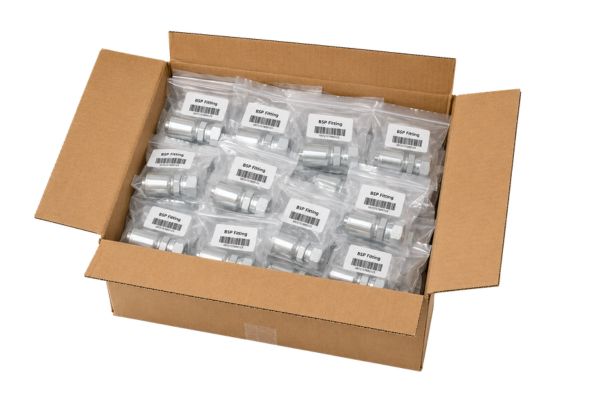
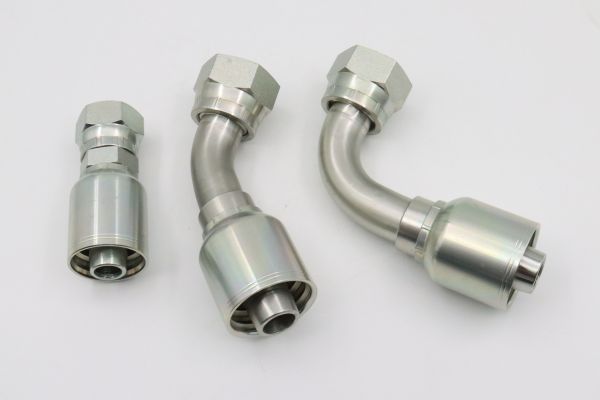
clear Fitting label

One-piece construction does not remove identification needs

A one-piece hydraulic hose fitting normally combines or fixes the fitting body or stem and ferrule as one component, although its construction varies by series. This can reduce the separate task of matching a loose ferrule to a stem, but many one-piece fittings still look similar across thread standards, hose sizes, angles, materials, and fitting families. Clear hydraulic fitting labels therefore reduce one source of ambiguity without claiming that the one-piece format makes every hose or crimp process compatible.

What Information Should a Fitting Label Preserve?

Use a unique code and a controlled description

The main identifier should be unique to one approved SKU, not shared by several “similar” parts. Pair that code with a concise description that distinguishes the features needed at receiving, picking, assembly, and reorder. The label should match the purchase order, packing list, bin record, drawing, and digital item master; multiple names for the same SKU or one name for several SKUs both create avoidable repeat-order risk. When more than one approved source exists, keep the internal item identity stable while linking each source code and its approval scope in the item record instead of printing a new local SKU for every quotation.

Include the fields that matter to your operation:

Do not compress away the decisive difference

A short label is useful only when it remains unambiguous. “BSP 1/2” does not say whether the connection is BSPP or BSPT, male or female, or whether it seals with a cone, washer, O-ring, or thread interference. “Metric -8 elbow” can also hide metric pitch, cone system, light or heavy series, elbow drop, hose size, and fitting family. Use an internal code to keep the printed label compact, but make the human-readable description specific enough to catch a wrong bin or wrong pick.

How Do Unclear Labels Break Repeat Orders?

They turn a verified purchase back into a new identification job

The first order may have required photos, measurements, drawings, samples, technical questions, and assembly checks. If the received box is relabeled with a shorthand name, the next buyer loses the chain that connected those checks to the approved product. The team must either repeat the work or trust an incomplete description, and time pressure often pushes the decision toward the second option. A clear label preserves the inquiry revision and approved code so the repeat order can begin with a controlled record while still requiring review when the drawing, source, hose system, or application has changed.

They allow similar parts to exchange identities

Two fittings can share a nominal size and general shape while using different thread forms, seat angles, sealing faces, hose tails, or ferrule designs. When labels detach, fade, or use the same description, returns and unused pieces may be placed in the wrong bin and later ordered under the wrong code. A measured thread-mismatch prevention process can resolve uncertainty, but clear labeling prevents routine stock from becoming uncertain in the first place.

Why Do Labels Improve Picking and Receiving Accuracy?

Receiving can compare shipment, order, and specification

A useful receiving label lets staff compare the physical package with the purchase-order line before parts enter approved stock. Part number, description, quantity, unit of measure, revision, lot or batch reference, and inspection status should agree with the receiving record. If a line is new, changed, or under evaluation, the label should make quarantine or restricted status visible so an urgent hose job cannot consume an unapproved part. Receiving should also verify that inner bags and split quantities retain identity after the outer carton is opened, since a correct pallet label cannot prevent mixing once unlabeled smaller packs move to separate bins.

Use a simple status flow:

Picking becomes a verification step, not a memory test

At the bin, the label should let the picker compare the work order with the part code, connection, hose size, fitting series, material, and orientation. Separate visually similar standards and give them distinct location codes or label layouts where confusion is likely. The fast-moving one-piece fitting stock method recommends consistent part numbers, descriptions, barcodes, units, and bin logic because a fitting that cannot be found or identified is functionally unavailable.

How Do Labels Connect to Inventory and Reordering?

The same identifier must follow every transaction

Use one controlled SKU code from quotation and sample approval through purchasing, receiving, bin placement, issue, return, stock count, and repeat order. The transaction history can then show true demand, stockouts, returns, and slow stock for that exact fitting. If one item has several local codes, demand appears fragmented; if several items share one code, the inventory balance may look sufficient even though the needed connection is absent.

clear label

The digital item record should connect the label to:

Barcodes accelerate capture but do not repair bad master data

A barcode or QR code reduces manual typing and can open the correct item record, but the encoded identifier must still point to accurate, governed data. The GS1 Global Traceability Standard distinguishes product-level, batch or lot-level, and serialized identification, allowing an organization to choose the level appropriate to its traceability objective. A small operation does not need a complex global system merely to label bins, yet human-readable text should remain beside machine-readable data so staff can verify the part when a scanner or database is unavailable.

Why Do Labels Matter for Hose Compatibility and Crimping?

The label should point to the assembly system

The connection end does not define the hose side. A JIC or ORFS fitting of one dash size may exist in several fitting series for different hose constructions and crimp procedures. The label should therefore show or link to the full fitting series and supported hose identity, while the controlled record holds the applicable crimp diameter, measurement point, insertion depth, die selection, preparation method, and inspection instructions.

A clear label cannot replace technical approval

Printing “compatible” on a package does not prove that the stem, ferrule, hose, and crimp equipment form a validated assembly. Before a new or alternative item receives an approved inventory label, complete the relevant hose, connection, material, application, and crimp checks. The trial-order inspection process keeps samples separate until their identity and assembly requirements are verified, preventing a well-printed but technically unresolved part from becoming routine stock.

How Should a Labeling System Be Implemented?

Start with the highest-confusion and highest-repeat SKUs

Do not begin by designing a complicated label for every old item. First map fast-moving fittings, visually similar thread families, frequent returns, repeated emergency orders, and bins that require staff to open bags for identification. Clean the item master, merge true duplicates, split falsely combined SKUs, and confirm technical descriptions before printing replacement labels. Test the format on a small group through receiving, picking, return, stock count, and reorder, then correct field order, abbreviations, scan behavior, label durability, and assigned ownership before expanding it across the full assortment and every affected storage location.

A practical label review asks:

  • Does one code identify exactly one approved fitting configuration?
  • Can receiving match the package to the purchase order and inspection status?
  • Can a picker distinguish the part without relying only on appearance?
  • Does scanning or reading the code open the correct technical and reorder record?
  • Will the label remain readable under the storage environment and normal handling?

Control changes, returns, and damaged labels

Define who can create or revise part records, what evidence is required, and when a change needs reapproval. Returned parts should retain their original identity and be inspected before they reenter approved stock; unidentified pieces belong in quarantine, not the nearest similar bin. Replace damaged labels from the controlled item record, record affected lots when required, and audit shelves against digital balances so a correct database does not hide mixed physical stock.

Final Labeling Decision

Clear hydraulic fitting labels improve repeat orders by keeping the physical part connected to the exact SKU that passed technical and commercial checks. The label should show a unique code and enough readable detail to distinguish connection, seal, hose size, fitting series, orientation, material, and status, while the linked record stores drawings, hose compatibility, crimp data, source, lot, and replenishment controls. Apply the same identifier across quotation, receiving, storage, picking, returns, stock counts, and reorders. Before changing a label, resolve duplicate codes, vague descriptions, and missing technical fields; a faster scan is valuable only when it retrieves the correct fitting record.

Frequently Asked Questions

Is a supplier part number enough for repeat ordering?
It is a useful source reference, but an internal controlled code can preserve approved sources, revisions, hose compatibility, bin location, and restrictions without assuming that all similarly numbered parts are interchangeable.

Should the label include the thread standard or only a barcode?
Include enough human-readable thread and sealing information to catch a wrong pick, while the barcode links to the complete record and reduces manual entry.

Do hydraulic fittings need lot or batch numbers?
Use lot or batch identification when required by the quality plan, application risk, contract, regulation, inspection process, or deviation-control needs; not every operation requires serialized pieces.

What should happen to a fitting with a missing label?
Move it to a controlled hold area and reidentify it from measurements and approved evidence; do not place it in a bin based only on visual similarity.

Can the same bin label cover straight and elbow fittings of one size?
No. Straight, 45-degree, and 90-degree forms are different configurations and may also differ in drop, orientation, and part number, so each approved SKU needs distinct identification.

How Can Distributors Build a Profitable One-Piece Fitting Line

How Can Distributors Build a Profitable One-Piece Fitting Line?

A profitable one-piece fitting line is not the largest catalog a distributor can offer. It is a controlled range of technically compatible fittings that matches local hose demand, turns at a healthy rate, and solves common customer requirements without tying up too much cash. Start with verified, frequently requested combinations, measure actual sales and stockouts, and expand only when the data supports another SKU.

What Makes a One-Piece Fitting Line Profitable?

Profit depends on turnover, not catalog size

Adding more part numbers may increase product coverage, but it does not automatically increase profit. Every new fitting uses purchasing capital, warehouse space, receiving time, labeling effort, and inventory-management capacity. Slow-moving items can remain on the shelf while commonly requested fittings continue to run out.

The main commercial objective is therefore not to stock every possible thread, size, and orientation. It is to make the right fittings available when customers need them. A smaller range with regular turnover can be more useful than a large range filled with low-demand parts.

one piece Fitting cross reference

Evaluate the complete cost of each SKU:

A fitting with a low unit cost may still be unprofitable if it rarely sells or frequently causes identification problems. A higher-priced fitting may contribute more if it turns regularly, supports repeat hose business, and reduces emergency purchasing.

Technical accuracy protects commercial margin

One-piece fittings have a stem and ferrule preassembled or fixed as one assembly, although the construction varies by product series. This design can reduce errors caused by selecting and stocking separate stems and ferrules. It cannot eliminate mistakes involving the hose series, thread, seat, sealing method, fitting orientation, or crimp data.

A fitting that is purchased incorrectly can affect margin several times. The distributor pays to receive and store it, the team spends time identifying the mismatch, and another part may need to be shipped urgently. If the fitting reaches a customer, the cost may also include a return, hose reassembly, complaint handling, and lost confidence.

Profitability therefore begins with a reliable technical foundation. Each stocked item should have a confirmed description, traceable part number, compatible hose reference, applicable assembly data, and clear warehouse identification.

Choose the Market the Product Line Will Serve

Build around actual customers and equipment

A profitable range reflects the hydraulic equipment, hose types, and connection standards found in the distributor’s service area. Demand may be influenced by agricultural machinery, construction equipment, industrial maintenance, mobile service, mining, transportation, or equipment manufacturing.

Do not copy another distributor’s stocking list without comparing the local market. A popular thread family in one country or equipment segment may move slowly in another. The correct range depends on installed equipment, repair frequency, customer purchasing habits, seasonal activity, and the hose series already supported.

Use available business records to answer practical questions:

Sales records provide part of the answer, but lost inquiries also matter. If a fitting is repeatedly requested but never stocked, historical sales alone will understate its potential demand. Record stockout requests and unsuccessful quotations so that inventory decisions include unmet demand.

Select one clear starting segment

Trying to serve every hydraulic application at launch spreads inventory across too many combinations. Select an initial segment where the distributor already understands the customers, hoses, and assembly requirements.

For example, the starting range might support the most common hose series used by an existing repair operation or a defined group of equipment. This creates a stronger basis for selecting compatible fitting families than beginning with a supplier’s complete catalog.

A focused starting segment also makes sales easier. Staff can explain which hoses and connections the range supports, purchasing can forecast a manageable number of SKUs, and warehouse teams can learn a consistent identification system.

Expansion should follow demonstrated demand. It should not be driven only by the availability of additional catalog items.

Select the Right Starting SKUs

Rank fittings using evidence

Begin with part numbers that combine repeat demand, technical clarity, and practical stock value. Historical sales, quotation frequency, repair records, equipment population, and stockout incidents are stronger evidence than assumptions about which fittings “should” sell.

Classify potential items into groups:

There is no universal number of fittings that every distributor should stock. The initial quantity of SKUs must reflect local demand and available working capital. Fixed recommendations such as stocking the same top 20 or 50 fittings in every market ignore differences in hose series, thread systems, and customer behavior.

Give priority to fittings that can be accurately identified and supported with valid technical data. A commonly requested but poorly defined connection should be clarified before it becomes a stocked item.

Cover useful combinations without duplicating inventory

A fitting range can expand quickly because each hose size may connect with several thread standards, sealing methods, and configurations. Straight, 45-degree, and 90-degree versions multiply the number of possible SKUs again.

Review whether each variation solves a recurring requirement. Straight fittings may move faster in some product groups, while angled fittings may be essential for equipment with restricted installation space. The ratio should come from actual demand rather than a mechanical rule applied across every size.

Avoid purchasing multiple references that perform the same approved function unless there is a clear reason, such as separate customer specifications or supply-risk management. Duplicate inventory makes forecasting harder and can divide sales across several slow-moving SKUs.

Use a controlled cross-reference table to connect:

Validate the Line Before Building Inventory

Use samples or a controlled trial order

Do not move directly from catalog review to a large inventory purchase. Begin with samples or a trial order containing familiar, measurable items. This allows the distributor to test the technical and operational process before committing more capital.

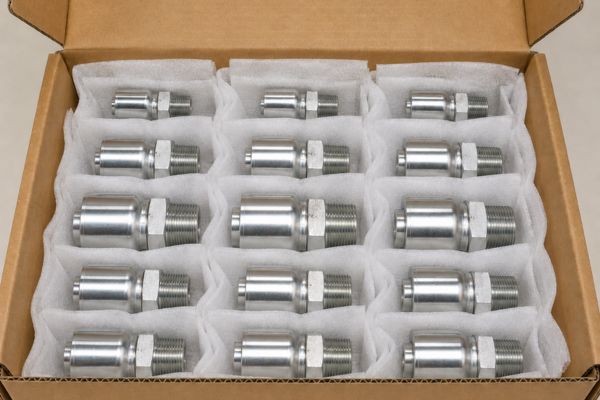
order of one piece Fitting

Select trial items whose hose combinations and connection details are already known. Avoid using the first order to evaluate unclear substitutions in safety-critical, severe-duty, or regulated applications.

Before ordering, define what the trial must verify:

Keep trial fittings separate from approved inventory. This prevents unverified parts from being sold or assembled before the evaluation is complete.

Test the complete operating process

A successful product inspection is not enough. The distributor must also confirm that sales, purchasing, receiving, warehouse, and assembly teams can handle the range without confusion.

Run several representative trial items through the complete workflow. Sales should be able to identify the customer’s requirement. Purchasing should order the correct supplier reference. Receiving should verify it, and warehouse staff should place it in the correct labeled location. The assembly team should then use the applicable hose, equipment, tooling, and current crimp data.

One-piece construction may reduce separate ferrule-picking mistakes, but dash size alone does not prove compatibility. The fitting series must match the hose construction and approved assembly specification. Do not create a universal crimp value for visually similar parts.

If an item fails, record the exact deviation instead of labeling the entire product line as acceptable or unacceptable. One SKU may pass while another requires a drawing correction, better labeling, or a different hose-series match.

Set Stock Levels from Demand and Replenishment Risk

Separate core stock from secondary items

Not all fittings deserve the same inventory policy. Core items with repeat demand should be managed differently from occasional or project-specific fittings.

A practical classification can include:

This classification helps sales teams set realistic expectations. It also prevents a special-order part from being reordered automatically simply because one unit was sold.

Review the classification periodically. A core item may slow down after equipment changes, while a previously occasional fitting may become a repeat seller.

Calculate reorder points instead of relying on memory

A reorder point should reflect expected demand during replenishment time plus an appropriate allowance for variability. It should not be copied from another product line without considering the fitting’s own demand and supply conditions.

The relevant factors include:

Safety stock should be higher only when the business impact justifies the additional capital. A slow-moving fitting does not necessarily need more inventory because it has a long lead time. Special ordering, shared replenishment, or a clearly communicated delivery time may be more economical.

Control Part Numbers, Labels, and Storage Locations

Create one identification system

Profit disappears when employees cannot identify the correct fitting quickly. Supplier codes, legacy numbers, handwritten descriptions, and customer references often accumulate until the same part is listed under several names.

Assign one internal part number to each confirmed fitting. Connect alternative references to that record rather than creating duplicate stock items. The internal description should consistently state the hose size, fitting style, connection, thread, seat, and sealing method.

Special Thread or Size Support

A warehouse label should contain enough information to prevent obvious picking mistakes without becoming unreadable. Depending on the operation, it may include:

Design storage to reduce picking errors

Separate fittings by a consistent hierarchy, such as product series, hose size, connection family, and configuration. The arrangement should reflect how staff search for parts during quotations, picking, and hose assembly.

Straight and angled fittings should not share an unmarked bin. Similar metric and inch connections also require clear separation. Bin dividers, location codes, barcode checks, and reference images can reduce confusion.

When new stock arrives, verify the supplier label against the product and purchase order before placing it in the active bin. Do not pour a new shipment directly onto old stock without confirming identification and deciding how traceability will be maintained.

Incorrect picking data should be recorded, even when the error is found before shipment. Repeated near misses often reveal unclear labels, duplicate part numbers, poor bin locations, or insufficient staff reference materials.

Manage Price, Margin, and Total Stock Cost

Set margin according to service value

Pricing should reflect more than purchase cost. A stocked fitting provides availability, technical identification, local inventory, order splitting, and faster customer service. These functions create costs but also provide value.

Review gross margin together with inventory turnover. A high percentage margin on an item that rarely sells may contribute less than a moderate margin on a fitting that turns regularly and supports additional hose or assembly sales.

Avoid using a single margin rule without considering:

Discounting should not hide an unhealthy SKU. If an item repeatedly requires discounts to move, examine whether it should remain a stock item, be purchased in a smaller quantity, or return to special-order status.

Measure the hidden cost of poor availability

Stockouts can cause lost fitting sales, but the larger loss may be the hose, assembly, or customer relationship connected to that item. Record when an unavailable fitting prevents the completion of a larger order.

The opposite problem is overstock. Excessive variety divides demand across many items and increases capital tied up in slow-moving inventory. It can also raise the risk of corrosion, mixed labels, obsolete references, and repeated stock counts.

Use a balanced set of indicators:

No single indicator gives the full answer. High turnover can result from insufficient stock, while low turnover may be acceptable for a strategically important service item. Review the commercial result together with customer and operational impact.

Expand, Correct, or Remove SKUs Using Evidence

Review the line on a fixed schedule

A fitting line should change as customer demand and equipment populations change. Set regular reviews so that expansion and removal decisions do not depend on individual opinions.

Label Support

For each SKU, ask:

Before removing a slow-moving item, determine whether it has genuine service value. A fitting may sell infrequently but help retain an important equipment account. In that case, a lower stock level may be better than complete removal.

Expand in controlled groups

Add new fittings around proven demand patterns. If one connection family performs well in several hose sizes, review requests for adjacent sizes and configurations. Do not automatically purchase the complete series.

Use another small trial for each meaningful expansion, especially when it introduces a new hose series, thread standard, sealing method, material, or crimping requirement. Confirm the technical data and internal workflow before treating the new items as core stock.

When an item underperforms, choose a clear action:

A profitable one-piece fitting line grows from controlled selection, verified compatibility, accurate identification, and measurable demand—not maximum catalog coverage. Start with the fittings your market repeatedly needs, validate them through a trial order, and expand only when sales, stockout, and margin data support the decision. Send TOPA your target hose series, connection standards, current demand records, trial SKU list, and expected quantities to prepare a focused one-piece fitting order.

Frequently Asked Questions

How many SKUs should a distributor stock at the beginning?

There is no universal starting number. Select a controlled range based on documented demand, local equipment, supported hose series, available capital, and the team’s ability to identify and assemble each item correctly.

Should a distributor stock every size in a fitting series?

No. Stock the sizes and configurations supported by repeat demand, and keep rare combinations available by special order when practical. A complete catalog is not the same as healthy inventory.

Are one-piece fittings easier to manage than two-piece fittings?

One-piece construction can reduce separate stem-and-ferrule selection and picking errors. It does not remove the need to control hose compatibility, threads, sealing methods, fitting orientation, and crimp data.

How often should fitting inventory be reviewed?

Use a schedule appropriate to sales volume and replenishment time, then review unusual stockouts or errors when they occur. The review should cover sales, inquiries, turnover, inactive stock, margins, returns, and technical-data accuracy.

When should a slow-moving fitting remain in stock?

Keep it when its service value, stockout impact, or support for an important customer justifies the capital. Otherwise, reduce the quantity or change it to a special-order item with a clearly communicated lead time.

How to Confirm One-Piece Fittings Before Ordering

How to Confirm One-Piece Fittings Before Ordering?

Before ordering one-piece hose fittings, confirm the hose series, fitting size, connection standard, thread dimensions, sealing method, fitting orientation, material, surface finish, application conditions, and applicable crimp data. A fitting that looks correct or shares the same dash size may still be incompatible. Checking these details before requesting a quotation helps prevent incorrect orders, assembly rework, leakage, and delays.

Confirm What “One-Piece” Means for the Required Fitting

Understand the fitting structure

A one-piece hose fitting normally has a fitting stem and ferrule preassembled or fixed together as one assembly. The exact method used to retain the ferrule may vary between product series. This design distinguishes it from a two-piece fitting system in which the stem and ferrule are selected and handled separately.

The one-piece structure can simplify picking and reduce the possibility of combining a stem with the wrong separate ferrule. However, it does not mean that the fitting is compatible with every hydraulic hose of the same nominal size. The hose construction, fitting series, hose-tail design, and crimp specification must still match.

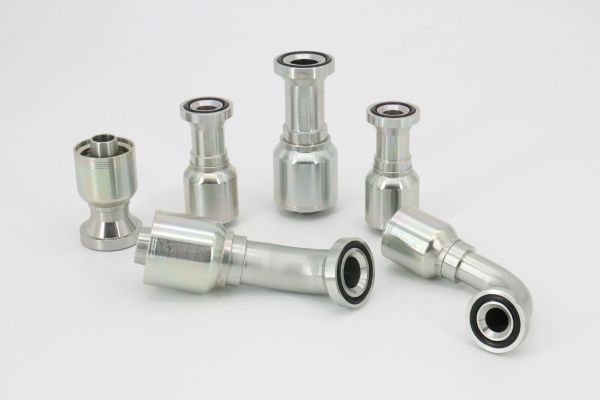
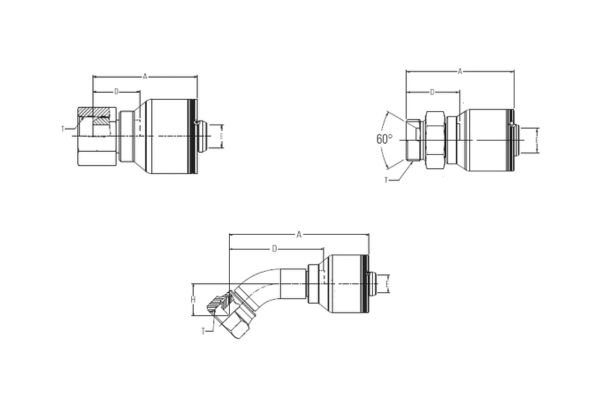
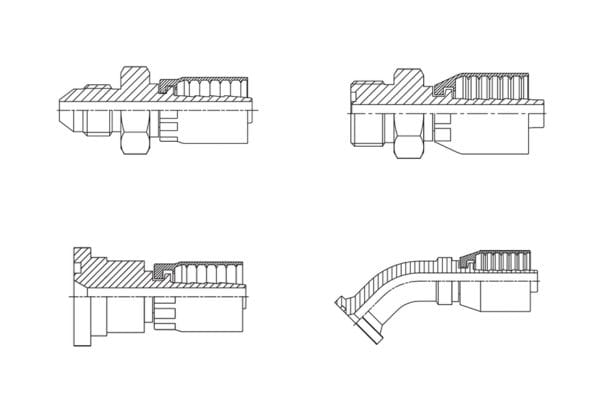
crimp hydraulic fitting design

Define the exact fitting configuration

“Hydraulic hose fitting” is too general for an accurate quotation. A complete description should identify both the hose end and the connection end. It should also specify whether the fitting is straight, 45-degree, 90-degree, or another configuration.

For an angled fitting, confirm the orientation and the dimensions that affect installation. Two 90-degree fittings can share the same connection and hose size but have different drop lengths or overall dimensions. These differences may determine whether the finished hose assembly fits inside a restricted installation space.

An initial order description should therefore include:

This information gives the supplier something measurable to confirm. It also creates a clear reference for checking the quotation and inspecting the delivered parts.

Confirm the Hose and Fitting Series Are Compatible

Identify the complete hose specification

Begin with the hose manufacturer, product series, construction, and size. Hose ID or dash size alone is not enough because hoses with the same nominal ID can have different reinforcement layers, cover thicknesses, tube materials, outside diameters, and fitting requirements.

Do not select a fitting only because its tail can be inserted into the hose. Physical insertion does not demonstrate that the stem profile and ferrule are suitable for the hose construction. An incorrect combination may damage the hose during crimping or fail to provide the required retention and sealing performance.

If you are replacing an existing assembly, record all available hose markings before removing or discarding the old hose. Useful markings may include the manufacturer, series, standard, size, pressure designation, and production identification. If the marking is worn or incomplete, consult the applicable equipment or component documentation instead of estimating the hose series from appearance.

Check the fitting series, not only the dash size

The fitting series connects the hose specification with the required stem, ferrule, and crimping procedure. Two fittings described as “-8” may have different tail geometries or ferrule designs even though both are intended for a nominal half-inch hose.

Confirm the following relationship before ordering:

Hose manufacturer and series → hose size → compatible fitting series → approved assembly data

If one part of this chain is missing, the order is not technically complete. Ask for clarification or applicable documentation before approving the item.

Compatibility claims should have a traceable source. Depending on the product and application, that source may be the hose manufacturer’s crimp chart, the fitting manufacturer’s assembly data, an approved internal specification, or equipment documentation. A catalog cross-reference can help narrow the search, but it should not replace confirmation of the actual hose-and-fitting combination.

Confirm the Thread and Connection Standard

Measure the thread instead of judging by appearance

Similar-looking threads are a common source of incorrect fitting orders. Confirm whether the connection is male or female, then measure the relevant outside or inside diameter and determine the thread pitch or threads per inch. Also identify whether the thread is straight or tapered.

Use suitable measuring tools, such as a caliper and thread-pitch gauge. Take measurements from an undamaged area and compare the result with reliable technical data. A photograph can help identify possible connection families, but it cannot show thread pitch or small dimensional differences accurately enough to confirm the final part number.

The basic thread-identification record should contain:

Do not force a thread to test whether it fits. Partial engagement does not prove compatibility and may damage both components. Thread sealant is also not a valid solution for an incorrect thread form or a damaged sealing surface.

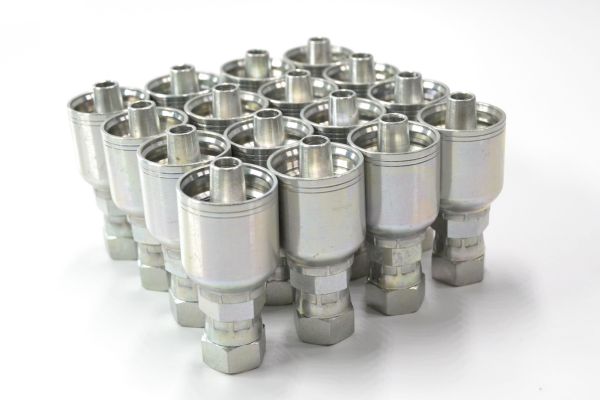
One piece Hydraulic Fitting component

Distinguish common connection families

Names such as JIC, NPT, NPTF, BSPP, BSPT, ORFS, ORB, metric, DIN, and JIS describe different connection systems or related product families. These names must not be used interchangeably.

For example, JIC and SAE 45-degree flare connections use different seat angles. BSPP and BSPT differ in thread form and sealing behavior. Metric fittings may use several different sealing arrangements even when the measured thread diameter appears similar. Some fittings seal on a cone, some on an O-ring, some on a bonded seal, and others through controlled thread interference.

An existing branded part number can support identification, but it is not complete evidence of interchangeability. Cross-reference information may contain series limitations, material differences, or application conditions. Use the part number together with measured dimensions and sealing details.

Confirm the Seat and Sealing Method

Find where the connection actually seals

Threads do not always create the hydraulic seal. In many connections, the threads provide mechanical engagement while a separate seat, cone, O-ring, or sealing washer contains the fluid. Ordering the correct thread with the wrong sealing face can therefore produce a connection that assembles but leaks.

Inspect the connection and determine whether sealing occurs through:

Record the seat angle when it is relevant. Do not estimate it from a front-facing photograph, especially when two connection families have similar external shapes. Use an appropriate gauge, a known technical reference, or the original product documentation.

Check seals and sealing surfaces

If the fitting uses an O-ring, confirm its location, dimensions, material, and compatibility with the hydraulic fluid and operating temperature. O-rings that look similar may use different compounds and may respond differently to heat, chemicals, or long-term compression.

Inspect an existing fitting carefully before using it as a reference. Scratches, corrosion, deformation, previous over-tightening, or a missing seal can hide the original sealing method. A damaged old fitting should not become the only standard for a new order.

The consequences of an incorrect sealing choice extend beyond visible leakage. A poor connection may require repeated tightening, damage the mating port, introduce contamination during rework, or cause unplanned equipment downtime. In high-risk applications, the result can also create a serious safety hazard.

Confirm Material, Finish, and Application Conditions

Match the fitting to the operating environment

Material and surface finish should be selected according to the fluid, temperature, pressure, corrosion exposure, mechanical load, and applicable regulatory requirements. No material is automatically the best choice for every hydraulic system.

Carbon steel fittings with an appropriate surface treatment are common in many applications, but the required corrosion protection depends on the actual environment. Stainless steel may be considered for particular fluids or corrosive conditions, but its suitability must still be checked against pressure, temperature, sealing, assembly, and system requirements.

Provide the supplier with the relevant application information:

Check the complete assembly pressure limit

A fitting should not be selected by an isolated pressure number. The allowable conditions of a hose assembly depend on the lowest-rated relevant component and the approved combination of hose, fitting, connection, and assembly procedure.

Pressure suitability can also change with temperature, fluid, impulse frequency, routing, bend radius, and external loading. A fitting connection may have different limitations from the hose itself. Confirm the complete assembly requirements rather than assuming that a high fitting rating increases the rating of the finished hose assembly.

Applications involving personnel safety, lifting systems, braking, severe impulses, high temperatures, or regulated equipment require additional technical review. A price comparison or approximate cross-reference is not sufficient for these systems.

Confirm the Crimping Requirements Before Purchase

Obtain data for the exact hose-and-fitting combination

Before ordering fittings for hose assembly, confirm that valid crimp data is available for the exact hose series, size, and fitting series. This information may include the target crimp diameter, die selection, insertion depth, skiving requirement, and inspection procedure.

There is no single crimp diameter that applies to all one-piece fittings of the same dash size. The correct result depends on the hose construction and fitting design. Copying a crimp setting from a visually similar fitting can cause under-crimping, over-crimping, hose damage, restricted flow, leakage, or fitting pull-off.

The assembly team should be able to answer these questions before the parts arrive:

If the supplier proposes a different fitting series from the one originally requested, do not assume the existing crimp settings remain valid. Treat it as a new combination and obtain the applicable data.

check before order

Make safe assembly and inspection mandatory

A one-piece design can simplify component handling, but it cannot compensate for an incorrect assembly procedure. The hose must be prepared, inserted, crimped, and inspected according to the applicable manufacturer’s instructions.

Before inspecting, repairing, or replacing a hydraulic hose assembly, shut down the equipment and release hydraulic pressure and stored energy. Follow the safety procedures supplied by the equipment, hose, fitting, and crimping-equipment manufacturers. Never search for a pinhole leak with a bare hand or disassemble a pressurized connection.

Do not approve a fitting because the crimped assembly looks acceptable. Record the specified and measured values, part identification, hose series, tooling, and inspection result. This record helps separate product issues from setup or assembly errors.

Prepare an Order Sheet That Can Be Verified

Use one controlled line for each part number

A clear order sheet reduces errors between technical confirmation, quotation, purchasing, receiving, and assembly. Each line should describe one fitting configuration and connect it to the supporting drawing or specification.

Include these fields where applicable:

Mark missing information as “to be confirmed” rather than leaving a blank field that may be interpreted as unrestricted. Keep technical questions associated with the correct line item.

When reviewing a quotation, compare every line with the controlled order sheet. Do not check only the total quantity and price. Verify the fitting series, connection, thread, orientation, material, finish, and drawing revision before issuing a purchase order.

Use samples or a trial order when uncertainty remains

A controlled trial order is appropriate when you are evaluating a new source, alternative product, or unfamiliar fitting series. Begin with technically confirmed, regularly used items that your team can inspect and assemble under controlled conditions.

Define the acceptance checks before ordering. Depending on the product and application, these may cover:

Keep trial parts separate from approved inventory until the evaluation is complete. Record the result by part number instead of giving the entire shipment a general pass or fail. Expand future orders only for items that meet the defined requirements.

Correctly ordering one-piece hose fittings depends on complete identification, not appearance or price alone. Confirm the hose series, fitting configuration, thread, sealing method, material, application conditions, and valid crimp data before approving the order. Send TOPA your fitting list, measurements, photos, hose information, application details, and estimated quantities to begin a controlled quotation or trial order.

Frequently Asked Questions

Can I identify a one-piece hose fitting from a photo?

A photo can narrow the possible fitting families, but it cannot reliably confirm the thread pitch, seat angle, sealing method, or hose compatibility. Provide measurements, hose details, and clear images of the complete fitting, thread, sealing face, and hose tail.

Is matching the dash size enough to confirm compatibility?

No. Dash size identifies a nominal size but does not confirm the hose construction, fitting series, stem profile, ferrule design, or crimp requirements. Use approved compatibility and crimp data for the exact combination.

Can two fittings with the same thread be interchangeable?

Not necessarily. They may have different seat angles, sealing features, materials, pressure limitations, orientations, or hose ends. Confirm the complete connection and application specifications before treating one as a replacement.

What should I do if the existing part number is unavailable?

Measure the thread and sealing features, identify the hose, record the fitting configuration, and obtain clear photographs and application information. Use the old number as a search reference only; do not approve a replacement until the technical details match.

Should I order samples before placing a bulk order?

Use a sample or trial order when the source, product series, or cross-reference has not been approved. Define the dimensional, documentation, assembly, and application checks first so that the trial produces a clear purchasing decision.

Contact Topa

Save 30% on maintenance costs with our easy-install hydraulic fittings. Contact Now!