Hydraulic fittings play a key role across many industries, including manufacturing, construction, aviation, and other applications that rely on hydraulic systems. Because hydraulic fittings come in many types and are used under different working conditions, proper identification requires a clear understanding of their basic features. Without this knowledge, it is easy to select the wrong fitting, leading to leaks, performance issues, or system failure.
The following steps outline a practical approach to identifying hydraulic fittings accurately and efficiently.
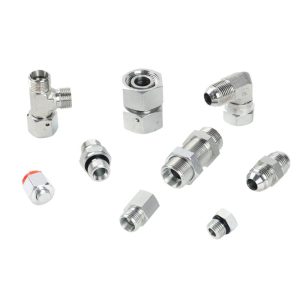
You can simply determine the type of hydraulic fitting by the appearance of the fitting. Common hydraulic fittings can be broadly classified into the following categories:
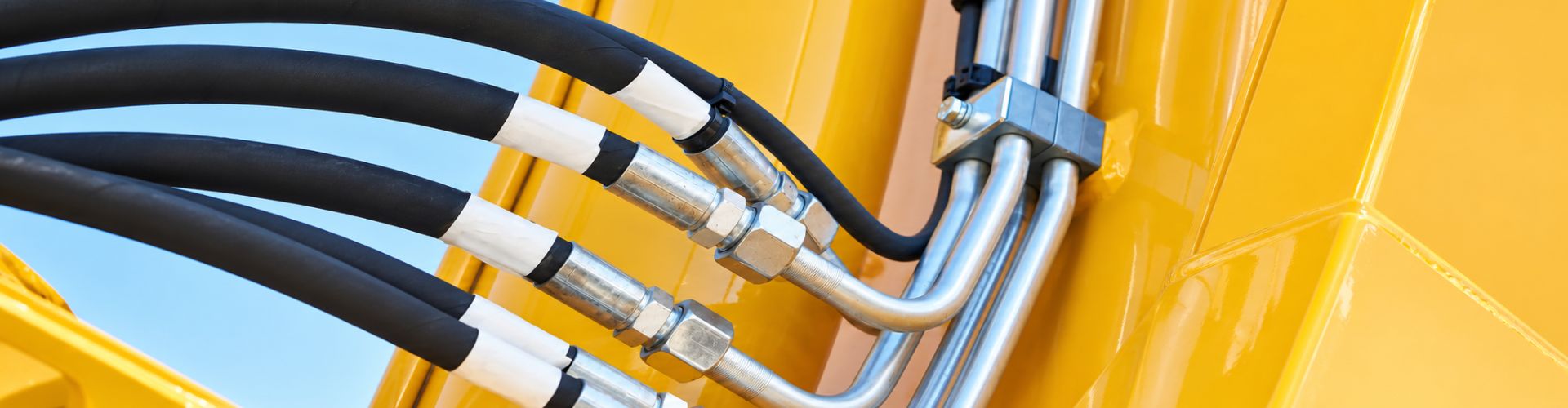
Hose fittings are used to connect with hydraulic hoses. They have a hose port on one end, which can be inserted into a hose and used in a hydraulic system. The other end is a threaded end, either male or female, and is used with other fittings or components. Hose fittings are available with bends from 15 degrees to 180 degrees included and can be used in a variety of applications.
Hydraulic adapters are the most common type of fitting. Each port of those fittings is threaded end and there exists a variety of different threads. Adapters include many types of hydraulic fittings: like tees, crosses, plugs, caps, bulkheads, grease nipples, etc. The different adapters have their own specific appearance and are very easy to distinguish.
There are three parts to a compression fitting: the nut, the ferrule, and the fitting. Commonly, there is a one-piece ferrule fitting and a two-piece ferrule fitting, which means that one or two ferrules are present in the fitting. These fittings can be used in tight places and do not require additional tools for installation.
Permanent hydraulic fittings, also known as one-piece fittings, are crimped fittings that are one piece. They are easy to install and operate and are the most popular type of fitting.
Reusable fittings have removable sleeves. They can be installed with a sleeve to hold the hose in place without causing displacement. Reusable hydraulic fittings are commonly used in applications that require field disassembly, saving most of the operating time.
Quick disconnect fittings are divided into two parts, the plug and the coupler, which are mounted together with a single push. Quick disconnects increase user productivity by minimizing the time spent establishing and disconnecting fluid connections.
Fitting Type | Main Features | Typical Use |
Hose Fittings | One end connects to a hydraulic hose; the other end is a male or female thread. Available in straight and bent forms (15°–180°). | Used to connect hoses to hydraulic components in various systems |
Adapters | Threaded on both ends; available in many shapes such as tees, crosses, plugs, caps, and bulkheads. | Used to connect, extend, or change thread types and directions |
Permanent Fittings | One-piece crimped design; permanently attached to the hose. | Common choice for fixed hydraulic hose assemblies |
Reusable Fittings | Two-piece design with removable sleeve; can be assembled and disassembled in the field. | Suitable for maintenance and field repairs |
Compression Fittings | Consist of a nut, ferrule(s), and fitting body; available with single or double ferrules. | Used in tight spaces where crimping tools are not available |
Quick Connects | Made of a plug and coupler; connect and disconnect with a simple push. | Used where frequent connection and disconnection is needed |
Threads are generally present in hydraulic fittings, and threads are all available at different standards. Common thread standards include American Standard Thread, British Standard, and International Metric Thread System.
American Standard threads have two notch marks on the outside of the fitting and a “U” on the thread cap. There are many types of threads involved in the American Standard thread, including JIC, NPT, and ORFS threads.
JIC fittings are straight threads with a 37-degree flare cone on both the internal and external thread cones. NPT fittings are tapered threads with a 30-degree chamfered internal flare, NPTF fittings are upgraded versions of NPT for better sealing. And ORFS fittings are straight threads with a groove on the top of the fitting to allow for the installation of an O-ring.
BSP fittings are marked with a notch on the surface and a “G” on the thread cap. BSPP threads are straight threads with a 60-degree chamfer on the male thread and a 60-degree taper on the female thread (swivel fitting). They can be sealed with a sealant or gasket.
BSPT fittings have a tapered thread, which can be easily confused with NPT. However, BSPT fittings do not have any chamfers, while NPT fittings have a 60-degree chamfer.
Metric threads are abbreviated as “M” and they are one of the most common threads used in hydraulic fittings. Globally, there are three standard metric fittings: DIN metric, JIS metric, and Komastu metric fittings. DIN metric fittings often have 24°, 45°, and 30° tapers. Some common fittings also require the help of O-rings or other seals.
Metric, BSP, and American fittings also differ in thread shape (the angle between adjacent threads), with American and metric fittings having a 60° thread shape and metric threads having a 55° thread shape.
Thread Standard | Marking / Identification | Thread Type | Sealing Method | Key Notes |
American Standard (SAE) | Two notch marks on fitting body, “U” on thread cap | Straight & tapered | Flare, thread seal, or O-ring | Includes JIC, NPT, NPTF, ORFS |
JIC | 37° flare surface | Straight thread | Metal-to-metal flare seal | Common in high-pressure systems |
NPT / NPTF | Tapered thread with chamfer | Tapered thread | Thread interference (sealant often required) | NPTF offers improved sealing |
ORFS | O-ring groove on fitting face | Straight thread | O-ring face seal | Excellent leak resistance |
British Standard (BSP) | Notch on surface, “G” on thread cap | Straight & tapered | Gasket, sealant, or thread seal | Includes BSPP and BSPT |
BSPP | Parallel thread | Straight thread | Gasket or washer | Often used with swivel fittings |
BSPT | No chamfer on thread | Tapered thread | Thread interference | Easily confused with NPT |
Metric Threads | Marked with “M” | Straight thread | Flare or O-ring | Includes DIN, JIS, Komatsu |
DIN / JIS / Komatsu | Various cone angles (24°, 30°, 45°) | Straight thread | Metal cone or O-ring | Widely used in Europe and Asia |
After identifying the fitting type and thread standard, the next step is to determine the exact size of the fitting. Accurate measurement is critical, as even small dimensional differences can lead to mismatched connections, leaks, or installation failure.
Two basic tools are commonly used for this process: vernier calipers and thread pitch gauges.
Vernier calipers are used to measure the overall length, inner diameter (I.D.), and outer diameter (O.D.) of the fitting. When measuring threaded fittings, the outside diameter of male threads is especially important, as it is one of the key parameters used to match the fitting with standard size charts provided by manufacturers or suppliers.
Thread pitch gauges are used to identify the thread pitch, which refers to the distance between adjacent threads. This step helps confirm whether the fitting uses metric, imperial, or specific standard threads such as BSP or NPT. By comparing the measured pitch with standard reference data, you can narrow down the correct thread specification.
Once the diameter and pitch are confirmed, these values should be compared with the supplier’s technical data or fitting charts. This comparison allows you to accurately select the corresponding fitting, adapter, or mating component.
Note:
Important notes:
These measurement steps are intended primarily for male threads. Measuring internal (female) threads directly can be inaccurate due to limited access and tool positioning.
To identify a female threaded fitting, it is recommended to first determine the corresponding male thread standard and size, then match the female fitting accordingly.
Minor differences between measured values and standard data are normal due to manufacturing tolerances or tool accuracy.
However, the measured outside diameter should never be larger than the standard reference value. If it is, the fitting may be misidentified or damaged.
Careful measurement, combined with standard reference data, greatly reduces the risk of incorrect fitting selection and ensures proper sealing and system performance.
Correctly identifying hydraulic fittings depends on a clear, methodical approach. By understanding fitting categories, recognizing thread standards, and measuring key dimensions accurately, you can avoid mismatches that lead to leaks, downtime, or system failure. Visual markings and basic identification provide a starting point, but final confirmation should always come from precise measurements and comparison with standard reference data.
When uncertainty remains, using verified supplier charts or consulting experienced manufacturers helps reduce risk and ensures compatibility. Careful identification not only improves system reliability but also extends component life and simplifies future maintenance.
Recognize by the shape of the sealing surface: JIC with 37° taper, NPT with tapered thread, ORFS with flat O-ring.
Use calipers to measure the outside diameter of the threads (male) or the outside diameter of the hose (e.g., 1/2 inch corresponds to -8 number).
NPT is 60° American Standard Taper Thread, BSPP is 55° British Standard Straight Thread, and Metric is 60° Flat Top Thread.
The markings contain the specification number (e.g. -8 = 1/2 inch), pressure rating (e.g. 3000 PSI), and material code (e.g. SS = stainless steel).
Stainless steel is non-magnetic (316L), carbon steel is magnetic, brass is gold, and aluminum alloy is matte gray.
Measure thread density (teeth per inch) and sealing surface angle against SAE J514 or ISO 8434 standard table.
Find out more about Topa Blog and learn more about specialized hydraulic fittings.
Automated page speed optimizations for fast site performance