Precision crimping technology that utilizes exact force control and high-quality die sets is the specific solution that can double the lifespan of your hoses. You have likely experienced the frustration of a hose failing just weeks after installation, leading to expensive downtime and messy cleanups. When a hydraulic assembly fails, it isn’t just a part that breaks; your entire production timeline grinds to a halt, risking revenue and safety. By implementing advanced systems, you move away from guesswork and toward a permanent, leak-free bond that ensures your equipment remains operational for twice as long.
How Does Precision Crimping Technology Extend Your Hose Life?
Precision crimping technology extends hose life by creating a perfectly uniform seal that prevents internal wire fatigue and external fitting slippage. When you use high-precision equipment, you ensure that the compression is distributed evenly across the entire circumference of the fitting. This prevents “hot spots” where excessive pressure might damage the hose’s reinforcement layers, leading to premature bursts.
Achieving Uniform Compression For Maximum Durability
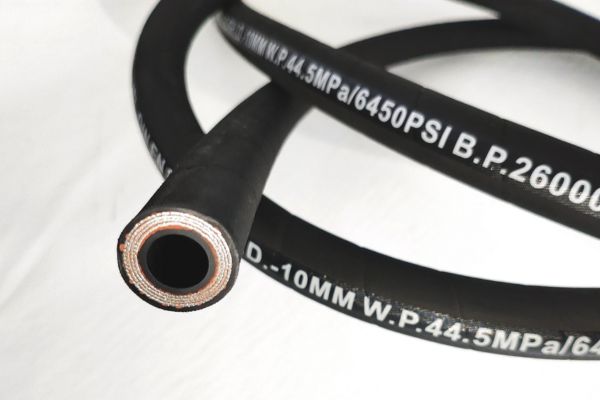
Uniform compression is the secret to a long-lasting hose assembly because it maintains the structural integrity of the rubber and wire braid. You need a machine that applies force from all angles simultaneously to ensure the metal fitting deforms exactly as intended.
- Simultaneous multi-angle force application.
- Preservation of internal wire reinforcement structure.
- Reduction of localized stress points on the hose wall.
- Consistency across high-volume production batches.
Preventing Premature Failure Through Proper Fitting Seat
When you use advanced systems, you guarantee that the fitting is seated correctly before the cycle begins. This prevents the hose from backing out under pressure, which is a leading cause of failure in systems relying on outdated methods.
| Feature | Standard Crimping | Precision Crimping |
| Compression Balance | Uneven/Variable | Perfectly 360-degree |
| Internal Stress | High (Localized) | Low (Distributed) |
| Lifespan Expectancy | Standard | 2x Longevity |
Why Is Choosing The Right Crimping Technology Critical For Safety?
Selecting the right crimping technology is vital for safety because it prevents high-pressure “blow-offs” that can lead to catastrophic equipment failure. In a high-pressure hydraulic environment, a fitting that is not securely attached becomes a dangerous projectile. By investing in modern solutions, you install a safeguard that protects operators from the hazards of high-velocity fluid injection.
Eliminating Fluid Leaks And Environmental Hazards
A secure crimp ensures that your system remains leak-free, which is essential for protecting the environment and maintaining a clean workspace. You avoid the slip hazards and soil contamination risks that come with poorly assembled hydraulic lines.
- Reduced risk of high-velocity oil injection injuries.
- Prevention of hazardous chemical spills in the field.
- Maintainance of clean and slip-free industrial floors.
- Compliance with strict environmental safety regulations.
Ensuring Connection Integrity Under High-Pressure Loads
Modern systems are designed to withstand the extreme pressure spikes found in heavy machinery. You gain peace of mind knowing that your connections will hold firm even when your equipment is pushed to its operational limits.
| Safety Factor | Impact of Poor Crimp | Impact of Correct Crimp |
| Pressure Spikes | Fitting Ejection | Secure Retention |
| Operator Risk | High Exposure | Maximum Protection |
| Fluid Containment | Frequent Leaks | Zero-Leak Integrity |
Which Portable Crimping Technology Suits Your Field Operations Best?
Hand-pumped or battery-powered crimping technology is best for field operations because it provides mobility without sacrificing the compression force needed for on-site repairs. If you are working in remote locations, you cannot always bring the machine to the workshop. Portable units allow you to perform professional-grade assemblies right at the equipment, reducing idle time.

Evaluating Manual Versus Battery-Powered Field Tools
Manual pumps offer the ultimate in reliability since they require no external power, while battery-powered units offer speed. You should choose based on the volume of field repairs you typically handle during a standard workday.
- Manual pumps for low-volume, remote emergency repairs.
- Battery-powered units for high-speed site maintenance.
- Integrated handles for easy transport across rugged terrain.
- Lightweight aluminum frames to reduce operator fatigue.
Balancing Tool Weight With High-Pressure Capability
Modern portable systems have become lighter without losing the force required for heavy-duty hoses. You can now carry a machine that handles two-wire or four-wire hoses without needing a dedicated transport vehicle.
| Specification | Portable Manual | Portable Battery | Workshop Electric |
| Portability | Excellent | Good | Limited |
| Power Source | Human Effort | Li-Ion Battery | Electrical Outlet |
| Force Output | High | High | Maximum |
Modern field tools now match the precision once only found in stationary workshop environments.
Mobility should never come at the expense of assembly quality or technical tolerances in the field. By selecting a high-performance portable unit, you ensure that every on-site repair is as durable as a factory-made hose.
What Role Does Crimp Force Play In Crimping Technology Success?
Crimp force is the central factor in crimping technology success as it determines whether the fitting is compressed tightly enough to hold pressure. You must strike a delicate balance because too little force leads to leaks, while too much force damages the hose structure. Advanced machines use sophisticated hydraulics to apply the exact tonnage required for a perfect seal every time.
Finding The Ideal Balance Between Tightness And Damage
You need to understand the compression requirements of different hose types, such as textile-reinforced versus steel-wire spirals. The right equipment allows you to fine-tune the pressure to match the specific resistance of the materials you are joining.
- Prevents crushing of the internal hose liner.
- Ensures steel wire “bite” into the fitting shell.
- Accommodates variations in hose wall thickness.
- Maintains fitting geometry for proper flow rates.
How Hydraulic Power Generates Consistent Sealing Force
Hydraulic-driven crimpers provide a smooth, steady application of pressure that manual tools cannot easily replicate. This consistency ensures that the fitting deforms plastically around the hose, creating a permanent and reliable mechanical lock.
| Specification | Portable Manual | Portable Battery | Workshop Electric |
| Portability | Excellent | Good | Limited |
| Power Source | Human Effort | Li-Ion Battery | Electrical Outlet |
| Force Output | High | High | Maximum |
Precise force application is the only way to accommodate the vast range of modern hydraulic materials.
Force control represents the fundamental difference between a temporary patch and a permanent hydraulic solution. Mastering this variable ensures your hoses can withstand extreme pressure spikes without compromising the integrity of the connection.
How Do You Select Dies For Advanced Crimping Technology?
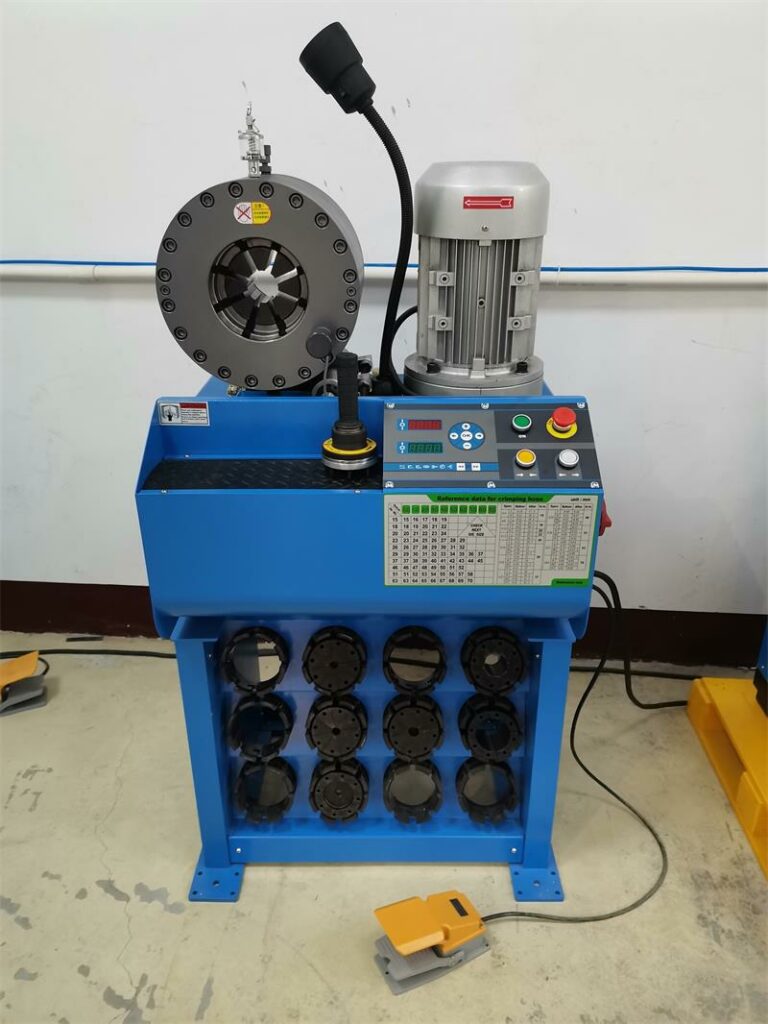
You select dies based on the specific outside diameter of your hose and fitting to ensure the crimping technology applies pressure evenly. Using the wrong die set is a leading cause of premature hose failure in industrial settings. You must ensure the “closed” diameter of the die set matches the finished specifications provided by the fitting manufacturer.
Matching Die Sizes To Your Specific Hose Dimensions
Every hose has a unique finished diameter once the fitting is applied to the end. You should always consult a standardized crimp chart to select the die that falls within the correct range for your specific combination.
- Consultation of manufacturer-specific crimp charts.
- Verification of fitting wall thickness before selection.
- Ensuring the die length covers the entire fitting sleeve.
- Double-checking the finished diameter with micrometers.
The Importance Of Quick-Change Die Systems
To keep your operations efficient, you should look for systems that feature quick-change die mechanisms. This allows you to move from a small fuel line to a large suction hose in seconds without losing small parts.
| Die Range | Typical Application | Changeover Speed |
| Small (10-14mm) | Fuel and Air Lines | < 10 Seconds |
| Medium (20-30mm) | Standard Hydraulics | < 10 Seconds |
| Large (40mm+) | Suction and Return | < 10 Seconds |
Why Is Material Compatibility Essential In Modern Crimping Technology?
Material compatibility is essential because crimping technology must account for the different deformation rates of carbon steel, stainless steel, and rubber. You cannot treat a stainless steel fitting the same way you treat a soft brass or carbon steel component. Each material responds differently to pressure, and your technology must be capable of providing the specific force profile required.
Adjusting Techniques For Steel Versus Brass Fittings
Harder metals like stainless steel require significantly more force to achieve the same level of deformation as carbon steel. You need to ensure your equipment has the “headroom” in its power rating to handle these tougher and more resilient materials.
- Higher tonnage for stainless steel components.
- Gentle compression profiles for brass adapters.
- Consideration of plating thickness on carbon steel.
- Adjustment for high-temp versus low-temp rubber.
Understanding Hose Inner Tube And Fitting Interaction
The “bite” of the fitting into the hose tube is what creates the high-pressure seal you rely on. You must use equipment that respects the limits of the rubber compounds to prevent cutting the inner tube and causing internal leaks.
When Should You Upgrade Your Current Crimping Technology?
You should upgrade your crimping technology when your current equipment shows inconsistent crimp diameters or when production requirements exceed your capacity. If you find yourself checking every third hose for leaks, your equipment is no longer serving your business effectively. Upgrading to a modern system often pays for itself through reduced waste and the ability to take on complex projects.
Identifying Signs Of Wear In Aging Crimping Systems
Look for signs of hydraulic fluid leaks around the cylinder or dies that no longer sit flush in the head. If your machine struggles to reach its rated tonnage, it is time to look for a more reliable replacement.
- Inconsistent finished crimp diameters.
- Visible hydraulic leaks in the machine head.
- Dies failing to return to the fully open position.
- Increased frequency of hose “blow-offs” in the field.
The Financial Benefits Of Modernizing Your Equipment
A modern machine reduces the labor time required for every individual assembly you produce. When you factor in the longer lifespan of the hoses, the return on investment for an upgrade becomes clear very quickly.
| Factor | Aging System | Modern System |
| Scrap Rate | High (5-10%) | Low (<1%) |
| Labor Cost | High (Manual) | Low (Automated) |
| Customer Trust | Declining | Growing |
How Can Digital Crimping Technology Improve Your Quality Control?
Digital crimping technology improves quality control by using sensors to verify every crimp diameter and storing data logs for compliance. You no longer have to guess if a hose was made correctly because the machine confirms it for you. Digital interfaces allow you to lock in settings, meaning an operator cannot accidentally change the specs mid-production.
Utilizing Data Logging For Traceability And Compliance
If a hose fails in the field, you can look back at the digital log to see exactly when it was made. This data is invaluable for continuous improvement and for meeting international ISO quality standards in your manufacturing facility.
- Full traceability of every assembly produced.
- Electronic storage of calibration records.
- Comparison of production runs over time.
- Easier auditing for safety compliance.
Conclusion
Maximizing the performance of your hydraulic systems starts with the bond between the hose and the fitting. By adopting advanced crimping technology, you ensure that every connection is built to last, providing the safety and durability your operations demand. Whether you are working in the field with portable tools or running a high-volume workshop with digital systems, the right choice in equipment will pay dividends in reduced downtime and doubled hose lifespan. Our vision is to empower your business with precision-engineered solutions that eliminate failure and maximize efficiency. To find the perfect components and equipment for your specific needs, contact us today and let our experts guide your selection toward a more reliable future.
Frequently Asked Questions
1. What is the main difference between manual and automatic machines?
Automatic machines use electric or pneumatic power to provide faster, more consistent results with significantly less operator fatigue than manual hand-pumped models.
2. Can I use any die set with my crimping machine?
No, you must use die sets specifically engineered for your machine model to ensure they fit the master die cage and apply pressure evenly.
3. How often should I calibrate my hydraulic crimper?
You should perform a quick calibration check daily using a micrometer and schedule a professional technical calibration at least once per year.
4. Is it possible to over-crimp a hydraulic hose?
Yes, applying too much force can crush the internal wire reinforcement and cut the inner tube, leading to immediate leaks or a shortened lifespan.
5. What materials are best for long-lasting fittings?
Stainless steel is the best choice for corrosive environments, while high-quality plated carbon steel is the standard for most general-purpose hydraulic applications.