BSPP and BSPT one-piece fittings are often confused because both belong to the British Standard Pipe thread family, but they do not seal the same way. To prevent leaks, damaged ports, and wrong hose assemblies, you must confirm whether the thread is parallel or tapered, where the seal is made, and whether the hose-end side matches the correct crimp data.
Why BSPP and BSPT Confusion Causes Real Assembly Problems
Similar thread names do not mean similar sealing
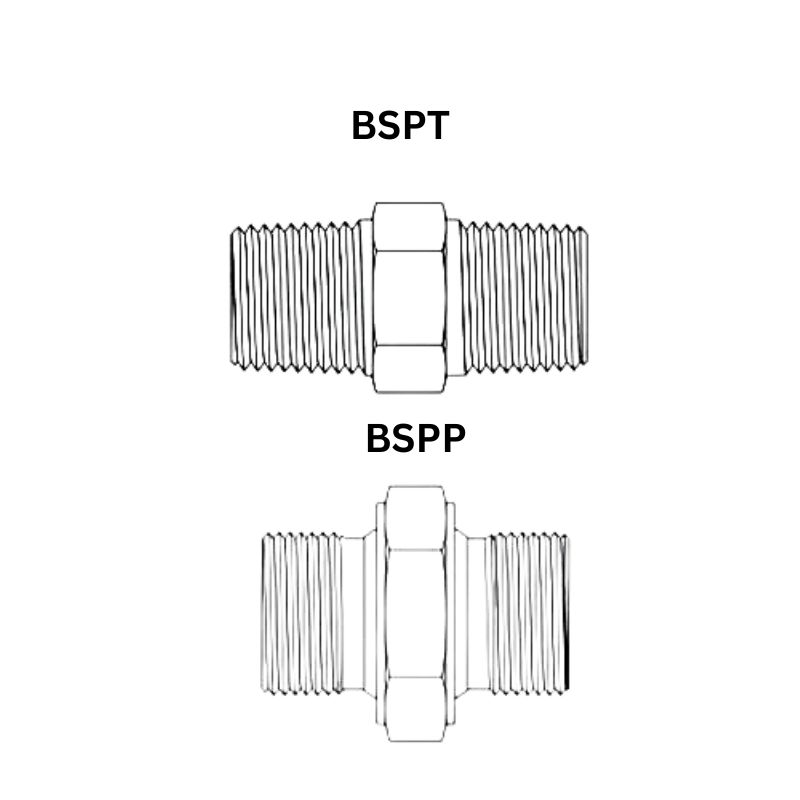
BSPP usually refers to a parallel pipe thread, while BSPT refers to a tapered pipe thread. That single difference changes how the fitting engages with the mating port and where the seal is expected to occur. A BSPP connection normally needs a defined sealing method such as a bonded seal, washer, O-ring, or seat arrangement, while BSPT relies on tapered thread engagement and the correct thread form to create the sealing interface.
The mistake often starts when the removed fitting is dirty, worn, or photographed from only one angle. The thread diameter may look close, the fitting may start into the port by hand, and the part description may only say “BSP.” That is not enough. If a BSPP one-piece fitting is installed where BSPT is required, or the opposite, the connection may feel tight before the sealing surfaces are correct.
One-piece fittings reduce ferrule errors, not thread errors
A one-piece hydraulic hose fitting combines the fitting stem and ferrule into one assembly. This helps avoid selecting a separate ferrule that does not belong with the stem, which can be useful in busy hose assembly work. It does not automatically confirm the port thread, sealing face, hose series, pressure suitability, or crimp specification.
One-piece construction helps on the hose-end assembly side, but BSPP vs BSPT identification still has to be done on the connection side. If the wrong thread type is selected, the fitting may damage the mating port, leak after pressure cycling, or require the whole hose assembly to be remade.
BSPP Vs BSPT: The Core Difference
BSPP is parallel and needs a separate sealing feature
BSPP threads are parallel, so the thread diameter remains consistent along the threaded length. Because the thread itself is not tapered, the seal must be created by another feature. Depending on the fitting and port design, that may be a bonded washer under the hex, an O-ring, a soft seal, or a metal seat inside the connection.
This is why identifying BSPP is not only a thread measurement task. You also need to inspect the sealing location. A BSPP male fitting with a bonded seal under the hex is not the same as a BSPP fitting that seals on an internal cone seat. If the thread is correct but the sealing method is wrong, the joint can still leak.
BSPT is tapered and seals through thread engagement
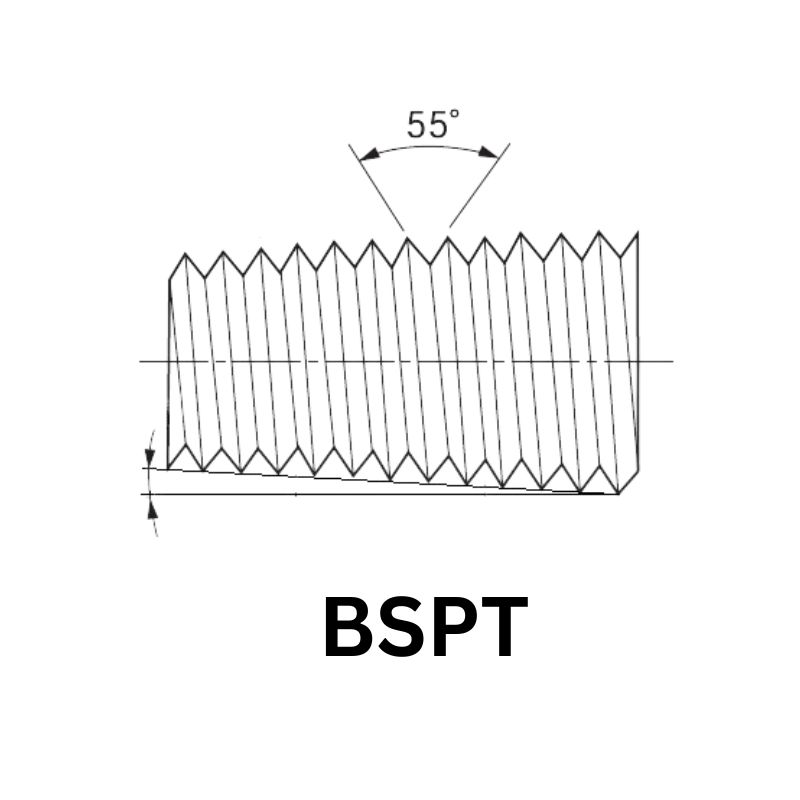
BSPT threads are tapered, meaning the diameter changes along the thread length. As the male and female tapered threads engage, they tighten progressively. In many BSPT connections, the sealing action depends on thread interference, often with an appropriate sealant used according to the equipment or component manufacturer’s instructions.
The risk is that a tapered thread can sometimes be forced into an incorrect parallel port. It may tighten enough to feel secure, but the engagement is not correct. That can distort the female port, leave insufficient thread contact, or create a connection that leaks under vibration or thermal cycling.
How to Identify BSPP or BSPT Before Assembly
Measure the thread and check the taper
Start with clean threads and good lighting. Use calipers to measure the thread diameter near the first full thread and again farther back on the threaded section. If the diameter stays consistent, it is likely parallel. If the diameter changes along the threaded length, it may be tapered.
Then confirm the thread pitch with a pitch gauge. BSP threads use inch-based pitch references, so a thread gauge is more reliable than estimating by eye. Do not make the final decision from outside diameter alone. Several pipe thread systems and metric connections can appear close enough to confuse a rushed inspection.
Confirm the sealing location
After checking the thread form, inspect where the fitting is designed to seal. Look under the hex for a washer or bonded seal face. Look at the end of the fitting for a cone, chamfer, flat face, or O-ring groove. Inspect the mating port if it is available, because the port often tells you more than the old hose assembly.
A practical identification process should include:
- Thread outside or inside diameter measured with calipers
- Pitch confirmed with a thread gauge
- Parallel or tapered thread form checked along the thread length
- Male or female connection confirmed
- Sealing method identified at the washer, seat, O-ring, or thread
- Port condition inspected for crossed threads, cracks, or damaged sealing faces
Common BSPP and BSPT One-Piece Fitting Mistakes
Treating “BSP” as a complete specification
A part label that says “BSP” is incomplete for a replacement decision. It may tell you the thread family, but it does not confirm whether the fitting is BSPP or BSPT, how it seals, what hose series it fits, or what crimp specification applies. This is one of the most common causes of wrong one-piece fitting selection.
The problem becomes worse when short labels are used in storage bins or service records. A label such as “1/2 BSP hose fitting” may be convenient, but it can hide important differences between parallel thread with bonded seal, tapered thread, or a seat-sealing design. A better label includes thread form, gender, size, sealing method, hose dash size, fitting angle, and fitting series.

Copying an old incorrect replacement
The removed fitting is not always the correct fitting. It may be a previous emergency substitution that was made to get equipment running. Signs such as excessive sealant, distorted threads, flattened washers, tool marks on the seat, or leakage staining around the port suggest that the old connection should not be copied without verification.
When the old part looks questionable, match the replacement to the equipment port, adapter, hose series, and valid fitting data instead of relying only on the removed assembly. This is especially important when the hose connects to a valve block, hydraulic cylinder, pump, motor, manifold, or imported equipment where several thread systems may be present on the same machine.
BSPP and BSPT Comparison for One-Piece Fitting Selection
Use a comparison table only as a screening tool
A table can help narrow the decision, but it should not replace measurement. BSPP and BSPT identification still depends on checking the actual thread, sealing feature, and mating component. If the port is damaged or the old fitting is worn, manufacturer data may be needed before assembly.
| Check Point | BSPP | BSPT | What Can Go Wrong |
|---|---|---|---|
| Thread form | Parallel | Tapered | Wrong thread may start but not seal |
| Seal location | Washer, O-ring, bonded seal, or seat | Thread engagement, depending on design | Leak path remains even when tight |
| Diameter along thread | Generally consistent | Changes along thread length | Misread taper causes wrong selection |
| Port requirement | Matching sealing face or washer area | Matching tapered thread form | Port damage from forced assembly |
| Identification risk | Confused with metric or other parallel threads | Confused with NPT or other tapered threads | Cross-threading or poor engagement |
Match the complete connection, not only the thread
Correct fitting selection requires a complete description. For example, “male BSPP” is still incomplete if the sealing method is not stated. A BSPP male with a bonded seal under the hex is different from a BSPP male designed to seal on a cone seat. The same applies to female connections, adapters, and swivel ends.
For a one-piece fitting, the description should also include the hose side. A correct port thread does not make the hose assembly correct if the hose construction, stem design, ferrule profile, or crimp diameter is wrong. Thread confirmation and hose-end compatibility must both pass before the part can be treated as a reliable match.
Hose-End Compatibility Still Matters
Confirm hose series before crimping
A one-piece fitting must match the hose ID, hose construction, and fitting series. Do not assume that the same dash size means compatibility. Two hoses with the same nominal ID may have different cover thickness, reinforcement style, bend behavior, and approved crimp requirements.
Before assembly, confirm the hose manufacturer and series if available. If the hose marking is unreadable, the risk increases because the crimp data may not be clear. In that case, copying the old fitting style is not enough. The assembly decision should be based on verified hose construction and approved fitting data.
Use valid crimp specifications
The crimping process is where a correct BSPP or BSPT fitting can still become an unsafe hose assembly. The crimp diameter, insertion depth, die selection, skive or no-skive requirement, and inspection method must match the hose, fitting, and crimping equipment data. There is no universal crimp diameter for all one-piece fittings.
After crimping, check the finished assembly at the specified measurement location. Confirm that the fitting orientation is correct, the insertion depth mark is still in the expected position, and the ferrule is not uneven, cracked, or visibly damaging the hose. If the crimp specification is missing, stop and verify the data before the hose is used.
What Happens When BSPP and BSPT Are Mixed Up
Leakage is only the first warning sign
The most obvious result of BSPP and BSPT mismatch is leakage, but the underlying damage can be more serious. A tapered male thread forced into a parallel female port can expand or distort the port. A parallel male installed into a tapered female port may have poor thread contact and fail to seal even when tightened.
The leak may appear immediately during testing, or it may show up later after pressure cycling, vibration, heat, or equipment movement. That delayed failure is particularly troublesome because the hose assembly may be blamed when the actual cause is thread and sealing mismatch at the connection.
Forced assembly creates hidden cost
A wrong BSPP or BSPT fitting can create rework beyond replacing one fitting. The port may need repair, the hose may need to be remade, hydraulic oil may be lost, and contamination may enter the system during repeated disassembly. In field repair work, the hidden cost also includes travel time, downtime, and the risk of returning with another incorrect part.
The best prevention is to avoid forcing engagement. A fitting should start cleanly by hand for the expected number of turns, align correctly, and seal at the intended feature. If it binds early, rocks in the port, bottoms out without sealing, or requires excessive sealant to appear usable, the identification should be checked again.
A Safer Checklist Before Ordering or Crimping
Prepare information that can be verified
The goal is to make the replacement checkable by another person. A clear description reduces wrong picking, wrong purchasing, and wrong assembly. It also helps build better records for future maintenance.
Prepare the following information before selecting a BSPP or BSPT one-piece fitting:
- Hose ID or dash size, hose manufacturer, and hose series
- Fitting style, such as straight, 45-degree, or 90-degree
- Male or female connection
- Thread diameter and pitch
- Parallel or tapered thread confirmation
- Sealing method, such as bonded seal, O-ring, cone seat, or thread seal
- Clear photos of the complete fitting, thread, and sealing face
- Existing part number, if available, used only as a reference
- Working pressure, fluid, temperature, vibration, and movement conditions
- Crimping machine, die information, and approved crimp specification
Know when to check manufacturer data
Manufacturer data should be checked whenever the hose series, fitting series, port standard, seal type, pressure rating, or crimp setting is uncertain. It should also be checked when the application involves lifting, steering, braking, high-pressure impulse service, aggressive fluids, high temperature, or equipment where a port failure would be difficult to repair.
Do not reduce a high-risk replacement decision to unit price or visual similarity. A lower-cost fitting that damages a valve block or causes repeated leakage is not cheaper in the real assembly process. The safer decision is to confirm the technical match first, then compare purchasing options within that confirmed specification.
Conclusion
Correct BSPP vs BSPT one-piece fitting selection depends on thread form, pitch, sealing method, hose compatibility, and valid crimp data. A one-piece fitting can simplify the hose-end assembly, but it cannot turn an uncertain pipe thread into a confirmed match. Before ordering or crimping, measure the thread, identify the seal, inspect the mating port, and record the hose and crimp information so the next replacement is based on evidence instead of appearance.
FAQ
Are BSPP and BSPT interchangeable?
No, BSPP and BSPT are not automatically interchangeable because BSPP is parallel and usually seals with a separate sealing feature, while BSPT is tapered and depends on thread engagement in the correct mating thread.
Can I identify BSPP or BSPT from a photo?
A photo can help with preliminary sorting, but it cannot confirm the final fitting. You still need thread measurements, pitch confirmation, taper inspection, and sealing-face identification.
Is BSPT the same as NPT?
No, BSPT and NPT are both tapered pipe thread families, but they are not automatically interchangeable. Thread form, pitch, and sealing behavior must be confirmed before substitution.
Does a one-piece fitting make BSPP vs BSPT selection easier?
It can reduce hose-end ferrule selection errors, but it does not identify the port thread for you. BSPP vs BSPT must still be checked by measurement and sealing method.
What should I do if the old fitting has heavy sealant on it?
Treat it as a warning sign and verify the thread and sealing method again. Heavy sealant may indicate a previous mismatch, damaged thread, or wrong sealing surface.