
A part number and photo cannot control a fitting from quotation through repeat order. Reliable one-piece fitting product data for each SKU must let sales describe the item, engineering verify it, purchasing order it, receiving inspect it, and the warehouse pick it without translating an informal description. The record should separate identity from engineering evidence, connection-side data from hose-side assembly data, and technical fields from packaging fields. It also needs document revisions and effective dates so an old drawing does not remain active after a controlled change. This data architecture defines the minimum record, conditional fields, and advanced fields required to keep one SKU consistent across its lifecycle.
Follow One SKU from Quotation to Repeat Order
Each lifecycle step asks a different question of the same item. Quotation needs an unambiguous commercial description. Engineering needs thread, seal, hose side, dimensions, material, and documents. Purchasing needs the controlled order identity. Receiving needs inspection references, while warehouse and repeat-order teams need labels, quantities, revisions, and traceability.
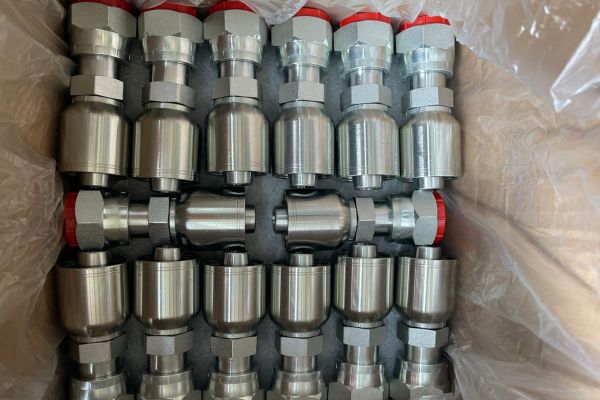
The item master should therefore act as a routing record rather than a giant text note. It stores stable fields directly and links to controlled drawings, crimp data, inspection documents, packaging instructions, and revisions. A user should be able to move from the SKU to its evidence without searching email attachments.
Define a single owner and source for every field
Assign ownership by data group. Product-data staff may own descriptions and barcodes; engineering owns technical definitions; quality owns inspection and evidence status; operations owns packaging configuration; document control owns revisions. Where the same value appears in several systems, name one authoritative source and synchronize the others.
Avoid allowing quotation text to become the de facto specification. Sales descriptions are designed for readability and may omit critical details. They should be generated from or reconciled with controlled attributes rather than edited independently for each transaction.
Separate Identification Data from Engineering Data
Identification data answers “Which SKU is this?” Engineering data answers “What technical characteristics define it?” Mixing these functions into one description makes duplicates hard to detect and changes hard to control.
Identification fields include internal part number, external or supplier part number where applicable, normalized short description, product family, active status, unit of measure, barcode, and approved cross-references. They should resolve one code to one controlled item and packaging unit.
Engineering fields include connection geometry, hose-side family, controlled dimensions, material, finish, seals, drawing, and applicable assembly data. These fields should not be overwritten when a marketing description changes. If a technical change alters identity or interchangeability under the organization’s policy, route it through revision or new-SKU control rather than silently editing the description.
Control duplicate SKU risk
Duplicate records often begin with conflicting descriptions: one item says “JIC female,” another says “female swivel,” and a third uses only a cross-reference. Normalize terminology and compare structured fields before issuing a new code. A photo match or similar description should trigger review, not automatic merging.
When duplicates are confirmed, preserve transaction history and controlled cross-references. When two similar records differ technically, make the distinguishing fields visible in the short description or selection interface so quoting and picking do not collapse them back into one informal item.
Keep Connection-Side and Hose-Side Data Independent
The port end and hose end belong in separate field groups because they control different interfaces. A correct connection standard does not prove that the stem and ferrule suit the selected hose. A correct hose dash does not prove the thread or sealing face fits the equipment port.
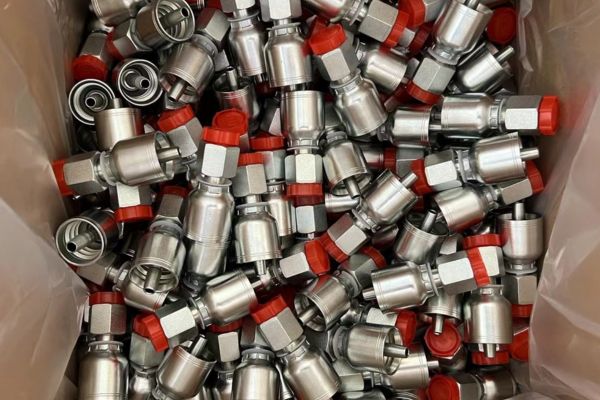
Connection-side record
Store fitting orientation; male or female arrangement; connection standard; thread diameter and pitch or TPI; straight or tapered form; port dash; seat angle where applicable; sealing face; sealing method; O-ring location and controlled seal identity where applicable. For elbows, include orientation-relevant drawing information and critical geometry references.
Do not identify JIC, SAE flare, NPT, NPTF, BSPP, BSPT, ORFS, ORB, Metric, DIN, JIS, or flange connections from appearance alone. Similar threads can mate partially while seats or sealing methods remain incompatible. The structured record should retain the measurements and document basis used for identification.
Hose-side assembly record
Store hose dash, stem/ferrule fitting series, and the exact approved hose manufacturer or compatible controlled specification and series. Link preparation, skive or no-skive instruction, insertion control, crimp equipment, die, final crimp target, measurement location, and document revision where approved data requires them.
Dash size alone is insufficient because hose OD, cover, tube, and reinforcement can vary among series. A one-piece design keeps the stem and ferrule together, but it does not create universal hose compatibility. Missing hose-series data should place assembly approval on hold even if the catalog SKU can still be quoted conditionally.
Store Dimensions, Material, and Finish in Technical Records
Dimensions should be structured around operational decisions. A drawing remains the controlled geometry source, while selected searchable fields help users compare, inspect, and prevent interference. Store units explicitly and never combine nominal, tolerance, and measured values in one field.
Typical dimensional fields include overall or reference length, thread or flange dimensions, hex or wrench size, elbow centerline geometry, hose-tail references, and other critical dimensions named on the drawing. Do not invent universal dimensions or copy values from a visually similar size. Each field should link to the drawing revision that defines it.
Material and finish records should distinguish base material, surface finish or plating specification, and seal material. A generic “steel fitting” description does not control grade, coating, corrosion requirement, or evidence. Likewise, salt-spray duration should not be treated as a direct prediction of field life.
Weight needs units and status
Weight may support logistics, costing, and inventory planning, but it should include unit, basis, and status. Identify whether it is controlled, measured, or provisional. If weight is missing, do not invent it from a nearby SKU; flag the field and use a documented operational fallback until verified data is available.
Material and seal suitability still depend on fluid, temperature, corrosion exposure, regulations, and equipment requirements. Product data should state what is defined and link to evidence; it should not turn an item-master field into an unsupported application guarantee.
Use One Master Record with Grouped Fields
The following master structure keeps searchable values concise while preserving links to authoritative documents. “Conditional” means the field becomes mandatory when that feature or process applies.
| Group | Core fields | Operational problem solved | Requirement level |
| Identity | Internal SKU, external part number, normalized description, family, status, unit | Prevents duplicate codes and ambiguous orders | Mandatory |
| Connection | Orientation, standard, gender, thread, port dash, seat, seal method | Prevents wrong port, thread, or sealing selection | Mandatory; O-ring fields conditional |
| Hose Side | Hose dash, fitting series, approved hose series, preparation and crimp-data link | Prevents dash-only compatibility assumptions | Mandatory for hose assembly use |
| Dimensions | Drawing dimensions, units, nominal/tolerance structure, critical flags | Supports inspection, clearance, and comparison | Drawing mandatory; searchable fields by need |
| Material/Finish | Base material, plating or finish, seal material, evidence links | Controls corrosion, fluid, and specification differences | Mandatory; seal fields conditional |
| Documents | Drawing, specification, crimp data, inspection plan, evidence status | Replaces uncontrolled attachments with current sources | Mandatory links where applicable |
| Packaging | Unit pack, barcode, inner and carton quantity, label and mark rules | Aligns ordering, receiving, scanning, and picking | Mandatory for stocked items |
| Revision | Data revision, drawing revision, effective date or lot, supersession | Prevents stale data and mixed-revision decisions | Mandatory |
Avoid turning the table into one free-text database column. Use controlled lists for standards, orientations, materials, and statuses; numeric fields should carry units; document fields should carry identifiers and revisions. Free text remains useful for limited exceptions and technical notes, but not for defining the primary identity.
Connect Logistics and Packaging to the Commercial Record
Commercial records should contain the data required to order, receive, store, count, and ship the SKU. This includes purchase and sales units, unit conversion where controlled, barcode, packaging level, pack quantity, carton quantity, carton dimensions or weight when verified and needed, label description, and handling requirements.
Packaging variants can require separate records when they change the sellable unit, barcode, brand, or contractual configuration. In other situations they may be controlled revisions under one SKU. Apply a documented item-governance rule rather than creating or merging codes case by case.
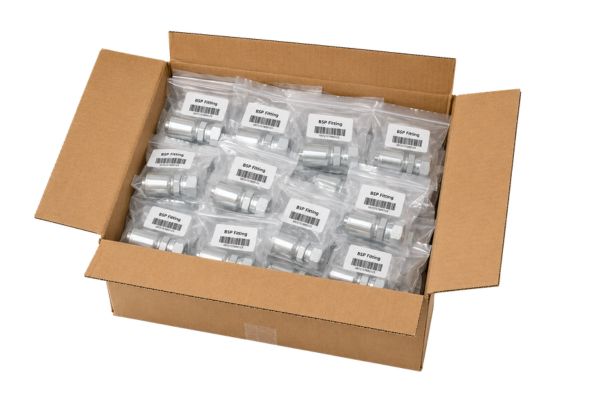
Make receiving able to reconcile the shipment
Receiving should be able to compare purchase order, part mark, unit label, carton label, packing list, quantity, and lot without opening unrelated systems. The record should also point to the current incoming-inspection plan and drawing revision. A carton with the correct brand but an old technical revision is not automatically acceptable.
Packaging data must not overwrite product data. A carton-quantity change may leave the fitting technically unchanged while still requiring label, ERP, warehouse, and effective-date updates. Preserve that distinction in revision history.
Control Revisions and Define Mandatory Fields
Drawing revision and data revision should be linked but not confused. A drawing can change while commercial packaging remains stable, or a label can change without altering geometry. The master record should show which documents changed, their effective date or lot, and the disposition of old stock and open orders.
Mandatory fields are those required to identify, order, receive, and technically distinguish every active SKU. Conditional fields become mandatory when the feature exists: O-ring data for an O-ring seal, elbow geometry for an elbow, skive instructions where preparation applies, or packaging variants where multiple sellable packs exist.
A minimum viable SKU record contains:
- Internal SKU, status, normalized description, unit, and approved cross-references.
- Complete connection-side identity and hose-side fitting family.
- Hose dash and approved hose-series relationship or an explicit unapproved status.
- Material, finish, seal fields, controlled drawing, and revision.
- Barcode, pack configuration, label identity, and lot-traceability rule.
- Effective revision and links to inspection and assembly documents.
Optional advanced fields include verified individual weight, 3D model, structured critical dimensions, digital product classification, market-specific descriptions, serial tracking, and automated document-validity checks. Add them when a workflow consumes them; unused fields tend to become stale and create false confidence.
Product data does not independently prove application suitability. Pressure is limited by the lowest-rated component, and pressure impulse, fluid, temperature, routing, vibration, hose construction, and current crimp instructions may still need application-specific confirmation.
Review active records periodically for broken document links, obsolete statuses, duplicate descriptions, and conditional fields that became mandatory after a product or packaging change.
Conclusion
An effective SKU record lets every function identify the same fitting without relying on a photograph, memory, or old quotation. Separate identity from engineering evidence, keep connection-side and hose-side fields independent, and link dimensions, material, finish, seals, packaging, and documents to controlled revisions. Make core fields mandatory and feature-dependent fields conditional, then expose missing data instead of filling gaps with assumptions. Revision, effective-lot, and supersession controls prevent stale drawings or mixed packaging from becoming repeat-order errors. The minimum one-piece fitting product data for each SKU should support quotation, technical review, purchasing, receiving, scanning, picking, and traceability. Prepare the authoritative field owners, drawing links, assembly-data status, packaging configuration, and revision rules, and document unresolved fields before expanding the catalog.
FAQ
What should the record show when a fitting weight is missing?
Mark the value as missing or provisional and state the operational fallback. Do not copy weight from a nearby SKU; add the verified value later with unit, basis, and revision.
Can a SKU remain active when the approved hose series is unknown?
It may remain identifiable for catalog cleanup, but it should not be released for hose assembly as though compatibility were proven. Use an explicit hold or unapproved status until current combination data is available.
Which revision matters when the drawing and item master differ?
The controlled document hierarchy should define authority and require reconciliation before use. Hold the transaction or technical decision rather than choosing whichever revision is easiest to access.
Does a packaging change require new product data?
Yes, affected commercial and logistics fields need controlled updates even when the fitting is technically unchanged. Whether it creates a new SKU or a revision depends on the approved item-governance rule.
Can product photos replace dimensions and drawings?
No, photos can support screening, condition checks, and visual identification. They cannot prove thread geometry, seat, sealing method, critical dimensions, hose compatibility, or revision status.