The difference between 43, 71, 77, and 78 series crimp fittings starts at the hose connection. Each family has its own approved hose relationships and assembly requirements. A matching thread, hose diameter, or elbow shape does not make the families interchangeable.
For buyers, this creates a familiar problem: two fittings can look nearly identical at the equipment end while requiring different hoses or crimp specifications. Choosing the wrong family may not become obvious until assembly, inspection, or service.
A useful comparison therefore needs to answer three questions: which hose is being used, which fitting configurations are available for it, and how the approved combination must be assembled.
A Practical Comparison of the Four Series
Where the main differences appear
The following table summarizes the useful starting points. It is an overview, rather than an approval list for individual assemblies.
| Series | Main distinction | Important selection check |
| 43 | Broad fitting family with varied connection forms and specified hose applications | Confirm the exact hose model and size instead of assuming universal compatibility |
| 71 | Separate permanent crimp family associated with specified hoses, including certain 721 variants | Check the applicable catalog version, hose designation, and size |
| 77 | Referenced with specified sizes of 387, 487, 787, and 797 hoses | Preserve the size restrictions for each hose family |
| 78 | Referenced with designated spiral hoses such as 781, 782TC, and 782ST | Confirm the complete hose designation and corresponding assembly data |
Some product references are historical or regional. Their listed relationships should be checked against the current information for the components being purchased.
The series designation identifies a fitting family. It does not identify the thread, sealing method, material, or complete assembly rating.
Why the numbers are not a performance ranking
It is tempting to read the numbers as a progression: 71 above 43, 78 above 77. That interpretation does not provide a reliable selection method.
A larger series number does not automatically mean higher pressure, greater durability, or better suitability. A 78 series fitting is not a general upgrade for a 77 series assembly, and a 43 series fitting is not simply a lower-performance version of the others.
The appropriate family is the one approved for the selected hose and application. Buying a different family because it appears more heavy-duty can introduce a mismatch rather than improve the assembly.
43 Series: Broad Coverage Still Requires a Specific Match
Connection variety is only part of the picture
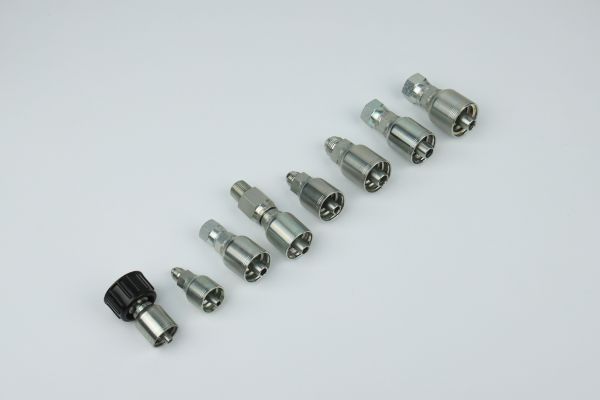
The 43 series is known for a wide choice of shapes and connection ends. That variety makes it relevant to workshops handling different equipment interfaces.
However, a broad product range should not be confused with unrestricted hose compatibility. The hose-side design still needs to match an approved hose model and size.
Descriptions such as “standard hydraulic fitting” or “general-purpose one-piece fitting” leave too much undefined. A useful specification identifies the complete part number, the hose it will be assembled onto, and the required connection.
This is particularly important when a workshop stocks several fittings with the same thread and nominal hose size.
Avoid reducing the family to a reinforcement label
A simple chart that describes the 43 series only as “for braided hose” can hide product-specific exceptions and size-dependent relationships.
Reinforcement type helps describe a hose, but it does not provide enough information to select the fitting. Cover dimensions, tube construction, and the particular hose design also matter.
Use the hose model as the starting point. Then locate the applicable fitting family and assembly specification.
This keeps the selection tied to the actual product rather than a broad category that may cover many different hose constructions.
71 Series: Keep the Hose Reference Complete
Similar connection ends do not establish equivalence
The 71 series is a separate permanent crimp fitting family. Published references associate it with specified hoses, including 721, 721TC, and 721ST in applicable catalog scopes.
That relationship does not mean any fitting with a similar stem or ferrule can replace it. Nor does it establish that every size of a named hose uses the same fitting family across all product versions.
If an existing assembly is identified as using a 71 series fitting, retain that information while checking the hose designation and current replacement requirements.
A supplier should not silently replace the family merely because another fitting has the same equipment connection.
Historical equipment needs careful identification
Older machinery may have a hose or fitting reference taken from an earlier catalog. The original combination can be useful evidence, but the replacement order must reflect what is currently available and approved.
Record the old hose marking, complete fitting number where readable, connection dimensions, and installation geometry.
If a newer hose is proposed, assess it as a new hose-and-fitting combination. Do not carry the original fitting choice over automatically.
This allows a replacement to preserve the required equipment interface while using a properly specified current assembly.
77 Series: Hose Size Changes the Answer
The hose family alone is insufficient
The 77 series illustrates why compatibility needs both a hose model and a size.
The supplied reference information lists these relationships:
| Hose family | Referenced range for 77 series use |
| 387 | -20 through -32 |
| 487 | -20 through -32 |
| 787 | -8 through -32 |
| 797 | -8 through -32 |
These are referenced ranges, subject to the applicable product version and assembly information. They do not establish that every fitting configuration is available throughout each range.
A workshop using 77 series fittings on a large 387 hose should not assume that the same family applies to smaller 387 sizes. The size boundary is part of the selection.

Several hose pressure classes can share a fitting family
The referenced 387, 487, 787, and 797 hose families span different nominal pressure classes.
This makes “77 series equals 6,000 psi” an unsuitable description. The family appears in more than one specified hose system, and the rating of an individual fitting still depends on its configuration.
For mixed orders, keep the hose model, hose size, connection, material, and part number together. A series-only description cannot capture those differences.
The same approach helps the workshop avoid using one crimp setup across combinations that happen to share a nominal inside diameter.
78 Series: Identify the Designated Spiral Hose
Preserve model suffixes
References for the 78 series include designated spiral hose models such as 781, 782TC, and 782ST.
Keep those full designations in the order and assembly record. Shortening a model to “782 hose” removes information needed to find the correct specification.
A named hose relationship should also remain within its documented scope. It does not approve every hose meeting a similar industry standard.
For example, a hose marked R13 still needs an explicit compatibility check. The standard marking alone does not establish that its dimensions and construction suit a particular 78 series fitting.
Do not substitute between 77 and 78 by appearance
Both families may appear in high-pressure hose applications, and both may offer familiar equipment connections. Those similarities do not establish interchangeability.
A proposed switch from 78 to 77, or from 77 to 78, requires review of the hose as well as the fitting.
Even if the equipment-end thread matches, the stem, ferrule, insertion requirements, and crimp process may differ.
Treat the proposal as an assembly change. Confirm the complete replacement combination before purchasing or production.
Compare the Equipment End Separately
The series does not tell you how the connection seals
After identifying a suitable fitting family, confirm the equipment connection.
A JIC connection seals at its mating cone surfaces. An ORFS connection uses a face-seal arrangement. An O-ring port connection and a tapered-thread connection have different requirements again.
Thread engagement alone cannot distinguish all of these interfaces.
For a threaded fitting, record the standard, male or female form, actual thread dimensions, and sealing geometry. For a flange, identify the exact flange form, head dimensions, sealing arrangement, and mating hardware.
Do not use a matching nominal connection size as a substitute for checking the complete interface.
Matching ends can still have different installation dimensions
Two fittings may have the same connection standard, hose size, and nominal angle while differing in length or elbow drop.
Those differences can affect clearance, tool access, and the direction in which the hose leaves the connection.
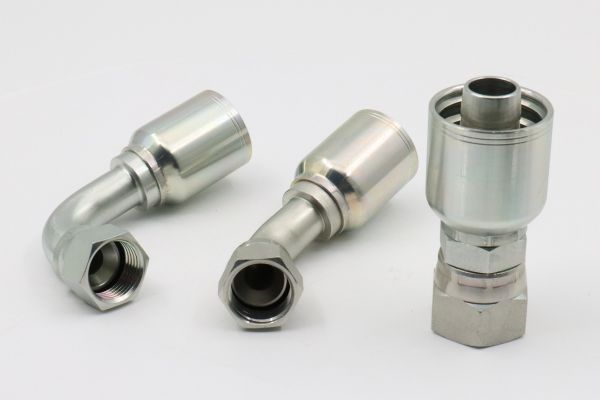
When comparing alternatives, use the drawing dimensions that control the installation. A short 90-degree elbow and a long 90-degree elbow should remain distinct unless the application review establishes that either will work.
For a hose with two angled ends, preserve their relative orientation as part of the finished assembly specification.
Crimp Requirements Belong to the Combination
One-piece construction does not mean one common process
All four families are being considered here as one-piece crimp fittings, with the stem and ferrule supplied together. This simplifies handling but does not make their assembly settings identical.
The applicable instructions must define hose preparation, insertion, equipment, tooling, target dimensions, tolerances, and measurement locations.
No-skive instructions also apply to approved combinations. They should not be generalized to any hose that can be inserted into the fitting.
Avoid using a die or crimp diameter from another series because the ferrules look similar. External resemblance cannot establish the required compression.
A correct diameter is necessary but incomplete evidence
Crimp measurement checks whether a specified dimension meets its acceptance criterion.
It does not independently prove that the hose was correct, fully inserted, properly prepared, or suitable for the service conditions.
Before repeating a new assembly, inspect the first piece against the applicable instructions. Confirm the components, insertion, crimp measurements, length, and orientation, together with any required inspection or testing.
A passed sample applies to its documented configuration and scope. It does not approve every size or fitting end in the family.
How to Choose Without Overcomplicating the Order
Start with four pieces of information
Before asking which series to buy, identify:
- The complete hose model and size.
- The equipment connection and sealing method.
- The required fitting shape and installation dimensions.
- The operating conditions and available assembly process.
These details usually reveal whether the question is about hose compatibility, connection identification, installation fit, or workshop capability.
If the hose identity is missing, resolve it first. Comparing four fitting families before identifying the hose often produces a longer candidate list without a reliable decision.
Keep the purchasing description specific
A practical order line should contain the full fitting part number, hose reference, connection description, shape, material, and quantity.
Attach the applicable assembly reference where the fittings will be crimped in-house. Clarify seals and accessories, particularly for flange and bulkhead configurations.
If a supplier proposes an alternative, request the changed details explicitly. Review the hose relationship, dimensions, and assembly requirements before updating the order.
A cross-reference can help locate a candidate. It should lead to a technical comparison rather than replace one.
Conclusion
The useful distinction between 43, 71, 77, and 78 series crimp fittings is their relationship to specific hoses, sizes, and assembly processes.
The 43 series offers broad configuration coverage; the 71 series has its own specified hose relationships; the 77 series includes important size-dependent applications; and the 78 series is associated with designated spiral hose models.
None of these descriptions replaces a part-specific check. Identify the hose first, confirm the equipment interface and installation dimensions, then use the correct assembly instructions for the selected combination.
That approach produces a fitting choice the buyer can order clearly and the workshop can assemble consistently.
Frequently Asked Questions
Which series is best for high-pressure hydraulic hose?
There is no universally best series. Select the family approved for the exact hose model, size, connection, and operating conditions.
Can the same hose size use different fitting series?
Different hoses with the same nominal inside diameter may require different families. Any alternative for one exact hose needs explicit technical support.
Is the 78 series an upgrade from the 77 series?
No. The numbers identify fitting families rather than performance levels. Their referenced hose relationships differ.
Can matching threads justify replacing one series with another?
No. Matching equipment-end threads do not establish hose-side compatibility, installation fit, or the correct crimp process.
What should I do if the original fitting is unavailable?
Identify the existing hose and connection, then obtain a supported replacement proposal. If the hose changes, confirm the new hose-and-fitting combination and its assembly requirements.